How are you doing?

During the decade in which I was overseeing farmers markets, we had many hurricanes, the Katrina levee breaks, the BP Oil spill, lots of location changes, vendor changes (including a good number passing) and a crisis with our host organization that forced us to go out on our own as a 501 c3 after more than a decade as a university program. Our team grew more adept at weathering these changes, but we definitely had more staff turnover, less time for reflection and planning, and less resiliency financially and emotionally.

When I left to become a consultant at the national level and to support FMC, I was very sad to go but also relieved that I had made it through without breaking.

So I think of you, dear market operators, network leaders and anchor vendors, wondering about how you are faring with this never-ending set of civic breaks, panics, governmental snubs to local food systems, governmental overreach over farmers markets, lack of funding, obfuscation of the goals of farmers markets because of entities that use the name willy-nilly, brutal weather swings and so on.

Also I wonder about this because at Farmers Market Coalition we have made a conscious effort in the last few years to highlight the role of the market manager. We do that because it is one of the least understood things about markets and makes it hard to make the case for markets without the audience knowing the intentional nature and structure of the modern farmers market.

To that end, FMC has a communication plan with a goal of 1/3 of our comms output to focus on markets and their operators.

But I gotta say; its hard to do that, because so few of you share info about your work. The social media I see overwhelmingly paints a beautiful picture of market day, with all of the tents up and flags fluttering, vendors at the alert, ready to bag.

Which is great. It’s joyful and it’s inviting. I get it. I did it too. And we should continue those posts and updates.

But we are also a movement of over 9,000 sites, of many types and sizes, with shared stresses both internal and external. Many of you have huge system change goals for your 4-hour a week market, and work diligently over most days of the week to make them happen. A bit of that shared with your community can help them understand why the market remains outside in a vacant lot after many years, why there are rules against anyone just joining as a vendor, why your local municipality should be supportive, why funders who share the same goals should seek you out.

So once in a while, tell us how you are doing, amid your gorgeous pics of produce and smiling vendors. Talk about your staff and volunteers. Talk about your dreams for the market.

And if you have the urge, take a second and let me know how you are doing.

National SNAP webinar for market leaders

Registration is now open and will close on November 18, 2025. 

Date/Time: Tuesday, November 18, 2025, 12 – 1pm Eastern Time

Join Project for Public Spaces and the Farmers Market Coalition for a FREEwebinar on how recent projected federal SNAP cuts will affect public markets nationwide.

  • What the “One Big, Beautiful Bill” means for federal nutrition assistance programs;
  • How market leaders are responding to these cuts in their communities;
  • Creative strategies market operators are planning to employ to mitigate negative impacts on their market communities; and
  • Actionable steps you can take during these uncertain times.

Hear directly from public market leaders and advocates who are on the front lines of these changes, and connect with peers facing the same challenges. The webinar will also include a facilitated Q&A. 

https://www.pps.org/events/made-by-all-navigating-snap-cuts-how-market-leaders-are-adapting

2025 AFT Farmers Market Celebration

Results for the annual social media campaign on farmers markets managed by the wonderful American Farmland Trust.

I know many of us do not appreciate ranking local markets this way, but I think we can all agree that it certainly highlights markets across the US.

 1. Farmers’ Market at Lakewood Ranch | Sarasota, FL | 3,936 votes 

 2. Coventry Farmers’ Market | Coventry, CT | 3,591 votes 

 3. Midtown Farmers Market Sacramento | Sacramento, CA | 3,430 votes 

 4. Charlottesville City Market | Charlottesville, VA | 3,170 votes 

 5. The Woodbury Farmers Market | Woodbury, NJ | 3,053 votes 

 6. Panama City Farmers’ Market | Panama City, FL | 2,184 votes 

 7. Black Mountain Tailgate Market | Black Mountain, NC | 1,862 votes 

 8. DeSoto Farmers Market | DeSoto, MO | 1,832 votes 

 9. Windward Mall Farmers Market | Kaneohe, HI | 1,621 votes (Plenty of Aloha)

 10. West Bend Farmers Market | West Bend, WI | 1,471 votes 

 See the full list of top markets including first place in each state: https://bit.ly/4mPoAkK. #FarmersMarketCelebration #NoFarmsNoFood

FMC’s POP Club Community of Practice

Farmers Market Coalition is kicking off a 2-year POP Club reflection and resource-share via a Community of Practice (CoP) among markets with POP Clubs, leading to a new revised Guide. This project is in partnership with the Pacific Coast Farmers Market Association (PCFMA)* which operates the club at many of their sites.

POP started in May 2011 at the Oregon City Farmers Market in Oregon City, Oregon. It was created by the market manager, Jackie Hammond-Williams in response to a grant offered by Clackamas County, Oregon for programs that improve the community’s health. The POP Club brought together families and farmers around fresh produce at farmers markets. The program’s mission was three-fold: (1) Empower children to make healthy food choices (2) Strengthen and sustain healthy communities through supporting farmers and cultivating future farmers market supporters (3) Expand farmers markets from a retail location into a place where children can try new foods and learn about healthy eating.

All current POP club members that participate in the CoP agree to share information on their POP club model and participate in at least 2 calls over the project period. They will be asked to review updates to the materials and possibly be featured in FMC’s POP Club social media posts.

If you operate a current POP Club and want to join the CoP, fill out the form here: https://forms.gle/9Zir92gUZgfLKzsd9

For those interested in starting a new POP Club, check out the downloadable resources here:
https://loom.ly/DKOHDYg

* Funding for PCFMA’s POP Club program was made possible by a grant/cooperative agreement from the U.S. Department of Agriculture (USDA) Agricultural Marketing Service. Its contents are solely the responsibility of the authors and do not necessarily represent the official views of the USDA.

ICE and farmers markets

Many many thanks to Maine Federation of Farmers Markets for organizing Tuesday’s “Preparing for ICE Actions at Farmers Markets” webinar with Legal Food Hub at the Conservation Law Foundation. So very informative.

The presenters did not want the webinar recorded or the ppt shared so I am using my notes from the webinar below. I do not have any more information than this to share or any expertise to expand on these notes and am not an attorney so none of this information should be construed as legal advice.

So much of market management is about preparation and logistics which obviously is key to your market’s response to an ICE audit or raid.

As discussed in previous posts, for any crisis, focusing on de-escalation techniques are always helpful for the market management to be aware and trained on using.

Make sure you know the status of your market space (privately or publicly owned) and how even a privately owned space CAN be construed as public space see this section of the FM Legal Toolkit under Risks, Section II here.

Many important ideas were covered on the webinar, including knowing individual rights, know if your police force(s) are participating with ICE “287(g) agreements,” knowing your immigration status liability with independent contractors, collecting a list of sites in your state that offer assistance for immigrants to share with vendors and shoppers, knowing how to be a witness to any ICE actions that you are unable to stop,

-No warrant is required in public areas, meaning little to no restrictions on an enforcement action there

Current entities

• Department of Homeland Security

– U.S. Citizenship and Immigration Services (USCIS)

– U.S. Customs and Border Protection (CBP)

– U.S. Immigration and Customs Enforcement (ICE)

• Department of Justice

– Immigrant and Employee Rights (IER) Section

– Executive Office for Immigration Review (EOIR)

•Department of Labor

 -PERM Labor Certification, H-2A, H-1B, etc. compliance

What should markets know?

– Public Space: no judicial warrant needed

– Do not interfere, hide or remove target individual (harboring)

Take proactive steps by:

– Ensuring employer compliance

– Not knowingly bringing unauthorized individual(s) to the market

– Partnering with local organizations regarding Know Your Rights (KYR)

– Partnering with local law enforcement to ensure a safe and inviting location

– Read and understand INA Sec. 287(g): https://www.ice.gov/identify-and-arrest/287g

Resources:

https://www.aclu.org/know-your-rights/immigrants-rights

https://www.ilrc.org/red-cards-tarjetas-rojas

PAIR Project: https://www.pairproject.org/

• RIAN Immigrant Center: https://www.riancenter.org/

• Refugee and Immigration Assistance Center (RIAC):

• American Immigration Lawyers Association: https://www.aila.org/

ALIEN REGISTRATION REQUIREMENT:

• A 1940 law, known as the Alien Registration Act, requires every foreign national, age 14 year or older who will be in the U.S. for 30 days or longer, must be registered and fingerprinted.

• Foreign nationals 18 years and older also required to carry proof of registration.

• Failure to carry proof of registration can result in a misdemeanor, including fines and/or imprisonment.

• Undocumented foreign nationals are required to register, but registering does not grant legal status and may result in detention and removal proceedings.

• Should consult with independent immigration counsel.


2025 LAMP RFA is out

June 27 deadline

FMPP offers four types of projects, 36-month Capacity Building, 36-month Community Development Training and Technical Assistance, 24-month Turnkey Marketing and Promotion, and 24-month Turnkey Recruitment and Training. Capacity Building projects range from $50,000 to $250,000, while Community Development Training and Technical Assistance projects range from $100,000 to $500,000. Each of the turnkey project options are available for a defined set of activities, with funding amounts ranging from $50,000 and $100,000.

LFPP offers four types of projects, 24-month Planning, 36-month Implementation, 24-month Turnkey Marketing and Promotion, and 24-month Turnkey Recruitment and Training. Planning projects range from $25,000 to $100,000, while implementation projects range from $100,000 to $500,000. Each of the turnkey project options is available for a defined set of activities, with funding amounts ranging from $50,000 and $100,000.

RFSP offers two types of projects, 24-month Planning and Design and 36-month Implementation and Expansion Projects. Planning and Design projects range from $100,000 to $250,000, while Implementation and Expansion projects range from $250,000 to $1,000,000. (there is a typo on the date to submit but we can assume it also meant June 27 this year!)

(VAPG are also included in this RFA but the link suggests the RFA closed in April.)

AMS will be hosting a webinar for applicants. To register, visit our AMS Grant Webinars page.

https://www.ams.usda.gov/services/grants/lfpp

Week of action April 22-29

This is from FMC’s advocacy network NSAC. There is a link below to the entire toolkit to find templates, calls to action, and hashtags.

Our food system and farmers are under attack, and we won’t stand by as Congress and USDA dismantle the essential programs and resources that we all depend on. Amidst all of the chaos and uncertainty, we are working together to both protect farmers and people from further harm and win positive policy change that will build a better food system for all. 

We have a shared vision of a world where farmers, workers, and communities sustain a thriving food and farm system that nourishes people, stewards our environment, and builds strong economies regardless of what the future brings.

Join us between Earth Day and President Trump’s 100th day in office to uplift the important advocacy efforts to safeguard and improve our nation’s food and farm system. Each day will have a different call to action, responding to a direct threat from the Executive Branch. We are calling on organizations to mobilize individuals in their network across the week of April 22-29. 

Each day focuses on a different threat our movement is facing. You know your audience best, please choose which days you want to participate in based on your capacity and your network’s appetite for action. It is okay if you cannot leverage these materials this week, they will be available for us to you whenever. 

 Tuesday, April 22nd – Earth Day, Agricultural Resilience Act (ARA).  

  • Defending: Climate protections for farmers and investments in climate mitigation
  • Advancing: The introduction of the Agricultural Resilience Act
  • Call to Action: Ask your Member of Congress to co-sponsor ARA 


Agricultural Resilience Act

Issue Overview 

In the last few months, we’ve seen brazen attacks on climate and environmental stewardship programs despite their clear benefits for farmers and communities. 

The reality is that not only are farmers on the front lines of volatile weather events, they are also among the most significant stewards of our nation’s water, soil, and air quality. To ensure our ability to grow food into the future, we need to resource farmers with the knowledge and support they need to weather any storm. That’s why we support the introduction of the Agriculture Resilience Act (ARA) – a farmer-centered bill that incentivizes and supports the work family farmers are doing to build soil health, improve water quality, build robust and resilient businesses, and feed our communities. 

This bill offers straightforward, incentive-based strategies for giving farmers the freedom to voluntarily improve the long-term health and resilience of their farms while supporting farmer livelihoods, and with enough support, it can become part of the farm bill. As lawmakers prepare to write the next farm bill, we need to make sure they are listening to farmers and advocating for their needs.

Toolkit

Rest of the week:

Wednesday, April 23rd – Restore Funding for Local Food Purchases

  • Call to Action: Ask Members of Congress to fully fund a permanent local food purchase program in the Farm Bill and/or post on social media about the impact LFPA cuts had on your community & tag Rollins 

Thursday, April 24th – Comprehensive Disaster Assistance for Farmers

  • Call to Action: Farmers sign on to a letter calling for disaster assistance 
  • Important Note: This farmer-only sign-on letter is open now until 4/28. Please use our mini toolkit beginning today to share with your farmers and help us reach our goal of 500 farmer signatures. Then, on 4/24, consider sharing a reminder to farmers in your community.

Friday, April 25th – Celebrate and Protect Federal Employees

  • Call to Action: Send a thank you note to your local NRCS/USDA staffers, and/or ask your Member of Congress to urge USDA Sec. Rollins to re-hire all USDA federal employees and fully staff local offices. 

Monday, April 28th – Hold Congress & USDA Accountable for Unlawful Action

  • Call to Action: Calling for the immediate release of all funding, for all signed contracts to be honored, and for Members of Congress to co-sponsor the Honor Farmers Contracts Act 

Tuesday April 29th – Trump’s 100th Day in Office Congressional Briefing

  • Call to Action: Join briefing and call on Members of Congress to co-sponsor the Honor Farmer Contracts Act

Federal funding

More reports from the field I have received in recent days suggest confusion and uncertainty especially around future funding for farmers markets from the federal government. That is not to say that NO funding is available or will be available, but it does suggest that market operators need to be much more creative in their search for funding partners.

I also thought it may be helpful for you to know the linear history of past federal funding, so as to see that it has not always been available, and not always focused on programs at markets.

https://the-story-of-the-modern-farmers-market.ghost.io/federal-legislation-and-farmers-markets-2/

I’ll write in future months about local and state efforts that have been successful. Feel free to send along any of those you use to include by sending me a comment or through the about page.

Federal funding freeze and cancellation

FMC sent out a survey to markets and state associations through our listservs asking for information on any funding freezes from their federal grants.

About 20 organizations responded to the survey directly, some with multiple grants. Another 8 organizations responded via email.

(The low level of responses for an FMC survey also points to another issue that FMC has identified in the last few years: it seems fewer markets are applying for these federal grants and USDA is awarding fewer grants each year than previously awarded.*

Many market operators report to FMC that the length and complexity of the proposal and “the randomness of the review process” reduces their interest in applying. A quick review of the funded grants from 2020-2024 suggests that many grants are awarded to entities that support direct-to-consumer activities rather than to farmers market organizations, which may support FMC’s anecdotal information that fewer market organizations even apply.) **

The majority of the responses from the freeze survey (over 70%) were FMPP-funded projects, with LFPA and LFPP tied as the second most used grants (10% for each).

About 50% received notice of a freeze in funding in January. Only one was notified that their grant was cancelled, and that was for an LFPA grant. Many of the others who did not report a freeze or a cancellation said they had NO information at all from their grant administrator.

As of March, many have reported they have been told to submit invoices for work through January of 2025, but report they still lack clarity on future payments.

Some report they are moving ahead “with fingers crossed” that payment will be made, and others say they are beginning to fall behind on some project activities because they are afraid to spend any funds beyond staffing and other absolutely necessary expenses. “we can’t afford to cover those grant expenses with our own general operations funds if USDA stops paying again.”


*In 2015 alone, the FMPP funded 164 proposals, and from 2009-2015 reported they funded 902 proposals.

Recent years:

2024: 60

2023: 55

2022: 55

2021: 88

2020: 49

**My analysis from a 2015 blog post said that for 2015 awards, 47 states, districts, and territories were represented. California had the largest number of grants with 14.

The majority of the proposals focused on simple marketing and outreach for markets. Here were the number of grants that specifically mention one of the following:

  • EBT/SNAP/benefit programs: 44

• Farmer/vendor assistance/expansion

  • Farmer Training: 47 (“Peer-to-peer”: 2)
  • Agritourism: 15
  • GAP training: 5
  • Storage for farmers: 4
  • Food trucks: 1

Marketing outlets

  • Mobile Markets: 17
  • CSA/Market Box/Farm Stands: 20
  • Online purchasing system: 6
  • Mobile app: 3
  • Food Hubs: 2

Market upgrades

  • New market development: 16
  • Market relocation: 3
  • 501 (c) application: 2

Strategic planning

  • Analysis/data collection/measurement strategies: 13
  • Network development/support: 16 (New FM associations: 2)
  • Additional staffing: 7 (internship program development: 3)
  • Market manager certification program: 1

Marketing/Outreach

  • Bilingual materials: 7
  • Transportation to market: 3
  • Curriculum: 4
  • Cooking demos or classes: 29
  • Kids events: 10 (POP: 2

In 2024, USDA announced the creation of “turnkey” grants through both FMPP and LFPP, suggesting these options were designed to “simplify the application process for common FMPP and LFPP activities, focusing on specific, predefined activities.” The amount of these awards is 50,000-100,000.

(FMC and other sector leaders had advocated for this change through its advocacy network NSAC, suggesting that smaller awards with more specific activities would encourage smaller and newer entities to apply.)

The list of awarded turnkey grants for 2024 included 21 of these grants, with 6 awarded to farmers market organizations.

Another day, 5 years later

A beloved neighborhood bakery in New Orleans posted a beautiful piece today on their experience trying to save their business as COVID became the reality for us all. (It’s Bywater Bakery; if you are ever in our city, do yourself a favor and check it out. And read Chaya’s beautiful piece on their FB page.)

It sent me down the same path of memory, although before I read that this morning, I did have to test for the virus once again. I heard from a friend who has miraculously escaped from contracting it over the previous years and finally got it last week, and after traveling 1200 miles across 6 states, I felt a little under the weather and decided to see if I was positive for the virus. This time, I was not, but like her, I also still expect my first positive test at some point….

I remember well the early news stories about the virus, especially as New Orleans had just had a huge Mardi Gras celebration even with the early reports of this virus. (One may remember that the federal response was not clear nor robust.) During MG, I had been on the streets with friends and strangers, but less than some others. That was partly because I had also been very sick with similar symptoms over the holidays, and a pal who was a nurse suggested during Carnival that maybe I was an early victim and asked me to test for it. Although negative, she warned me to be extra careful even in those early days and so I heeded her advice.

I was also extremely lucky to already have a remote job at FMC, and so was inside on my own a lot of the time.

So I spent loads of time on news sites from the beginning, and in reading markets updates and answering emails from leaders, and so I have a unique vantage point to the magnificent way that markets handled this crisis.

I will share that I remember that year mostly in a fog from exhaustion not only because (like so many of you) I worked every day until finally taking a day off in late November, but also because my elderly mother became gravely ill with an infection and had to be hospitalized for 3 months that summer. I’d rise early, attend to emails and FMC business, and then I’d head to her house to feed her cats and then to calls with doctors and caregivers and trying to unpack the medical tangle in conference with my sister who was a thousand miles away, and thankfully a master at deciphering medical and legal technical information. After that, I’d be back to the laptop to do more with markets and local leaders and national partners into late into the night.

I tell you that not to gain sympathy for what was a very typical situation thousands of families had to face, but to share the regular pride and jubilation I felt first thing and then at the end of the day on hearing how state associations and markets were winning the bureaucracy battles, how they made sure to include MORE vendors and MORE initiatives in their makeshift drive through, or one-way, or timed entry markets (remember those words??) and how I had an inkling as to how exhausted everyone was*.

But as a result of that incredible pivot (another word to remember!) during the worldwide emergency, markets gained a lot of respect and trust from some who may have only ever watched us with one eyebrow raised, or without any idea of why we showed up rain or shine, week in and week out.

FMC was asked to join a multi-year, multi sector USDA initiative to catalogue the innovation and challenges of this emergency response. I tell you all, that to a person, every leader congratulated us on how well U.S. markets responded, and noted their brilliant design changes and deep care to make sure that no one was left out. We accepted that on behalf of you all, and did our best to transmit it back to the thousands of leaders doing the actual work.

Here is the link to the hundreds of resources gathered and created to tell the story of local food systems response: https://lfscovid.localfoodeconomics.com/

This is important to remember not only because of this anniversary of COVID, but also because we find ourselves in another national crisis. This time, millions of dollars in funding promised or already underway has been withdrawn with little or no information as to why it is gone or if it will return. Farmers and sector leaders find themselves with costs incurred, promises made, and carefully made plans, now out on their own.

So just as before, I know market leaders will pivot, look for other sponsors or grants for their programs, rework their plans to make it without the promised funding, and ensure that week in and week out, the farmers and makers have a space to collect, share their talents, and make enough to come back another day. Coming back another day is a lot of the battle; the rest is how we treat ourselves and each other during all of the another days after that. I promise, just as during COVID, I’ll be here, doing my best to help but also being nourished by the community built by each of you and by all of you.

*As usual I want to firmly state how talk of “resilience” and resilient systems in that year or the next was very misguided. Resilience is later; what markets (and others did) did that year was pure survival, spending down every asset and bit of energy, hoping to refill it later on. Some were able to do that; others were not. Over the last 3 years, we saw and heard anecdotal reports of even greater staff turnover and many markets struggling to regain their pre-COVID energy. NOW is when to measure resiliency from that emergency; now is when you also note that the emergencies keep coming and formal responses are beginning to lessen, forcing individuals into permanent recovery mode.
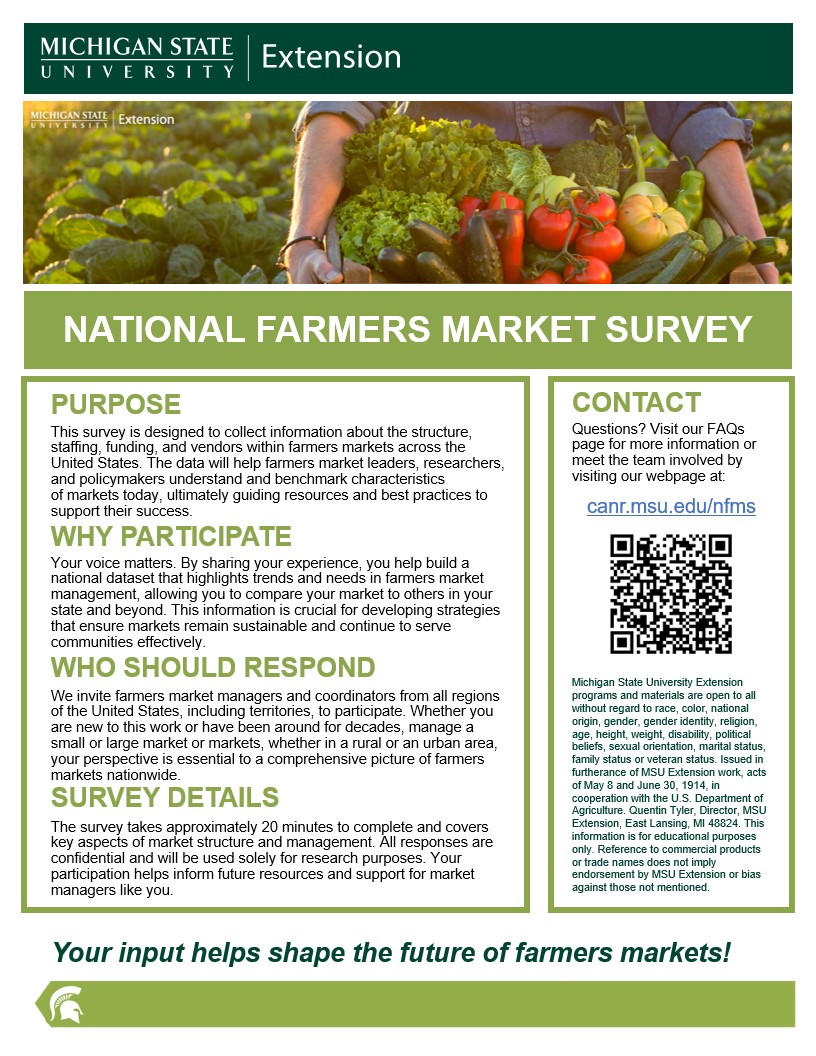
Survey on federal grant delays and cancellations

This survey is for farmers market organizations with an active federal grant and will be used by FMC and its partners to understand the situation’s scope and to help us all respond. 

FMC will share what is learned from this survey on its list-serve and website.

https://forms.gle/dSfbgj9daJNRsbMF8

Thank you all for your incredible work to keep farmers markets thriving.

Chicago chooses farmers markets over brick and mortar

“Chicago officials revealed Tuesday they’re considering opening public markets across the city, pivoting from their 2023 concept of creating a single municipal-owned grocery store.”

The original report recommendation was for a proof-of-concept grocery store, possibly leading to 3 new stores, all owned by the city. Fascinating to see the analysts had suggested an annual subsidy of $130,000 would be necessary for just one store location.

The article credits the Food Equity Council for the change in direction from grocery store to farmers markets. Congratulations to these grassroots leaders.

There are many questions as to how this welcome change might be successfully undertaken, what type of market is best, and how to use properly use farmers markets to address food insecurity.

I certainly hope they avail themselves of the expertise in the national field of 4500+ entities that run the 9,000 or so farmers markets in the US.

STILL, it is a monumental and bold decision, and one that will benefit farmers and neighborhoods in the Midwest’s world-class city.

“We want this to be an example that we can set for other cities who are looking to do this type of food equity work, but ultimately, for the specifics of how many; and who’s going to own and operate; who’s going to pay? We haven’t worked that out yet,” the mayor’s office spokesperson said.”

https://chicago.suntimes.com/chicago/2025/02/12/chicago-plan-open-city-grocery-store-changed-favor-public-farmers-markets

* There is an unfortunate use of the apostrophe in the article, but one might assume they mean farmers markets even though they use the term farmer’s market (does that mean one farmer?) and public market interchangeably. Yes I’m being a bit snarky, but my pet peeve is the lack of a consistent style choice in writing these terms which makes it hard for the public to understand what we mean.

**The article also suggests that only 2 cities operate markets which is far from accurate. If they mean shed (public) markets, there are quite a few and if they mean open-air farmers markets, there are also likely hundreds managed by their municipality. That is based on information from PPS, from national surveys done by my employer Farmers Market Coalition, and through my consulting for projects that include markets managed by small and large towns and cities.

Safeguard your community

Farmers markets will become even more important in this chaotic time; consider how to make sure they continue.

Market day should be the priority. That doesn’t mean your programs are not vital (they are!) but if the market doesn’t open none of those can happen.

Some suggestions:

Confirm that your market space will continue to be available. That may be an issue if you only have a handshake agreement with an entity that may not be understand all that the market provides or in some cases, you may just be finding out they may be in opposition to some of the things markets provide. So check, get a signed agreement for a few seasons in place and look for a possible back up spot if needed.

Ensure your budget is not completely tied to federal grant programs. Some folks think that because they get money from a city or a state that it means it will continue, but those monies may originate from federal grants. Check. And start to look for local and regional foundations that support democratic civic activities. Put the word out on social and with your email list that your market has programs that need funding partners. If you haven’t yet partnered with like minded businesses as sponsors, consider this. Tent Talk has LOTS of episodes on partners and fundraising locally.

Revisit your budget to reduce spending anywhere you can. Make sure that the market day budget (meaning the costs for staffing and hosting the actual space) is finalized and separately managed from any other initiative or program budget.

Talk to your vendors. Find out what they are planning, what they are worried about for 2025. So far, it does seem that food producers will be in great demand; encourage them to talk to you about opportunities they are approached about and if you can, help them sort through those. I wish I could tell all of you to not get angry with vendors who pull out of markets (esp at the last minute) but I know we are human and that their absence could be a problem for your market; still I can tell you it won’t help and will make others less likely to tell you if they are getting offers.

If you are approachable, respectful and open to listening to their needs you may see some decide to stay because of that, and if nothing else, by being a good listener, you may know earlier. And because…empathy goes both ways.

Talk to your shoppers. See above.

Do more than use social media; revamp the newsletter, have a simple website, put flyers up, design kitchen magnets with website and phone number, give dedicated shoppers materials to hand out.

Be visible at market.

At market, let’s stay away from shame and blame, and focus on connection and inclusion.