I suggested Groupon earlier in the year for the Crescent City Farmers Market in New Orleans as the way to sign people up for the CSF (community supported fishery) that they ran at their Thursday market. They didn’t use my idea this year, but knowing them, they will use it or a version of it and use it well. I’d love to see a market fully embrace the idea of using these coupons for a pre-sell item at a farmers market. Maybe for a Thanksgiving turkey sale?
Groupon
what’s next?
If you came to the blog because of an email I sent out, then you probably know me as the past director of the marketshare program at marketumbrella.org, or as the market manager at Crescent City Farmers Market, or as the White Boot Brigade staff or the Festivus, The Holiday Market For The Rest Of Us manager or the Go Fish on Film “producer.” Now, you’ll know me as an independent organizer, consulting with many market organizations throughout the US.
I have worn many hats in my 9.5 years with the wonderful marketumbrella.org. I enjoyed every minute of my work there and believe our relationship is just moving to a new definition.
But why?
It has been my belief for some time that we (the market community) need to continue to be as nimble and as brave as the generation of market founders that started this movement were, back in the 1970s-1990s. They did the impossible sometimes, the slightly difficult often, and the nutty more often than they would like to admit.
But what they did do was to build a wide foundation. They allowed a lot of new ideas to come together under one tent (pardon my market analogy) and kept innovating as needed. Some of those folks are still around running markets:
Ann Yonkers and Bernie Prince in DC
Donita Anderson in Cleveland OH
Leslie Schaller in Athens OH
Richard McCarthy in New Orleans LA
Chris Curtis in Seattle LA
Pompea Smith in Los Angeles CA
Just to name a few. I am sure there are many more that I am forgetting. Or don’t even know. Folks that are still around and deserve your appreciation and if you do get a chance to sit and pick their brain, take it.
But many others have moved on to other work or initiatives, leaving their markets in good hands they hoped. So this is our question: what is the legacy for those of us in the second and third generations of market organizers and market trainers?
I hope it’s to understand how markets sit within the larger alternative food system, within the larger public space movement, how they support newer markets and other initiatives. I hope it’s to continue to be brave and add difficult ideas to our markets and to welcome new people every week. I hope it’s to change the way we ALL live but with dignity and fun. And it better be to keep on honoring the farmer, the fisher, the harvester, the forager, the entrepreneur. They are our partner in this and yet are left out of the decision-making too often.
This is one of the reasons I am now on my own. I want to build this as a movement and to do that, we need to move even faster to connect to more ideas and to share more skills and to make some decisions about what we believe in, what we stand for in the public market movement. My old employer marketumbrella.org, will be there at the forefront with me, this I know. Farmers Market Coalition will be there too. Community Food Security Coalition, Food and Water Watch, National Campaign for Sustainable Agriculture, the SAWGs, Federation of Southern Cooperatives, ALBA, Native American Farmers Associations, Food Secure Canada, Projects for Public Spaces, APA, APHA… again to name just a few of the many, will be there too.
Share your stories here, and call on me if I can help you.
Dar Wolnik
dar wolnik at gmail
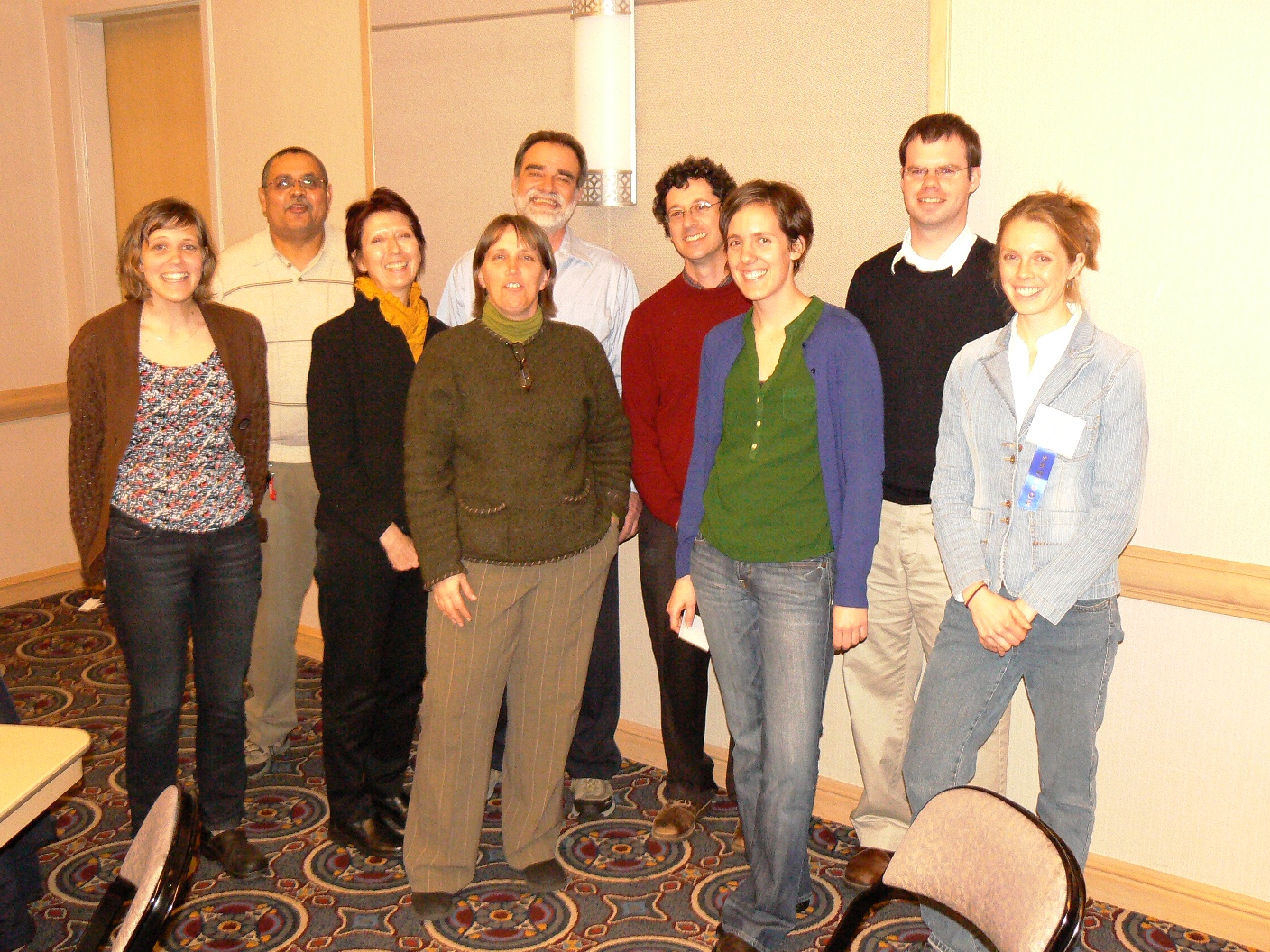
My favorite place to be- among my peers. Well, if there was a market around us, that would be best...Sarah Blacklin Mkt Mgr Carrboro NC, Cliff Slade VA farmer, Bernie Prince Co-Director Fresh Farms DC, Darlene Wolnik, Mike McCreary Mkt Mgr Asheville NC, Peter Marks Director Appalachian Sustainable Agriculture Project, Erin Kauffman Mkt Mgr Durham NC, Matt Kurlanski of Wallace Center, Stacy Miller Executive Director FMC.
Job Postings
from com-food list-serve
Organic Farm Education Paid Apprenticeship Live Earth Farm, Watsonville, CA
Apprenticeship Posting
Garden Educator and Manager, MUSE School, Malibu, CA
Malibu Posting
Product Review Coordinator, OMRI, Eugene, OR
Deadline: June 17, 2011, 5pm PST
Product Reviewer Posting
Instructional Technician, Life Lab, Santa Cruz City Schools
Santa Cruz Posting
Deadline 6/10/11
Edible Schoolyard, Berkeley, CA
Two open positions: ESY Berkeley Posting
Good Luck!
1-acre urban farming workshop in NYC
The Brooklyn Grange (Queens, New York)
Sunday, June 12th, 4pm-8:30pm
Free for NOFA-NY members/$15 for non-members
Looking for insight on starting or improving your urban farm? Join us on June 12th in Queens, NY to delve into the challenging yet rewarding business of rooftop farming & production for urban markets. The Brooklyn Grange is a working farm on a rooftop in Long Island City, Queens, New York. Ben Flanner is the founding farmer and CEO of the 1-acre farm, which uses 750 cubic yards of soil to produce vegetables for farmers’ markets, restaurants and a 25-member CSA. The farm is actively expanding to incorporate educational efforts, in the form of their City Growers program. They are also planning to include bees and chickens into their rooftop environment. During our Beginning Farmer Workshop, the farmers at The Brooklyn Grange will discuss the philosophical and technical aspects of their farming operation, including the process of site selection, rooftop farm installation & funding. Through a thorough exploration of the 1-acre farm, we will see space-saving intercropping, crop rotations, soil fertility management, the unique aspects of farming a formerly non-agricultural acre of space & much more! To celebrate the revival of city agriculture, we will end the day with a rooftop potluck picnic & social hour (please bring food to share & your own place settings). This event is free for NOFA-NY members, $15 for non-members- some scholarships may be available. For more information, visit https://www.nofany.org/events/field-days or call Rachel at (585) 271-1979 ext. 511. Space is limited to 30 attendees, so pre-register by June 6th to guarantee your spot! If you are looking to share transportation or lodging to attend this event, please see our newly-launched virtual bulletin board at https://www.nofany.org/bfam/bulletin-board
Philanthropists talk about measurement
As many in the farmers market have figured out, funders come with expectations attached to the check. It is important to remember that when markets ask for financial support, they need to return a completed project and some learning that forwards the funders goals. So it’s important to talk now about HOW, WHAT, WHY we measure our work, so that those measurements make sense for our mission and our part of the movement.
This quote is from a philanthropy newsletter:
Wouldn’t it be fun – fun being a big incentive these days — to extend the Consumers Union model into the philanthropic worlds of charity, development, and justice? Wearing our consumer hats, we could impartially and rigorously “test” our neighborhood soup kitchen, for example, and compare them with others. We could do the same with our nearby job training and employment service. And our state coalition for (or against) our favorite cause.
Instead of Consumers Union, we could have a Clients Union, or a Beneficiaries Union. What about a Members Union? Me, I’d like to be part of a Stakeholders Union.
Community size? 150 give or take…
Robin Dunbar
How Many Friends Does One Person Need? Dunbar’s Number and Other Evolutionary Quirks
Harvard University Press, 2010. 312 pp.
excerpt from a review from Los Angeles Review of Books:
Our big brains — in particular our species’ inordinately large neocortex — evolved, Dunbar argues, in lockstep with our ability to manage increasingly large social groups: to read motives, to keep track of who is doing what with whom, of who is a reliable sharer, who a likely freeloader, and so on. Many evolutionary biologists have made this point over the years, of course. Where Dunbar is unique is in having assigned a definite number to what constitutes a stable human group or community. The “Dunbar’s number” of his title is (drum roll…) 150. Extrapolating from the estimated size of Neolithic villages, of Amish and other communities, of companies in most armies, and other such data, Dunbar argues that this number is, more or less, the limit of stable social networks because it represents the limit, more or less, of our cognitive capacities.
The number is highly debatable, but it turns out that, Facebook aside, the average person has about 150 friends — people he or she might actually recognize and be recognized by at a random airport, 150 people he or she might feel comfortable borrowing five dollars from. As for how many friends we have evolved to “need” in a more intimate sense, that is a different matter. According to Dunbar, most of us have, on average, about 3-5 intimate friends whom we speak to at least weekly, and about 10-15 more friends whose deaths would greatly distress us. These circles can include kin; indeed, the more extended family we keep in close touch with, the fewer friends we are likely to have — precisely because our neocortices can only manage so many relationships. What is perhaps most intriguing is the degree to which the inner circles change over time; close friends can drop through the circles of intimacy if we do not spend time with them, and even out of the 150, especially when someone new captures our attention. By contrast, kin have enough staying power that we can visit and expect to be housed by a cousin we have never met or a great-aunt after decades of neglect. In short, while friendships “decay” if not actively cultivated, kin relationships do not. Or so Dunbar claims.
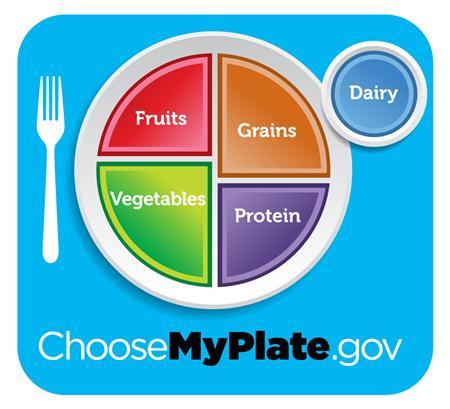
New food plate replaces food pyramid
Useful criticism of the plate from retail analysts:
Hartman
USDA is readying new food “pyramid”
Boy, this issue goes to show the power of the lobbyists and experts that surround the beltway. Over the years, the food pyramid has changed dramatically, and remains a political football to kick back and forth. The first pyramid was adopted in 1992, changed in 2005 and now reports are that the new version will be a plate showing how much of each food group an adult person should eat for healthy weight.
Here are some examples of past pyramids:
Caring for migrant workers
Thanks to Cindy Torres of Colorado Farmers Market Association and Rocky Mountain Farmers Union for providing this link:
Napa story
A good localvore challenge, right here in New Orleans
Chock full of events and ideas, the Nola Localvore Challenge is underway as of tomorrow. One reason I like this version is that it includes movie nights during the Food Justice Film Series and loads of other events to network. I also like that it has levels for those who want to try this idea but maybe not entirely be ready for 100% local just yet. Crescent City Farmers Market has been instrumental with advice as to what is available locally, posting news in their weekly Market Morsel and on their site and allowing the group to table at the markets themselves as well.
The food system keeps growing more branches, making the tree stronger and stronger.
Start a seed saving branch
I have noticed that we have more than a few markets either on library property or within a very short walking distance around the country. This idea seems like a good way to link the two even more closely:
Corporations pick up on “shared value”
Harvard Business Review recently published an article with some language that sounds an awful lot like the stated “triple bottom line” of Farmers Market Coalition, marketumbrella.org and others in the public market field. Shared value is the new concept to deepen corporate social responsibility to include social progress as a measurement for their company. Seems like markets need to use the language and idea to find ways to connect with Main Street more…
Harvard Business Review
Where do food truck vendors use the bathroom?
Street vendors are interviewed about their culture:
Food policy-stage center.
As the attendance at Community Food Security Coalition’s (CFSC) conference showed, the healthy/regional food movement is gaining maturity and strength.
Over 600 attendees from every part of the U.S. and Canada came together to discuss, to see Portland’s leadership and to network. (I can personally attest to the networking ability of regional food system people.)
The Coalition always manages lively face to face opportunities and backs it up with good leadership in the sessions themselves. Planners, public health professionals, farmers, market organizers, grassroots activists, city officials were all in attendance.
They also tried to use technology to get real time voting in the Friday plenary which had some bugs (Laurel MacMillan CFSC staff, was a trouper on stage with amazing aplomb and humor to keep it going and people engaged, paired with local leader/market trainer Suzanne Briggs up there with Laurel, typing madly) but since everyone was in good humor after a pleasant breakfast, all was fine by mid-morning.
From Vancouver’s Food Charter poster to the free pear savers (those spun their own debate) to the lively networking sessions (the South/Southeast session was almost drowned out by an insurance conference play acting in the next conference space but valiantly held their space) there was plenty to learn, see and hear. As we know the 2012 Farm Bill is the focus of every food system and CFSC did an admirable job capturing the breadth of issues on the table and tactics that will be needed. The draft of priorities outlined by CFSC included:
Defend and expand Community Food Projects and Farmers Market Promotion Program
Secure support for the infrastructure needed for local and regional food systems.
Increase access to federal nutrition programs participants to food system points of entry.
Work on urban-rural linkages across existing programs.
Require USDA to streamline SNAP redemption and technology.
Promote incentives for fruit and vegetable purchases for federal nutrition program participants.
Call for a USDA report and guidance document on how local government regulations can support access to healthy foods.
Incorporate more local product into DoD Fresh and USDA Foods.
Institutionalize the tracking and evaluation of Farm to School programs.
Of course, those were presented as draft priorities so that CFSC Policy Director Kathy Mulvey and Associate Policy Director Megan Lott can continue to evolve the platform based on the membership needs of CFSC. They were very active throughout the conference as they have been in the listening sessions they have held throughout the year.
As a board member of the Coalition, I was very proud of the program staff and the work done to make the conference happen. As always, Emily Becker our conference planner (and I am sure Aleta and Erika as support) hit another home run for the movement. Doubletree Hotel was a nice location with food sourced locally.