Oysters suffer too

In 2009, I went to Puget Sound to film sustainable oyster farming at Taylor Shellfish. Those short videos are to be found on the You Tube channel of marketumbrella.org. The company works with small oyster growers like the amazing Evan and John Adams of Sound Fresh Oysters who have varieties that they only bring to the Olympia Farmers Market.
Taylor also grows their own and encourage home growers with a waterfront oyster garden kit that they sell one day a month, to help people understand how oysters develop. (Go to the Go Fish chapter and look for the oyster videos.)
YouTube channel
I have never forgotten how the Taylors (and Oyster Bill!) build the future of their ecosystem with their techniques and can only hope that some of their innovation can rub off on my own oystermen of Southeastern Louisiana so we can save our dying oyster industry here.
However, the issues are constant, and one grave threat is explained in the article link. When will environmental destruction finally hit home for humans? What amount of food will we have to lose before we address it?

Acidification

Muddy fish tales

The world’s largest independent product-testing organization revealed last week that 22% of the seafood it tested at supermarkets, restaurants, fish markets, gourmet stores and big-box stores in three states was either mislabeled, incompletely labeled or misidentified by store or restaurant employees.

I would assume that this research does not include producer-only farmers markets that have seafood.
So its another example of how criteria at farmers markets helps consumers.

USA Story

Fair trade; yes? no? not yet? too late?

As a market organizer that created and ran a fair trade market in New Orleans for 5 years, I researched the idea heavily, many times while sitting at my neighborhood fair trade coffeehouse, Fair Grinds. I did find the fair trade argument thin in places, as it seemed to be more about a fuzzy mostly environmental rating on a bag and less about the part that a market organizer would focus on: that it offers more direct relationships with farmers and allows for a fairer accounting of labor and resource use. The painstaking knowledge of what it takes to farm and to survive in colonial regions is often reduced to a sepia toned photo of a farmer and a name on a sign. What is also interesting is that fair trade has not spread past commodities such as coffee and chocolate. Where is the fair trade wheat or sugar for example? And as more and more distributors enter the game, everyone it seems has at least 1 fair trade coffee on the shelf, often with very little paperwork or knowledge to support it. So, it seems to me to be have developed as more of a brand for consumers than a new values-based set of relationships. I will say, I continue to support my fair trade coffeehouse and purchase it when I can find it.
This article explains some of the weaknesses that it has as a movement, but I will say, their argument that it lacks a “single issue” focus is, in my mind not one of them. In any case, I appreciate the article and the magazine that published it.
Briarpatch

Utne Visionary

Food hero Gary Paul Nabhan surely deserves this award since his “place-based” food research has been groundbreaking for decades. “Coming Home To Eat” was the first short mile diet I read and it is quite different from the rest (still), with the cultural reclamation context he shares in it. His Renewing America’s Food Traditions (RAFT) work was immensely useful for me and my fellow organizers; the RAFT map (see below) is a wonderful representation of how America should be seen. Gary’s books range from a leisurely walk through a Franciscan walk in Italy to why peppers are heaven to some to his essays on desert life. Treat yourself:
Book list

Utne award

Agripedians Wanted for Food System Wiki

(For subscribers of the Journal of Agriculture, Food Systems, and Community Development and/or as a member of AgDevONLINE):

The local food movement is growing dramatically, and with it is emerging new lingo and jargon. The Food System Wiki — a collaboration of the Department of Urban and Regional Planning at the University of Wisconsin Madison and the Journal of Agriculture, Food Systems, and Community Development — is designed as a user-friendly and evolving repository of food system lexicon. This is a place where you can contribute new words and definitions, show how the terms are used, and fine-tune those of existing words.

There are several dozen agripedians contributing currently to the Food System Wiki. We would like to see greater participation from nutritionists, community development professionals, Extension agents, faculty, students, public officials, agency representatives, and, of course, farmers and food entrepreneurs.

Please join in the project! SIGNING UP to use the Food System Wiki is easy. After approval, follow the simple instructions to get started. Start by being a member of JAFSCD:
agdevjournal

Food Day market run by students

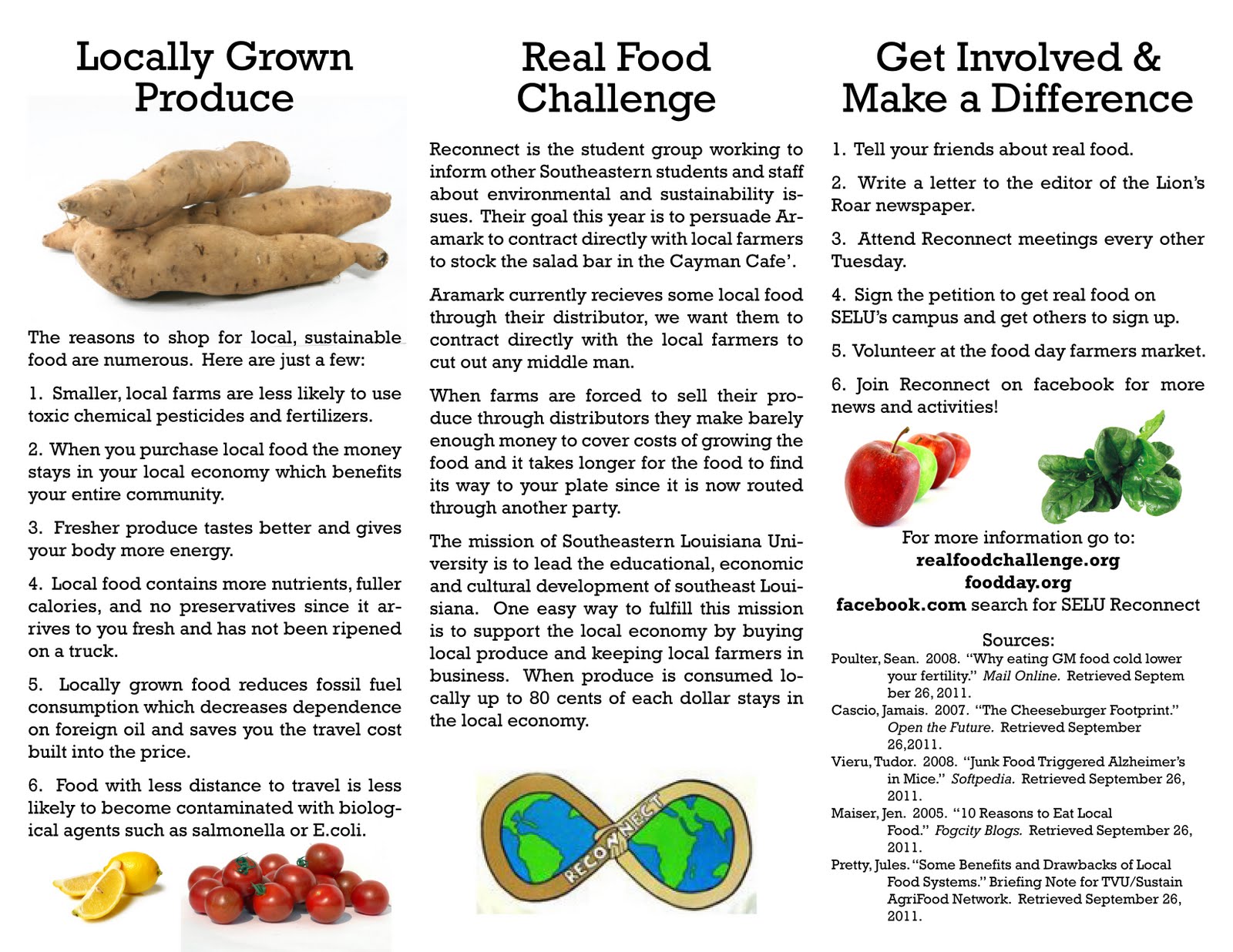
Another way we can use the mechanism of markets to encourage food system changes. A student group in Hammond Louisiana called Reconnect will be hosting a one day farmers market at their Southeastern Louisiana University campus to encourage Aramark to consider buying directly from farmers for the campus. This one day market can begin a multitude of conversations around farming, food, small business growth and smart planning.

One day farmers market at Southeastern Louisiana University to be held on October 24th.

No time to hide your head…

Good news for champions of wild-caught seafood. The latest news on turtle-excluder devices (TEDs) shows a 90% drop in turtle deaths. This shows the importance of environmentalists and fishing families working together to solve problems rather than pointing fingers. “Our findings show that there are effective tools available for policy makers and fishing industries to reduce sea turtle bycatch, as long as they are implemented properly and consistently.” said Elena Finkbeiner, lead author of the report. Duke University and Conservational International worked together to analzye turtle bycatch data compiled by the National Marine Fisheries Service.
While at marketumbrella.org, I produced a series of films called “Go Fish” that showed innovation among fishers and markets. The one on bycatch reduction devices (BYRDs) is very useful for any market or direct-marketing fisher. All are found on their YouTube channel:
Go Fish

Conservation incentives

According to a press release from The National Sustainable Agriculture Coalition,
the Conservation Stewardship Program (which is outlined in the link below) offers support to farmers in exchange for better environmental practices, The Conservation Stewardship Program pays farmers for adopting “new conservation enhancements” and actively managing ongoing conservation activities. Those payments are calibrated directly to the environmental benefits derived from specific practices.

Each geographical region has its own unique agricultural challenges, which are addressed in a five-page section of data analysis. The data includes analysis of program participation by geographic region, land use type, commodity type, and the top conservation practices and enhancements chosen by farmers and ranchers who enrolled in the program.

Some of the important issues addressed by the program include water quality, wildlife habitat, soil quality and erosion. In some areas of the country, water conservation and air quality are also important considerations

Read more: More information here

Update from Jean at NOFA in Vermont

Since Jean Hamilton from NOFA-VT is scheduled to speak at our first statewide conference in Louisiana, I have been in touch with her during this difficult week up there. She sent me this email:

Our offices were closed yesterday due to the fact that all roads into town were completely flooded. I tried driving in from two of the three directions when I finally got a glimpse of the Winooski river turned sea.

So, I headed into Burlington instead where I spent the day helping farmers at the Intervale cart produce to high ground. A bunch of us filled a cooler with as much as four farms could harvest before the water took their fields, only to realize that the water was definitely going to fill the cooler as well. Luckily, our local school district is very supportive of local farms and invited them to move all their stuff up to a HUGE walk in cooler at the middle school. It was an emotionally confusing day with lots of sunshine, inspiring community cooperation, and oh so much farm food gone bye-bye.
For the most part, people are taking this opportunity to reaffirm the things that matter most, but I know there are some very low spirits among the farmers.

Anyway, it was touching to come home, see this email, and realize how many people are thinking of us up here.

Disaster planning

What a few months for the natural world in North America. It seems that we are now fully in the next phase of environmental uncertainty and change, and as market organizers, must plan for the eventuality of it coming to us.
Vermont is currently in the grips of the devastation and as a recent visitor, I worry about those farmers and markets that I met while there. I know from experience that the issues they will face over the next few months will be both unique to their place and similar to New Orleans 2005, Iowa 2008 or even the horror of Japan 2011 and so on. Sure we can help and should help, those of us who have seen it, but more importantly:
How can we begin to add some resilience into our organizations so that we can quickly react to our community when they need us? Is funding the top priority after disasters, or is the primary responsibility a series of human responses that offer comfort and solace? And what can be done as a national community of markets to offer help without becoming a FEMA-like casualty of bureaucracy?
Is this a series of audio pieces or maybe even a packet, downloadable for those who are ready to plan?
I am beginning to work on post-disaster planning for markets. If you feel like adding your thoughts, do send me any ideas as they pop up. And good luck to Vermont and to the entire Northeast.

Vermont

email me at dar wolnik at gmail if you have ideas or details that you want to share.

Record for billion-dollar weather disasters tied

Unfortunately, we in the agricultural biz are just going to have to get better at explaining disasters to our communities…

Record for billion-dollar weather disasters tied – Weather – msnbc.com.

Goats-Ambassadors of Agriculture

LA goat story

Meat-Eaters Guide

As markets find more ways to measure themselves, natural capital will have to be an important category. Yet, the local food system is not always the lowest user of energy (sometimes the lack of centralization in distribution seems to work against us) but of course, we know that will balance out by the green style of shopping, innovative farming, and intentional planning of the market organizers. An example such as the Crescent City Farmers Market which no longer sells plastic bottles of water, but simply filters water and offers it free or sells a reusable cup to those who forget theirs. In many ways, markets should work hardest on the environmental issues of farming and consumerism, because they come the hardest.
Environmental Working Group has released a carbon footprint for meat eaters. It may be worthwhile to link or to print for your shoppers and farmers to read through. As usual, we don’t need to preach but to lead with information and allow people to make good healthy choices.
EWG

Farmageddon, the movie.

Here are the current locations for Farmageddon screenings..more should be coming soon.

July 8th – 21st
New York City
Cinema Village
22 East 12th Street

July 17th
Bethlehem PA
Starfish Brasserie

July 22nd – 26th
Portland OR
Hollywood Theater

August 6th
Palm Springs CA
Camelot Theater

August 11th
Tampa FL
Roosevelt 2.0

August 20th
Sedona AZ
Sedona Public Library

Aug 26th – 31st
Chicago IL
Gene Siskel Film Center

Aug TBA
Boulder CO
University of Colorado International Film Series

Sept TBA
Cleveland OH
Cleveland Institute of Art

Thank you for supporting your local farmer!
Kristin Canty
Director, Farmageddon

If you have a large group that would like to put together a screening for your area, you can contact us at Farmegeddonmovie.com. Currently, we are aiming for a short theatrical release so that we can get this issue into the mainstream press. We are also encouraging community screenings in places that don’t have a local theater.