Session proposals for 2012 Main Street conference

2012 National Main Streets Conference: Rediscover Main Street

Over the past year a constant theme heard locally and nationally is the trend of retailers – including “big box” stores –moving away from strip malls and back downtown. Businesses are not alone either. Residents and visitors are also choosing more traditional locations. In Baltimore we will continue to showcase the power of preservation-based economic and community development and to provide education and networking opportunities to help businesses, governments, residents and visitors Rediscover Main Street.

The National Trust Main Street Center is seeking session proposals designed to help inform, inspire ideas, and explore methods and best practices to capitalize on this growing trend and to encourage the rediscovery of what Main Street has known for decades – preservation as economic development works! Read more about submitting a proposal for the 2012 National Main Streets Conference here
Deadline: August 26, 2011

Contact the National Trust Main Street Center:
1785 Massachusetts Avenue, NW, Washington, DC 20036
202.588.6219 | mainstreet@nthp.org | http://www.mainstreet.org/

The National Trust for Historic Preservation is a private, nonprofit membership organization providing leadership, education, advocacy, and resources to save America’s diverse historic places and revitalize our communities.
Reuseable bag reminder

The tip I read in Larry Leach’s HuffPostcolumn gave yesterday is another excellent idea for markets with chalk or dry wipe signs at their entrances:

I also have yet to see a retailer place a reminder sign on their entrance, “Did you remember your reusable bag?” Now that would show shoppers they care for the environment, especially if they GAVE you a reusable bag with their logo on it.

His advice is often geared to the small business with sensible tips and ideas for all sizes. Do yourself a favor, get a board member or a volunteer to subscribe to his blog’s RSS.

Larry Leach is an advertising sales rep for 11 Calgary Community Newsletters and the British Canadian newspaper. He is chair of ARTICS a Calgary based education group, publicity director for Crossroads Community Association and past president of Deerfoot Soccer.
His advertising blog (2011 Canadian Weblog Awards Nominee) can be found at larrytheadman.blogspot.com

Self-checkouts may be a thing of the past soon

Consider yourself a human again. More than one industry grocery giant is experimenting with ridding their stores of the self-checkout lines. I would assume that the stores losses were climbing (from theft at those checkouts and from people just walking out with stuff since there is less personnel up there to watch), and that the complaints also went up (no friendly interactions makes shoppers feel vulnerable so they are more critical.)

And, I’ll suppose that the growth of public markets is also showing the industrial system how to regrow trust and dignity when shopping.
Story

Cash=healthier?

Journal of Consumer Research © 2011 Journal of Consumer Research Inc.
Analysis of actual shopping behavior of 1,000 households over a period of 6 months revealed that shopping baskets have a larger proportion of food items rated as impulsive and unhealthy when shoppers use credit or debit cards to pay for the purchases (study 1).
JSTOR

Cookbook LA

I know Echo Park because of the fine weekday evening market that is run by SEE-LA, which also runs many others in L.A. including the iconic Hollywood Farmers Market. When I worked at marketumbrella.org, they conducted a pilot of their NEED tool (meant to measure social capital) at that location and at SEE-LA’s other markets. I visited during the survey days and was very impressed at the location and vibrancy of it and their other “food security” and “neighborhood/niche” types of markets.
This Green Grocer was not around in 2007, so I have to believe that part of the credit for its birth must go to the Echo Park Farmers Market and the SEE-LA organizers.
Cookbook LA

Fleas welcome

Flea markets are fascinating to people watch at and someday we’ll figure out how they and open-air farmers markets are related.Like any public market geek, I follow the flea market news regularly and years ago, set up at a venerable old one in Ohio (Hartville for those of you in Buckeye Land). Wow, was that fascinating…. The pre-dawn culture was even more traditional than any farmers market I have watched. Of course, that market had been running for over 60 years…
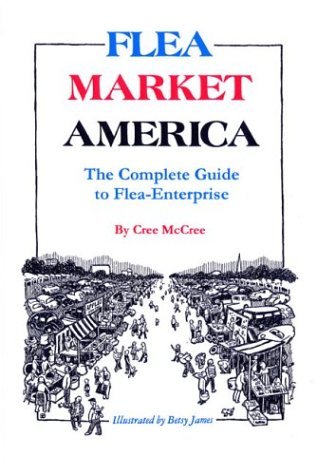
It is also my honor to count among my friends, Cree McCree author of “Flea Market America” and a regular art and flea market maven here in New Orleans. (I call her Cree McCree, Godmother of Flea).

Cree McCree's book. available for purchase everywhere


She was a prized Festivus vendor of mine (when I ran both farmers markets and a holiday fair trade market from 2002-2007 for marketumbrella.org). She is always working to find new venues and ideas to get more street vending out there.
Maybe we’ll even see a true producer-only farmers market and a criteria-based flea market in the same location with the same manager. Why not?
Their missions may be different from farmers markets, but its easy to see some similarities:
1. Many flea markets have rules about products that can be sold.This is often to keep out dangerous goods, but in any case, it speaks to the need for a manager/organizer curating the deal.
2. They have return shoppers and regular vendors.
3. There is a decidedly social air about them.
4. They attract a wide range of shoppers.

Here’s an example of one that works to engineer a total experience:

Uvalde Market Days will be open for shoppers on June 25th, 2011

It is one of the most unique open air markets in southwest Texas
June 15, 2011- Hundreds of dealers showcase their merchandize in tree shaded park. The visitors can enjoy shopping at Uvalde Market Days in the afternoons.
Visitors can enjoy music while they shop. The dealers at the market will be displaying huge variety of arts and crafts, plants, jewelry, wearable, collectibles, home décor, antiques, carpets, kitchen accessories, clothes, hats for men, women & children and lot more.
Uvalde Market Days is open for public on every fourth Saturday of the month.
It is open from 10 am to 5 pm.
It is located at:
Uvalde Plaza
Main Street And North Getty
Uvalde, Texas
Parking and admission is absolutely free.

Groupon all over the grocery aisles?

I suggested Groupon earlier in the year for the Crescent City Farmers Market in New Orleans as the way to sign people up for the CSF (community supported fishery) that they ran at their Thursday market. They didn’t use my idea this year, but knowing them, they will use it or a version of it and use it well. I’d love to see a market fully embrace the idea of using these coupons for a pre-sell item at a farmers market. Maybe for a Thanksgiving turkey sale?
Groupon

Where do food truck vendors use the bathroom?

Street vendors are interviewed about their culture:

Huff Post article

Open-air market dot org

I just posted some information on the street vendor project in New York, so thought I’d better also send this link for the Open Air Market Network. The site bills itself as “The World Wide Guide to Farmers’ Markets, Street Markets, Flea Markets, Street Vendors, and the Informal Sector.”
open air market network

It has not been updated in some time, but still has loads of pieces from all over the world and all type of markets to check out. Dr. Morales, who many markets know from conferences and listserves among other places, is one of the folks behind this site and a few others sites like Streetnet.org. His work is researching and writing about the informal networks of vending and is a must for any market organization to know as a reference. Just like our friends at Projects for Public Spaces, he links our markets to academics, city planners and social scientists. I know he is currently working on a book covering how markets take part in furthering community. I look forward to that coming out.

Appropriate technology for the industrial food system shopper

Don’t just think about the traditional grocery stores when comparing prices

Dollar stores might be where some of our shoppers are also shopping: This report talks about the biggest increase in their shoppers are among households earning over 100,000 a year.

Good explanation how to see The Tipping Point in context

Was recently chatting with Stacy Miller of Farmers Market Coalition about the book, The Tipping Point. She was asking if I thought it had relevance to our work. I found this quote from the author that explains what I think makes it useful to read, although with a caveat that we are not trying to start a social epidemic in markets, but to actually make long lasting economic and behavior changes. So limited relevance.
In any case, the language is useful to see how one might use word of mouth to spread a piece of your message…

it takes theories and ideas from the social sciences and shows how they can have real relevance to our lives. There’s a whole section of the book devoted to explaining the phenomenon of word of mouth, for example. I think that word of mouth is something created by three very rare and special psychological types, whom I call Connectors, Mavens, and Salesmen. I profile three people who I think embody those types, and then I use the example of Paul Revere and his midnight ride to point out the subtle characteristics of this kind of social epidemic.

Remember that 96%

As much as we can use retail techniques to fashion our markets, I think we should. However, there are times when it is clear that the techniques do not match up so well to our market world. Here are some retail techniques that we should be aware of and know how to either adapt and adopt, or just realize that sometimes the point of view from the shoppers will include a perception that we do operate in the same way.
Loss Leaders– the idea that you “give away” some products at cost or just above to entice people to buy other more expensive products. Things like newspapers and magazines are often loss leaders. Believe it or not, so is milk a lot of times…So as a result, people see those costs as actual, rather than a loss. When they come to us and see the actual cost of those same products, they are horrified, so it has to be communicated that our farmers cannot afford to offer things at a loss.
Add-ons– When you go into a coffeehouse and the barista asks if you want a muffin with your latte, they are doing that because they have been told they must offer other products. I have heard shoppers complain that the market vendors are not “friendly” often enough to watch interactions and notice that shoppers are sometimes uncomfortable when farmers stand there silently with an open bag. Add-on sales could be as simple as market managers spending time on the shopper side pointing out a newly seasonal product. Or just a smile and a nod when the shopper picks their own products!
Rotating signage-I wish more markets used seasonal signage. Farmers do, but markets rarely do. Just a thought…
Easy Shop technologyIn essence, we offer this: the chance to buy and bag each item while in the aisles, skipping the lines. Interesting that stores are coming closer to us, rather than farther away…
WiFi available an interesting idea that might be developed in a few larger flagship markets. Could be a bloggers corner or simply access to wifi during market hours under a tent. Some savvy tech-centric market could have a public computer that has the market website with a recipe database for customers to access.

There are many more techniques in the retail world to notice. Again, no question that some will never fit all markets and some may never fit any, but let’s keep our eyes open.

Adding incentives for healthy living

Another sector heard from on how to reward behavioral changes: The fitness/gym world. By adding discounts up front, they reduce the costs to join. But talk about “conditional”: they charge you 10 bucks per day if you sign up and don’t use it! Can’t imagine farmers markets ever getting that punitive…