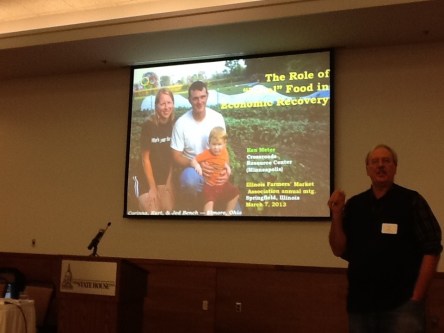
Great points from Meter at the Illinois Farmers Market Association Thursday:
Community food systems build health, wealth, connection and capacity
Local food may be the best path toward economic recovery in U.S.
If we can’t grow an economy around food, how do we expect to grow it around windmills or technology?
Counting food miles matter less than banding business together to work for a social value.
Farmers often create systems that are often more efficient by reducing energy costs and using “waste” products to do value-added. Snowville Creamery in Pomeroy Ohio sells their skim to Jeni’s Splendid Ice Cream for a high quality ice cream product. Both businesses are innovating waste reduction and distribution systems that shorten the chain.
Community food systems don’t just measure the multiplier-they build the multiplier.
Southern Illinois farmers (Meter’s study) show that from 1969 to 2010 commodity farmers sold 1.1 billion worth of products and spent 1.1 billion in production costs during the same time.
1.8 billion amount of food bought in Southern Illinois region; 1.7 billion of it was produced outside of the region.
If every person in that region bought 5.00 of local food directly from local farms each week, farms would earn 191 million of new farm income (why not have a 5.00 campaign at farmers markets?)
The promise of permanent markets abroad in the 1970s drove farmers into the “Get big or get out” mindset and into more debt. Those permanent markets disappeared within the generation.
The link between the oil crisis of 1973 can most likely be directly linked to the obesity crisis: the oil crisis in the U.S. led to the rise of the corn economy which added high fructose corn syrup to production.
Viroqua, Wisconsin is a model of an economic development recovery after their national company that had supplied 85 jobs left town. The city government convinced the owner to sell their building for a small amount (explaining to the company that the investment that the county had made for 30 years maybe should be repaid before leaving).
Viroqua used 100,000 square foot building to start to build an entire local food system and expect to replace those 85 jobs within the next 2 years.


 Helping Farmers Markets Grow