Helping Farmers Markets Grow

Skip to content
  • About

Farmers markets and resiliency: Don’t get me started.

Hello leaders.

I’m out on my “summer tour” of the northeast part of the US leaving my beloved New Orleans simmering and hunkering down for hurricane season, one that is projected to be an extremely active one.

When I began to regularly (around 2009) to leave for weeks and then for the summer, I got a lot of raised eyebrows and jokes about it, but those have completely stopped in more recent years. My take on that is that all New Orleanians are now accepting of the fragility of our coast, and constantly preparing for interruptions that come with the loss of land and the rising temperatures of the Gulf. So now, leaving for a time is one of the new normals. No more friendly texts of “wimp” allowed.

What has also changed is the number of natural and civil interruptions happening in the other places that I visit.

In the areas that I was in just over the last series of months, we watched the Vermont and Kentucky floods, the Canadian wildfires, and many other localized disasters that elicited organizing from one or more market organizations.

That organizing was rarely to raise money or awareness for the market entity, but rather, focused on their role as conveners (using their site for recovery), as analysts of the local/regional food system for media or policy makers, and/or as pass-through entities to get resources to their vendors.

The very nature of open-air markets allowed these varied and immediate responses, since most are without infrastructure and therefore have no physical damage to their own organizational assets. I say that with consideration, because many had to move their location for a few months or even longer, which requires design and logistical planning, work even longer hours than before, and pay for new marketing and messaging to let everyone know what and where the new version was happening.

And for the markets that provide centralized payment processing, the damage to shopper or vendor homes and/or businesses can often mean more and higher average transactions because of increased government benefits and private philanthropy, which in turn – although very welcome – increases the costs of managing such a system, and does not come with appropriate administrative funding increases. (In fact, it seems appropriate to mention here that for most market organizations, ANY significant increased use of their centralized system does not increase their income at the same level, if at all. That is the opposite for brick and mortar stores since those entities own the items they are selling and more items sold mean more profit for the store.)

I point this all out because I have been in the position many times to hear funders and policymakers slide right past markets when discussing how to invest in regional food systems that have suffered losses or interruptions. It also raises a red flag when we use the word resiliency to congratulate those who make it through the recovery phase, even though there are a few other phases before and after.

After the 2005 Katrina Levee Breaks, we had artists sew some of these words into prayer flags for us: Return/Reconnect/Recovery/Reopen/Renew/Rebuild/Rejoice/Rest. What those of us in the Gulf Coast mix since 2005 know now is that resilience comes after all of those if it comes at all.

Recovery does not describe resiliency as one cannot “bounce back” while still in the emergency. Instead, during recovery, we watch markets and other local entities “spend down” their social, intellectual, economic savings, but almost always see the attention moving on when true resiliency should have been measured – meaning long after, and no ‘R” savings account replenishment offered.

As another example, during the COVID crisis, the word resilient was used for direct to consumer outlets opening during the restrictions and although that part WAS incredibly difficult, little research was done on the larger-than-normal turnover of market staff that by state and network leaders noted after the restrictions lifted and markets were allowed to return to previous operational structures.

Resiliency also does not take into account how institutional power brokers use the moment of an emergency to shift the burden of future emergencies away from the formal civic sector and on to informal and individual recovery efforts. Of course, local community leaders should always have a leadership role in recovery but they shouldn’t be expected to raise the majority of the funds, or to be the only local response visible to their neighbors, yet in multiple emergencies, this is increasingly typical. (How many local GoFundMe campaigns, can or clothing drives, and or free 24/7 power/charge stations are managed by corporations?)

During the early days of recovery, a local activist in New Orleans famously refused the word:
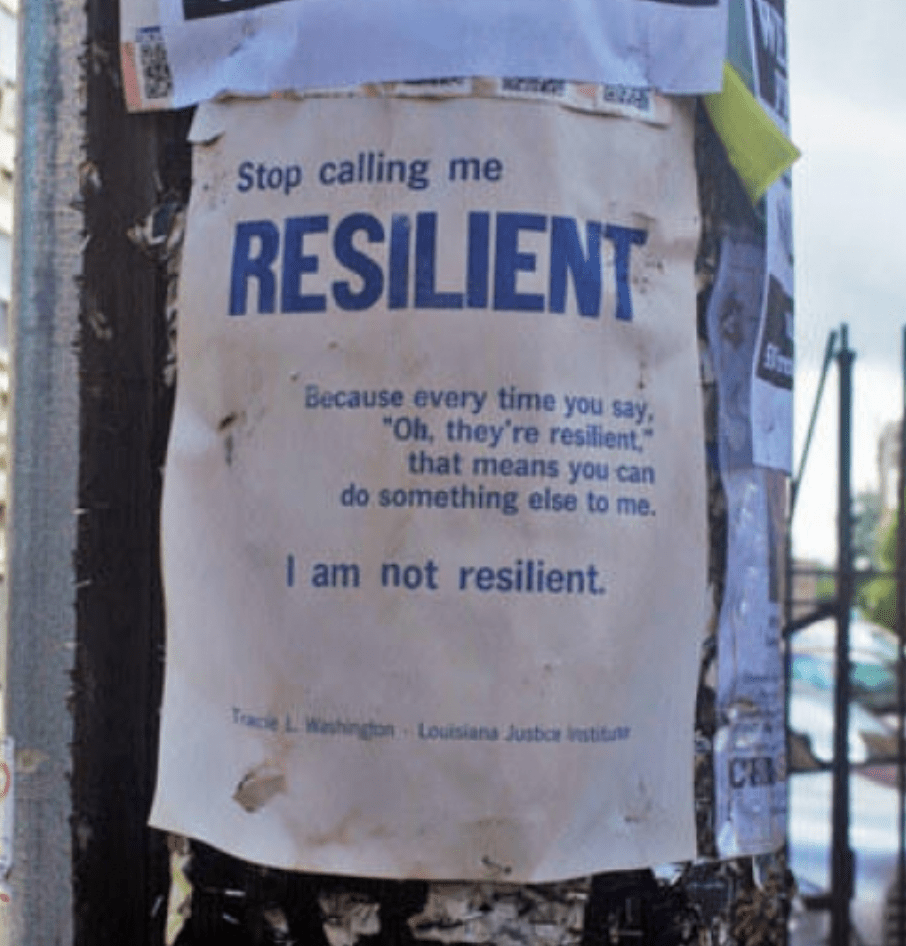
So is it even possible to rescue the word to be meaningful to local activists and grassroots organizations, or is it (as Ms. Washington says in the poster above) a word one does not want applied?

How should market communities partner with the formal sector without ceding any local power?

And as importantly, how do we prepare for the injustices likely to be raining down on our communities because of civic and natural emergencies even as we take care of our own health and well-being?

Share this:

  • Click to email a link to a friend (Opens in new window) Email
  • Click to print (Opens in new window) Print
  • Click to share on Reddit (Opens in new window) Reddit
  • Click to share on Facebook (Opens in new window) Facebook
  • Click to share on X (Opens in new window) X
  • Click to share on Pinterest (Opens in new window) Pinterest
  • Click to share on LinkedIn (Opens in new window) LinkedIn
  • Click to share on Pocket (Opens in new window) Pocket
  • Click to share on Tumblr (Opens in new window) Tumblr
Like Loading...

Related

Leave a comment Cancel reply

06/10/2024
DW
civic engagement, climate change, disaster planning, diversity/racial justice, ecological capital, ecological capital, economic development issues, environmental issues, farmers markets, fundraising, human capital, intellectual capital, Market organization resources, national food system work, outreach/marketing, Polls/Surveys, public health, racial equity, regional food, resiliency, social capital
alternative food systems, farmers, farmers markets, local food systems, market vendors, New Orleans, resilency, SNAP, social capital

Post navigation

Education through the 1619 Project
2025

Search this blog

Tags

alternative food systems BALLE big data book reviews California Canada CCFM chefs Chicago Cleveland climate change conferences cooperatives cottage food laws Covington Crescent City Farmers Market Detroit EBT evaluation farm bill farmers Farmers market Farmers Market Coalition Farmers Market Metrics farmers markets farming farm to table FMC FMC Farmers Market Metrics FMPP FNS Food food hubs food systems food system work Food Tank healthy food incentives La Via Campesina local food local food systems Los Angeles Louisiana markets Market Umbrella market vendors Mississippi New Orleans NOFA-VT North Carolina NSAC NYT Ohio Oregon oysters Poppy Tooker Power of Produce (POP) PPS Richard McCarthy Slow Food SNAP social capital social media SSAWG St. Joseph's Day Stacy Miller sustainability technology Toronto USDA Vermont Wallace Center webinars wendell berry Wolnik webinars

Enter your email address to subscribe to this blog and receive notifications of new posts by email.

Join 598 other subscribers

Helping Public Markets Grow 2011-2021

Independent Researcher and Analyst list of contracts (In November 2019 began full-time role as FMC’s Program Director)

•AMS TA project: Mentor for national technical assistance project for current FMLFPP grantees led by the Northeast Regional Center for Rural Development at Penn State University.
•Brooklyn NYC: Assisted BDPHO with developing farmers market technical assistance programs.
•Report on BDPHO’s 5-year market capacity project.
•Farmers Market Coalition Senior Research Associate for Farmers Market Metrics project creation (2015-)

• Farmers Market Coalition’s Senior Advisor, focusing on technical assistance for markets and networks (2015-)
•Illinois: Worked with ILFMA on evaluation plan for integration and upgrade of statewide fms and DTC information on integrated platforms.
•Louisiana: Assisted students at Southeastern University in Hammond with food system research and farmers market strategy.
•Louisiana: Assisted ReFresh Market and Garden with evaluation plan (2017)
•Louisiana: Working with Ruston Farmers Market on outreach strategy for new location

• Helping to craft resources and training for 2019 Fresh Central Certified Institute for Central Louisiana markets and producers with CLEDA.

•Louisiana: Organized first statewide farmers market conference for LSU Ag Center archives found at: lafarmersmarkets dot blogspot dot com

•Maine: Researched farmers market job descriptions found at www.helpingpublicmarketsgrow.com

• Mississippi: Providing research and analysis for City of Hernando MS 3-year project to grow flagship market

•Mississippi: Assisted Gulf Coast markets with FMPP project on analyzing access to markets for Gulfport resident and farmers. 2014 Local Food Awareness Report for Gulfport MS, found at www.helpingpublicmarketsgrow.com

•Vermont: Providing analysis and resource development for NOFA-VT’s annual data on farmers markets.

•Supporting markets creating their Legacy Binders
•Vermont: Researched and wrote report on SNAP, FMNP technology and policy answers for VT farmers markets in collaboration with NOFA-VT and VAAFM, 2013 Vermont Market Currency Feasibility Report found at www.helpingpublicmarketsgrow.com
•Vermont: Working with Vermont Law School on legal resources for farmers and market organizations.

•Vermont: Assisting with 3 year project to build capacity for direct marketing farmers and outlets through DIY data collection and use.

Wallace Center: Moderator of FSLN, advisory to the 2020 NGFN Conference to be held in New Orleans in March of 2020

•Why Hunger: Created online toolkit for grassroots communities.

Feel free to contact me at my name at gmail dot com if I might be able to help your market or business.
Thanks
Dar Wolnik

Posts by category

Create a free website or blog at WordPress.com.
Privacy & Cookies: This site uses cookies. By continuing to use this website, you agree to their use.
To find out more, including how to control cookies, see here: Cookie Policy
  • Comment
  • Reblog
  • Subscribe Subscribed
    • Helping Farmers Markets Grow
    • Join 246 other subscribers
    • Already have a WordPress.com account? Log in now.
    • Helping Farmers Markets Grow
    • Subscribe Subscribed
    • Sign up
    • Log in
    • Copy shortlink
    • Report this content
    • View post in Reader
    • Manage subscriptions
    • Collapse this bar
 

Loading Comments...
 

You must be logged in to post a comment.

    %d