Inside Aleppo: the tale of the flower-seller

I swear this story was already set up to go live this week long before Libertarian Party  Gary Johnson’s fail this week. Okay maybe it was due to go live next Monday and I sped it up a little.

This incredibly moving and tragic story is a glimpse at how some people share beauty and kindness even in the face of ugliness and despair. We must honor this level of selflessness and belief in the power of community, anywhere and anytime that it happens. And remember.


(For another view of life in Aleppo click here)

Food Price Monitors Needed for First Nations Study

LONGMONT, CO–(Marketwired – August 04, 2016) – First Nations Development Institute (First Nations) is seeking up to 75 people or organizations — located on or near Indian reservations across the U.S. — to monitor and report food prices on a monthly basis over a 12-month period.

Participants each will be paid $500 at the end of the study. Applications are due by 5 p.m. Mountain Time on Thursday, September 8, 2016.

The participants will collect prices on a list of food products sold in Native communities by monitoring their community/reservation grocery outlet, and then report the prices via an online database. First Nations will use the information to update and significantly expand its initial 2015 report titled Indian Country Food Price Index: Exploring Variation in Food Pricing Across Native Communities (a PDF of the report can be downloaded athttp://www.firstnations.org/knowledge-center).

Most reservation consumers believe they pay more for food products than consumers in urban areas, but there is little data on food prices in Native communities to fully substantiate the claim. In 2015, First Nations piloted an attempt to collect food prices in Native communities, and an overview of that effort was documented in the initial Food Price Indexreport mentioned above. That report found that, on average, many food products were more expensive with the exception of some junk foods. Building on this initial effort, First Nations is seeking individuals, organizations or tribes to collect monthly prices in their local community’s retail outlet.

Monthly food prices will be collected on the following food items:

  • Loaf of white bread
  • One pound of ground beef
  • Whole chicken (price per pound)
  • One dozen large eggs
  • One gallon of whole, fortified milk
  • Red delicious apples (price per pound)
  • Pound of tomatoes
  • Coffee (ground, cost per pound) of a common brand such as Folger’s
    • Regular
    • Decaffeinated

Project participants will enter their monthly collected prices into an online database provided by First Nations by the 15th of each month. This data will be analyzed and shared with all project participants. Moreover, at the end of the 12 months, the information will be shared with Indian Country at large via the revised Indian Country Food Price Index report.

The project will begin as soon as all of the participants are selected.

To apply to participate, individuals, organizations or tribes must complete a short online application at this link: https://www.grantrequest.com/SID_1243?SA=SNA&FID=35135. Please note that not everyone who applies will necessarily be selected. The selection process will involve consideration of geographic locations, retail outlets to be monitored and other factors. The online application will ask for information such as name, physical address, tribal affiliation, email address, distance to nearest grocery story, whether the store in located on a reservation, if it’s a tribally-owned outlet, and other similar questions. Reliability and accuracy are highly desired traits in those who will be selected. Applications are due by 5 p.m. Mountain Time on Thursday, September 8, 2016.

About First Nations Development Institute

For 36 years, using a three-pronged strategy of educating grassroots practitioners, advocating for systemic change, and capitalizing Indian communities, First Nations has been working to restore Native American control and culturally-compatible stewardship of the assets they own – be they land, human potential, cultural heritage or natural resources – and to establish new assets for ensuring the long-term vitality of Native American communities. First Nations serves Native American communities throughout the United States. For more information about First Nations, visit www.firstnations.org.

Image Available:http://www.marketwire.com/library/MwGo/2016/8/4/11G109314/Images/Food_Price_Cover_large_500-b61d945bdaab9229896530f92708d1ad.jpg

CONTACT INFORMATION

  • PROGRAM CONTACT:
    Raymond Foxworth, First Nations Vice President of Grantmaking, Development & Communications
    rfoxworth@firstnations.org or (303) 774-7836 x207

    MEDIA CONTACT:
    Randy Blauvelt, First Nations Senior Communications Officer
    rblauvelt@firstnations.org or (303) 774-7836 x213

Sign up for Food Tank’s live stream Summit

I’m a big fan of Food Tank and thought last year’s summit was thought-provoking and lively. I kept the live stream on all day while I worked to be able to stop and take notes when necessary.

Program found here


CgR_csiWsAEJrDQ.png

Amid Climate-Fueled Food Crisis, Filipino Forces Open Fire on Starving Farmers 

Police and army forces shot at about 6,000 starving farmers and Lumad Indigenous people demonstrating for drought relief in the Philippines on Friday, ultimately killing 10.


On Monday, local farmer Noralyn Laus gave Democracy Now! a firsthand account of the disaster:

“Why we came down here is not to make trouble. We just want to demand for rice, because of the situation of El Niño is leaving our tribes hungry. What happened yesterday, we didn’t start it. They started it by beating us. We wouldn’t be angry if we weren’t beaten up or attacked. We’re having a crisis. We don’t have anything to eat or harvest. Our plants wilted. Even our water has dried up.”

“Our farmers—the country’s food producers—are battered the hardest and are left in poverty and hunger,” Rapollo said. “Civil disobedience will continue to escalate until the government stops playing deaf and blind to the genuine cry of the people.”

Source: Amid Climate-Fueled Food Crisis, Filipino Forces Open Fire on Starving Farmers | Common Dreams | Breaking News & Views for the Progressive Community

Marché international de Rungis

Here’s a sneak peek inside Paris’ massive market with 450 types of cheese and more.

You’ll also notice a box of carrots, scrubbed clean, but then sprinkled with a fine dusting of dirt for aesthetic reasons — to reflect the increased demand for organic products. “Parisians buy with their eyes,” one vendor explains.

You can find everything at Rungis, even exotic foodstuffs like ostrich, zebra and crocodile. Interestingly, you’ll never see prices displayed at Rungis as they’re negotiated based on the buyer-seller relationship.

Traceability is really important — you know exactly where your products are coming from — and trailblazing initiatives include an impressive recycling program which provides energy and heating for Orly airport.

Beyond the magnificent goods, you’ll marvel at the work culture. Just under 12,000 people work at Rungis and it’s a jovial, jolly place. Folks love what they do, and you can see merchants socializing over coffee or verres de vin (glasses of wine) in the early morning hours. In fact, the café Saint-Aubert outside the poultry pavilion sells the most cups of coffee in France: 3,000 a day.

Source: Marché international de Rungis

Wrapping up 2015 with Food First

The third of 3 organizations that I am highlighting today. Of the three, this is the international organization, and one that has created some very thoughtful and provocative positions for food organizers. The democratization of all supporting systems is vital to winning food sovereignty and Food First has done admirable work on that level for 40 years.
The sophistication of their work on environmental issues, social justice, monetary policy, labor policies and much more allows all little markets and gardens to be a integral part of a huge movement. As someone who has seen many movements splinter or become proprietary before they matured enough to have wide impact, I am thankful to those who remember and work so that this rising tide carries all boats.
And way too often, those of us building those fulcrums of local food systems-farmers markets- focus only on doing and spend too little reflecting or analyzing on what has worked and what hasn’t. Lucky for us, Food First is on top of that too.
Through Food First, I have learned about dozens of inspiring campaigns across the globe and had access to some of our most influential thinkers. Spending a little time at the vision level and checking out what is happening at the global level is what makes working locally entirely satisfying. I hope that you find Food First as useful as I have.

Source: World Hunger: Ten Myths : Food First

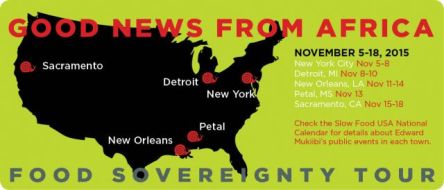
Slow Food Int’l Food Sovereignty Tour with Eddie Mukiibi

274

Where & When

will visit five American cities where disparities in power and wealth trigger an inspired use of food to grow leadership, self-reliance and cooperation. Stops on the tour include universities, schools and school gardens, and urban farms.

November 5-18, 2015: New York City, Detroit, New Orleans, Petal, and Sacramento. Learn more about the public events listed below on theNational Slow Food Calendar:

  • November 5-7 in New York City
    • Thursday, November 5: Kelso Beer Tap Takeover at the Berg’n Beer Hall (6-8pm)
    • Friday, November 6: A global discussion at NYU followed by light refreshments and Ferrari sparkling wines (5-7pm)
  • November 7-10 in Detroit, MI
    • Sunday, November 8: A discussion at the Spirit of Hope Church about youth and food with Detroit youth activist Kadiri Sennefer followed by soup and bread (6-8pm)
  • November 11-14 in New Orleans, LA
    • Wednesday, November 11: Slow Food New Orleans Happy Hour at Café Carmo (6-8pm) featuring under-utilized seafood species
    • Saturday, November 14: Ring the opening bell at the Crescent City Farmers Market (8am-12pm)
  • November 13 in Petal (Hattiesburg), MS: Invitation-only event
  • November 15-18 in Sacramento, CA
    • Monday, November 16: A Slow Food Fall Mixer to draw solidarity between African and American garden projects (6-8pm)
      More information here

From WWII to Syria, How Seed Vaults Weather Wars 

But though the need for seed banks is often associated with more stereotypically environmental, even futuristic, cataclysms (climate change; disease; pesticide-resistant insects) their history is inextricably tied up with something more banal and present-day—war.

…virtually no conflict has gone by without a devastating loss of seeds, often mitigated by a heroic rescue or underscored by a tragic attempt. Afghani mujahideen destroyed Kabul’s national seed collection in 1992. (Local scientists managed to smuggle some seeds into the basement of a few city houses, but by the time they returned to check on them a decade later, looters had dumped them on the floor in order to steal the storage jars.) During the Georgian civil unrest of 1993, just before the country’s Sukhumi Seed Station was destroyed, an 83-year-old botanist named Alexey Fogel escaped into the Caucasus Mountains with its entire lemon collection. Scientist Alexis Rumaziminsi, now known as the “bean boffin of Rwanda,” protected the many varieties of beans in his research plots during 1994’s civil war and genocide. The US-led invasion of Iraq resulted in the razing of the country’s national seed bank in Abu Ghraib—not to mention the implementation of American-style seed laws, which mean that if Iraqis want to buy new seeds, they will have to pay for yearly usage licenses.

Source: From WWII to Syria, How Seed Vaults Weather Wars | Atlas Obscura

The Global Goals

GlobalGoalsSeems to me that at least 12 of these are primary to the market movement’s goals too:

In September 2015, the United Nations are launching global goals, a series of ambitious targets to end extreme poverty and tackle climate change for everyone by 2030.

Source: The Global Goals

Delhi’s cheap food war: Street vendors fear city’s canteen scheme will threaten their livelihoods

Officials say they have studied the budget “mother restaurants” in the southern state of Tamil Nadu, introduced by its popular matriarch leader, which serve up fresh local dishes for next to nothing and have been widely praised for their success.

The common man canteens form part of a raft of pro-poor measures promised by the Kejriwal’s AAP since it returned to power in Delhi earlier this year.

“For a daily-wager, spending up to 20 rupees on a meal is not a small amount,” said Ashish Khetan, of the Delhi Dialogue Commission, which was behind the common man canteen idea.

Street traders fear the new establishments will be far more widespread than the existing government stands, which number 38 in a city of 17 million people. At one of the battered yellow cabins during the lunchtime rush, diners were largely unaware of the new plans, but many were encouraged to hear that prices would be low.

Delhi’s cheap food war: Street vendors fear city’s canteen scheme will threaten their livelihoods – Asia – World – The Independent.

Expo Milano 2015

US food rocks the Expo
Visitors enter the 42,000-square-foot barn-like structure on a wide ramp built from the reclaimed Coney Island boardwalk, which was destroyed by Superstorm Sandy. One side of the building is a living vertical farm the length of a football field which is harvested daily. Inside, a self-guided tour of interactive kiosks features videos of farmers, chef activists, research scientists and policy makers all speaking to the Expo’s theme of how it’s going to be possible to safely feed a population of 9 billion in the year 2050.

———————————————————-
Milan Southern Agricultural Park

During the Milan Expo 2015 the attention will be mainly focused on the Milan Southern Agricultural Park (Parco Agricolo Sud Milano), the “park of Expo 2015”, featuring 47 thousand hectares and representing one of the biggest areas aimed at feeding itself and the planet. An amazing space that coverss almost fifty per cent of the provincial area around Milan where historical farms, agricultural productions, natural, cultural and environmental resources are gathered and they might become the Biosphere’s Reserve. That means being awarded with the International praise from UNESCO for the keeping and protection of the environment within the program “Man and Biosphere”.

USA rocks Expo Milano 2015.

“…the pesadilla of the American dream”

“I acknowledged that farm workers were seldom given the spotlight, I saw this as an opportunity to honor the hard work of my parents, and farm workers all over the country,” Gonzalez told ATTN:. “They are the hardest working people in the world, and hardly ever are given the dignity and respect they deserve. I needed them to see, this wasn’t simply my success, this was a success of 22 years in the fields, this was all them.”

parents

These Incredible Photos Prove What the American Dream Really Looks Like – attn:.

A Taste of Plastic

A recent study found that people ingest as many as 11,000 plastic particles per year in their food, and that those who eat a lot of seafood may be consuming much more than that.
Orion Magazine writer Jourdan Imani Keith is a playwright, naturalist, educator, and storyteller whose work blends the textures of political, personal and natural landscapes to offer voices from the margins of American lives. In the latest issue of Orion Magazine she gives a personal view about ingesting particles of man-made items in seafood:

My tongue has not yet been able to discern cosmetics in my curried mussels or plastic pearls in my oysters, but in 2013 researchers in Belgium at Ghent University found that microplastics are present in food consumed by humans. The study showed that some Europeans eat as many as eleven thousand plastic particles per year. Coastal Salish tribes, Asians, and Asian Pacific Islanders in Washington State, and all who eat lots of fish and seafood, like I do, may also be consuming more microplastics than others. The potential risks for human health have not been studied. We don’t tend to think of plastics as part of our diet, but by the time they make it to our plates, it’s hard to say they haven’t become part of our food web.

A Taste of Plastic

The Law of Seeds

The Law of Seeds” is a Bill of Rights for seeds, created by Beth Grossman. She scribed these rights with a quill pen on eleven vintage seed bags that are also painted with images of the stages of germinating corn from seed to mature plant. This traveling art exhibit evokes an appreciation of the wonders of seeds and the importance of protecting this precious source of our food chain. Brisbane, CA was the first U.S. city to adopt this Law of Seeds as a Proclamation. As the exhibit travels, the artist hopes to encourage other cities to develop, adopt and enforce rights of nature.