Know Your Farmer, Know Your USDA

Excellent interview with USDA/AMS Administrator, Elanor Starmer.


She shares the success to date and paints a picture of invigoration that includes Know Your Farmer Know your Food, Farm To School, Urban Agriculture and a wide spectrum of programs and citizen initiatives that is reaching millions.


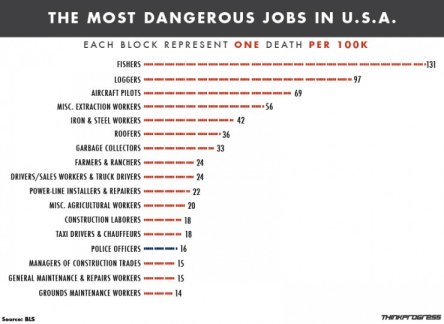
Who has the most dangerous job in the US?

Cp1EedzXYAQejLM.jpg

Indigenous food

I love this article.  I have learned so much about organizing from Native American leaders, about honoring the skills and traditions of the community. Even though some of the most brutal colonialism on the planet has been directed at those on Turtle Island  who have been here for millennia, they continue to offer love and protection to our planet.


As the brilliant Bill McKibben said in his recent piece, The Axis Of Destruction And Hope:

 So in North Dakota, as in the tar sands of Alberta, and at the proposed Cherry point coal port in Washington, and on the pipeline routes in British Columbia, indigenous people are leading the fight against the planet’s destruction. It’s not hyperbole to say that the most important force in the fight for the planet’s survival has been the recognition of native leadership, in North America and elsewhere, in the last five years. The Keystone pipeline would never have been stopped without native organizing, nor plans for the world’s largest coal mine in Australia. The earth’s oldest people are — maybe just in the nick of time — being recognized as its most important protectors. And they need us to stand behind them.


In the NYT article linked below, Sean Sherman’s goals to reclaim First People’s food traditions and share them are outlined:

They were also composed without wheat flour, sugar or dairy — the government-issued commodities that replaced many native foods on reservations more than a century ago. Mr. Sherman avoids them.

This means he does not cook fry bread, the simple deep-fried dough familiar to every tribe in the country. Fry bread was born as a food of survival, developed by ingenious cooks who needed to make the most of flour and lard, and it later became the base of the Indian taco: fry bread under ground beef and toppings like shredded cheese and sour cream….

But Mr. Sherman’s ambitions go beyond dinner service. He hopes his new restaurant can bring jobs into Native American communities, and start careers in the industry. He wants to create a larger demand for Native American-owned food businesses. (He already buys walleye from Red Lake Fishery, and the wild rice he uses is harvested by tribes who live around the lakes of Northern Minnesota.)

In time, Mr. Sherman and Ms. Thompson plan to open a culinary center and school focused on indigenous food systems.

Board recruitment tips

As you’re nominating people for your board, how many times have you heard this advice: “Recruit individuals with fundraising experience.”

Or maybe, “We need people who’ve raised money before.”

Good suggestion, right? Well, maybe not.
From a trainer’s perspective, it’s WAY more productive to work with open minds.

When Recruiting Board Members, Look for a Willingness to Learn

Louisiana Update #4: Telethon for Second Harvest Food Bank: donate at www.no-hunger.org

Louisiana Update #3: Anglers, hunters crucial to rescue efforts

This was also the story after the levee breaks of Katrina; the fishers came into the city and rescued scores of people and were the “eyes on the streets” during those dark days.
During this August 2016 flood, authorities have been overwhelmed and caught by surprise by the force and treachery of the rushing water and forced to wait while fishers who know how to maneuver and how to gauge currents could begin rescues. For example, it was reported on Sunday with hundreds of people trapped on I-12 since Saturday, the Louisiana State Patrol had no water equipment to get past the water on the highway and needed to either wait for other rescuers to arrive or for the water to subside.
Just another reason to honor the rural/urban connection that has been maintained through initiatives like farmers markets.#CajunNavy


Call to arms on social media attracts 60 boats.

Jared Serigne would be the first to admit most of his Facebook interaction doesn’t involve life-or-death matters. The St. Bernard resident uses the social-media forum to share hunting and fishing information with a network of “friends,” many of whom he’s never even met.

But the Hurricane Katrina survivor knew things were going to be different when he signed into the site Saturday morning.

“I woke up and saw one report of people flooded in Zachary, and I knew then it was going to be bad, so I made the decision to go,” Serigne said.

Serigne hitched up his boat, and prepared to kiss his wife and young son goodbye, but before he did, he put up a post on Facebook, letting his friends know his plans.

Within minutes, he was bombarded by messages, texts and emails from close buddies and mere Facebook friends who wanted to join his effort. Many were from St. Bernard, but others from Houma and Thibodaux joined the mission.

In all, Serigne’s call to arms attracted 60 South Louisiana residents willing to tow their boats into a dangerous situation to ease the suffering of their fellow men and women.

nola.com

Louisiana Update #2

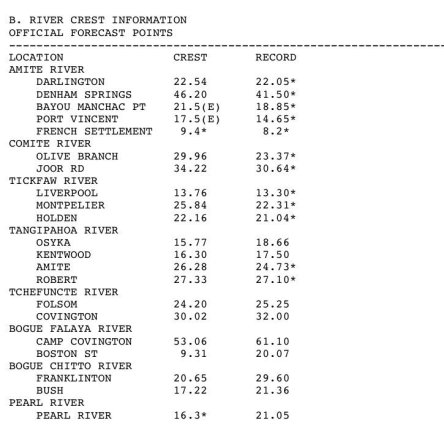
Current crest level and the previous record levels of the rivers in our watershed:Cp6brbwVUAAjtEz.jpg

Mississippi Floods; Update #1

JACKSON, Miss. —The Mississippi Emergency Management Agency said damage reports are coming in on the flooding in southern Mississippi

Greg Flynn, an agency spokesman, said Wilkinson County Emergency Management reported 71 homes damaged by flooding, primarily in the towns of Crosby and Centreville.

Flynn said there are 67 people in a shelter opened in Natchez on Saturday. The Mississippi Department of Human Services and American Red Cross are managing the shelter.

Officials in Amite, Harrison and Pike counties report several roads damaged by the floodwaters.

Flynn said damage assessments conducted by MEMA and local officials are scheduled to begin Monday.

The National Weather Service said southwest Mississippi received over 14 inches of rain late Thursday and Friday.

Louisiana Floods, Update #1

Sunday update from Copper Alvarez, BREADA Executive Director:

Checking in with our Red Stick farmers and Main Street Market folks today — A lot of fields under water but most homes are okay…Keeping Louisiana and the Baton Rouge region in our prayers! 

Support the farms of Louisiana by donating to the BREADA Small Farms Fund.

—————————————————————–

Sunday update from Hammond Farmers Market:
Hello all, from what we’ve heard all of our market family is safe and sound! We hope everyone else is faring well through this crazy time.

Our farmers are all safe, although fields, fences, and feed did not fare so well…If anyone is looking to help out, we are asking for livestock/chicken feed as one of our farms lost everything in the storm.

If you’re interested in donating feed to help our farmers out, please email us at hammondmarket@gmail.com or message us on or FB page.

Everything, no matter how small is appreciated.

-Ashton


—————————————–

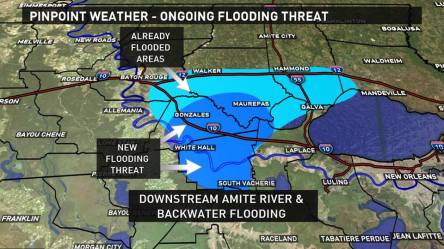
UPDATED: Darker blue shade shows areas that have a new flooding threat from back water off the Amite

14054113_10207271734854784_4775183861359430274_n.jpg


Dear Baton Rouge, New Orleans has your back


Food Price Monitors Needed for First Nations Study

LONGMONT, CO–(Marketwired – August 04, 2016) – First Nations Development Institute (First Nations) is seeking up to 75 people or organizations — located on or near Indian reservations across the U.S. — to monitor and report food prices on a monthly basis over a 12-month period.

Participants each will be paid $500 at the end of the study. Applications are due by 5 p.m. Mountain Time on Thursday, September 8, 2016.

The participants will collect prices on a list of food products sold in Native communities by monitoring their community/reservation grocery outlet, and then report the prices via an online database. First Nations will use the information to update and significantly expand its initial 2015 report titled Indian Country Food Price Index: Exploring Variation in Food Pricing Across Native Communities (a PDF of the report can be downloaded athttp://www.firstnations.org/knowledge-center).

Most reservation consumers believe they pay more for food products than consumers in urban areas, but there is little data on food prices in Native communities to fully substantiate the claim. In 2015, First Nations piloted an attempt to collect food prices in Native communities, and an overview of that effort was documented in the initial Food Price Indexreport mentioned above. That report found that, on average, many food products were more expensive with the exception of some junk foods. Building on this initial effort, First Nations is seeking individuals, organizations or tribes to collect monthly prices in their local community’s retail outlet.

Monthly food prices will be collected on the following food items:

  • Loaf of white bread
  • One pound of ground beef
  • Whole chicken (price per pound)
  • One dozen large eggs
  • One gallon of whole, fortified milk
  • Red delicious apples (price per pound)
  • Pound of tomatoes
  • Coffee (ground, cost per pound) of a common brand such as Folger’s
    • Regular
    • Decaffeinated

Project participants will enter their monthly collected prices into an online database provided by First Nations by the 15th of each month. This data will be analyzed and shared with all project participants. Moreover, at the end of the 12 months, the information will be shared with Indian Country at large via the revised Indian Country Food Price Index report.

The project will begin as soon as all of the participants are selected.

To apply to participate, individuals, organizations or tribes must complete a short online application at this link: https://www.grantrequest.com/SID_1243?SA=SNA&FID=35135. Please note that not everyone who applies will necessarily be selected. The selection process will involve consideration of geographic locations, retail outlets to be monitored and other factors. The online application will ask for information such as name, physical address, tribal affiliation, email address, distance to nearest grocery story, whether the store in located on a reservation, if it’s a tribally-owned outlet, and other similar questions. Reliability and accuracy are highly desired traits in those who will be selected. Applications are due by 5 p.m. Mountain Time on Thursday, September 8, 2016.

About First Nations Development Institute

For 36 years, using a three-pronged strategy of educating grassroots practitioners, advocating for systemic change, and capitalizing Indian communities, First Nations has been working to restore Native American control and culturally-compatible stewardship of the assets they own – be they land, human potential, cultural heritage or natural resources – and to establish new assets for ensuring the long-term vitality of Native American communities. First Nations serves Native American communities throughout the United States. For more information about First Nations, visit www.firstnations.org.

Image Available:http://www.marketwire.com/library/MwGo/2016/8/4/11G109314/Images/Food_Price_Cover_large_500-b61d945bdaab9229896530f92708d1ad.jpg

CONTACT INFORMATION

  • PROGRAM CONTACT:
    Raymond Foxworth, First Nations Vice President of Grantmaking, Development & Communications
    rfoxworth@firstnations.org or (303) 774-7836 x207

    MEDIA CONTACT:
    Randy Blauvelt, First Nations Senior Communications Officer
    rblauvelt@firstnations.org or (303) 774-7836 x213

Timeline: The Most Common Job In Every State

When you see the most common (general category) job in most states now, those of us working on food equity will not be surprised at all.

The jobs picture has changed profoundly since the 1970s. This map shows how those changes played out across the country.

Map: The Most Common* Job In Every State : Planet Money

SNAP videos

Simple, clear and appealing videos on using benefits at markets that can be shared with community centers, sent to targeted social media users and can be used as a banner on news sites too. Bravo Urbana and Fond du Lac!

More about the market

And from Fond du Lac Wisconsin:

More on this market

Taste, sip, learn: Farm to Table Experience

What: A three-day event, with tastings, talks, hands-on workshops, receptions and meals sponsored by the National Farm to Table Alliance, the Louisiana Department of Agriculture and Forestry and the New Orleans Convention Center, which promotes sustainable local farms, food safety as well as supports communication between home cooks, brewers and wine makers as well as chefs and other food professionals and policy makers.

Where: New Orleans Ernest N. Morial Convention Center, 900 Convention Center Blvd.

When: Aug. 18-20.

Ticket price: Half-day registration is $49, full-day $79, two-day $129 and full conference $169. Separate tickets are required for the food and drinks events: The Garden & Glass reception on Aug. 18, $69; the bistro lunches each day, $29; the Lunch & Learn session, Aug. 19 and 20, $49; and the Chefs Taste Challenge Dinner on Aug. 19, start at $129.

F2T website


To register: For all events, except the Chefs Tasting Challenge, visit f2texperience.com, call 504.582.3072 or send an email to info@f2te.com. To register for the Chefs Tasting Challenge, visit chefstastechallenge.com.


NFMW coming soon: are you ready?

USDA Secretary Tom Vilsack officially declared August 7 through August 13, 2016, as the 17th annual National Farmers Market Week, highlighting the key role that farmers markets play in bringing communities together around agriculture.

If you’re a market manager, USDA has resources to help you celebrate. USDA is offering free online National Farmers Market Week graphics and templates to help you customize posters, emails, websites and other promotional materials.  Customizing materials is easy with the help of a short demonstration video. Contact Peter Wood, AMS Public Affairs, for more information at (202) 720-6179 or via email at Peter.wood@ams.usda.gov.


(Also, check out FMC’s lovely and extremely useful NFMW media kit with examples of social media messages and more.)

Learn more about National Farmers Market Week:

 We’re kicking off a campaign where people share their favorite aspect of their farmers markets using the hashtag #marketfav with a photo of their favorite thing about the market.


Additional hashtags:

#LocalIsCool #MyFarmer, #MyRancher, #MyCommunity, #MyLunch, #MyIngredients, #MyProduce, #MyFiddler, #MyInspiration, #MySenses

 Follow AMS Twitter account: https://twitter.com/USDA_AMS

Update or add your markets in USDA’s Farmers Market Directories: http://usdalocalfooddirectories.com