Up next: New Orleans, Vermont, Massachusetts

Over the last ten years, my travel schedule has remained pretty constant in the late winter and spring: a.k.a. farmers market/agricultural conference season. Sometimes it means that I am leaving New Orleans during Carnival season, (or my fav festival event) the Tennessee Williams Literary Festival or just at the loveliest time of year. Still, I am honored to be invited to participate in so many market development workshops and say yes to as many as I can manage.

This year my conference travel has taken me to North Carolina, Atlanta and Illinois and next up are three meetings, two in places I know and love, and one new to me:

New Orleans: AFRI-funded “Indicators for Impact” project team/market pilot sites meeting.

Vermont: NOFA-VT Farmers Market meeting

Massachusetts: Mass Farmers Markets meeting

• In New Orleans, I will serve as the host team member and support the FMC team in presentations, facilitating open discussion among participating markets and in absorbing those markets feedback on their first year of gathering and compiling data. This University of Wisconsin-led research is informing the development of Farmers Market Metrics.

• In Vermont, I return for the 5th or 6th year to support my colleague Erin Buckwalter in her work at NOFA-VT to build capacity for direct marketing outlets and to support VFMA. I’ll be presenting some retail anthropology techniques for markets to consider when refreshing their markets. Sounds like I’ll also be called on to facilitate a open session on EBT issues, which should be helpful to the Center for Agriculture and Food Systems at the Vermont Law School (CAFS). The students are leading the design of a Legal Market Toolkit along with project partners NOFA-VT and FMC. Exciting stuff coming out of this project, I promise.

• Final stop of the season is to one of the most established state associations and to work with one of the longest serving state leaders, Jeff Cole. I remember well that in the formation days of Farmers Market Coalition, our Market Umbrella E.D. always came back from those meetings with great respect for Jeff’s input. Since then, I have called on him to offer analysis in some of my projects (shout out to some of my other informal advisor mainstays: Stacy Miller, Amy Crone, Sarah Blacklin, Ben Burkett, Colleen Donovan, Copper Alvarez, Kelly Verel, Suzanne Briggs, Helena St. Jacques, Richard McCarthy, Beth Knorr, Leslie Schaller, Jean Hamilton, Paul Freedman, Devona Sherwood  along with a whole bunch of others..)   Jeff has asked me to do an overview on market measurement history (RMA, SEED, PPS audits) and recent evolutions like FM Tracks, Demonstrating Value, and of course Farmers Market Metrics.

So, keep yourself busy on other blogs while I sit in meetings, learning and sharing for the next few weeks. And if you are attending any of these meetings, please say hello and share your news or ideas with me. Maybe it’ll be the next best practice that I post on my return to these pages.


EBT and markets: One size does not fit all

A new post from Cathy Curmudgeonly about the Los Angeles opinion scolding markets that don’t offer EBT yet: THIS is the kind of editorial I have long worried about on EBT and markets. It is a piece that ignores many facts and offers a one-sized-fits-all “solution” that is neither. And tells that to a sector that innovated this acceptance of EBT almost on their own, found private partners to fund the existing pilots while all the while absorbing the added time to figure out the first round of this stuff with great enthusiasm. To now be told that we haven’t done enough is almost too much to hear and to remain polite while responding, but I’ll do my best…(And yes, I get that this is one of those backhanded compliments to those markets that are pioneers, applauding their leadership. Backhanded indeed..)
Let me say that I also look forward to the day that all markets can accept every type of currency and offer programs that encourage more healthy food consumption produced by one’s neighbors. I not only encourage it, I actively work towards that day, but the present is far from that moment. I know that because I have worked with hundreds of markets over the last 10 years on this stuff and have learned from seeing their pilots and hearing the feedback received.

The idea that the costs are negligible is mostly incorrect and not really the only issue: First, many markets operate on less than a shoestring for many reasons and have been able to do so because of the simple management structure they adopted to bring producers and eaters together and to use whatever money they raise through stall fees etc towards marketing and offering amenities.
Others have found a way to also keep it pretty simple but to offer some regular pay to a person who is usually working on less hours than they would get at their local Starbucks and maybe even less of an hourly wage, but still passionate about what they do and happily living with roommates and using a bike or public transportation so they can continue to work at a market.
Others (a very small number) have sustained funding and a professional full-time staff. It is the last group that introduced the wireless machines and tokens to the market world back in 2003/2004. That system works fairly well for that type of market, but almost all other market types are still struggling to cover the costs not covered by their state program (and there are costs not covered, no matter how generous it is), or struggling to create a professional reimbursement system that doesn’t endanger their vendors cash flow or add to their own liability as an organization. Really important to mention again that the costs go far beyond the machine and wireless fees. Far beyond those.


To address that point made that an EBT dollar is the same as a regular dollar, it may be best explained as it has been to me by many vendors who actually like the added system:
when the system means waiting weeks for a check and then time to away from the farm to go cash it, the EBT dollar is not the same as the cash dollar. When the eligible goods for each program differ and require that the vendor stop and explain the rules to that new shopper rather than handling 2-3 shoppers at once with bags and a quick answer, the EBT dollar is not the same as the cash dollar in their estimation. Let me repeat- most vendors at markets welcome the chance to get their goods to more people and willingly go along with markets to test these pilots. Still, these are individual businesses with their own reasons for existing and their own unique levels of competency (cultural and professional) for integrating these programs into their business model. The important thing to state here is these are pilots still and require added time and practice to make sure these systems work for everyone.

Now on to that costs are not the only issue to adding machines at the market: The need for agencies and health systems to understand the very sophisticated approach to encouraging fresh fruits and vegetables among at-risk populations that include benefit program users is a much bigger deal than has been addressed by any government policy as of yet. First, “food as medicine” is not as accepted as we’d all like to think. And even when there is an innovative policy written it doesn’t mean it is used correctly by agency staff or works for all. Time after time I have witnessed markets that added the machine, funded the incentives, hired temporary staff for outreach, readied their vendors and the numbers did not come. Some have done some investigation of what happened and concluded that the agencies responsible for assisting with the program either did not understand the market and so poorly translated the program to their client base, or the information about the program did not work its way to those on the front lines working with the clients. Or, their state leaders have a approach to food that borders on zealotry in supporting commodity products while dismissing “specialty crops projects,” therefore leaving many barriers to growth to remain. And yes, some (many) markets have logistical or other issues within that need to be addressed, but do not have the staff time nor the embedded skills to do so.

This doesn’t even raise some of the other external barriers that markets face like connectivity issues for internet, constant changes in the available technology, parking woes, lack of public transportation, effects of climate change on their seasonal products, production economies of scale, hours and location issues, byzantine rules at every level of government, industrial food co-opting our message without adopting our values, a very different pricing system that offers the best deals on those incredible items at the very height of season with value-added items often at the middle to higher end of the spectrum, which is the opposite of most other food retail… Those issues surely hamper shoppers of every socio-economic strata, but they severely impact the addition of those at the bottom rung of our capitalist system. Those at the bottom rung of the economic ladder are also hampered by those issues reserved mostly for them: working more and often the hours no one else wants, no access to private vehicles or child care, poor health, all of which lead to civic disconnect; in fact, almost every part of their lives discourages their participation in farmers markets and other healthy activities. Yet even with those barriers and perception issues, we have added millions of those shoppers in the last 10 + years and we soldier on, to happily lead the march to good food for all, focused on the day when all markets are connected to every system and can manage them successfully. So don’t lambast us for making sure we do it right and instead, spend that effort now used for tsk-tsking our sector on addressing the other systemic issues still in play. We’d appreciate the help.


An example of one such type
Plant-Based Foods Go To Washington

… with the launch today (March 7) of the Plant Based Foods Association, a new collective voice is set to join the fray. Organized by its executive director, food and public health attorney Michele Simon, the group’s goals will be similar to those of its animal-based counterparts: public education, media outreach, and lobbying—only in this case it will seek to change the policies that put eggs, meat, and dairy front and center.

“The deck is stacked against plant-based foods because they cost more and people can’t find them,” Simon told Quartz. The new association, she says, is aimed at “leveling the playing field.” To do that, the organization will educate retailers and foodservice companies about these products, Simon says, and it has hired Elizabeth Kucinich, who previously served as policy director at the Center for Food Safety and as director of government affairs at the Physicians Committee for Responsible Medicine, to represent the group in Washington as its policy and partnerships consultant. (Kucinich is the wife of ex-congressman and former presidential candidate Dennis Kucinich, and she helped form the Congressional Vegetarian Staff Association.)

You may  know Michele as the author of the excellent report: Food Stamps: Follow the Money, and the book Appetite for Profit: How the Food Industry Undermines Our Health and How to Fight Back and as president of Eat Drink Politics, a watchdog consulting group.


This is going to be helpful to food advocates to have this focus  in D.C.


See an American town that’s about to be completely lost to climate change.

The Jean Charles band of Biloxi-Chitimacha-Choctaw lived in the same place for more than 200 years. But now it’s almost entirely washed away.

By the middle of the 20th century, there were nearly 400 people living on the island. At that point, the land was 11 miles long and five miles wide — providing this Biloxi-Chitimacha-Choctaw tribe with 55 square miles of lush, open land on which to hunt, farm, and thrive.

But all that’s left today is a half square mile of marshland — two miles long and a quarter-mile wide — with two dozen families struggling to survive. The island’s remaining residents still speak their own colloquial French-Cajun dialect and work as fishermen, oystermen, and fur trappers to survive. But ecological damage has made that work hard to come by too.


Food companies distort nutrition science says Nestle

…So Nestle decided to document the problem: On her blog, Food Politics, she began tracking all the industry-funded food and nutrition research she came across, paying particular attention to the number of studies that had positive results (i.e., favoring the funder).

Her findings so far are remarkable. Of the 152 industry-funded studies she has examined, 140 boast results that favor the funder. That’s more than 90 percent.


Source: Food companies distort nutrition science. Here’s how to stop them. – Vox

Fondy Food Center’s executive director, Young Kim, departs

A great guy and a first-class leader in food systems who deserves kudos for his long service to this organization. Young was also the principled, fearless and fair Board President for CFSC while I served as its V.P. (due to his request) near the end of its long life; in those last difficult days we all grew to admire him a great deal.  I’ve expected this news (just based on the number of years he has held this demanding job!) but still am hopeful he continues in other food system work, maybe working one with a regional or national focus this time around.

Young Kim, who has been the executive director of the Fondy Food Center and directed its farmers market since 2003, has left the north side organization.

Source: Fondy Food Center’s executive director, Young Kim, departs

West Side Market adds another day… …and some disagreement

This slideshow requires JavaScript.

As many of my readers know, I spent my early years in the west suburbs of Cleveland. Like many of us, I occasionally trucked over to the West Side Market to buy special items or to soak up the atmosphere-actually, maybe the right word is rarely.

Luckily for me, I moved to the nearby Tremont neighborhood while a poor community organizer in the 1980s and 1990s and had more access to the market. My friends and I used the market quite regularly, as without it gas stations and a very dirty grocery store many dangerous blocks from us were our available shopping outlets. As we became regulars, many of the WSM vendors shared their end of day produce with us at a lower price or even threw in some items with our purchase. Later on, my nephew worked there while a teenager with a pal of my sister’s and since he had to be at work in the pre-dawn hours on the weekends moving meat up and down the stairs, now knows what hard work looks and feels like.

So for those reasons I keep up on the news from this market so closely and why changes to it remain deeply personal to me. The changes that are being made, like paid parking and more days open, sound like they are to support the nearby businesses around the market more than those within the market- not that there is anything inherently wrong with that, just that it seems like the city is mostly responding to external pressures. I will say however, that for a public market to be closed on Sundays has always surprised me. I’d have preferred to see Mondays and Tuesdays as their dark days.

Achieving balance between the needs of the neighborhood and of the vendors and shoppers is the most important task and, as any market organizer knows, is a delicate dance. Some of the comments in these articles from the vendors are implying a purely political reason for this change, others are willing to believe this is a good marketing idea in a constantly changing retail environment while still others are intractable in not changing the tradition of Sunday hours and even believe that it will only dilute Saturdays sales. (That may very well be a valid point that I will of course answer with they should be collecting data on their shoppers to know and be able to answer that question.) Shoppers’ opinions tend to line up on more days are better, which is certainly understandable. The parking woes that exist currently for shoppers are likely a large reason for people staying away and so more days open may solve that issue temporarily, but probably not permanently.

I think what is missing in the announcements is the clear plan for this market and for these vendors by the management and advisors. Is the WSM becoming part of the cafe/entertainment culture that has grown up around it and therefore expected to primarily serve it? Or is the WSM part of the robust local food culture in Cleveland and meant to align itself with those values? Or do the operators see the WSM as an anchor for small business in and of itself?

As a traditional shed market, a primary purpose must be defined and acted upon in their decision-making process because unlike pop up (open-air) markets, it cannot move and/or redefine itself easily. It must constantly draw people to its bulk through changing times and offer enough regular return to those permanent stall vendors who have also invested in shared infrastructure.

How this change was handled in Cincinnati at the Findlay Market  a few years back seemed unfortunate and led to a very public argument that meant the market had some bad vibes around it for a little while, but indications show that the changes there may have helped their growth. However, it is important to recognize that the entire area around Findlay is seeing increased vibrancy with millennials and urbanists repopulating  OTR and downtown and so this success may have little to do with its added hours. I do think the management and supporters did some great work supporting that expansion.

Certainly, there it is difficult or even impossible to achieve full agreement for almost any decision made by a market organization, but collecting data and using it to redefine the market’s mission and understand its context historically, now and for the future will help make the right decision clearer.

And yes, I’ll shop on Sundays rather than Saturdays whenever I am back in Cleveland to leave my Saturdays for the direct marketing farmers markets around town.

http://www.cleveland.com/business/index.ssf/2016/03/west_side_market_will_add_sund.html

http://www.cleveland.com/business/index.ssf/2010/10/changes_considered_for_histori.html

2016 FSMA 

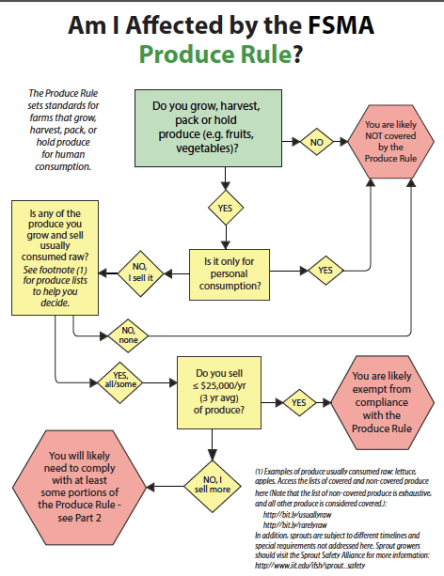
The U.S. Food and Drug Administration (FDA) recently finalized two new food safety rules, the Preventive Controls Rule and the Produce Safety Rule, under the Food Safety Modernization Act (FSMA). These rules establish new requirements for farms and food businesses, with different levels of compliance based on operation type and size. In order to help farmers and food businesses navigate the new federal food safety requirements, the National Sustainable Agriculture Coalition (NSAC) has released an updated version of our “Am I Affected?” FSMA flowchart.

Originally created during the FSMA proposed rulemaking stage, the flowchart has now been modified to reflect the final versions of the rule governing produce farms (the Produce Rule) and the rule governing food-processing facilities (the Preventive Controls Rule).

FSMAFlowP1

Source: See entire 2016 FSMA flowchart

The Seasons on Henry’s Farm

The first full morning back in town after my trip to the IFMA conference was satisfyingly spent on actual labor: helping my pals at Crescent City Books get the store moved to the new location by shelving their cooking and gardening sections. Afterwards, I came back to the Quarter to make a pizza with as many farmers market ingredients as could be crammed on, sided by local ale and all to be enjoyed in the sunny and warm courtyard. As background music from the drums and horns of the pickup band always working for tourists dollars in Jackson Square wafted over the wall, I continued to read a wonderful farming book authored by Terra Brockman, founder of The Land Connection, Illinois family farmhand, and clearly, top-notch writer.

safe_image

I met Terra a few years back at the first IFMA-led Illinois farmers market conference and found her to be one of those doers who think with absolute clarity about the ecological and human impacts of the industrial agricultural age. That type of intellect,  paired with that determined pioneer spirit for building logical new systems, is always encouraging to find in one’s colleagues. I knew that since that conference she had put TLC in other capable hands (as I saw through their presentations and available materials at this year’s conference) and had herself gone back to working with her family farm and written this highly regarded book. So, I was pleased to see it available for purchase at the TLC table this year.

If you want to know what it it means for a direct-marketing family farm in a commodity state to live and work in service to their land and its seasons, as well as to their ancestors and their present community, I suggest you pick up her book, “The Seasons on Henry’s Farm.” It is absorbing, beautifully written and organized to give you a snapshot of the life of a farm, season by season, plant by plant, decision by decision. Like any good farmer, any talk of the food being grown also includes recipes and the ones in the book are so good that I dogeared almost every page with one. I think it should be required reading for every grower, marketgoer, market manager and every municipal and regional leader. In other words, everyone interested in food sovereignty and those influencing its future.

http://www.brockmanfamilyfarming.com/terras-writings

Securing or Expanding Your State Cottage Food Law 

BY far, the most visited posts on this blog over the last two years have been those on cottage food laws. As someone who ran markets in a city/state with byzantine rules and a total lack of clarity for producers, I was gratified when a cottage producer took it upon herself to push for such a law in Louisiana, following recent adoption of one in neighboring Mississippi. That law had been championed by a task force headed ( I believe) by a researcher from Harvard.

Markets can help this process even when not leading it by maintaining and sharing their internal process for inspections, permits and on-site pricing/labeling rules with those advocates working to begin or expand their cottage food laws.

In addition, markets can collect qualitative data through Marker Surveys (allowing them to write a quote on the sheet) from shoppers about how they feel about the short chain system that relies on the deep and regular relationship they have in their markets and then to share those stories with those advocates.

In addition, I’d be happy to share the template of the mystery chef project that I employed at my markets which encouraged selected market community members to purchase products already at market and gave a written  assessment on the taste, display and labeling of that product. That assessment was sent via postcard to the vendor via mail and a copy was put into their file. The most common result was a positive assessment and so we also encouraged them to display the postcard at their table if they wished. Send me an email to dar wolnik at gmail if you want me to send you that template-that is if I can find it. Additionally, the other piece of that system was the mystery shopper surveys that we also created; one of the templates is available on the http://www.marketumbrella.org site on their Marketshare page. All it requires is the creation of a free log in and password to see all of the resources they offer on their page.

Here are the results from my posts about cottage food laws; and the link below leads to a very good framework for those states (or cities or counties) to plan or expand their own systems: Securing or Expanding Your State Cottage Food Law – Real Food – MOTHER EARTH NEWS

Downtown development leaves Crescent City Farmers Market searching for new home new

The Saturday morning market has been at Magazine and Girod streets for 20 years but is being displaced by a new development.

Unfortunately,this sort of situation is happening across the US, even with markets that have been diligent about making the case for their space. Here is some of the anecdotal background I learned when I joined the organization in 2001 and some that I experienced in my decade there.

When this location was chosen more than 20 years ago, the neighborhood was somnolent and even slightly sketchy. Some of the supporters were concerned about the supposed danger and even advocated for security to be on site every Saturday. Yet, the lack of attention is partly why the founders chose the location. That underused space would allow them to grow as needed in the first few years without too much intrusion on residential areas and could illustrate how markets were social spaces as well as economic drivers for the community. The use of the inside parking area made it especially appealing and allowed for the market to be bustling even when raining.  And of course, security staff was never needed.

As the market grew in size and attention, the founders made another decision: instead of expanding the space into the street or searching for larger spaces to host the Saturday market, the organization opened other markets in other locations, determined to serve as many neighborhoods as possible.  In the spring of 2000, Market Umbrella opened the Tuesday market Uptown which drew weekday shoppers who rarely made the Saturday market. That Uptown market also allowed senior centers and community centers to become partners as they could shuttle their clients to a regular market while they had staff to drive them and could use their new FMNP coupons (the market started around the time when the Senior FMNP began in Louisiana). The Saturday market however, continued to draw residents from across the city and was packed from end to end from the opening bell at 8 am ’til the closing bell at 12 noon.The owners of the lot even built a small permanent toilet for the market and repaired the roof of the indoor space.

In 2003, Market Umbrella added “Festivus, the Holiday Market for the Rest of Us” a fair-trade locally made craft market, held for three days every December next to the Saturday market.  Market Umbrella offered this non-food, pop up market as another way to animate the location and as a way to increase sales at the usually quiet December farmers market. Festivus was a success, drawing 2000 or more shoppers on most of its days, many of whom had never made it to the Saturday market before Festivus.

Even in 2005, Festivus was held for one post-Katrina day on December 10th; that highly successful market day also brought a never-ending succession of long-time CCFM shoppers asking when the market would return to the location. (CCFM was open as of November 22, 2005 but only at the Tuesday location uptown. The original location would return in March of 2006.)

Four or five years after the market opened,  the neighborhood added a major amenity: the D-Day museum opened down the street and quickly grew in size. That museum has added a series of regular weekend events and significant tourism to the corridor (and is now named the National World War 2 Museum) which has had both a positive and a negative affect on the market. It has been joined by  the Ogden Museum, and in the last few years, significant residential  development as well as blocks of retail and even a full-sized grocery store have been added to this old warehouse and office building area.

With all of that new activity, the reality may be that the market should have expected it would need a new location and begin to plan for it long ago. In other words, open-air farmers markets that operate on a handshake and disappear from sight as soon as the bell rings at the end of the market may need to seek out new underused space once enough permanent development becomes attracted to the space originally animated by the market. Or,  it may mean that flagship markets that are determined to stay in their original space may have to do a capital campaign to build some sort of permanent infrastructure and still may expect they have to negotiate for parking, event space and attention, which would require added staff savvy in lobbying and in working with neighborhood groups and developers. Either way, it seems to show the need for strategic planning and constant communication about location at a very early stage of market development.

CCFM has started to search for its new location and hopes to stay near to the original area. However it may not be possible, given the new demand. Either way, Market Umbrella has a new future in store.


What may also be helpful is for markets to do a location scan every five years,  checking in on the changes in the market area and maintaining an eye out for other locations. Source: Downtown development leaves Crescent City Farmers Market searching for new home | NOLA.com

NYT writer: seasonality? bah humbug!


A ridiculous and myopic piece from a writer in the NYT this week is attached to this post at bottom. Her argument is that seasonal and local are out of touch and at odds with good eating and for her Manhattan restaurant. Notwithstanding the lack of awareness of the value in supporting farmers in order to increase production in one’s region, the use of terms like “forces of snobbery” without backing it up with evidence of it instead show that she is herself employing that very idea. Farmers markets and the producers in them have made her “brand” even possible which she ignores in this piece.

Add to that her lack of awareness about the extension of seasonality of producer through innovative farming techniques by small-scaled producers and supportive agricultural advocates indicates that her ignorance is massive. On top of those now extended seasons, our past generations canned and stored food throughout the non-growing season to keep it available and those techniques are not only still available to us but better and easier than ever to employ; instead she believes we should instead wait for our food to come via truck from far away simply because that is the modern world and a “beautiful thing.” As for the ‘post-seasonal”world she likes to live in, how about talking about the chemicals and processes needed to pick food thousands of miles away to have on shelves in the Midwest?

I’d like to see swift rebuke from the community to this person, and some education offered to her to teach her how items like regionally produced winter tomatoes are largely available in every area, how citrus can be and is grown outside of Florida and California, how garlic, grapes, oils and more are possible in many other areas too and how farmers markets are the main engine behind increasing production and access to healthy and tasty food that is competitively priced and often incentivized. THAT work is creating the “demand”that she asks for and relies on for her own location-based business. Lastly, let me also offer my opinion that the NYT has recently become the paper of hysterical food nonsense which does not do The Gray Lady credit.  How about cutting down on the hyperbole about local food and instead report on the actual data of our field made up of small businesses and public policy all designed to increase healthy living for all.

Amanda Cohen, the Dirt Candy chef and owner, satisfies a craving and proves that even tomatoes don’t have to be eaten in season to taste good.
NYTIMES.COM|BY AMANDA COHEN

NOLa ‘food port’ Roux Carré opened Nov. 27 

I’m a big fan of the entity that operates this project in Central City. What is interesting on a sytem level is that, just like another neighborhood in town, there are actually two different projects focused on food access there. (In the other neighborhood you can view St. Roch Market and Mardi Gras Zone to see what I mean. And compare the NOLA Food Coop for good measure, as all three are within 8-9 blocks of each other.)

On OCH, the Roux Carre project shares the street with another project that I wrote of recently, the Dryades Public Market. On paper, it might seem that these two have a lot in common, but in reality I think how they were formed, and by whom and what items they sell are quite different. I plan on spending some time there this month to check them both out and will post some pictures.

And how do you like the term “food port”?

Caribbean, Latin and Southern-inspired food court on Oretha Castle Haley Boulevard

Each vendor has a 175-square-foot “pod” to set up its operation, and a retractable window opens into the space from where they can sell their food. A large, industrial-size communal kitchen includes ovens, a flat grill, stoves and prep space and storage.

By getting low-cost and low-overhead entry, aspiring restaurant owners are able to build a following for their food while receiving training in food service, retailing, accounting and payroll. There is no limit to how long a vendor may stay at the location, although Cassidy suspects most want to take off on their own eventually.

“It’s really an incubator for these small businesses,” Cassidy says. “They’re all really good cooks; we want them to learn how to really run a restaurant, so, if they want, they can leave here and do that.”

Source: Central City ‘food port’ Roux Carré opens Nov. 27 | Blog of New Orleans | Gambit – New Orleans News and Entertainment