Better Health for Food Deserts: Are Mobile Farmers Markets the Answer? | Health on GOOD

Thanks to new NYC friends Anna and Manuel of Zago for sending this. Whenever I see an article on mobile markets, a few questions immediately come to mind, here are some in no particular order:

• How can people use these initiatives to leverage good food coming into their area more regularly? Has there been an example of a mobile truck initiative that led to food security? It would seem to me that if paired with some other food and social initiatives either in concert or in succession, this might be a powerful tool.

• Has anyone figured out a good business model yet? I believe that there is one out there, yes have not read of it yet.
Possibly using it as a simultaneous delivery mechanism for middle or upper income food orders might help offset the costs.
Or maybe mobile trucks can be a meal service that offers healthy food also as healthy prepared meals sent out just before and during non-traditional meal times (for those working people with typically odd work schedules) at low prices, along with some information. Sort of a combination of the food truck with the mobile market.
Or one of those ideas on our “someday” list at my last organization in New Orleans-to create a “useful” mobile market with non-food items like paper products, juice, simple hardware items etc along with those food items.

• Along those lines, is this type of thing best used as a temporal idea that to begin to promote good food and to gather initial data to then get the area to the next more permanent idea or is there a long term strategy as to their use?

• Finally, when farmers sell to these outlets, does it increase their reach or decrease it? In other words, have farmers begun to grow or make products just for these endeavors or are they taking products from other outlets? And if they have added this to their sales reach, is it financially viable for them to do so? And from the standpoint of the organizers, are many of these using their very mobility to share gleaned or seconds from those market farmers that these mobile trucks can reach easily and in some quantity on market day?

or as Manuel eloquently wrote in the conversation we had via email around this topic:
One of the biggest challenges for me when thinking about scale and community, especially when thinking about underserved urban populations, is the problem of density and offerings. The smaller and more challenged the environment the more difficult is to build volume, presence and relevance.

YES.

I look forward to the continuing conversation around this idea and connecting these initiatives to market organizations whenever applicable.

Better Health for Food Deserts: Are Mobile Farmers Markets the Answer? | Health on GOOD.

Sysco to buy US Foods for about $3.5 billion

Feel free to read the details of the press release closely and notice how the deal is trumpeted as a way to cut costs for the companies involved and nothing about their “product” quality.

“Restaurants and other customers tend to want more than one supplier, and Mr. Delaney acknowledged that the merger could cause customers who use both Sysco and US Foods to go elsewhere for some of their products. “In our model, we have factored in that risk,” Mr. Delaney said. “We have been a little more conservative on our sales growth for the first couple years…but we are going to do everything we can to minimize customer flight.”

And this of course:

Sysco estimates the combined company will have about 25% of the U.S. food distribution market, up from about 18% now for Sysco alone.

WSJ

Turning up the voice of America – Comment – Voices – The Independent

I have been thinking we need a weekly radio call in radio show for farmers and shoppers and organizers to discuss food and farming just as we often do at farmers markets locally.
Maybe it should be on AM radio?

“… AM, which is simpler and cheaper, is of special value to minority broadcasters. No less important, it really comes into its own during an emergency. Ice storms, tornadoes and hurricanes can knock out power and mobile networks, but not battery-operated radios. AM signals travel further too, enabling a greater number of people to keep in touch. Most importantly of all, the AM industry has one supporter that really matters – the FCC, the federal agency that regulates radio, television and cable.

Last month, the FCC published various proposals to revitalise AM radio. They include looser limits on transmitter power at night and an end to regulations that made it difficult to install new equipment. AM stations will also be allowed to use spare slots on the FM spectrum to boost reception in urban areas. If they work, every devotee of driving around America will raise his voice in thanks.

Turning up the voice of America – Comment – Voices – The Independent.

Adult Obesity Ranking

2030-adult-obesity-ranking

Egads.

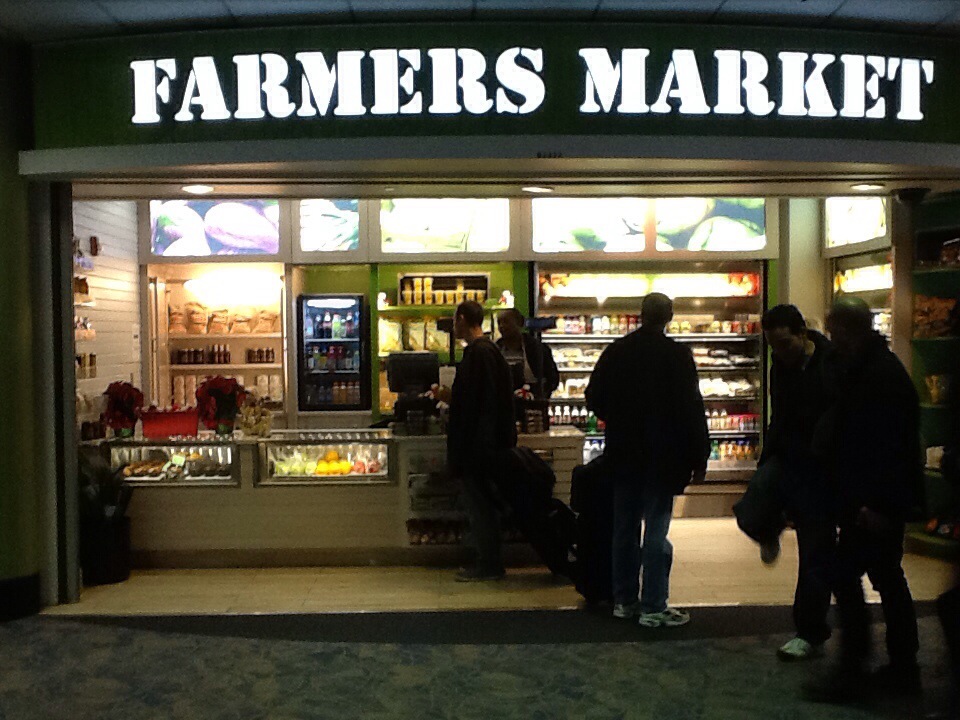
This picture is for anyone that believes that we have effectively gotten our message of how farmers markets stand for local and direct across to the other 97% of America. Clearly, we need to keep on defining our message so as not to be co-opted completely. This, by the way, is the Charlotte, NC airport.

20131202-101107.jpg

Watershed organizing

I believe this is a necessary layer of food sovereignty organizing.

“As Lavey writes in a post on the Community Builders website, the map raises all sorts of questions about the way we have developed our population centers:

If states were organized around watershed and the idea that water should be used efficiently, then that conservation ethic could also have taken root in the way places were built. Recognizing that it is both fiscally unwise and squandering of agricultural/open space, towns may have grown up with a more compact, mixed use form because of their performance relative to those two benchmarks.”
http://nextcity.org/watermark/entry/what-if-states-had-developed-around-watersheds

Why Urban States Need Their Rural Counties

Although this article was ostensibly about the different secession movements afoot, it is also uses the rural/urban context for the argument that the red/blue divide has to be bridged more often before it gets worse. One place that has happened is in farmers markets and on farms where both groups often interact to access what they deem as healthy or culturally accurate foods. This means that it is crucial for market organizers to think of their pop up town square as a “no politics” zone where libertarians can meet anarchists and yellow dog Democrats and Tea Partying Republicans can hold spaces in line for each other and ultimately, find some common ground on Saturday morning. It is just as important that market organizers balance the needs of their urban or peri-urban shoppers/farmers with those of their rural farmers and vice versa and as important that rural farmers markets find ways to link with their urban peers to change policy or to add benefits to gain new shoppers. Why Urban States Need Their Rural Counties – Emily Badger – The Atlantic Cities.

At Alcatraz Island’s Thanksgiving Day, the native spirit lives on

By Eliza Strickland, East Bay Express

Do you know where you’ll be at 6:59 a.m. on Thanksgiving morning, as the sun rises over the eastern hills and paints the bay pink? Sure, you could be in bed, visions of turkey and stuffing dancing through your head. But if you crave spiritual nourishment to start the day, join like-minded folks for the Sunrise Gathering on Alcatraz Island, organized by the International Indian Treaty Council. It’s both a rallying point for Indians of the Bay Area and beyond, and a moment when others can express their solidarity with native people. “It’s a gathering to offer thanks, in our way, for the survival of our indigenous nations on this hemisphere in the face of genocide,” says Andrea Carmen, the treaty council’s executive director. The morning’s events include dances by both California Pomo Indians and Aztecs, and a prayer to the rising sun as the first rays hit the island.

Brave souls have been congregating at Fisherman’s Wharf in San Francisco for the early morning boat trip for over thirty years now. In its earlier years, the event was called Unthanksgiving Day and had a more confrontational tenor. It was an explicit rebuttal, Carmen says, to the grade-school construction-paper picture of Pilgrims and Indians sitting down together and happily swapping maize recipes. “That’s not what happened, and we know it,” she says. Over time, the organizers have adopted a more positive tone. “The message of Unthanksgiving doesn’t convey the true feeling of indigenous people,” Carmen says, “which is to give thanks every day for our survival, and the survival of the natural world, and the courage of our ancestors who fought and struggled and resisted to keep our culture alive for us.

Give the gift of the Farmers Market Coalition to your favorite market or farmer

Use the link below to donate today or to gift a membership to your favorite market. FMC membership offers your market’s organizers and farmers access to tools, programs, and support networks that will help your market thrive, and give it a voice in the national food dialogue.

Farmers Market Coalition.

A Grocery Store That Takes ‘Local Food’ to Its Logical Extreme – Bonnie Tsui – The Atlantic Cities

YES.
I think this “less waste and more uses” of local food is exactly what it will take for a small store to re-imagine itself as a source of healthy food. To simply move itself into local sourcing through distributors is not going to be enough. Stores like the Saxapahaw grocery outside of Raleigh Durham are also taking the closed loop seriously and combining gourmet takeout and diverse food stuffs with nearby local sourcing so that even the scraps go back to the animals and compost heaps that supply their store.
I’m still not sure the business plan is completely figured out, but it will certainly help these stores bottom lines to be more waste conscious and to build nearby farms and cottage industries to supply their shelves.

A Grocery Store That Takes 'Local Food' to Its Logical Extreme – Bonnie Tsui – The Atlantic Cities.

New Market Umbrella Director hired

Since Richard McCarthy left in January to take over as Slow Food USA director, the board has been diligently searching for a new executive director for the New Orleans-based farmers market organization. They have found a new director who has long worked in the public health sector in the city on food access, pedestrian and bicycling issues, among many other healthy living projects.
It’s always interesting when a market moves from its founder to the next generation; the market community will certainly be working for a smooth transition and I am sure the new leadership will be very attuned to that fact.
Let the new day begin!

http://www.nola.com/food/index.ssf/2013/11/new_executive_director_is_name.html

Are YOU The Next BALLE Fellow?

Even if you missed the webinar, there are still many ways to learn more about this excellent organization and this opportunity.

BALLE
 
FREE Webinar!  
BALLE Local Economy Fellowship Info Session
Tuesday, November 12, 2013 | 10am PDT/1pm EST

BALLE FellowshipThe search for the 2014-2015 BALLE Local Economy Fellows has officially begun!  Join Christine Ageton and Leanne Krueger-Braneky, BALLE Directors of Fellowship and Alumni, to learn about the only Fellowship program dedicated solely to advancing the local economy movement and how YOU can become the next BALLE Local Economy Fellow.  Deadline for applications is December 15, 2013.  Read More

Where other programs focus on individual social entrepreneurs trying to scale single enterprises, the BALLE Fellowship focuses on local economy connectors – people who each represent, convene, and influence communities of hundreds of community entrepreneurs. This is an incredible opportunity for top innovators to connect with their peers, strengthen their capacity for transformative personal and community change, and help reshape local economies across North America. 

To get the most of out this webinar, please review information on the Fellowship, watch this brief video, and download your application prior to the session.  

Topics covered include:

  • Why the BALLE Local Economy Fellowship is so unique;
  • Common criteria for applicants and the application process;
  • Stories of community impact from our Alumni and existing Fellows;
  • Time for Q&A
RegisterButton


Vitality in the hive

Colorful Texan Agriculture Commissioner Jim Hightower said it best:
“For me, however, the true measure of a town’s vitality comes down to whether it has three non-corporate essentials: a vibrant farmer’s market, a good local pub (or a coffeehouse), and an independent community-based bookstore.”

When I heard that more than a few years back, I thought how true that was and back then, how rare. These days, it seems more likely to find this combination in my travels. Of course, my travels are most often to those places with emerging community food systems, especially farmers markets. But still, it is the combination of these local places that is really important in his assessment and that combination may actually point to indicators of success for those farmers markets.

For example last week, I was sitting in Durham, North Carolina at an excellent coffeehouse, having walked passed a small locally owned/locally sourcing restaurant a few doors down that my airbnb.com host spoke of proudly. While there, my Carrboro pals Sarah and Ben took me to many meals with artisanal specials also locally sourced and then for the same for after dinner cocktails. They debated a number of choices for both quality and level of seasonality in the food and drink and although Durham is still emerging as successful walkable downtown/ neighborhood destinations, there were clearly options. And if you asked people in any of these places if there is a regular farmers market, my experience tells me that most would be able to tell me where and when the Durham Farmers Market happens.

What begets what? Does the market reach a point in its history where its stability and its steady curation of local joie de vivre and talents gives other entrepreneurs the courage to chance riskier ideas and to plant their fair own trade or worker owned or other flag firmly in their ground?
Or is it the market itself that is the main beneficiary of an increase of artisans and localvores in more places around its town and to give its vendors and shoppers the additional comfort and approval to keep on with their work?

I wish more markets were ready to measure their own success and that once ready, would add this indicator: counting the ancillary businesses and fellow artisans whose values align with their local farmers market and asking them to detail how they and their shoppers depend on each other and support each other. To me that success measure data might be best illustrated with those folks as honeybees pollinating their ecosystem, building its diversity and resilience.