What is…Dollars for Doers?

What is…Dollars for Doers?.

I’m Farming and I Grow It

here it is. if you hadn’t heard about it before, now you can show how cool you are.

Office Buildings Add Cash Crops To Their Balance Sheet

From | Co.Exist: World changing ideas and innovation
As those who have met me know, I am determined to see year-round growing (and of course, year-round farmers markets) in every part of North America. When I say that in cold climes, people quickly counter with “”well, you can’t grow here in the winter”, and so I am usually ready with my regular reply: ‘well, someone USED to grow (or can or pickle or hunt) in the winter; are you SURE you can’t?”
Technology is not always the enemy of farming. And in some cases, offbeat ideas have furthered agriculture much more quickly than would have happened without them. Michael Pollan raises that theory in his classic book “The Botany of Desire” with his chapter on marijuana growing. He contends that hydroponics and greenhouse technology was greatly aided by the innovative and yes illegal activities of growers in the Nordic countries in the 1970s. Think of the seed-saving, the homemade lighting systems, watering systems and precise cultivation that now aids farmers growing lettuces, tomatoes and hundreds of other food crops.
With the amount of energy and infrastructure available to urban growers, it makes sense to me that most of them should attempt different farming systems than the rural or exurban farmers who have access to acreage to rotate crops and diverse landscapes. Farming in or on a building seems like a no-brainer as far as what is available. And look folks- this project is starting in Montreal and coming soon to a Northern urban city in the U.S. probably near you.

4 | Office Buildings Add Cash Crops To Their Balance Sheet | Co.Exist: World changing ideas and innovation.

Reclaiming Our Food book review

Reclaiming Our Food: How the Grassroots Food Movement Is Changing the Way We EatReclaiming Our Food: How the Grassroots Food Movement Is Changing the Way We Eat by Tanya Cobb Denckla
My rating: 5 of 5 stars

Useful book that shows a multitude of approaches to building food system pieces, especially garden projects. The stories are well written and best of all, they are followed by a description of the organizing techniques each used for their project.
Easy to pick up and read a profile and then put aside and get something done yourself. Highly recommended for food organizers and city activists.

View all my reviews

Anti

Below, find an article about an anti-local author from Canada, of all places. Never forget these folks are out there, writing and speaking to other academics and a few decision-makers too.

My feeling is that these are the same type of folks who told us that nuclear power would be “too cheap to meter”, that global weather instability was “bad science’, that health care insurers know more than we do about costs and so on. A healthy suspicion of energetic movements is fine, but to limit food movements to upper middle class foodies buying fancy items is a short view of the many outcomes that come from alternative food systems. What about (to name just a few) healthier menus, soil reclamation, farmer generation, multi-cultural mapping, seasonal food increase, smarter regional planning, more public edible or low-water usage landscaping, biodiversity education, seed-saving, mental health projects, child health, social cohesion, geographical awareness?

What also occurs to me is he seem blissfully unaware that he views industrial ag as having the purpose of being for all when it is actually only for profit-making corporations. And then argues that food activists (“locavores” as he terms us) only want better food for their class and ignore the “realities” of the social woes in the larger system. I laugh aloud when I see or hear this, as I know that many, many food activists came to it from other social movements because they know it is a necessary approach for every system, whether we are talking about education, childcare, aging, anti-racism, environmental issues, immigrant reform, healthcare and so on.

Unfortunately, often we play into hands such as these with our gorgeous color photos of someone carrying a root vegetable who looks like they’re from upper-class middle America (read young, trim white person in overalls with white teeth and skin smiling from the cover of the report who tell us inside about their transformation from college kid to new farmer as they work in some “underserved” area) rather than reporting a before and after of what health crisis our citizens have saved themselves from by turning to human-scaled sustainable agriculture.
Stories should abound of activists who came to this to reclaim their health from their own degenerative medical conditions, or of those who lost the last of the soil on their farm or those who use it to engage multi-cultural communities. Or of communities organizing around cultural assets to create true wealth, and it just so happens that those assets happen to be food based.
Actually, I don’t worry too much about these writers. I don’t worry that much because I know that those we have already reached with our message so far have taken the time to consider the alternatives, so won’t be easily swayed. The audience for writers such as these may therefore even smaller than ours! And most of those who haven’t joined the good food revolution yet aren’t reading academics like this.
But as I said at the beginning, for some policymakers, this argument would be appealing. After all, inertia is an easy thing to allow. And I know that brands are powerful: there are people among us that remember being called: 1950s “reds”, 1960s “dirty hippies”, 1970s and 1980s “tree-huggers”, 1990s “angry queers” and so on. Smart people; they turned those tables and labels to their advantage and still made change in their time. Let’s do the same here. Gather data on your impact and share it widely. It’s the best way to silence the Chicken Littles of the industrial world.

Grist

New Agtivist: Jenga Mwendo grows community in New Orleans | Grist

I met Jenga when she assisted Sankofa Community Development Corporation with the beginnings of what became the Sankofa Farmers Market. That market is in its third iteration now but still, is the only other farmers market besides Crescent City Farmers Market’s three that exists in New Orleans. I know- only 4 in New Orleans? It seems hard to believe…
She struck me then as a serious yet warm young woman who was committed to her community’s health and to leading the good health and well-being of her own family. In other words, I liked her immediately and expected great things.
What she represents in the lower 9 is almost unfathomable to many Americans-one person who is spending her life helping her small, struggling community without any real gain to herself.And doing it in small, quiet ways that rejoice in the re-discovery of the cultural assets of her home.

New Agtivist: Jenga Mwendo grows community in New Orleans | Grist.

1960s market song

So, on the lighter side:
A charming 1960s market song that I came across recently performed by Herman’s Hermits in their movie “Mrs. Brown, You’ve Got A Lovely Daughter”
Something to hum while setting those tents up….

“Lemon And Lime”
(Gouldman)

Mr Brown: Lemon and lime
Turn of the time
Or five for a couple of bob.
Good for a cold
You’ll never grow old
For wheezing there just the job.
Around the corner
In the market square
Thats the spot to make your pitch.
Around the corner
Put your barrel there
That the place where you’ll get rich.
Carrots and spuds
Jeffers and bloods
They’re lovely, ripe and sweet.
Let it out loud
Pull a big crowd
To value they can’t be beat.
Around the corner
In the market square
Thats the spot to make your pitch.
Leck: Around the corner
Put your barrel there
That the place where you’ll get rich.
Pippens with pips
These are the tips
On how to make punters punt
Keith: Give them a schpeal
Polish the peel
And put the good one’s up front.
Around the corner
In the market square
Thats the spot to make your pitch.
Mr Brown & Keith: around the corner
Put your barrel there
That the place where you’ll get rich.
Mr Brown: Peas in their pods
Never lay odds
Mr Brown & Barry: Aware of the golden thumb
Mr Brown: Press down the scale
You’ll go to jail
The costomers are tom thumb
Everyone: Around the corner
In the market square
Thats the spot to make your pitch.
Around the corner
Put your barrel there
That the place where you’ll get rich.
Mr Brown & Karl: Play it my way
Make the game pay
Tell them what they want to hear
Serve with a smile
Cut for the pile
After you’ve sold the idea.
Mr Brown & Herman: Lemon and lime
Turn of the time
Or five for a couple of bob.
Good for a cold
You’ll never grow old
For wheezing there just the job.
Around the corner
In the market square
Thats the spot to make your pitch.
Around the corner
Put your barrel there
That the place where you’ll get riiiiich.

Allergic levels higher for urban kids

Urban kids have more allergies.

Data revealed that the odds of food allergies were significantly higher in more densely populated areas as compared to rural areas and small towns. Rates varied significantly from almost 10 percent prevalence in urban centers to only 6 percent in rural areas. The study also found that the most common food allergy was for peanuts, and milk and soy were two of the most consistent allergies throughout the various demographic areas.

One explanation for a higher prevalence of food allergies in urban areas is that exposure to certain “microbial agents’” or agitants earlier in life may somehow protect a child from developing food allergies later in life. Kind of the same argument for people who use sanitizers too much on their hands and become more susceptible to getting sick as it weakens their immune system. Either way, the association between food allergy prevalence steadily rose as population density rose as well, which makes it clear rural kids are far less likely to suffer from an allergies than their city-dwelling counterparts.

So, once again like in the Dirt Adds Value story from the NYT, linked on this blog, we need to be part of the natural world from the beginning for so many reasons. Farmers and farmers markets contribute to that familiarity and need to be recognized for that.

Growing trend: Nighttime farmers markets – Video on msnbc.com

Growing trend: Nighttime farmers markets – Video on msnbc.com.

GMO language taken out of Farm Bill

In case you wondered what the Bernie Sanders (VT) amendment on GMO that failed to pass the Senate was about, here it is:

Co-sponsored by Sens. Barbara Boxer (D-Calif.) and Mark Begich (D-Alaska), Sanders’ amendment would have made clear that states have the authority to require the labeling of foods produced through genetic engineering.
In the United States, Sanders said, food labels already must list more than 3,000 ingredients ranging from high-fructose corn syrup to trans-fats. Unlike 49 countries around the world, however, foods that contain genetically engineered ingredients do not have to be labeled in the U.S.
The measure also would have required the Food and Drug Administration and the U.S. Department of Agriculture to report to Congress within two years on the percentage of food and beverages in the United States that contain genetically engineered ingredients.

http://www.care2.com/greenliving/senate-votes-keep-consumers-in-the-dark-about-gmo-food.html

Seed in Oregon City

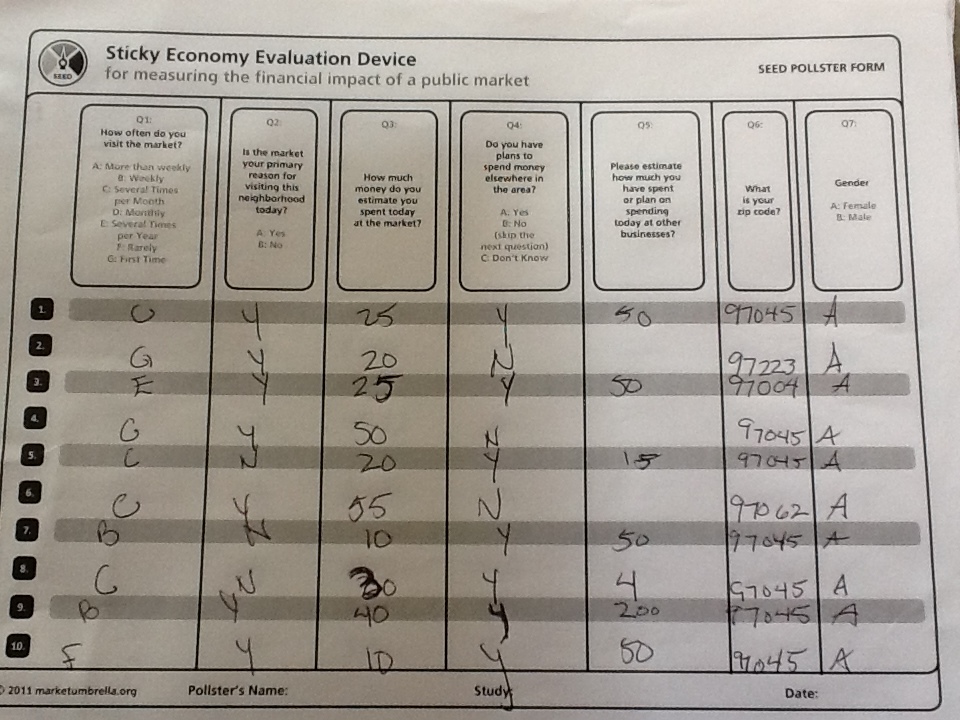
Just finished the first ever SEED http://www.marketumbrella.org/marketshare/
study in Oregon City, Oregon. Market manager Jackie Hammond-Williams puts together an amazing market every few days and has a lot of fun while she does it. Look for my upcoming FMC newsletter story about the study day and how this economic tool measures a markets impact. AND you’ll be able to read the report too – which was ready the next day. I guess we’ll let OCFM look at it first but I’m sure they will have it on their website very soon, and it will be followed by their weekday market SEED report too.

20120626-081822.jpg

Award winning sustainable farmer ad

This won an award for this ad where a farmer realizes the error of his ways and returns his farm to sustainable farming, and presumably because of his change of heart, becomes a supplier to Chipotle.
I’m not kidding.
See how far we’ve come?
http://usat.ly/Mft5Cp