October Newsletter from Center for Agriculture and Food Systems (CAFS)

I am a huge fan of the Center for Agriculture and Food Systems at the Vermont Law School. This activist center has already added a great deal of thoughtful research to the field of community food and their impact continues to grow exponentially. It is my honor to be working on one of their projects, a legal toolkit for farmers markets, along with the good folks at NOFA-VT.

OCTOBER 2015

  Like us on Facebook    Follow us on Twitter    View our profile on LinkedIn

GREETINGS
As I write this, the harvest is in and the farmers markets are in their final weeks. At CAFS, we have also had a bountiful season, presenting at conferences on each coast (the University of Oregon and Harvard University), teaching a wonderful class of food and agriculture law and policy students, and continuing our project work for food and agriculture producers and entrepreneurs. We are thrilled to report the award of additional funds through the National Agriculture Library, expanding that partnership through our innovative collaboration with William Mitchell Public Health Law Center and the Rudd Center for Food Policy and Obesity at the University of Connecticut. We are also pleased to announce the expansion of our staff with one of our own graduates, Sarah Danly, who is spearheading our leading-edge use of design, technology and the law to produce relevant and powerful legal tools. These are just a few highlights of what you will read below.
I hope you enjoy the fall issue.
Eat well, be well,
Laurie Ristino
Director, Center for Agriculture and Food Systems
Banner image courtesy of Brooklyn Grange

PROJECTS & RESOURCES
USDA National Agricultural Library
Awards CAFS $728,273 Grant
In September, CAFS received a $728,273 grant from the USDA National Agricultural Library. The grant will support three new projects; the largest — the Community FoodWorks project — is a collaboration with the Public Health Law Center at William Mitchell College of Law and the Rudd Center for Food Policy & Obesity at the University of Connecticut. The two additional projects, How to Use a Lawyer and Farmland Access Lease Assistant, will be designed to help farmers find and utilize legal resources.

STAFF SPOTLIGHT
Sarah Danly
Program Officer for Legal Design
Sarah recently earned her MELP (Master of Environmental Law and Policy) from Vermont Law School. She also holds a BA in Architectural Studies and Community Health from Tufts University, as well as a BFA from the School of the Museum of Fine Arts, where she focused on sculpture, drawing, design, and digital skills.
   Sarah will work with students in the Food & Agriculture Clinic on designing accessible online legal tools and information, which include the animated clip, “What Does the Food and Ag Clinic Do?” Prior to coming to CAFS, Sarah conducted outreach for Next Step Living, a Boston-based home energy efficiency company, and worked at farmers markets as a vendor and assistant manager.

FACULTY SPOTLIGHT

CAFS Welcomes Practicing
Faculty Members Beth Boepple
and Amy Manzelli
Beth Boepple (right) is developing the fourth food and agriculture distance-learning course for CAFS, drawing on her rich experience practicing food and farm law. A VLS alum, Beth is a shareholder and attorney with Lambert Coffin in Portland, Maine, specializing in corporate, commercial and banking law; farm and food production law; and real-estate and land-use law.
    In addition, Beth will be co-teaching Agriculture and Food Entrepreneur Lawyering Skills with Amy Manzelli (left) in the spring. Amy currently collaborates with CAFS on two USDA-funded projects. She is a partner at BCM Environmental & Land Law, PLLC in Concord, New Hampshire, specializing in environmental, conservation, and land law.

NEWS & EVENTS
Director Laurie Ristino Presents at Harvard Law and the University of Oregon School of Law
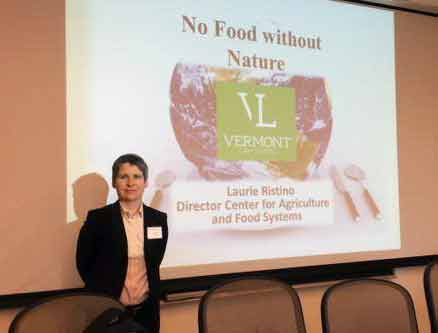
On September 25, 2015, Ristino gave the presentation “Food, Agriculture, and Drought: Implications of Water Supply Scarcity on Food Production and Policy Solutions at the Federal, State, and Local Levels” at the Drought in the American West Symposium at the University of Oregon School of Law in Eugene. On October 3, she also gave a seminar at Harvard’s Food Law Student Leadership Summit entitled “No Food Without Nature.”
Associate Director Laurie Beyranevand Contributes to Recently Published Books
Beyranevand wrote the chapters “Breaking Down Barriers to Local Food Distribution in Urban Centers” from Urban Agriculture: Policy, Law, Strategy, and Implementation, and “Agricultural Biotechnology and NAFTA: Analyzing the Impacts of U.S. and Canadian Policies on Mexico’s Environment and Agriculture,” from NAFTA and Sustainable Development: The History, Experience, and Prospects for Reform.
People at CAFS
* Associate Director Laurie Beyranevand was interviewed October 1, 2015 on Heritage Radio Network’s Eating Matters podcast about food labels and CAFS’ food labeling site Labels Unwrapped. She was also quoted in Mother Jones‘ article, “Chipotle Says it Dropped GMOs. Now a Court Will Decide if That’s Bulls-t;” in ClimateWire‘s “Businesses learn there are tax incentives and laws to help them recycle mountains of food;” in the Valley News‘ article “Food Notes: A Modern Take on an Old-Time Product;” and in the Health Affairs Blog article “The FDA’s Determination on Artificial Trans Fat: A Long Time Coming.”
* Director Laurie Ristino was quoted in the Law360 article “9th Circ. Pesticide Ruling Holds EPA to High Standards,” commenting on the 9th Circuit Court’s decision to vacate several EPA registrations of bee-killing pesticides.

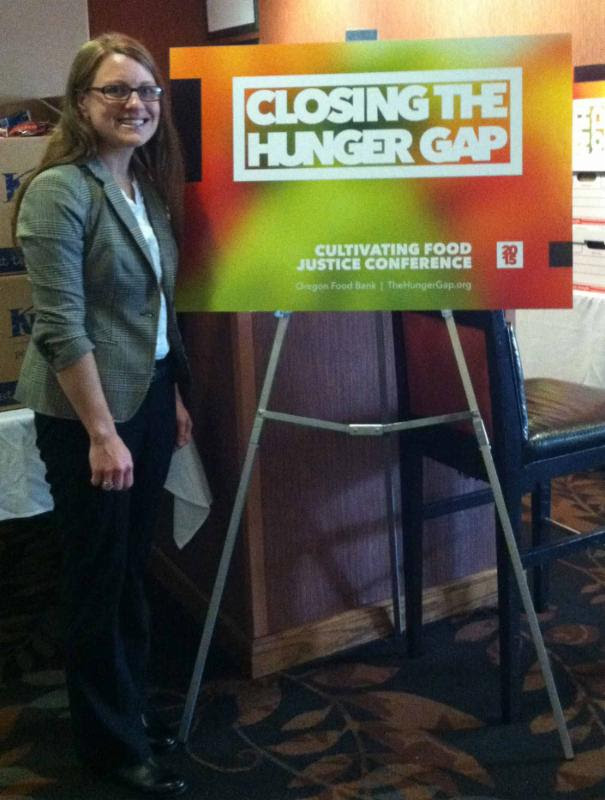
* Research Fellow Amber Leasure-Earnhardt(right) attended the Closing the Hunger Gap: Cultivating Food Justice conference in Portland, Oregon, in September. She met with food bank representatives, farmers, and advocates to discuss the role of CAFS’ gleaning research in furthering food justice.
* LLM Fellow Carrie Scrufari will be presenting her paper “Generally Recognized as Safe-Until They’re Not: Why the FDA Never Subtracts Food Additive From GRAS” at the Yale Food Systems Symposiumon October 30-31, 2015. She workshopped the paper in September at Pace Law School’s 2nd Annual Future Environmental Law Professors Workshop.
 

Farmers Market Metrics site updated

We are pleased to present an updated version of Farmers Market Coalition’s Farmers Market Metrics (FMM) website. We have streamlined and organized information about the current efforts, and will use this site to offer background information and project updates on all of the components of FMM that are underway. The final set of resources and tools will be available on a separate portal in development, expected in 2016.
Some highlights include:
Unique pages for current and past projects
Information on our project partnerships and funding sources
Examples of some of the resources being developed (currently in draft phase)
We hope you will take some time visiting and exploring our new pages. Please contact me with any questions.
Thank you for your ongoing support and enthusiasm for Farmers Market Metrics and the Indicators for Impact project.
Sara

Sara Padilla, FMC Project Manager

Joanne Clevenger: A Girl Scout with Gumption

One of the great restauranteurs of our age, and found right here in New Orleans. She speaks of her work with such love and respect, yet clearly suffers no fools. And yes, she is a supporter of local farmers and fishers with countless sightings at area farmers markets to her credit.

The Gift of Food: What to Give to Those Who Have Lost

I absolutely love this reminder of gifts of food as a source of comfort to those grieving or healing. I remember well how my pals put together a schedule of healthy food after I had surgery a few years back, as well as food being dropped off by my friends and work colleagues when family members passed in the last few years, and how much those very special gifts from all of those busy people meant to me and to my family.

I wonder if markets could assist their customers (and make some income too) by stretching this idea with “winter cold” baskets, full of greens, carrots, garlic and chicken or a “welcome to summer” baskets with flowers, fruits and light foods or by printing cards with room for a note and a list of what is being dropped off for the basket?

Source: The Gift of Food: What to Give to Those Who Have Lost | Cooking Light

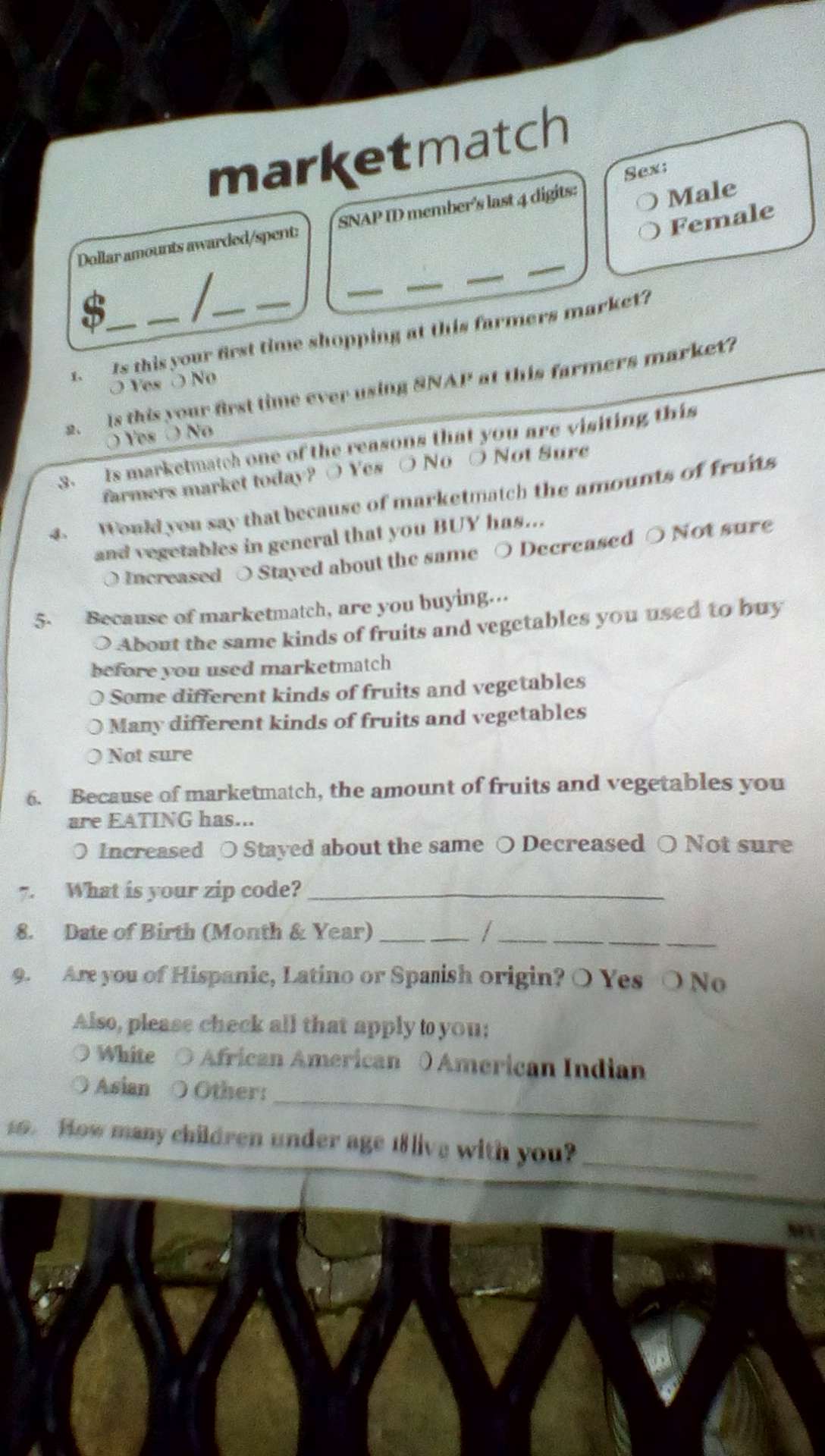
Self-administered survey-New Orleans Market Match user

This is (basically) the same system that Crescent City Farmers Market (CCFM) in New Orleans has used to gather data from incentive users (incentiv-ers?) since they began doing them some years back. They call their incentive Market Match.

As one of the staff who was responsible for doing it when it began and was part of the discussion about it, I really liked it. It is on a pad that is pulled off to have the person fill out and then each slip is added to the clipboard (or put in a container) to be entered into spreadsheets at a later time. The darker grey is filled out by the market staff person after the other part is completed by the shopper. What I know is that the system was designed with both the shopper and the market staff needs in minds, which as we all know is important and yet not always done. I’d like them to be numbered chronologically so as to know that none were lost. Maybe they are numbered, I’ll check to see.

Sorry for the wrinkles- it ended up in my market bag under the citrus. I’ll get some more pics of their system-including a better version of this and maybe the other collection forms if they will allow me to continue to peek over their shoulder.

MMtracking form_CCFM

New state laws boost farm to school in Louisiana

The first is Senate Bill 184 – the “Small Purchase Threshold” bill. Up until now, any food purchase a school made larger than $30,000 was subject to a complicated bidding process, known as a “formal bid.” This made it difficult for schools to get seasonal and local foods because the process is often challenging for smaller-scale, local farmers. The passage of SB 184 increased the small purchase threshold to meet the federal standard of $150,000, enabling schools to work more closely with small-scale farmers to serve local food to Louisiana children.

The second is House Bill 761 – the “Urban Ag Incentive Zone” bill. This bill creates urban agriculture incentive areas and reduces taxes on land used for urban farming. It greatly reduces expenses associated with acquiring urban agricultural land, and in turn encourages Louisianans to grow more local food.

Source: New state laws boost farm to school in Louisiana

From WWII to Syria, How Seed Vaults Weather Wars 

But though the need for seed banks is often associated with more stereotypically environmental, even futuristic, cataclysms (climate change; disease; pesticide-resistant insects) their history is inextricably tied up with something more banal and present-day—war.

…virtually no conflict has gone by without a devastating loss of seeds, often mitigated by a heroic rescue or underscored by a tragic attempt. Afghani mujahideen destroyed Kabul’s national seed collection in 1992. (Local scientists managed to smuggle some seeds into the basement of a few city houses, but by the time they returned to check on them a decade later, looters had dumped them on the floor in order to steal the storage jars.) During the Georgian civil unrest of 1993, just before the country’s Sukhumi Seed Station was destroyed, an 83-year-old botanist named Alexey Fogel escaped into the Caucasus Mountains with its entire lemon collection. Scientist Alexis Rumaziminsi, now known as the “bean boffin of Rwanda,” protected the many varieties of beans in his research plots during 1994’s civil war and genocide. The US-led invasion of Iraq resulted in the razing of the country’s national seed bank in Abu Ghraib—not to mention the implementation of American-style seed laws, which mean that if Iraqis want to buy new seeds, they will have to pay for yearly usage licenses.

Source: From WWII to Syria, How Seed Vaults Weather Wars | Atlas Obscura

Technology for markets and farmers: EMV (or chip and pin technology) for cards

This week is the deadline for all merchants to have new machines with chip and pin technology. RE-reposting to remind everyone to remind everyone to ask for updated machines.

(and here is some detailed background  info about credit cards and how the fees are designed that was posted on an electronic bulletin board site recently. Warning-VERY detailed!)

*This is a reposting to remind markets to check in with vendors and with your own credit card processor to ensure your readers are up to date. NOFA-VT leader Erin Buckwalter asked me about Square readers on a call today which reminded me to repost this information. And so yes, Square has an updated version as well, so make sure anyone using that or any other older card processing technology for credit cards is updating it!

*original post*
Was fortunate to be on a call with market state and network leaders today and to hear speakers including Kim Lyons, a long time supporter of small retailers at MerchantSource®; she gave us a great overview today of the chip and pin enabled devices/aka EMV devices/aka smart card technology that is coming down the pike. Here is what I heard, and as I get updates I’ll post them here and if what I wrote here needs to be corrected by my more able colleagues, I’ll also update. But since I know many markets don’t have state or network support systems, I felt it was necessary to get this on radar screens asap.And do remember, this is also important for market vendors that have their own credit card machine to address, so feel to print this out and share widely.

Chip and pin technology has existed for many years in Europe but had not been pushed in the US market- that was, until some of the worst security breaches of cards seen happened in the past year, including the Home Depot and Target breaches. So, whether or not those issues would be solved by it, chip and pin technology is coming and coming soon.

nobrand

This technology means credit and debit cards contain an embedded microchip and are authenticated automatically using a PIN. When a customer uses a card, it is placed into a “Point of Sale” (POS) terminal, which connects to the chip on the card. To complete the transaction, the customer enters a 4-digit PIN. These new technologies are meant to reduce the likelihood of breaches, especially at the merchant level. This is also true of new app-based systems (also called “contactless systems”) like Apple Pay which allow a user to upload credit cards to their iPhone 6 and use encrypted “near-field technology” to just tap or wave the smart phone at the merchant pad. The card itself never leaves ones wallet in those cases.

This chip and pin technology directly relates to all debit and credit but not to EBT only technology because EBT uses a different software kernel (system). However, many expect FNS to address this issue with changes in their technology sooner or later.
Important to note: This technology is for “card present” (CP) transactions and so internet or phone based transactions aka card not present (CNP) transactions will need their own version of chip and pin; some exist already. Of course, markets are not usually running CNP transactions so this is less of an issue right now for physical farmers markets.

There is a great deal left to learn about these issues as markets move into the next generation of technology. What is crucial to understand right now is the expected deadline of October 2015 for having this emv/pci compliant technology will shift liability of any breach on to merchant’s shoulders rather than the merchant providers of Mastercard/Visa etc. After that expected date of October 2015, in order for liability of any breach to stay with the merchant service providers, it will be necessary for any retailer to have these integrated pin pads or systems at that point. That means either adopting brand new card technology or app-based services like Apple Pay or upgrading their existing magnetic stripe only capabilities.
Once again, this technology is not directly related to EBT right now as a different type of technology so EBT only machines are not affected at this time but rumors abound of possible changes…

A recap of what is written above: Markets or state associations need to know if their merchant service providers or app-based solutions are emv/pci/contactless compliant. This new technology needs to be embedded into their pin pads or new technology by October of 2015 or the liability for any breach shifts to the merchant (read market). That entering into any lease system for readers at this point may mean getting technology that is “end of life” and cannot be upgraded or may mean paying for equipment after its technology is outdated. (Leasing versus renting contract language also needs to be understood by the buyer!) So, state associations, national partners and advocates for farmers and markets are working hard to understand these issues and to find resources for markets and farmers to understand the issues that will arise.

===================================================
What was also raised on this call was Farmers Market Coalition’s new contract with FNS to administer 3.3 million in support grants to markets for EBT systems and 700,000 in replacement equipment. I am sure that system along with the existing Marketlink system (which is an entirely separate program from FMC’s contract and supports NEW EBT systems for markets and for market farmers) are both going to work diligently on making sure these new systems are addressed.
Start reading up, folks.

FMPP 2015

After reading through the thumbnails on the USDA site a few times (and they are added at the end of this post), you’ll find some of my takeaways on this round of successful grants. I combed through this list a few times, and did my best to collect data correctly (!)  but do realize my numbers are not precise and may be off since I just took the data from the summaries listed.

USDA expected to fund around 190 with this round of funding and, by their count, ended up funding 163 projects.

47 states, districts and territories are represented.

California has the largest number of grants with 14 (one was listed with KS projects)

The majority of the proposals focus on simple marketing and outreach for markets. Here are the grants that specifically mention one of the following:

  • EBT/SNAP/benefit programs: 44

Farmer/vendor assistance/expansion

  • Farmer Training: 47 (“Peer-to-peer”: 2)
  • Agritourism: 15
  • GAP training: 5
  • Storage for farmers: 4
  • Food trucks: 1

Marketing outlets

  • Mobile Markets: 17
  • CSA/Market Box/Farm Stands: 20
  • Online purchasing system: 6
  • Mobile app: 3
  • Food Hubs: 2

Market upgrades

  • New market development: 16
  • Market relocation: 3
  • 501 (c) application: 2

Strategic planning

  • Analysis/data collection/measurement strategies: 13
  • Network development/support: 16 (New FM associations: 2)
  • Additional staffing: 7 (internship program development: 3)
  • Market manager certification program: 1

Marketing/Outreach

  • Bilingual materials: 7
  • Transportation to market: 3
  • Curriculum: 4
  • Cooking demos or classes: 29
  • Kids events: 10 (POP: 2)

Some other odds and ends of creativity to share that showed up at least once: inclement weather supplies for shoppers and vendors, SNAP advisory committee made up of SNAP recipients, a road show that will highlight regional farmers via traveling through region, DRIVE (Demo, Ride, Incentivize, Vary, Eat) and FORAGE (Food Oases’ Role to Advance and Generate Economies), door-to-door outreach, meal-kit CSAs, online discussions, a Latino ambassador program, expanding shoulder season products (early Spring and Fall),  a pre-purchase system that allows for the use of (SNAP) benefits, a financial analysis to review market budgets,  creating easy-to-use fillable templates for managers, direct mail campaign regarding artisan meats, a partnership with library to offer educational opportunities for vendors and consumers, culturally-appropriate public service announcements, TANF workforce assistance in production, WiFi addition, assessing agritourism readiness, a farm-to-work week, technical support for U.S. Veterans to become farm entrepreneurs, best practices of university farmers’ markets.

Some specific outcomes written into the description: fresh produce and healthy living cooking experiences to 100 neighborhoods, strategic community development action plans for each FMNP market county,  two new retail options (pop-up markets), three thriving, community-run farm stands, extending the farmers’ market to year-round, a financially self-sufficient farmers’ market, eight new points-of-sale, collaboration between fifteen Latino owned farm enterprises and five local farmers and three local food businesses.

wow. I wish everyone good luck in this round of funding and will look forward to reading the results.

Awards List, listed by state

Continue reading

2015 Farmers Market SNAP Support Grantees

Some very exciting projects in here. Congratulations to all of the successful organizations.

As approved by Congress in the President’s FY 2014 budget request for FNS (The Food and Nutrition Service: 2014, Explanatory Notes), these funds are intended to support “the participation of farmers’ markets in SNAP by providing equipment and support grants to new markets and those currently participating in the program.” The goals of the FMSSG program are to increase SNAP accessibility and participation at farmers’ markets, and support the establishment, expansion, and promotion of SNAP/Electronic Benefits Transfer (EBT) services at farmers’ markets. This is a new program, which may continue in subsequent years.

Supplemental Nutrition Assistance Program (SNAP)

Link to original RFA

Last Published: 10/02/2015
  1. Plant Chicago, NFP – Ensuring SNAP Success at Plant Chicago’s Farmers Market
    Chicago, IL
    Choice Neighborhood
    Estimated Federal Funding: $15,379
    Plant Chicago’s Ensuring SNAP Success project, will improve SNAP programming in the urban center of Chicago, IL by increasing SNAP-customers at the organization’s farmers market through community, bi-lingual outreach and a local marketing campaign.  Through this project the SNAP program at the market will expand to include a volunteer program for weekdays and weekends.  Plant Chicago intends to increase SNAP participation at their market by over 25% for 2017.
  2. Trust for Conservation Innovation – Making Farmers Market Purchases a SNAP in Northern California
    San Francisco, CA
    Choice Neighborhood
    Estimated Federal Funding: $123,068
    The Making Farmers Market Purchases a SNAP in Northern California project will support staffing for the SNAP at eight small-scale farmers markets in Northern California that currently struggle to provide SNAP on a regular basis. Through this project, these markets will receive EBT technical training and assistance.  Additionally, the project will increase SNAP redemptions at farmers markets through community outreach and promotion and develop best practices to ensure growth and sustainability.
  3. Morgantown Farmers’ Market Growers Association – Expanding a Targeted SNAP Program to Demographically-Diverse Member Markets
    Morgantown, WV
    Strike Force State
    Estimated Federal Funding: $36,599
    Through the FMSSG, the Morgantown Farmers’ Market Growers Association will hire an EBT coordinator to manage the growing SNAP at two farmers markets and increase redemptions by engaging in outreach specifically targeted to SNAP-participants in urban food-desert of West Virginia.  The Association will also identify best practices that can be incorporated into a long-term plan for the SNAP at other markets throughout West Virginia.
  4. Growing Places Indy, Inc. – Indy Winter Farmers Market (IWFM) “Good Eating Is a SNAP, All Winter Long”
    Indianapolis, IN
    Promise Zone
    Estimated Federal Funding: $58,740
    The Indy Winter Farmers Market (IWFM) “Good Eating Is a SNAP, All Winter Long” program will increase access to SNAP by hiring a dedicated EBT manager that will also coordinate educational demonstrations and outreach materials.  This staff member will provide farmer vendors with needed training and technical support. These activities will help to increase the consumption of farmers market products by SNAP customers and give farmers the tools they need to increase SNAP redemptions and build their businesses.
  5. Homefull – Growing SNAP Success with Southwest Ohio Farmers’ Markets
    Montgomery, OH
    Estimated Federal Funding: $113,258
    Through Growing SNAP Success with Southwest Ohio Farmers’ Markets, Homefull will reach a three-county area to bolster and increase SNAP at over fifteen local farmers markets and promote SNAP availability at the participating markets.  Homefull will achieve this through EBT training and technical assistance, outreach, EBT staffing, and market ambassadors.  The project plans to double the number and dollar value of SNAP transactions at southwest Ohio farmers markets.
  6. The Experimental Station-6100 Blackstone –  EBT Support and Outreach For Illinois Farmers Markets and SNAP Clientele
    Chicago, IL
    Choice Neighborhood
    Estimated Federal Funding: $250,000
    Over a two-year project, the Experimental Station will provide EBT support to Illinois farmers markets accepting SNAP through EBT/SNAP consulting, technical support and establishing an online community of EBT support to Illinois farmers markets.  This project will also create and disseminate outreach materials and television advertisements, to create greater awareness of the availability of SNAP at Illinois farmers markets. The Experimental Station aims to double SNAP sales at markets throughout Illinois during the life of this project.
  7. Houston Department of Health and Human Services – Expanding Opportunity for Use of SNAP at Houston Farmers Markets
    Houston, TX
    Strike Force State
    Estimated Federal Funding: $250,000
    The Houston Department of Health and Human Services through the Expanding Opportunity for Use of SNAP at Houston Farmers’ Markets project will provide staff and EBT technical support and promotional activities related to the expansion of SNAP acceptance at Houston farmers markets.  Outreach and promotional activities will be implemented in partnership with local community organizations to increase the number of farmers markets accepting SNAP to six.  The project aims to increase the number of SNAP transactions at farmers markets within the City of Houston to 8,980 by 2018.
  8. Missouri Farmers Market Association – Growing SNAP at Farmers Markets in Missouri
    Webb City, Missouri
    Choice Neighborhood
    Estimated Federal Funding: $73,160
    The Missouri Farmers Market Association will expand the SNAP at ten farmers markets throughout Missouri. SNAP-expansion will occur through a variety of marketing tools tailored to the individual market and its SNAP-customers.  The marketing tools range from radio advertising to cooking demonstrations, to banners, and brochures, all designed to best reach local SNAP-participants.
  9. Hamakua Harvest, Inc. – Hamakua Harvest Farmers’ Market SNAP/EBT Expansion Program
    Honokaa, HI
    Estimated Federal Funding: $137,174
    The Hamakua Harvest Farmers’ Market SNAP/EBT Expansion Program will support the newly-authorized farmers market in Honokaa, HI gain the support it needs to thrive. The funds will be used to promote and expand the SNAP through staffing an EBT manager, purchasing SNAP supplies, training for EBT market vendors, and outreach to SNAP-recipients.  Hamakua Harvest anticipates the impact of the project to include 36 vendors to be trained to accept SNAP.
  10. North Union Farmers Market – Increasing SNAP Benefit Use at North Union’s Cleveland Markets through Educational Outreach and Targeted Marketing
    Cleveland, OH
    Choice Neighborhood
    Estimated Federal Funding: $59,302
    North Union Farmers Market will strengthen their SNAP by hiring a part-time educational coordinator who will be responsible for expanding the market’s outreach programs and build relationships with community partners that work with SNAP-clients. The expanded outreach programs will include cooking demonstrations, family-friendly educational activities and workshops on food preservation.  The North Union Farmers Market will also implement a marketing program using print and digital media and radio advertisements.  The anticipated impact of the project is an increase in redemptions by 10%.
  11. Broad Street Events, INC. – Spotlight on Snap, Raising SNAP Awareness in Rural Michigan
    Chesaning, Michigan
    Estimated Federal Funding: $17,480
    The project Spotlight on SNAP will effectively market the SNAP to surrounding SNAP-residents and increase the amount of SNAP users at the Downtown Chesaning Market.  Funding will provide the needs to expand outreach and effectively promote SNAP through market activities, newspaper articles, television commercials, and outreach events.  Broad Street Events will partners with many local organizations and schools with high populations of SNAP-recipients.
  12. Village of Park Forest – Park Forest Farmers’ Market EBT Program
    Park Forest, IL
    Choice Neighborhood
    Estimated Federal Funding: $16,975
    The Park Forest Farmers’ Market EBT Program will increase SNAP benefit redemption at the Park Forest Farmers Market by hiring an EBT manager who will administer the program, plan and implement outreach strategies for informing SNAP participants of their ability to use benefits at the farmers market, and conduct trainings for farmer-producers new to the market on participation in the EBT program.  By expanding the EBT program, the market can continue to involve more vendors and offer greater varieties of products available to SNAP customers.
  13. Harvest Home Farmer’s Market – Farm Fresh for Every Body
    New York, NY
    Choice Neighborhood
    Estimated Federal Funding: $250,000
    Through 19 different farmers markets in food-deserts around New York, Harvest Home will increase the number of SNAP transactions processed at their farmers markets, increase the number of farmers and vendors who serve SNAP recipients, and broaden their reach into the surrounding communities. Harvest Hands will achieve these goals by creating culturally and linguistically appropriate promotional materials to reach SNAP-recipients, improve the technology needed to process SNAP transactions on-site and in real time, and conduct ongoing vendor SNAP recruitment for farmer producers.
  14. Everyone’s Harvest – Monterey County SNAP Initiative
    Marina, CA
    Estimated Federal Funding: $109,716
    Everyone’s Harvest will double its annual SNAP redemptions and grow its SNAP customer base by 70% by using a customer relationship management database and outreach to SNAP market shoppers.  The organization will achieve this by engaging Spanish-speaking community members in producing a Spanish-language promotional video focused on SNAP and creating a mailing and email outreach campaign.
  15. Eastern Market Corporation – Eastern Market: Detroit’s SNAP Food Security Blanket
    Detroit, MI
    Strong Cities Strong Communities
    Estimated Federal Funding: $249,663
    The Eastern Market: Detroit’s SNAP Food Security Blanket program will provide resources for program support staff, consulting fees, and supplies to allow for significant program improvements through increased operational efficiencies and greater program effectiveness.  This will be achieved by discontinuing the use of a paper-based system and expanding the SNAP program to an additional market.
  16. Friends of the Rochester Public Market, Inc. – Greater Rochester Farmers’ Market SNAP Collaborative
    Rochester, NY
    Estimated Federal Funding: $178,902
    Through the Greater Rochester Farmers’ Market SNAP Collaborative project the Friends of the Rochester Public Market will implement a community-wide marketing campaign that increases awareness of SNAP use at regional farmers markets.  Additionally funds will be used to develop a new SNAP Token Center at the Public Market and staff salaries for SNAP related activities
  17. Fresh Approach – SNAP Training and Outreach for Farmers’ Markets in San Francisco Bay Area Counties
    Concord, CA
    Choice Neighborhood
    Estimated Federal Funding: $190,951
    Fresh Approach will use funds to perform SNAP data collection, build a network of farmers market stakeholders, create and distribute bi-lingual marketing material, produce outreach events, create a best practices manual for farmers markets to utilize setting up a SNAP program, and train farmers market staff on SNAP program implementation.
  18. Glenville State College Research Corporation – Expansion of Acceptance of SNAP at the Gilmer County Farmers’ Market: Population of low income households in a food desert
    Glenville, WV
    Strike Force State
    Estimated Federal Funding: $42,020
    This project will use funds to design and distribute educational posters and handouts, create and execute an extensive marketing campaign including TV and radio ads, provide salary for an EBT operator and manager, and train volunteers and market staff on SNAP procedures.
  19. Southern Tier West Regional Planning and Development Board – From the Ground Up: Expand and Sustain SNAP at Farmers Markets
    Salamanca, NY
    Estimated Federal Funding: $99,813
    From the Ground Up: Expand and Sustain SNAP at Farmers Markets project will provide research and data analysis, technical assistance, educational training, volunteer training, and capacity building strategies to farmers market managers, and perform outreach to SNAP clients, develop curriculum and training materials for the Southern Tier West Regional Farmers Market Network.
  20. City of Independence – Increasing SNAP Awareness and Utilization at Independence Farmers’ and Craft Market
    Independence, MO
    Choice Neighborhood
    Estimated Federal Funding: $144,976|
    The City of Independence will use FMSSG funds to design and implement a marketing plan for the Independence Farmers market through movie, billboard, local print and bus advertisements, additionally banners and other printed advertising material will be used at the farmers market and distributed throughout the community.  City staff will also perform outreach and educational events in order to increase redemptions at the farmers market due to higher community awareness of SNAP at the farmers market.
  21. Florida Certified Organic Growers and Consumers, Inc. –  Increasing the Capacity of Fresh Access Bucks in Florida
    Gainesville, FL
    FINI & Choice Neighborhood
    Estimated Federal Funding: $250,000
    The Increasing the Capacity of Fresh Access Bucks in Florida project will use FMSSG funds to pay personnel for SNAP administration, organization to provide resources, and technical assistance to farmers market managers.  The project will also develop strategic branding and promotional materials for FL farmers markets and promote SNAP at markets through regular press releases, advertising on the radio, in newspapers, on public transit, on electric bills in each county, direct mailings, and through social media.
  22. Boulder County Public Health – Building and Growing Regional Capacity for SNAP at Farmers’ Markets in Colorado’s Front Range
    Boulder, CO
    Strike Force State
    Estimated Federal Funding: $231,460
    The Boulder County Public Health will use funds to staff a farmers market SNAP coordinator, conduct focus groups on the barriers to accessing farmers markets, develop and implement an outreach plan, train farmers and market managers on managing a SNAP program, hire bi-lingual staff for markets, and create communication tools to distribute best practices to farmers markets in the county.
  23. Appalachian Sustainable Agriculture Project – Increasing SNAP at NC Farmers Markets
    Asheville, NC
    Strike Force State
    Estimated Federal Funding: $164,625
    Through the Increasing SNAP at NC Farmers Markets project, the Appalachian Sustainable Agriculture Project will conduct outreach and promotion to and collaboration with local agencies on SNAP at farmers markets, conduct trainings for market managers and farmers on how to increase SNAP redemptions at markets, evaluate community needs through research and surveys, and provide technical assistance to market managers following their initial training.
  24. The Food Trust – Making Fresh Food a SNAP: Increasing ACCESS Sales at Food Trust Farmers’ Markets
    Philadelphia, PA
    Promise Zone, FINI, Choice Neighborhood
    Estimated Federal Funding: $150,103
    The Food Trust will conduct focus groups, staff EBT operation at markets, implement promotional events around SNAP, develop marketing plan to educate SNAP-clients on EBT at farmers markets, develop bi-lingual marketing and educational materials, train market managers on SNAP program management, and collaborate with local partners.
  25. Hub City Farmers’ Market – Expanding South Carolina’s SNAP Use at Farmers Markets
    Spartanburg, SC
    Strike Force State
    Federal Funding: $247,100
    This project seeks to create a market model that can serve as an inspiration to markets across the state, alleviate market and user barriers, and help municipalities understand the importance of supporting SNAP in markets they run. Hub City Farmers’ Market of Spartanburg will work with Eat Smart Move More South Carolina and the University of South Carolina Center for Research in Nutrition and Health Disparities to develop a set of best practices to help mentor two markets in key areas of the State.
  26. El Dorado County Trails Farm Association – Improvement and Expansion of EDC Farm Trails Association Farmers’ Market SNAP Program
    Placerville, CA
    Federal Funding: $16,057
    The project’s main goal is to boost public awareness of farmers’ market accepting SNAP benefits.  Applicant plans to partner with the Health and Human Services Department and El Dorado CNAP to conduct outreach along with media blitz and raise awareness about the program.
  27. Feed the Hunger Foundation – SNAP at Honolulu Farmers Market
    San Francisco, CA/Honolulu, HI
    Federal Funding: $243,450
    The plan for this project includes outreach to the following communities: 1) news outlets engaging communities whose first language is not English: Samoan, Tongan, Chuukese, Tagalog, Ilocano, Korean, Cantonese, Vietnamese, Thai, Lao, Cambodian, Japanese; 2) Military news at Joint Base Pearl Harbor Hickam; 3) University of Hawaii system (including community and adult education outreach colleges). 4) Coordinating with other SNAP –accessible farmers markets to collaborate on promotion.
  28. Ecology Center – California Farmers’ Market EBT Program
    Alameda, CA
    Strong Cities, Strong Communities (SC2)
    Federal Funding: $242,828
    The project’s aims to support the Ecology Center’s CA Farmers Market EBT program and will: (1) reach out to the 350 CA farmers’ markets that do not yet offer SNAP access with a compelling Case Statement on the benefits of accepting SNAP; (2) provide comprehensive technical assistance, training, shopper outreach materials, scrip, and systems to help a minimum of 120 of those markets add SNAP access; (3) update, improve, and maintain FMfinder.org, the Ecology Center’s website and mobile site designed to helps SNAP shoppers easily find up-to-the-minute information on CA farmers’ markets where they can use their benefits; (4) work with the Departments of Social Services in Los Angeles and Alameda Counties to mail over 1.3M inserts to 632,205 SNAP in order to educate them about the availability of SNAP programs at local farmers’ markets and direct the shoppers to FMfinder.org to find locations and hours of operation; and (5) through these combined efforts, increase SNAP sales at CA Farmers’ Markets by $1.23M (a 33% increase over 2014) by the end of the grant term.
  29. Kokomo Farmers Market Corp – SNAP To Kokomo Farmers’ Market: a targeted marketing, outreach and expansion project to increase SNAP user participation and benefits use at the KDFM
    Kokomo, IN
    Federal Funding: $248,770
    The project goals are to (1) increase SNAP client accessibility and participation at the Kokomo Downtown Farmers Market (KDFM) through extended hours, targeted outreach and expanded marketing, to (2) improve systems for SNAP transactions, recording, and reporting, and to (3) support SNAP recipients with cooking and preserving demonstrations at various outreach locations.
  30. Sustainable Farms & Communities, Inc. – Expanding SNAP Participation in Boone County, Missouri
    Columbia, MO
    Estimated Federal Funding:  $146,983
    Expanding SNAP Participation in Boone County, Missouri project will provide staff for EBT market management, including record keeping, token management and educational activities.  Also, the project will develop a comprehensive marketing and community outreach plan, and healthy cooking and living demonstrations.
  31. Health Education Council – Sacramento Region CalFresh Market Expansion: Connecting Families to Farmers
    West Sacramento, CA
    Promise Zone & Choice Neighborhood
    Estimated Federal Funding: $240,429
    This project will provide technical training and support to SNAP market managers, the funds will also provide EBT staffing for markets, outreach to SNAP customers at markets, marketing material, and regional meetings and trainings.
  32. Washington State University – Skagit Farmers Market Flash
    Pullman, WA
    Estimated Federal Funding: $250,000
    Washington State University will implement the Skagit Farmers Market Flash project through organizing and producing market outreach events, increase access to farmers markets for seniors, develop and roll-out a marketing campaign, and provide EBT training and technical assistance for farmers market managers.
  33. Federation of Massachusetts Farmers Markets – Massachusetts SNAP Support Project
    Waltham, MA
    Choice Neighborhood
    Estimated Federal Funding: $250,000
    Massachusetts SNAP Support Project will provide SNAP operating support to farmers market managers across Massachusetts; awarding sub-grants for time spent operating SNAP/EBT machines at market, SNAP accounting, vendor payments, reporting, and performing outreach to SNAP participants, as well as purchasing scrip and accounting software necessary for SNAP/EBT.
  34. Dianne’s Call – Optimizing Peoples’ Everyday Nutritional (OPEN) Path to Healthier Lifestyles
    Sumter, SC
    Strike Force State & Choice Neighborhood
    Estimated Federal Funding: $229,589
    Dianne’s call with expand the SNAP program at local farmers markets through training, conducting hands-on cooking classes, provide educational material for SNAP at farmers markets and implement health and behavior promotional events.
  35. Downtown Fond du Lac Partnership, Inc. – Reaching Diverse Populations through SNAP at the Farmers Market
    Fond du Lac, WI
    Estimated Federal Funding: $28,471
    This project will provide market managers and farmer EBT trainings, SNAP community outreach, extensive marketing campaign to SNAP-clients, creation of promotional videos, language translation for marketing materials, market and SNAP tours for clients, educational and cooking demonstrations, and additional SNAP signage.
  36. Village of Farwell – Farwell Farmer’s Market SNAP Project|
    Farwell, MI
    Estimated Federal Funding: $89,160
    The Farwell Farmer’s Market SNAP Project will provide staff for the farmers market, train vendors on EBT use, create marketing materials, implement marketing plan, and a social media campaign.
  37. Maine Federation of Farmers’ Markets – Building a SNAP Support System for Maine Farmers’ Markets
    Pittsfield, ME
    Estimated Federal Funding: $249,677
    The Main Federation of Farmers’ Markets will use funds to provide training for market managers and farmers on EBT, provide support and technical assistance for local farmers markets, produce and utilize SNAP-Farmers Market communication tools, update EBT training manual, implement a branding campaign in conjunction with FINI, and develop and train market liaisons.
  38. Sankofa Safe Child Initiative – Sankofa Seniors Farmer’s Market Project
    Chicago, IL
    Choice Neighborhood
    Estimated Federal Funding: $28,616
    The Sankofa Seniors Farmer’s Market Project will use funds to do community outreach, cooking demonstrations and other educational sessions targeted toward seniors, and increase access to farmers market for seniors.
  39. Farm Fresh Rhode Island – The Rhode Island Farmers Market SNAP Network
    Pawtucket, RI
    Choice Neighborhood
    Estimated Federal Funding: $250,000
    Farm Fresh Rhode Island will develop and implement extensive marketing plan focusing on SNAP at farmers markets and provide financial support to local farmers markets to maintain their EBT programs.
  40. Billings Forge Community Works, Inc. – More SNAP: Local Vegetables and Fruit for Hartford Tables
    Hartford, CT
    Promise Zone
    Estimated Federal Funding: $198,776
    The More SNAP: Local Vegetables and Fruit for Hartford Tables project will involve rolling-out promotional plan for SNAP at farmers markets, which includes various advertisements, produce a farmers market toolkit, and train market managers and farmers on EBT.
  41. CEN-TEX Certified Development Corporation – Supporting SNAP redemption at Mercado O’liva Farmer’s Markets in San Antonio
    Austin, TX
    Strike Force State, Promise Zone & Choice Neighborhood
    Estimated Federal Funding: $88,662
    This project will provide EBT staffing and administration for the Mercado O’liva Farmers Markets. Additionally the project will implement social media promotion and an advertisement campaign consisting of print, radio and TV and CEN-TEX will hold cooking demonstrations targeted to SNAP-clients at markets.
  42. Ajo Center for Sustainable Agriculture – Good Food For All – Introducing SNAP at Authentically Ajo Farmers Market
    Ajo, AZ
    Strike Force State
    Estimated Federal Funding: $223,530
    The Good Food for All project will expand and support the SNAP/EBT program at the Ajo Farmers Market, design and implement standard practices, provide training on EBT for market vendors and volunteers meeting the needs of SNAP-clients in a poor rural area.
  43. Council on the Environment, Inc. (GrowNYC) – Branding and Advertising to Boost SNAP Sales at Greenmarket
    New York, NY
    Choice Neighborhood
    Estimated Federal Funding: $186,335
    GrowNYC will create a branding and advertising campaign that promotes SNAP acceptance at Greenmarkets throughout the city and purchase marketing materials, such as banners, flyers, canopies, etc., based on the campaign.
  44. The Gleaning Network of Texas (GROW North Texas) – Expanding SNAP at Farmers Markets in Dallas
    Dallas, TX
    Strike Force State
    Estimated Federal Funding: $230,230
    The Gleaning Network of Texas will use FMSSG funds to hire market staff for four seasonal markets to run SNAP programs, provide technical EBT assistance to farmers, purchase SNAP tokens, and implement and outreach plan.
  45. Corporation for Findlay Market – Get Fresh With Us
    Cincinnati, OH
    Choice Neighborhood
    Estimated Federal Funding: $37,932
    Get Fresh With Us will use funds to train interns to help manage EBT operations at farmers markets, provide community outreach for SNAP at farmers markets, give market tours for SNAP-clients, develop and distribute SNAP outreach materials, and hold cooking demonstrations at markets in the area.
  46. Gloria Tu Gilbert – Westford Farmers Market SNAP 2015-2017: Sustainable Incentive
    Westford, MA
    Estimated Federal Funding: $27,709
    The Westford Farmers Market Project will provide staff for operating the SNAP program at the farmers market, training for EBT staff, and marketing SNAP at the farmers market and throughout the community, and supplies needed to operate a SNAP program.
  47. Main Street Monroe, Inc. – Enhancement of SNAP Accessibility and Participation at Main Street Monroe Farmers Market
    Monroe, WI
    Estimated Federal Funding: $179,051
    This project will collaborate with community partners to implement community outreach promoting SNAP acceptance at the Main Street Monroe Farmers Market, develop a transportation plan to distribute to SNAP-clients helping them overcome transportation barriers, establish procedures for operating EBT at the market, and provide training to vendors to operate EBT.
  48. Sustainable Food Center – Central Texas Farmers’ Market SNAP Expansion
    Austin, TX
    Strike Force State & Choice Neighborhood
    Estimated Federal Funding: $147,210
    This project will hire staff for running EBT at markets, develop a Neighborhood Farm Market Startup Guide and training materials, train market managers and vendors on EBT management, provide technical assistance to farmers markets, and provide community outreach.
  49. Fuller Park Community Development Corporation – Eden Place Farmers’ Markets SNAP Outreach
    Chicago, IL
    Choice Neighborhood
    Estimated Federal Funding: $111,418
    The Eden’s Place Project will develop outreach and marketing materials, targeted outreach to seniors on SNAP, on-site educational demonstrations at the market, host informational and training workshops on managing EBT at markets, and provide technical assistance to market managers and farmers on EBT.
  50. Northeast Organic Farming Association of Vermont (NOFA-VT) – Growing EBT Access and Capacity at Vermont’s Farmers Markets
    Richmond, VT
    Estimated Federal Funding: $247,048
    This project will implement a marketing campaign using direct mailings, financial and technical support for area farmers markets, provide outreach and education to community partners on SNAP acceptance at farmers markets, and provide supplies to markets for successful EBT programs.
  51. The CSU, Chico Research Foundation – Increased EBT Participation in North Valley Farmers’ Markets
    Chico, CA
    Estimated Federal Funding: $250,000
    The Chico Research Foundation will use funds to develop and implement a SNAP outreach and marketing campaign, purchase SNAP signage and other supplies, farmers market staff will be trained on SNAP operations and program strategies, host market tours to promote EBT use at the market, and cooking demonstrations will be held to encourage eating more fruits and vegetables.
  52. North Carolina State University – More In My Basket at the Market
    Wake, NC
    Strike Force State
    Estimated Federal Funding: $248,530
    This project will provide outreach and information to community SNAP-clients, marketing materials published and distributed to SNAP-clients, provide market tours to SNAP-recipients, and cooking demonstrations.

Big Data on Shopping and Transportation

Some of you may remember the 3-part Big Data and farmers market posts I did a few months back. Here is another article from Next City that talks of a Big Data partnership for city planners to understand how people move about, to shop and to work.

What is great about this type of big data is that many markets can be a part of this data since a significant number of them accept MasterCard cards, either at the Welcome Booth or among vendors. Think about a funder doing this, using the number of and dollar amount of transaction metrics to analyze with transportation data; it could illuminate the need for more buses during market hours or simply to show the cluster patterns of market shopping among card users. That data could then pinpoint outreach.

By combining MasterCard’s transactions data (they process 43 billion per year) with Cubic’s transportation data, analytics and visualization technology, the platform — dubbed the Urbanomics Mobility Project — will yield insight into the way transit and economic activity are linked in cities.

https://nextcity.org/daily/entry/how-human-is-big-datas-newest-city-planning-tool

The Global Goals

GlobalGoalsSeems to me that at least 12 of these are primary to the market movement’s goals too:

In September 2015, the United Nations are launching global goals, a series of ambitious targets to end extreme poverty and tackle climate change for everyone by 2030.

Source: The Global Goals

The Truth About Poor People’s Eating Habits Will Surprise You 

A recent Centers for Disease Control survey of 5,000 American children and adolescents age 2 to 19 offers proof that poor people not only don’t consume more fast food than those with higher incomes, they actually consume slightly less. The study, which looked at figures from 2011-’12, found that “no significant difference was seen by poverty status in the average daily percentage of calories consumed from fast food among children and adolescents aged 2 to 19.” In fact, the poorest children surveyed got the least amount of their daily calorie intake from fast food, at just 11.5 percent. That number rose to 13 percent for their more affluent peers.

And a Gallup poll from 2013 found “[t]hose earning the least actually are the least likely to eat fast food weekly — 39% of Americans earning less than $20,000 a year do so.” Conversely, more affluent Americans — “those earning $75,000 a year or more — are more likely to eat [fast food] at least weekly (51%) than are lower-income groups.”

Source: The Truth About Poor People’s Eating Habits Will Surprise You | Alternet