Food Among the Ruins / Guernica / A Magazine of Art & Politics

I am quite suspicious of media that tries to decree our movement as the answer to a region’s entire set of problems, and as a food activist, I am on record as being uneasy with terms like “urban ag” as I believe in regional ag as the better term to describe entrepreneurial farming in both the urban and rural areas TOGETHER. I mean if a rural farmer came to me and told me to support rural farming, I’d argue for the urban by asking for him or her to consider their regional needs.
And I also like regional ag since it includes existing farmers and appreciates our hinterlands and waterways which we also need to supply food for our beloved cities. I believe in urban farming, let me say that- but as for agriculture, I think we’re best served when we just support family farming and farming as an honorable profession.. Add to that, the power shift that needs to happen to support new farmers should happen today by supporting those existing farmers, some of whom are still stuck deep in in the industrial food system. We can polarize them and point at them as “part of the problem” but it may be better to learn from them and to assist them in gaining knowledge and awareness about why they may want to join us over in the alternative food system.

However, I love these quotes from legendary Detroit activist Grace Lee Boggs from the article linked below about Detroit’s agricultural movement:

“The food riots erupting around the world challenge us to rethink our whole approach to food,” she said, but as communities, not as bodies politic. “Today’s hunger crisis is rooted in the industrialized food system which destroys local food production and forces nations like Kenya, which only twenty-five years ago was food self-sufficient, to import 80 percent of its food because its productive land is being used by global corporations to grow flowers and luxury foods for export.” The same thing happened to Detroit, she says, which was once before a food self-sufficient community.

I asked her whether the city government would support large-scale urban agriculture. “City government is irrelevant,” she answered. “Positive change, leaps forward in the evolution of humankind do not start with governments. They start right here in our living rooms and kitchens. We are the leaders we are looking for.”

Detroit: Farming Paradise?

Food Among the Ruins / Guernica / A Magazine of Art & Politics.

Facing Race

Within our food system work, we need to face and address it. Within our own communities, we need to face it and address it.

Facing Race Conference

Farmers Market Promotion Program Grants Available

AMS No. 021-12

Gwen Sparks (202) 260-8210
gwen.sparks@ams.usda.gov

WASHINGTON, April 5, 2012 – Agriculture Deputy Secretary Kathleen Merrigan announced today that the U.S. Department of Agriculture (USDA) is seeking grant applicants for the 2012 Farmers Market Promotion Program.

Approximately $10 million is available for marketing operations such as farmers markets, community supported agriculture and road-side stands. The grants, which are administered by USDA’s Agricultural Marketing Service (AMS), are available through a competitive application process on http://www.grants.gov. The grants aim to increase the availability of local agricultural products in communities throughout the county. They will also help strengthen farmer-to-consumer marketing efforts.

“These grants will put resources into rural and urban economies, and help strengthen efforts to provide access to nutritious and affordable foods,” said Agriculture Deputy Secretary Kathleen Merrigan. “This program not only supports the health and well-being of local communities but also the economic health of their farms and businesses.”

Projects that expand healthy food choices in food deserts or low-income areas (where the percentage of the population living in poverty is 20 percent or above) will receive additional consideration. USDA, in coordination with the Departments of the Treasury and Health and Human Services, seeks to increase access to fresh, healthy and affordable food choices for all Americans, while expanding market opportunities for farmers and ranchers.

Information on applying for a Farmers Market Promotion Program grant will be published in the April 6, 2012, Federal Register and available online at http://www.ams.usda.gov/FMPP. Applications will only be accepted via grants.gov and must be received by May 21, 2012. Applications that are incomplete, hand-delivered, or sent via U.S. mail will not be considered. Applicants should start the grants.gov registration process as soon as possible to meet the deadline. Contact Carmen Humphrey, Program Manager, by phone: (202) 720-8317, or e-mail: usdafmppquestions@ams.usda.gov for more information.

Authorized by the Farmer-to-Consumer Direct Marketing Act of 1976 and amended by the Food, Conservation and Energy Act of 2008 (the Farm Bill), the Farmers Market Promotion Program is in the seventh year of funding direct markets that benefit local and regional economies.

The Farmers Market Promotion Program is part of USDA’s commitment to support local and regional communities. These investments are highlighted in USDA’s Know Your Farmer, Know Your Food (KYF) Compass. The KYF Compass is a digital guide to USDA resources related to local and regional food systems. The Compass consists of an interactive U.S. map showing local and regional food projects and an accompanying narrative documenting the results of this work through case studies, photos and video content.

A large selection of USDA-supported programs and projects is also visible on the KYF Map, which can be displayed by theme, program, or recipient type. Both the KYF Compass and map will be regularly refreshed with new data and case studies.

#

Get the latest AMS news at http://www.ams.usda.gov/news or follow us on Twitter @USDA_AMS. You can also read about us on the USDA blog.

Gleaning is good.

I appreciate when markets can measure how many pounds of food are given to food banks each year by their farmers. Gleaning is another way to use the productivity of the farms in your area. In both cases, markets should assist their farmers in knowing how to record the amount of food their business donates and how they might invite gleaners to their farms without a major disruption to those businesses during harvest season. The markets should also thank those farmers in annual reports or marketing literature, both their own and any beneficiary like the food banks.
http://civileats.com/2012/04/06/gleaning-for-good-an-old-idea-is-new-again/

Hollywood Farmers Market CEO is fired

Pompea Smith, founder and director of the Hollywood Farmers Market and 7 others, has been let go by her board of directors. Without detailed information, nothing can be inferred from this decision, but I will say, the commercial kitchen the organization had recently built worried me a great deal. It’s unfortunate that somehow open air markets suffer from the perception of being difficult (or for some) impossible to maintain funding for their operation, when often it is the ancillary projects and added staff for those other projects that reduce the markets’ financial health. To be clear, I am not saying what contributed to this particular change as I have no idea, but the economic future of markets is something I work on for many communities and assume that sooner or later every board is having this type of economic future conversation with its market leadership.

I know and admire Pompea, having worked with her on some research a few years ago. She deserves the thanks of her community and the entire market movement. I also support the need of this board and staff to move forward with new leadership. It’s time to welcome the next generation of leaders.

http://www.latimes.com/features/food/la-fo-marketwatch-online-20120406,0,434699.story

Greenmarket Union Square – Wednesday

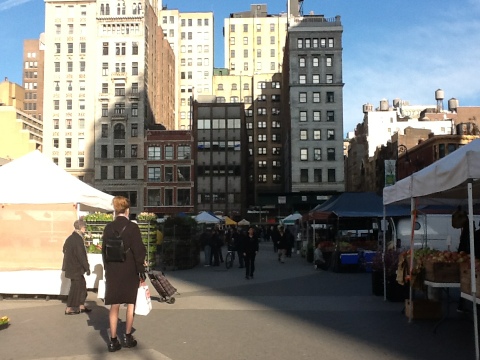
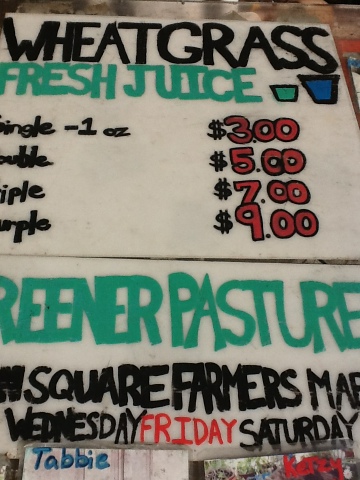
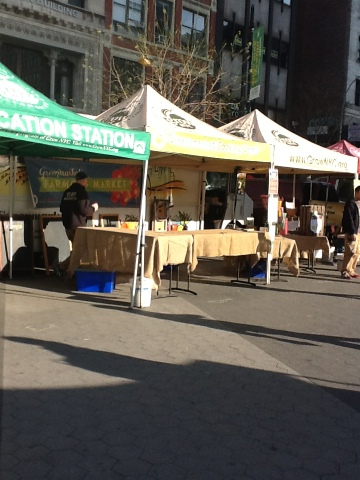
On my way to a morning meeting, I had the great fortune to be able to stop at the Greenmarket on a beautiful Wednesday morning. This is the first half hour of opening, and let me tell you, it never looks this quiet again! I didn’t get close ups of vendors this time, but will whenI go back on Friday morning!

20120404-105156.jpg

20120404-105220.jpg

20120404-105233.jpg

20120404-105251.jpg

20120404-105308.jpg

Farmer Federation of New York farmer information day

This week in Manhattan, Diane of the Farmers Federation of New York leads an overview on EBT, WIC, FMNP and food handling for farmers working at farmers markets. The Farmers Federation works with FNS, Dept of Ag and other partners to streamline EBT acceptance for markets in New York. They facilitate the markets receiving free machines, supply each market with their own tokens, reimburse the transaction costs and train market vendors and managers. A very instructive morning for markets and vendors, courtesy of the Farmers Federation. Nice model for other states to check out.

20120404-104921.jpg

WIC’s Fresh Produce Program Cut 30 Percent – NYTimes.com

Education is part of almost every market’s mission. Explain to your vendors and shoppers that when food assistance programs include regionally sourced food and farmers, it benefits everyone. HOWEVER, do remember those of you that are 50(c)3 organizations, you must not use your organization’s resources to lobby for legislation.
From the IRS website:
… may not attempt to influence legislation as a substantial part of its activities and it may not participate in any campaign activity for or against political candidates.

For those of you NOT 501(c) 3 organizations, a letter writing campaign might be in order!

WIC's Fresh Produce Program Cut 30 Percent – NYTimes.com.

Vendor’s 360 degree view

Recently, I noticed that this vendor at the New Orleans Road Food Festival had thought through their entire setup-both from the front and from the back. It’s a great idea when vendors walk the space they use to see how people will view their setup from a less obvious vantage point.

Not only does this vendor have a 2-sided sign up, the entire group has t-shirts on that identify their site. AND, the whole thing looks pretty organized.
If a shopper happens to see mess, or can’t tell what what is being sold from whatever side they are on, they may just keep on walking…
and by the way, they had great gumbo. And had another great idea- they offered a 2-dollar “tasting size”!

Technical Assistance Poll-Type

Applied Research Center – ARC’s Spring 2012 Racial Justice Webinar Series

JUst attended the first of these which was very informational and useful for organizers. Some good tools to work towards racial justice. Recorded webinars are available on their excellent site.

Applied Research Center – ARC’s Spring 2012 Racial Justice Webinar Series.