Business Alliance for Local Living Economies Conference

I was fortunate enough to receive a Community Capital Sponsorship from RSF Social Finance for the annual conference that is being held in Grand Rapids Michigan this week. I am especially looking forward to the workshop on indicators for measuring local economies, as well as listening in on some of the case studies for funding entrepreneurial businesses.

If you have not heard of BALLE, it’s high time:

The Business Alliance for Local Living Economies, or BALLE, is North America’s fastest growing network of socially responsible businesses, comprised of over 80 community networks in 30 U.S. states and Canadian provinces representing over 22,000 independent business members across the U.S. and Canada.

BALLE believes that local, independent businesses are among our most potent change agents, uniquely prepared to take on the challenges of the twenty-first century with an agility, sense of place, and relationship-based approach others lack. They are more than employers and profit-makers; they are neighbors, community builders and the starting point for social innovation, aligning commerce with the common good and bringing transparency, accountability, and a caring human face to the marketplace.
BALLE’s mission is to catalyze, strengthen and connect networks of locally owned independent businesses dedicated to building strong Local Living Economies.

In late 2001, BALLE was officially launched with Laury and Judy as founding co-chairs and Michael Shuman and David Korten on the first board of advisors. Under Laury’s leadership, BALLE eventually spun off from SVN to become its own nonprofit organization, and held its first national conference in Portland, Oregon, in 2003. Since then BALLE has grown to include more than 80 other local business networks encompassing over 22,000 entrepreneurs in the US and Canada.

BALLE is a 501c3 non-profit organization.

http://www.livingeconomies.org/conference-2012

First Giving May Webinar

Register for our May webinar:

It’s Electric! Spark Engagement with Virtual Participation

Thursday, May 17th, 2012
1pm to 2pm EST / 10am to 11am PST

It’s not always easy to get your motivated supporters together in one place at one time. But don’t let this discourage you from putting on a truly awesome event! FirstGiving’s Account Management team will walk you through how to turn potential no-shows for your event into active fundraisers by offering a virtual participant option.

We’re excited to share with you some noteworthy examples of nonprofits that have creatively set up virtual participation for their event. In addition we’ll warn you of common pitfalls some nonprofits have fallen into, and of course tackle your toughest fundraising questions.

Presented by FirstGiving’s Account Managers:
Jeff Love and Meg Savin

Register now

http://info.firstgiving.com/about-us/resource-library

A few of the questions we’ll address in this webinar are:

What is virtual participation?

When is it a good idea to set this up for my event on FirstGiving?

How do I best keep virtual participants engaged?

FirstGiving is dedicated to one purpose: empowering passionate nonprofit supporters to raise more money than they ever thought possible for the causes they care about.

Have a question? Visit our or call us: (877) 365-2949. Please add sender@firstgiving.com to your address book or safe sender list so our emails get to your inbox. This message was sent by FirstGiving, 34 Farnsworth Street, 3rd FloorBoston, MA 02110.

Only once per year – but boy, imagine that logistics checklist!

By the middle of summer when you market managers get tired of the pop up tents and the vendor grump factor when being asked to spread out or squeeze in to the summer market spaces, take a nice shady break, grab a limeade and watch this time-lapse movie of the New Orleans Jazz and Heritage Festival setting up in April of this year. Talk about a well-oiled machine (although wouldn’t it be funny if they had misplaced a tent and you watched one move 3 feet to the right in this? well, maybe not…)
When we talk about the skills of market management, we should seek out other sectors to compare each piece; obviously the festival logistical expertise is a great one to see how we stack up to this amazing work. How do we compare to this, do you think?

3 Ways to Tap Into Your Customers’ Network | Inc.com

As we hear about more markets opening and more markets staying open longer past summer seasons, we need to figure out who will support us past the early adopters that the original markets found. Honestly, when I hear talk of “cannabilization” of existing markets, I know there is some truth to this although I find the language overly dramatic and needlessly provocative. When I work with a new or an expanding market, I often ask them to describe the type of anchor vendors and first tier of customers they hope to attract, but few are able to do it with any detail. If you don’t know who you’re focusing on with your outreach and marketing, then you won’t know how to reach them.
Especially for new or newer markets, it is imperative to use the existing group that you do attract to find others. As we all know, money is tight and marketing is expensive. Add to that, almost every analysis of good marketing tells you that word of mouth is the most important way to find long lasting customers, which, of course, is exactly what we are all about. This article offers sensible ways to build trust with customers and really your vendors if you choose to see your vendors as your internal customer, which I hope you do.

3 Ways to Tap Into Your Customers’ Network | Inc.com.

Organic canteens: what remains of the pioneer spirit? – Metropolitics

French school cafeterias (or canteens) have started the long trek back to sustainable, healthy food. Unfortunately, this article makes the case that the government focused on organic over local thereby opening up all of the can of worms that entails: corporate organic first before local? using the same kitchen for non-organic production? education for the staff?

Organic canteens: what remains of the pioneer spirit? – Metropolitics.

Sourlands Trailer

Please keep your eyes and ears out for a new film called Sourlands by Jared Flesher, who also did “The Farmer and The Horse” another agricultural film many of us supported through Kickstarter.
I urge everyone to support this important movie, a documentary film starring food, energy, habitat, crazy weather, global climate change and — most important of all — the people these issues impact.

Senior Hunger in America 2010: An Annual Report

From the Meals on Wheels Research Foundation report:

14.85% of seniors, or more than 1 in 7, face the threat of hunger. This translates into 8.3 million seniors. In contrast, in Ziliak, et al. (2008) we reported that as of 2005 1 in 9 seniors faced the threat of hunger.
Those living in states in the South and Southwest, those who are racial or ethnic minorities, those with lower incomes, and those who are younger (ages 60-69) are most likely to be threatened by hunger.
Out of those seniors who face the threat of hunger, the majority have incomes above the poverty line and are white.
From 2001 to 2010, the number of seniors experiencing the threat of hunger has increased by 78%. Since the onset of the recession in 2007 to 2010, the number of seniors experiencing the threat of hunger has increased by 34%.

http://www.mowrf.org/The2010AnnualReport.pdf

Senior Hunger in America 2010: An Annual Report
Prepared for the Meals On Wheels Research Foundation, Inc.
May 3, 2012
Professor James P. Ziliak Professor Craig Gundersen University of Kentucky University of Illinois

Help Establish the Healthy Farms, Healthy People Coalition’s Priorities

• The Healthy Farms, Healthy People Coalition is setting its priorities and you can help determine what they will be. These immediate priorities will help to establish a framework for the coalition’s longer term agenda. Moving forward, they’ll be engaging with partners in a conversation about longer term priorities.

• The survey should take about 10-15 minutes.

• Please note that only one survey response is permitted per organization and that coalition members’ responses will be weighted more heavily than non-members. You will be given an opportunity to join the coalition at the end of the survey.
http://www.surveymonkey.com/s/HFHP_Survey_1

Join the Healthy Farms, Healthy People Coalition:

You can join the Coalition as an organization or an individual. Joining the Healthy Farms, Healthy People Coalition means that you or your organization is committed to fostering dialogue to improve understanding and identify joint priorities that serve both public health and agriculture. It does NOT mean that you or your organization will automatically be signed on to all actions taken by the Healthy Farms, Healthy People Coalition. It also does NOT mean you will necessarily share the Coalition’s top policy priorities. Members will be provided opportunities to sign on to each activity, letter, etc.

Join the Healthy Farms, Healthy People Coalition online at: http://hfhpcoalition.org/join/

About the Healthy Farms, Healthy People Coalition:

The Healthy Farms, Healthy People Coalition works for policy reform that promotes the health of all Americans while strengthening the economic and environmental viability of the food and agricultural sectors. HFHP focuses on policies that help ensure all Americans have access to a safe, affordable, and healthy diet. Healthy farms and healthy people are essential ingredients for a healthy economy.

Overarching goals:

To identify and articulate the common interests of the agriculture, health, equity, and environmental communities in food and farm policy debates.
To advocate for policies at all levels of government (local, state and federal) that support better nutrition for citizens, a healthier economy for rural communities, and a more resilient and secure farm sector, with justice throughout the food system.
To build a broader-based, more diverse movement, spanning rural and urban interests, to achieve the Coalition’s vision.
Contact Project Coordinator, Holly Calhoun, with any questions at hcalhoun@phi.org or (510) 547-1547.

Banana project at CCFM-NOLa

The Crescent City Farmers Market is currently working on a pilot program in partnership with the Louisiana Department of Agriculture & Forestry to get Louisiana-grown bananas in the hands of hungry shoppers. They’re still looking for a few growers to give this a try, but expect to find some willing farmers who agree to grow bananas that are more edible than the starchy plantains and bananas that we have around the city. Seriously, we can throw brown sugar and butter on anything and make it edible, but CCFM smartly wants to see peel and eat bananas for the seniors in FMNP season and so have received a grant to inspire growers to add bananas to their crop list.
Great idea from my home markets and my old employer.

Toronto Market profile-Dufferin Grove Farmers Market

I had the pleasure of visiting our food community in Toronto in mid April, courtesy of the Greenbelt Farmers Market Network and its organizers, Anne Freeman and Sara Udow. Before I left, I was able to visit Anne’s well established, highly respected market (many people I chatted with throughout the city mentioned this market to me when they found I work with public markets), the Dufferin Grove Farmers Market.
The Dufferin Grove Park is a study in itself, and deserves to be used as an example by other neighborhoods that want to be a bridge for their residents and to use their space to inspire and share. I had the great fortune (thanks to Anne Freeman) to sit down with Jutta Mason who has dedicated much of her time to the evolution of this park and its activities. I could say more nice things about Jutta, how market organizers should be so lucky to have a partner like her, but she’d just find this lionizing of her quite odd probably.
But do take some time to see the wealth of resources and activities this informal group has brought to their area:
Friends of DGP

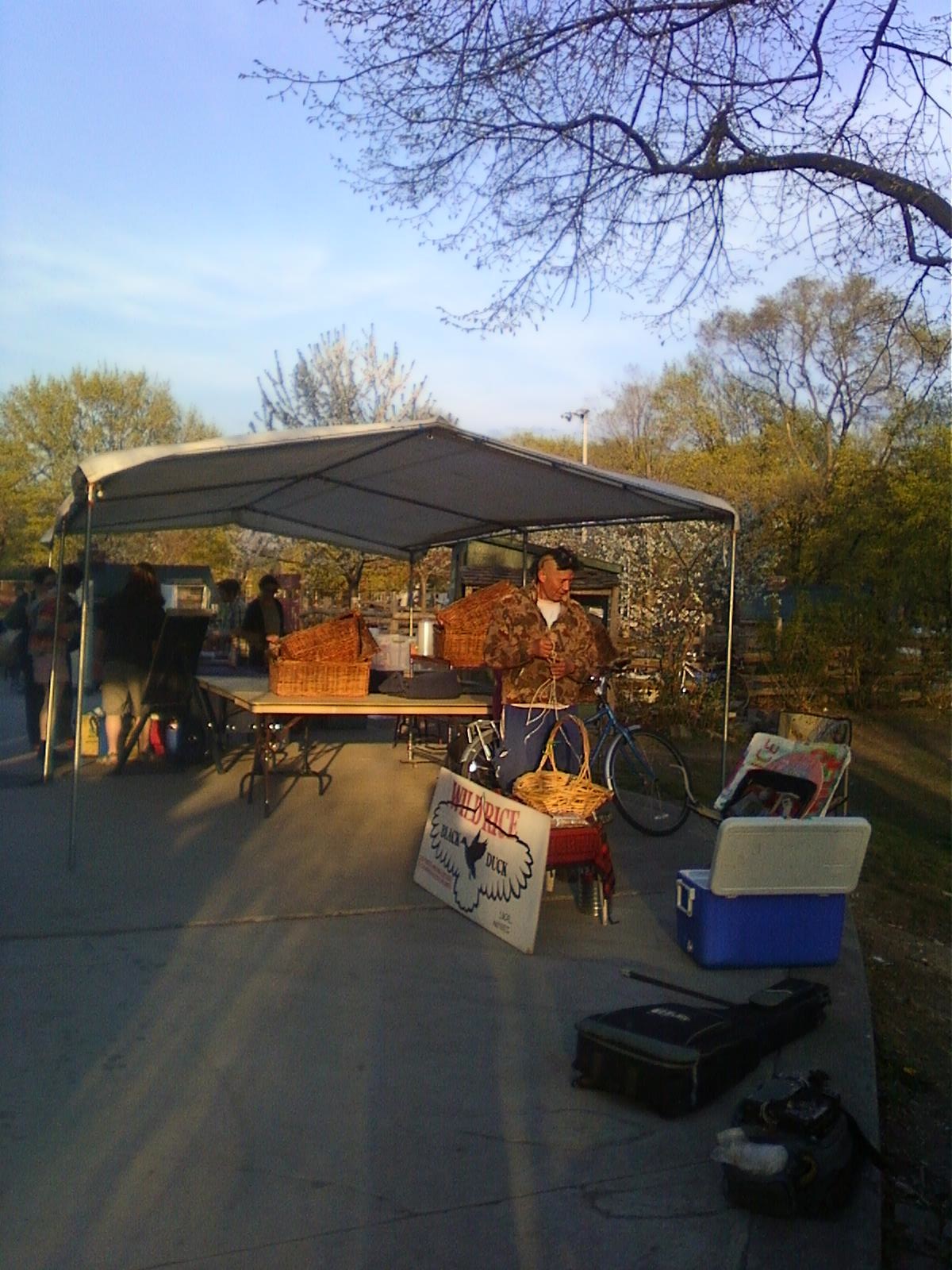
The market itself runs year-round (take that, northerners that say it can’t be done!) and has focused on organic producers, but does have farmers that represent non-organic farming as well. A good mix of small and large vendors. The wild rice vendor is a good example of the mix of season and scale of the vendors- he was sold out for the year after I bought some of his rice and would be back to his regular work until he harvested rice next year. (He told me to throw some of his rice into the swamps down in New Orleans- I might take that idea for an old creek bed on my family property…)
In any case, this is a fantastic Thursday evening farmers market that has been around for a decade already and will be there for future generations….

Black Duck Wild Rice-Toronto

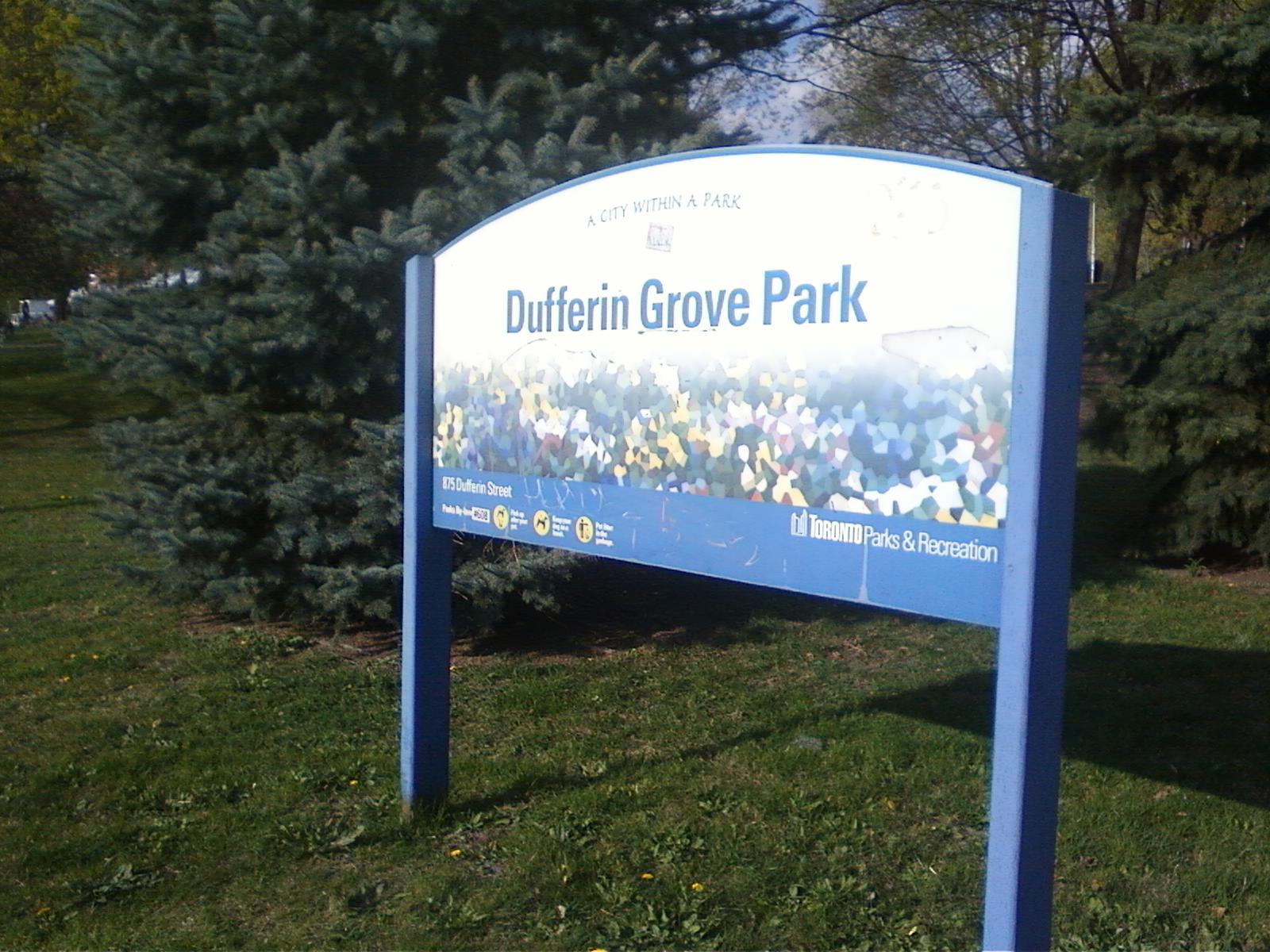
Toronto CA community park


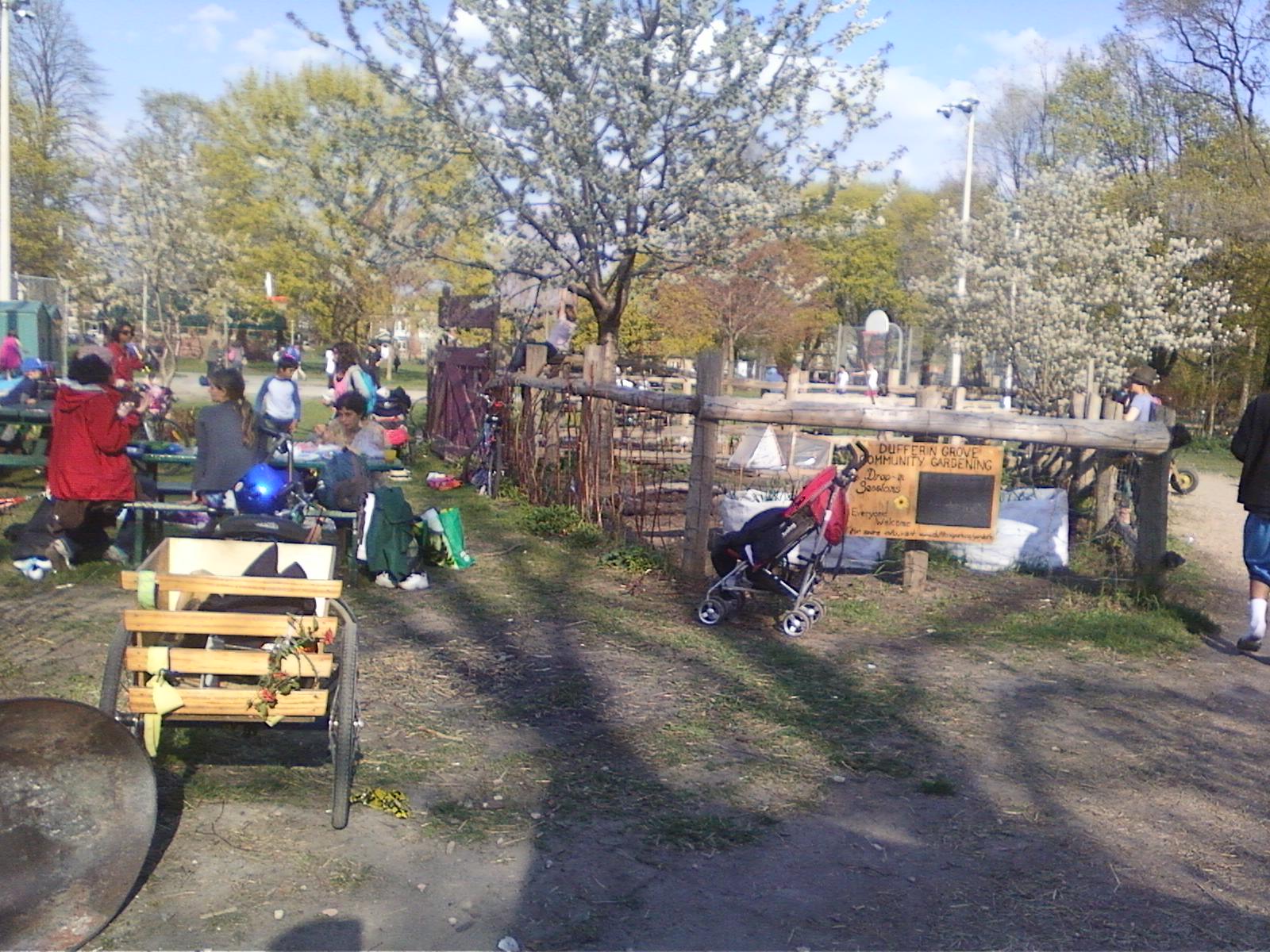
The community garden at the Dufferin Grove Park in Toronto. Sits right next to the weekly farmers market...


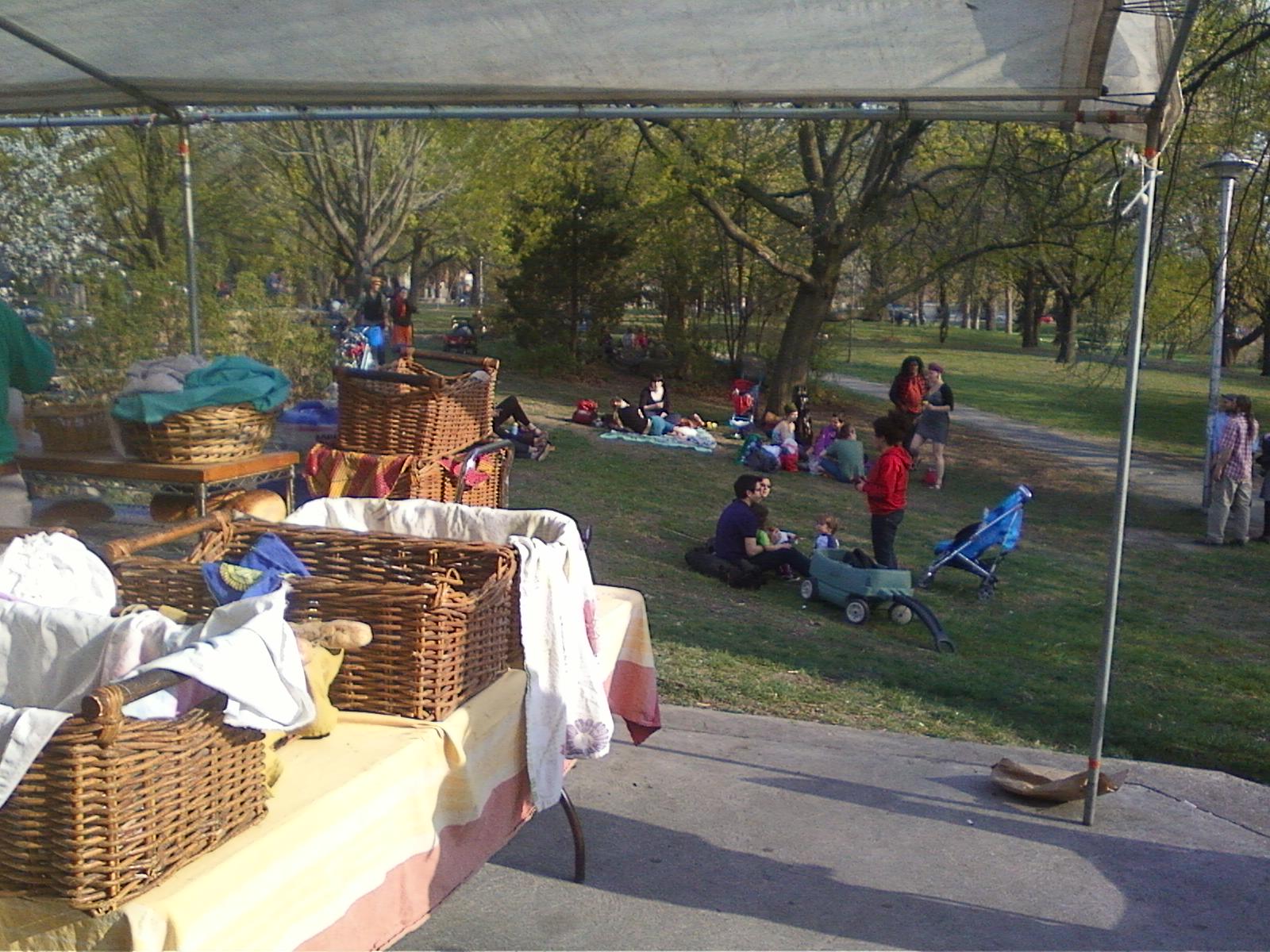
Folks sitting on the grass in Dufferin Grove Park next to the weekly farmers market.


Anne Freeman, the manager of the Dufferin Grove Park Farmers Market is seen here (in pink shirt) talking with one of her vendors in the Zamboni storage area (it is Canada after all!) where the market camps out in the winter and then spills out into the walkway for the rest of the year.


The market sets up this cleaning station for shoppers to add condiments and to clean their plates. A very attractive set up..


The market sale board for the park folks who make bread and food in their bake ovens and have a Friday night dinner as well.

Toronto trip #1

I just returned from giving the keynote at the Greenbelt Farmers Market Network Market Manager Day in Toronto Canada. I know, how lucky does one person get…

Spending four days with my peers to the north taught me a great many things and confirmed some others. I will post a few different stories and highlights about the trip this week, but let me start today with some generalities:
1. The deep awareness of the importance of civil society in Canada serves the market and food system well. Those working on these issues know that in order for change to be calibrated correctly, it is important for citizens to constantly act as “civic agents.” They are not afraid to be oppositional when needed (when dealing with government especially) but also understand that they need to “assist each department in achieving their particular mandate” as eloquently stated by Barbara Emanuel, Manager of the Food Strategy at Toronto Public Health. (That civic agent term was defined again for me in an article I read on the way home in the latest Democracy: A Journal of Ideas in a series called Reclaiming Citizenship which I heartily recommend as well.)
2. Every food organizer I met on that trip understood that the farmer/producer needs to remain as the central partner in all projects. In other words, I didn’t come across lip service to the needs of the farmer. That lip service is usually found in code words or phrases such as “scaling up” or “elitist farmers markets” in food system conversations that I find myself in across North America and in other Western countries. Those code words tell you that the sayers are content to ignore the facts of the relative age and sophistication of our work and the intractable nature of the industrial food system so far.
I instead heard complex, thoughtful responses to the needs of farmers while balancing health equity needs for shoppers. I wish I found that more often in my travels.
3. A set of organizers who recognize that they all must remain at the same table. More specifically, that they all sit at the table but may not have the same menu of choices in front of them. Debbie Fields, the extraordinary Executive Director of FoodShare Toronto said as much to me about her colleague Anne Freeman (my host, the organizer of the Greenbelt Farmers Market Network and founder of the Dufferin Grove Farmers Market) “Anne and I understand that we have the same goal but have to use different avenues to get there.”
4. Internal evaluation is becoming known and necessary. I can’t wait to tell you more about the dynamic presentation (and later meeting of the mind) I experienced through Helene St. Jacques, a Food Share board member and marketing research professional showing results of the research done on behalf of the markets. . And, I look forward to doing some of that US/Canada evaluation sharing with Helene as well.

So much to tell you….

Earth Day FMC radio interview

Stacy Miller, Executive Director of Farmers Market Coalition and Michael Hurwitz, Greenmarket Executive Director (and FMC Board member) talk about markets and food systems.
Good quotes for all of you to use in your annual reports and grants proposals:
(Stacy)
“The myth that somehow that supermarkets are this gleaming beacon of healthy choices…”
“in 2006 that first year of the (FMPP) grant program, they spent a million on promoting farmers markets…that same year, McDonald’s spent 850 million on its traditional media advertising…”
“We’re really in the early stages for fighting for health and equity…”
“I see farmers markets as the ultimate food hub”

in response to the assertion that food deserts are a myth:
(Michael) “Don’t get me started..”

“Our greatest competition are subsidies and advertising”

“Institutional buyers are trying to pay as little as they can”

Straight, No Chaser

Charming piece about European public squares

Our belief that farmers markets are for public good is based partly on this concept that many of our founders took from the European marche rather than the American. This describes the public space in Europe well in a few sentences.

http://usat.ly/IF45Py

An Open Letter to the Food Policy Council

Dear colleagues,

I appreciated the time and courtesy you showed me today in the middle of your packed agenda. I am even more hopeful about the future of a healthy food system after listening in on your hard work. I thank you for all that you have done and promise to do.
As I traveled back home this afternoon, I decided to write out a few major points of what I attempted to get across today, in case some of it was missed by me or simply not clear in our short time together.
My work will continue to be focused on how to build public markets into a movement and their role in the larger food system. I hope my work will benefit you as I gather and analyze data to understand the typology of markets through their characteristics so that we can all better understand how to sustain them and build healthy systems through them.

In the meantime, I want to share what I know about farmers market activists; such as that the reasons for starting or managing a market are wide ranging. It could be economic need in that community or a desire to reconnect citizens or it might be to build an entire food system. In all cases, what each farmers market learns sooner or later is that balance is the key to success. Balancing producers, shoppers and community members’ needs and changing campaigns to meet those needs is the only way to lift barriers and keep people coming back to the same place to continue to have an evolving conversation. As I said today, all great markets have one thing in common: their ability to create and maintain extensive partnerships. The more partnerships (at the appropriate time!) the better.

In the serious work you have before you, you may ask how do farmers markets fit into this health and social equity paradigm you are creating. Here is what I would like you to remember:

•In every conversation we have about food systems, there is one constant. The profound need for successful producers able to work within the human scale of our emerging system. For that need, farmers markets are the best point of entry yet found for encouraging the farmer. A market can work for one, two, or more years with a farmer, patiently letting them find their level of comfort and their own skill set.
•The incredible set of skills within a market (in the farmers, managers, shoppers and partners) can ensure that innovative and (sometimes risky) food system ideas make it past pilot stage. In other words, we experiment well and as we learn to measure those experiments, sensible policy ideas appear.
•The open, democratic, nature of markets mean that true bridging and bonding happen when they are managed well. Can you think of another place the bank president and the bus driver are on the same footing and see each other as often?
•Entry-level positions are necessary for the food system to grow. As we continue to professionalize farmers market management, we will begin to see generations of food system activists in every region with real experience and know-how.

I hope we can all agree on those. The reason I bring them up is to encourage your food leaders to make those things happen. Here’s how:

•Support farmers markets ability to work over many seasons with their producers. Understand that a market farmer is often just beginning the thinking that will often take him or her to complete immersion into larger food system sales. But also grow sisters to your farmers market points of entry by encouraging other types of farmers that might be interested in wholesale or quasi wholesale. Promote CSAs, CSFs, investor circles like Slow Money, marketing cooperatives and other ideas. Realize that markets are encouraging retail farming for one set of farmers, which leaves a piece of the farming pie still covered. Who is encouraging direct marketing of wholesale farm goods at a respectable income level with the same set of criteria that farmers markets demand? (By the way, it might end up being farmers markets again- wholesale markets are cropping up in every region run by the very same organizations that manage the farmers markets.)
•Support action organizations like the Farmers Market Coalition, which is working to build and support comprehensive training for market managers and state associations. Advocate for markets to become members and avail themselves of the webinars, the Resource Library and its advocacy work. And, of course, support practioner/ research organizations like marketumbrella.org.
•Encourage the markets to get to their most useful form. Expect your markets to have proper governance, rules and regulations BUT make sure that all of it fits in with the characteristics of your state’s farmers markets. Each region comes at this slightly differently and policy should reflect that reality. And give it time to get there.
•Professionalize market management by advocating for it. All of the lofty ideas I put forth here are based on someone or a group of someones staying in one place and building it. Let me be clear- yes paid positions must be a priority, but board training and market project planning are just as important, as are sustainable income streams.
•Use the market to address the barriers that the industrial food system and surrounding systems have put in place. Issues like racial equity and the rural-urban divide can be addressed by connecting through food sovereignty. Where better to lead the nation on these issues but here? Look at http://www.foodsecurity.org and http://www.growingfoodandjustice.org to see how to address those issues.

Lastly, policy that will last will come from those markets and roadside stands and school gardens, especially if the measurement is built properly. In that vein, I am attaching the draft of the Indicator matrix that I am working on with the Farmers Market Coalition. It comes from markets and farmers, public health activists and planners. I’d love to hear your feedback and look for ways that you can pilot pieces of it.

In closing, I heartily recommend that you think about success first in terms of your front line – your farmers and market managers. I promise you – they will help you get to the finish line.

Sincerely,

Darlene Wolnik