In the U.S., a Quick Walk to the Store Is a Rare Thing Indeed

Another report to share with food communities as an indicator of the positive changes we can make if we can embed our initiatives in neighborhoods.

“After you pass Seattle, ranked 13th with just 31 percent access, no other city in the U.S. cracks 30 percent, and the bottom 22 cities of the U.S. top 50 by population all have 10 percent or fewer residents within a five-minute walk to the store.

The numbers paint a picture of a dramatically divided nation, one in which even residents of the nation’s largest cities rarely have quick access via active transportation to the ingredients for fresh and healthy meals.

It’s just one more way of measuring how development defines our lives and our choices in ways that we are only beginning to understand.”
Link to story

The Crunchy Cities Index – Support Farmers Markets

This is an exciting piece on the explosion of farmers markets, but I must confess that based on my own knowledge, I find the data to be less than precise. The USDA list of markets is not checked for accuracy and as it is up to market organizers to list and to de-list their own markets, most estimations believe that the list is far from accurate, even though the USDA does everything within its (limited) time to make it right. Even the definition of what can be listed as a market is loose; this may seem like nitpicking (after all more “markets” is good news isn’t it?) but since we know how the capacity of markets remains low partly because of low support among funders and policy makers, the lack of clarity may hurt chances to expand well-managed farmers markets or public markets that support local entrepreneurs.
What is also true is that many retail operations masquerade as farmers markets without directly supporting farmers or managing those involved in direct sales; regular operation, transparent governance and some direct sales for regional producers should at least be the minimum to being listed on this list. Don’t get me wrong; I like the idea of auxiliary and ancillary food initiatives that get regional food into more communities being listed somewhere and to be tied to efforts at flagship or sister market organizations, but we should get better at describing each of them with their own type so we can allow more to flourish.

The Crunchy Cities Index – Buy Local by I Support Farmers Markets.

Experience helps restaurant managers stick with local foods

In a study of the cost and benefits of purchasing local foods in restaurants, managers and chefs indicated that certain actions of local food producers stand out as reasons why they continue to buy local foods. For instance, managers said that a local farmer’s or producer’s response time — the time it took a business to respond and process an order — was more important than delivery time — how long it takes to actually receive the goods — as a factor when they considered buying local food products.
Managers did not seem to think food safety was an issue with handling local food.
Clear labeling is another selling point for restaurant managers who are purchasing foods in grocery stores and markets. The labels should be accurate and easy to read, containing specifications including weight, date and product details, for example, according to Sharma, who worked with Joonho Moon, doctoral student in hospitality management, Penn State, and Catherine Strohbehn, state extension specialist and adjunct professor in apparel, events and hospitality management, Iowa State University.

Amit Sharma, Joonho Moon, Catherine Strohbehn. Restaurant’s decision to purchase local foods: Influence of value chain activities. International Journal of Hospitality Management, 2014; 39: 130 DOI: 10.1016/j.ijhm.2014.01.009

Innovation through your people

Read a recent article on innovation, and I think the point about how to keep innovation alive, even with departing staff (or board) is crucial for market and food organizations to think about.

“Organizations really need to reexamine their management attitudes and practices within a new and more sophisticated framework of innovation. It is important that everyone actively seek out and support the human agents of innovation through, not only the best practices of good management, but also creative initiatives aimed toward innovation at all levels of the business. Assuming a degree of mutual trust and respect has been properly developed, when good people get ready to leave, organizations need to step up their efforts to maintain some sort of ongoing relationship.

A much broader, more human-centered framework for innovation may take on many forms, but could include a range of opportunities to have departing talent on the hook as speakers or mentors within a group. There should also be incentives to build joint ventures with the most entrepreneurial of the bunch, including seed money for new enterprises that feed into market niches of the organization’s endeavors.”

And if you missed this free workshop offer in an earlier post, here it is again:

https://darlenewolnik.com/2014/03/10/free-human-centered-design-workshop-offered/

Maps Made Of Regional Foods

Love these maps; However, wouldn’t it be great if we could change the US map to something less destructive and harder to convert to sugar? Or is that just wishful thinking?

usa-11

“regional food” maps

Childhood hunger

Link to a NBC news story about kids who only eat in school; this is an epidemic problem within the industrial food system that those of us working to build an alternative system must address in our initiatives. We can assist those working on school food issues by using our place and products to offer comfort and good food with just a little incentive…

How about markets offering a case of free fruit near the end of the day so kids have it for later in the day or offering a market incentive for high marks (think 5.00 token to the A students)? That token, along with bus tokens and all offered during SNAP incentive seasons could allow families to expand their time together and expand their meals.

http://www.nbcnews.com/nightly-news/invisible-problem-kids-who-only-eat-school-n55111

Tomorrow is another holiday in the New Orleans area and in many other Italian-American areas- St. Joseph’s Day. St. Joseph is the patron saint of the island of Sicily and it’s said during the famines of the Middle Ages, residents prayed to St. Joseph to deliver them, and the altars are built in thanks on his feast day, March 19.In the late 19th century, New Orleans was a major port of immigration for Italians from Sicily. Many settled in the French Quarter, nicknamed “Little Palermo” at the time. Devout Catholics promise altars for answered prayers and favors granted, such as healing or safe delivery.The food on an altar is supposed to be donated, or “begged.” Countless people work on the altars: Altar societies, church members, Catholic and non-Catholic spend untold hours, starting at the beginning of the year. Many New Orleaniains try to make a “pilgrimage” to a number of altars on the feast day, to churches, store and even to private homes.


and for those of you looking, those who secretly steal a lemon from a St. Joseph’s Day altar will get a husband. For those not in the search, you can just ask for a fava bean: Legend has it that you will never be broke as long as you carry a fava bean.

St. Joseph's Day Altar

St. Joseph’s Day Altar

Keeping Agricultural Land Prices Affordable for Farmers in the UK

“The idea goes back to 2005, when members of various groups involved in ecological land management and cooperative development got to talking. Inspired by a vision for what would become the Ecological Land Cooperative (ELC), they sketched out a plan to buy degraded agricultural land and lease it to people with the desire and skill—but not enough cash—to start small-scale farms with regenerative practices (think permaculture and agro-forestry).”

Keeping Agricultural Land Prices Affordable for Farmers – Economy – Utne Reader.

Be a sign up genius

Whenever I get to farmers market conferences, I learn a few new things: this time, I learned about signupgenius.com from Jaime Moore, Columbus area market manager, Ohio Farmers Market Management Network Board member AND “Central Ohio’s Agricultural Queen” with farm Wayward Seed.

Jaime uses it to manage her three area farmers markets volunteers and based on her to-do list, she needs it…
It looks like a great tool to use (and is free) for market organizations of many sizes and types.

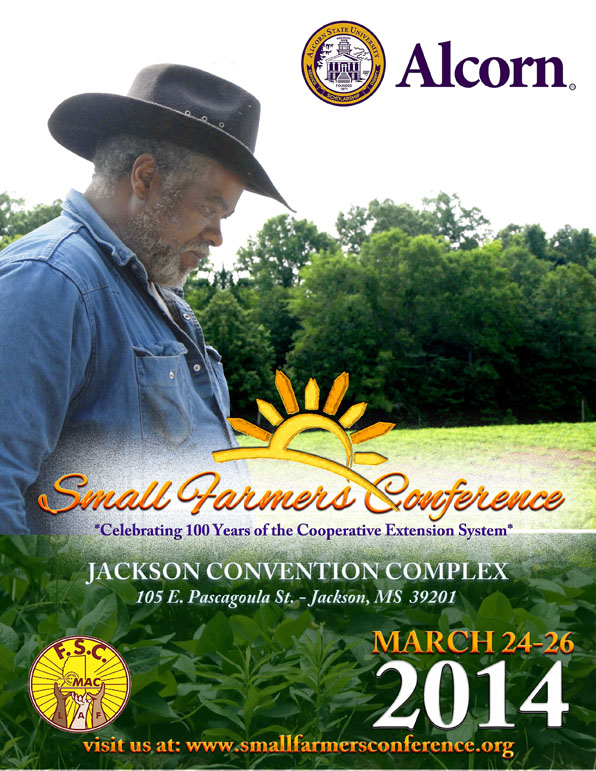
2014 Small Farmers Conference in Jackson MS

The 23rd annual Alcorn State University Extension Program (ASUEP) Small Farmers Conference, slated for March 24-26, 2014, will be held at the Jackson Convention Complex, 105 E. Pascagoula St., Jackson, Miss.
“Using Smarter Innovations to Strengthen Agriculture” is this year’s conference theme. The event is co-sponsored by ASUEP and the Mississippi Association of Cooperatives (MAC).
2014 SFC Web Registration

Free Human-Centered Design Workshop Offered

IDEO.org is happy to announce the second iteration of Human-Centered Design for Social Innovation, a course that we’ve created in conjunction with Acumen. This seven-week course will get you started using the human-centered design process to create innovative, effective, and sustainable solutions for social change in your community. Last year, we had over 13,000 people sign up for this course. They formed over 4,200 design teams bringing human-centered design to 134 countries. Want to learn more? Watch this short video.

How does the course work? This course is designed with a group-guided learning structure. This means that in order to participate, you’ll need to form a team of between two and six people. Once you have your team, you’ll meet each week to learn the human-centered design process via the readings and workshop materials that we’ve created for you. Along the way, you’ll also tackle a social sector design challenge in your own community.

How much does the course cost? The course is free. 

When does the course start and how long does it last? The course begins on March 31, 2014 and is designed to be conducted over a minimum of seven weeks. However, you can also choose to do the course over a longer period of time if a different pace is right for your team.  

Do I need to be a designer to sign-up for the course? This course is open to all and does NOT require any prior design experience.

What if I’ve taken the course already? We’ve created a bonus chapter for those who want to scope their own design challenge. Even if you learned with us last summer, please consider furthering your knowledge of human-centered design by joining us again!

Who else is taking the course? You’ll join teams from around the world taking this course as part of the leadership classes offered by Acumen. Last year, many participants found it valuable to take the course with their coworkers and explore how human-centered design can add new perspectives to their work–whether it be applied to nonprofits, social enterprises, educational institutions, or international aid organizations. In addition, you’ll have the opportunity to share your learnings, ask questions, and get to know other course participants from around the world via an online Google+ community.

Interested in signing up? Register by March 30th at: http://plusacumen.org/courses/hcd-for-social-innovation/

More information? +Acumen course ambassadors are holding precourse Meetups in cities around the world. Attend a Meetup to learn more and to meet other human-centered designers interested in taking the course. More questions? Email HCDCourse@IDEO.org


First Taste

Pass the Virginia Food Freedom Act

Hey Virginians (or friends of Virginians): Please sign or forward this to those who can help influence the legislature to enact a cottage industry law that other states including my own Louisiana and nearby Mississippi passed recently.

Pass the Virginia Food Freedom Act! | Peers.