Fat Tuesday food

Today is a holiday in my city and region, combining the best parts of tradition and public spectacle, and food is an important part of the tradition of Carnival. Our own Poppy Tooker talked about it on NPR last week.
Happy Mardi Gras everyone.

Rex decrees:
“I do hereby ordain decree the following…that during the great celebration all commercial endeavors be suspended. That the children of the realm be freed from their studies and be permitted to participate in the pageantry.”
And to the city’s political leaders, he added:
“That the mayor and City Council cease and desist from governance.
“We will fulfill the will of the people and turn over the key to the city to you, so that tomorrow in New Orleans will be a day of abandon,” Mayor Landrieu said. “Happy Mardi Gras.”

all to eat on a Mardi Gras day…

10 New Orleans chefs share their culinary hopes for the 2014 New Orleans restaurant scene

More ethnic, more niche and available in every neighborhood and supportive of farmers and producers:

10 New Orleans chefs share their culinary hopes for the 2014 New Orleans restaurant scene | NOLA.com.

Regional food sez Real Pickles

Sustainability is the balance of the positive and negative environmental, social and economic demands in any sector and across sectors. In the food work we do, regional systems have a better chance to address them together and yet we spend little time defining those demands. In that framework, local food systems by themselves can grow overly ‘muscular” and crowd out others nearby or focus on demand more than supply (or vice versa) or spend too much energy fighting to build systems for every process that could be shared instead.
In that important work, this blogger wrote a very good piece about the regional and sustainable approach to food that is worthwhile to share:

Those of us in rural areas – rich in agricultural resources – thus have an inescapable responsibility. As we do the necessary work of helping to overhaul the food system, we must consider what part we can play in feeding the populations of places like Boston, New York, and Philadelphia. While it is surely tempting (and so much simpler) to focus inwardly and exclusively on how to feed merely ourselves, that is not, in the end, the way to build a better food system. It is essential to be actively promoting and supporting our local farm economies – and, at the same, we need to thinking more broadly.

Resiliency
There’s another strong reason why we need to think regionally as well as locally, one that undermines the notion that it would even be possible for any one town or small state to securely depend on its own agricultural resources. It has to do with things like weather and pests – those unavoidable factors that make farming inevitably risky and unpredictable. Factors which also threaten to make farming even more unpredictable as a result of climate change.

Regional food

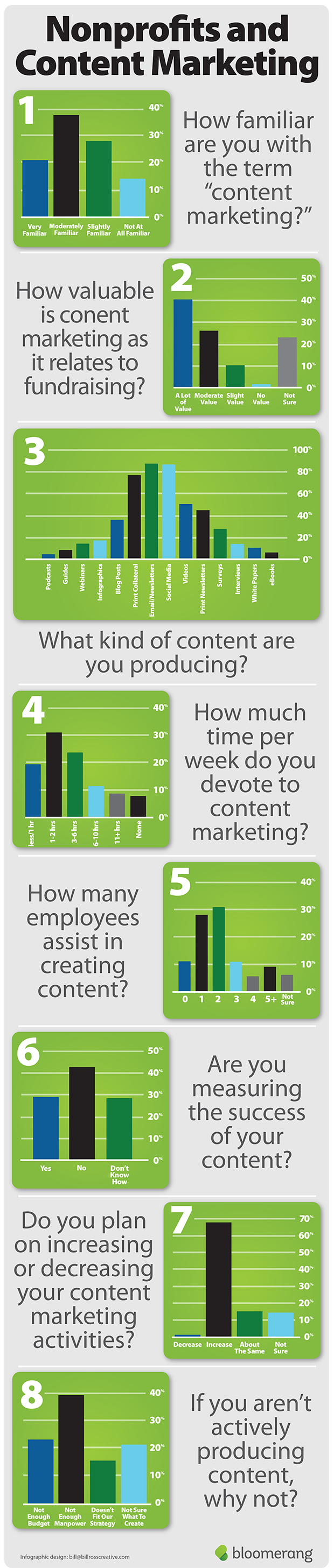
Non-profits and content marketing

bloomerang-ig4a

Trader Joe’s Ex-President To Turn Expired Food Into Cheap Meals

The former president of Trader Joe’s, is determined to repurpose the perfectly edible produce slightly past its sell-by date that ends up in the trash. (That happens in part because people misinterpret the labels, according to a report out this week from Harvard and the Natural Resources Defense Council.) To tackle the problem, Rauch is opening a new market early next year in Dorchester, Mass., that will prepare and repackage the food at deeply discounted prices.

The project is called the Daily Table. Here’s what he shared with NPR’s Scott Simon, edited for brevity.

Simon: What gave you the idea?

Rauch: It’s the idea about how to bring affordable nutrition to the underserved in our cities. It basically tries to utilize this 40 percent of this food that is wasted. This is, to a large degree, either excess, overstocked, wholesome food that’s thrown out by grocers, etc. … at the end of the day because of the sell-by dates. Or [it’s from] growers that have product that’s nutritionally sound, perfectly good, but cosmetically blemished or not quite up for prime time. [So we] bring this food down into a retail environment where it can become affordable nutrition

.

Trader Joe's Ex-President To Turn Expired Food Into Cheap Meals : The Salt : NPR.

What I Learned from a Week on Food Stamps: Paul Ryan Couldn’t Be Any More Wrong

A surprisingly well done article, even though it springs from what I consider an overdone and less than useful premise that I’ve seen before: a reporter using SNAP for a week. However, this one is has decent information and connects this issue to some larger issues, partially thanks to Daniel Bowman Simon.

The average amount that a family on food stamps gets per month is $133. That is $133 for 93 meals. For three meals a day, $133 breaks down to less than $1.50 per meal.

Luckily, the New York City Department of Human Resources’ website has guides available for SNAP participants, including a one that explains how to “Cut the Junk” and another with recipes for healthy and cheap meals on it. (Most of these are bean/chili based….)

———————————————————————————————————————————–
Daniel Bowman Simon is deep into SNAP, which is the focal point of his research at New York University’s Food Studies program. And he is frustrated. Seated in the Food Studies program’s fifth-floor conference room, he ticks off a list of grievances relating to the SNAP program and the Farm Bill, as well as the media’s coverage of the issue — framed as a contest between farm subsidies and SNAP benefits….

————————————————————————————————————————————-

My mom posed a simple question: “Sarah, does SNAP feed people?”

“Yes,” I responded, “and it’s actually really efficient.” It’s true: SNAP has less than a 4 percent error rate, according to Riley — and sometimes that error is because of people who received less money than they should have. The program also has very low rates of fraud. The USDA just released a report saying that only 2.77 percent of errors in the programwere in the form of overpayment, which includes fraudulent applications.

“Food is one of the most cost effective forms of prevention,” Sarah Franklin explains. Obesity, cognitive abilities, and heart disease are all linked to eating habits. “Making sure that people have access to food is, in my mind, one of the most important and no-brainer policies,” she says. “The food stamp program, even though it’s not the perfect program — to make cuts to that program is idiotic.”

What I Learned from a Week on Food Stamps: Paul Ryan Couldn’t Be Any More Wrong | Alternet.

FMC Supports the 2014 Farm Bill | Farmers Market Coalition

    link.

A Koi-Fueled Nursery in New Orleans Yields Tasty Profits

Thanks to Sanjay for sharing this; I have followed VEGGI’s emergence and believe that their efforts are one of the best examples of entrepreneurial farming combined with technology solutions and will benefit many farmers, rural and urban alike. The VEGGI cooperative and cooperatives like it are one of the best ways that small lot farmers can truly become economically sustainable and avoid the burnout of a one-farmer endeavor and how urban initiatives can learn quickly enough to benefit the region.

A Koi-Fueled Nursery in New Orleans Yields Tasty Profits – Wired Science.

New reef rebuilt entirely to help save fisheries in the Gulf of Mexico

The Nature Conservancy is working to restore Half Moon Reef, an underwater oyster colony in the heart of Matagorda Bay, which is one of the most productive fisheries for blue crabs, oysters and shrimp in Texas.
The 45-acre Half Moon Reef will be the Conservancy’s first reef constructed from the ground up.

Chardbodies

from a recent Parks and Recreation, a comedy show set in small town Indiana. I happened to catch it when it aired (do we still say that-aired?) and enjoyed every small joke in it. Someone that writes for this show has to have a family member that runs a market.

Click to watch

Knight Foundation supports research for farmers markets

As a member of Farmers Market Coalition’s research team, I for one am very excited to receive this support from the Knight Foundation and their Prototype Fund. This pilot will allow FMC to listen to markets’ needs and ultimately fashion dynamic solutions to upload simple data (customer counts, number of new products offered, staff time dedicated to outreach for at-risk populations) to then see that data in an appealing info-graphic style for use with market partners as well as to see it aggregated on a national map with other markets data.
Please let me know if you have ideas or experience in data work in your market that may lend itself to iterations of this prototype and please look forward to more information throughout the year on this Farmers Market Metrics work happening at FMC.

http://www.knightfoundation.org/press-room/press-release/24-new-projects-will-go-idea-demo-funding-knight-f/

Class gap: Obesity declines in well-off kids, but climbs in the poor

In 2009 to 2010, 26 percent, or roughly 1 in 4 kids whose parents have at most a high school education, were obese, compared to 7 percent, or roughly 1 in 14, kids whose parents have at least a four-year college degree, according to Frederick. He cited data from the National Health and Nutrition Examination Surveys and the National Survey of Children’s Health.

link

2014 resolution: Let’s work seriously on erasing the divide

As we move into another year of organizing around regional food and public health in the US, we are facing opposition that has become stronger and more agile at pointing out our weaknesses and adding barriers to those that we already have to erase. That opposition can be found in our towns, at the state legislature, in Congress and even among our fellow citizens who haven’t seen the benefits of healthy local food for themselves yet.

That opposition uses arguments of affordability without measuring that fairly against seasonality or production costs, adds up the energy to get food to local markets while ignoring the huge benefits of farming small plots sustainably, shrugs its shoulders at stories of small victories, pointing past them to large stores taking up space next to off ramps and asks isn’t bigger better for everyone?
Why the opposition to local producers offering their goods to their neighbors, their schools and stores? What would happen to the society as a whole if our projects were allowed to exist and to flourish alongside of the larger industrial system?
I would suggest that very little would change, at least at first. Later on-if we continue to grow our work-it may be another matter and this fear of later is at the core of the opposition. That fear has to do with the day that democratic systems become the norm and necessary information is in the hands of eaters, farmers and organizers. And so we need to address and keep on addressing the divide that keeps that from happening.

The truth that we all know is that there is already two systems-one for the top percent and another for the rest. Writer George Packer gave his framework for this very argument in an eloquent essay written in 2011 called “The Broken Contract.” Packer argues that the divide in America began to take hold in 1978 with the passage of new laws that allowed organized money to influence elected officials in ways not seen before.
Packer points out that the access to Congress meant that labor and owners were not sitting down and working together any longer. That large corporations stopped caring about being good citizens and of supporting the social institutions and turned their entire attention to buying access in Congress and growing their profits and systems beyond any normal levels.

“The surface of life has greatly improved, at least for educated, reasonably comfortable people—say, the top 20 percent, socioeconomically. Yet the deeper structures, the institutions that underpin a healthy democratic society, have fallen into a state of decadence. We have all the information in the universe at our fingertips, while our most basic problems go unsolved year after year: climate change, income inequality, wage stagnation, national debt, immigration, falling educational achievement, deteriorating infrastructure, declining news standards. All around, we see dazzling technological change, but no progress…
…We can upgrade our iPhones, but we can’t fix our roads and bridges. We invented broadband, but we can’t extend it to 35 percent of the public. We can get 300 television channels on the iPad, but in the past decade 20 newspapers closed down all their foreign bureaus. We have touch-screen voting machines, but last year just 40 percent of registered voters turned out, and our political system is more polarized, more choked with its own bile, than at any time since the Civil War.
…when did this start to happen? Any time frame has an element of arbitrariness, and also contains the beginning of a theory. Mine goes back to that shabby, forgettable year of 1978. It is surprising to say that in or around 1978, American life changed—and changed dramatically. It was, like this moment, a time of widespread pessimism—high inflation, high unemployment, high gas prices. And the country reacted to its sense of decline by moving away from the social arrangement that had been in place since the 1930s and 1940s.
What was that arrangement? It is sometimes called “the mixed economy”; the term I prefer is “middle-class democracy.” It was an unwritten social contract among labor, business, and government— between the elites and the masses. It guaranteed that the benefits of the economic growth following World War II were distributed more widely, and with more shared prosperity, than at any time in human history…

…The persistence of this trend toward greater inequality over the past 30 years suggests a kind of feedback loop that cannot be broken by the usual political means. The more wealth accumulates in a few hands at the top, the more influence and favor the well-connected rich acquire, which makes it easier for them and their political allies to cast off restraint without paying a social price. That, in turn, frees them up to amass more money, until cause and effect become impossible to distinguish. Nothing seems to slow this process down—not wars, not technology, not a recession, not a historic election.

The economic divide and the lack of information about it hurts our movement since many still see us as either too small or too elitist and so delays our work getting to more people that need it. I urge everyone to find a copy of this entire essay and share it and discuss it widely.