Current crest level and the previous record levels of the rivers in our watershed: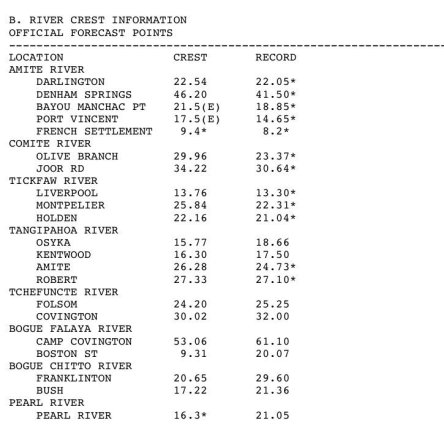
Louisiana Update #2
0 CommentsLeave a comment
Current crest level and the previous record levels of the rivers in our watershed:
The Mississippi Emergency Management Agency said damage reports are coming in on the flooding in southern Mississippi
Greg Flynn, an agency spokesman, said Wilkinson County Emergency Management reported 71 homes damaged by flooding, primarily in the towns of Crosby and Centreville.
Flynn said there are 67 people in a shelter opened in Natchez on Saturday. The Mississippi Department of Human Services and American Red Cross are managing the shelter.
Officials in Amite, Harrison and Pike counties report several roads damaged by the floodwaters.
Flynn said damage assessments conducted by MEMA and local officials are scheduled to begin Monday.
The National Weather Service said southwest Mississippi received over 14 inches of rain late Thursday and Friday.
Sunday update from Copper Alvarez, BREADA Executive Director:
Support the farms of Louisiana by donating to the BREADA Small Farms Fund.
—————————————————————–
Our farmers are all safe, although fields, fences, and feed did not fare so well…If anyone is looking to help out, we are asking for livestock/chicken feed as one of our farms lost everything in the storm.
If you’re interested in donating feed to help our farmers out, please email us at hammondmarket@gmail.com or message us on or FB page.
Everything, no matter how small is appreciated.
-Ashton
—————————————–
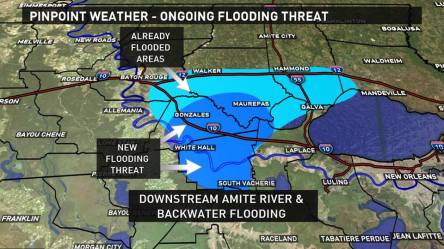
UPDATED: Darker blue shade shows areas that have a new flooding threat from back water off the Amite
Dear Baton Rouge, New Orleans has your back
LONGMONT, CO–(Marketwired – August 04, 2016) – First Nations Development Institute (First Nations) is seeking up to 75 people or organizations — located on or near Indian reservations across the U.S. — to monitor and report food prices on a monthly basis over a 12-month period.
Participants each will be paid $500 at the end of the study. Applications are due by 5 p.m. Mountain Time on Thursday, September 8, 2016.
The participants will collect prices on a list of food products sold in Native communities by monitoring their community/reservation grocery outlet, and then report the prices via an online database. First Nations will use the information to update and significantly expand its initial 2015 report titled Indian Country Food Price Index: Exploring Variation in Food Pricing Across Native Communities (a PDF of the report can be downloaded athttp://www.firstnations.org/knowledge-center).
Most reservation consumers believe they pay more for food products than consumers in urban areas, but there is little data on food prices in Native communities to fully substantiate the claim. In 2015, First Nations piloted an attempt to collect food prices in Native communities, and an overview of that effort was documented in the initial Food Price Indexreport mentioned above. That report found that, on average, many food products were more expensive with the exception of some junk foods. Building on this initial effort, First Nations is seeking individuals, organizations or tribes to collect monthly prices in their local community’s retail outlet.
Monthly food prices will be collected on the following food items:
Project participants will enter their monthly collected prices into an online database provided by First Nations by the 15th of each month. This data will be analyzed and shared with all project participants. Moreover, at the end of the 12 months, the information will be shared with Indian Country at large via the revised Indian Country Food Price Index report.
The project will begin as soon as all of the participants are selected.
To apply to participate, individuals, organizations or tribes must complete a short online application at this link: https://www.grantrequest.com/SID_1243?SA=SNA&FID=35135. Please note that not everyone who applies will necessarily be selected. The selection process will involve consideration of geographic locations, retail outlets to be monitored and other factors. The online application will ask for information such as name, physical address, tribal affiliation, email address, distance to nearest grocery story, whether the store in located on a reservation, if it’s a tribally-owned outlet, and other similar questions. Reliability and accuracy are highly desired traits in those who will be selected. Applications are due by 5 p.m. Mountain Time on Thursday, September 8, 2016.
About First Nations Development Institute
For 36 years, using a three-pronged strategy of educating grassroots practitioners, advocating for systemic change, and capitalizing Indian communities, First Nations has been working to restore Native American control and culturally-compatible stewardship of the assets they own – be they land, human potential, cultural heritage or natural resources – and to establish new assets for ensuring the long-term vitality of Native American communities. First Nations serves Native American communities throughout the United States. For more information about First Nations, visit www.firstnations.org.
Image Available:http://www.marketwire.com/library/MwGo/2016/8/4/11G109314/Images/Food_Price_Cover_large_500-b61d945bdaab9229896530f92708d1ad.jpg
PROGRAM CONTACT:
Raymond Foxworth, First Nations Vice President of Grantmaking, Development & Communications
rfoxworth@firstnations.org or (303) 774-7836 x207
MEDIA CONTACT:
Randy Blauvelt, First Nations Senior Communications Officer
rblauvelt@firstnations.org or (303) 774-7836 x213
When you see the most common (general category) job in most states now, those of us working on food equity will not be surprised at all.
The jobs picture has changed profoundly since the 1970s. This map shows how those changes played out across the country.
Simple, clear and appealing videos on using benefits at markets that can be shared with community centers, sent to targeted social media users and can be used as a banner on news sites too. Bravo Urbana and Fond du Lac!
And from Fond du Lac Wisconsin:
USDA Secretary Tom Vilsack officially declared August 7 through August 13, 2016, as the 17th annual National Farmers Market Week, highlighting the key role that farmers markets play in bringing communities together around agriculture.
If you’re a market manager, USDA has resources to help you celebrate. USDA is offering free online National Farmers Market Week graphics and templates to help you customize posters, emails, websites and other promotional materials. Customizing materials is easy with the help of a short demonstration video. Contact Peter Wood, AMS Public Affairs, for more information at (202) 720-6179 or via email at Peter.wood@ams.usda.gov.
(Also, check out FMC’s lovely and extremely useful NFMW media kit with examples of social media messages and more.)
Learn more about National Farmers Market Week:
We’re kicking off a campaign where people share their favorite aspect of their farmers markets using the hashtag #marketfav with a photo of their favorite thing about the market.
Additional hashtags:
#LocalIsCool #MyFarmer, #MyRancher, #MyCommunity, #MyLunch, #MyIngredients, #MyProduce, #MyFiddler, #MyInspiration, #MySenses
Follow AMS Twitter account: https://twitter.com/USDA_AMS
Update or add your markets in USDA’s Farmers Market Directories: http://usdalocalfooddirectories.com
The article from the title of this post is linked at the end and focuses on Vermont’s market “saturation” from someone who has been a vendor at some of these markets. There is no question that these very real concerns from vendors must be addressed and addressed soon. However, I think that more attention could be paid to the details and challenges of building new food systems by this author in this piece. The market idea works best when it is designed and actively managed as a community activity that reactivates the town square vibe and rewards its ecological mindset and cannot just be judged for its increase or decrease in sales. And that means everyone must honor the town square role, including competing market vendors. Let me elaborate:
First, I hope most of us really don’t think we have reached saturation and cannot find a way to bring the 99%-95% of those who don’t yet shop for local food regularly. I also hope most of us don’t think we can’t encourage more producers to provide it even if it means some different organizing tactics and infrastructure choices. I say let’s dig a little deeper. This includes longtime vendors of markets, many of whom have become comfortable in their spot and with their regular shoppers and as a result, spend less time than they should thinking about newer visitors to markets (notice the lack of prices or details on the farm’s story at many booths as possible indicators) or in assisting in the growth of the market organization once market sales arrive at a sustained level.
A few years back, I did some early analysis of the VT SNAP token system and found that the less-than-robust numbers for SNAP use at markets at that point seemed closely related to the extreme low capacity of their market organizations (people are always surprised to hear how there are no year-round full-time market managers in the state and low, LOW pay for seasonal managers), and a need for a suite of market technology and scrip set ups and outreach strategies, depending on the market situation.
Included in that is the necessary redesign of the market manager job, which in the last decade has seen the need for a whole bunch of new skills and to-dos for the market day that keeps them from the deep customer service and the spot analysis that previous generations could do. Yet:
* In 2011, Vermont market operators reported an average budget line item of less than $1500.00 to pay for market management with most markets reporting between $3,000- $5,000 as a stipend for the manager and no Vermont market reported having a full-time market manager on staff in 2011. In 2010, 59% (37) of reporting markets paid their manager/coordinator, with amounts ranging from $348 to $14,600, with the funds coming primarily from vendors’ stall fees. Of the 37 reporting markets, only 16 markets paid managers/coordinators more than $2,000 for the year.
The added work of permanent programs requires training and relationship-building with a kaleidoscope of agencies and entities around the market; that training should be invested in both the organization and in the person of the manager. In other words, systems to strategically build these and other programs must be created at the market level and at the network level.
Once established, those systems would free managers and overworked vendor board members from the stressful work of recreating the same market structure each season and instead, encourage them to plan mid and long term and spend more time with their community which will lead to better outreach and more intuitive interactions.
One of the most obvious indicators of this lack of planning time is the reduction in time in working with or visiting farms or farm leaders. I believe that the move away from markets by some farmers is directly related to their suspicion that some now see them only as a tent and a table, unable or unwilling to assist them with the development of their business. Another indicator to me of the need for more professional development is the lack of alignment between food hubs and farmers markets that should share the development of vendors businesses even as they have different goals for them.
The capacity of current market vendors has certainly become a storm cloud looming: to understand this issue, data on the number of competing outlets that market vendors now use should be gathered and analyzed. It may be that the issue is not too many markets but too many other outlet types that tax the current vendors. Really, just knowing what each vendor is about and who and how they sell is the goal.
An example of the type of information that could help a market manager is a discussion I once had with a vendor who had stopped selling to chefs after being a favorite for many years. When I came behind the table and sat down at a quiet moment to have him tell me what was up, this is what he said:
You see, what happens is at the Saturday market, Chef (from fancy restaurant; supportive guy) comes by and asks me if I can sell him some of my crop this week; he wants to do a big dinner and give me some publicity. So he tells me to call him first thing Monday morning. I go out to harvest, come in around 10 and call him. They answer and tell me he is running late, but to call back in an hour. In the meantime, the deadline for the Tuesday market is coming and so I call you and tell you I am not sure if I am coming tomorrow but will confirm before the afternoon. (As you know, that market has been a little slow lately as it is this time of year so if I can sell it all to one place quickly I’d prefer it this week.) I wait an hour and call the chef back; they tell me I just missed him and he is in a waiters meeting but told them to tell me he will call me immediately after. You call me back, I have no answer so I don’t answer when you call. Finally, he calls me, still enthusiastic about the crop but tells me regretfully the numbers for the dinner are lower than expected so he can only buy 1/2 of what he thought. That means I have to drop off 1/2 and could bring a little to the market now. Or should I call another chef to sell the rest? I still haven’t called you to confirm one way or another, so I finally decide to call you to tell you I am not coming even though I’d have a little to sell; you are not pleased of course.
I finally decided the stress compared to the sales were not worth it.
Now this is only one vendor’s story and there are differing situations of every hue to uncover about each market. The point is to know exactly how each of your small businesses are doing, with which shoppers and with which outlets. And to know the demographics of your area to know how you can add shoppers to that group. That takes time and support from your board and vendors.
Data on number of visitors per market, average sale, length of time the average shopper remains at market, # of vendors they visit, and the number of shoppers per anchor vendor for example should be examined by each established market suffering with a slowdown in sales. Some tendency may be revealed, such as an abundance of longtime shoppers who purchase from a small number of vendors first thing in the morning with too few newer shoppers who roam the market later trying an abundance of items. Or, it may be that events that look robust and fun are actually not helping sales but impairing them and should be curtailed during the busy season. Or, products are not displayed with prices and details in all cases, driving away those uncertain about the protocol at a market to find out the information that shoppers need. And in some cases, the number of products has decreased, especially in number of new products offered each year. Like it or not, shoppers grow tired of making the same items every night and look for inspiration.
At the state level, the passive approach to the design of direct marketing outlets from some states’ leaders seems an issue. (This seems to be more prevalent in states with a strong farmer/activist core but limited state associations). To increase the chance of success, it seems necessary for leaders to become more involved in exploring and understanding the typology of markets and programs in order to help markets use limited resources extremely efficiently. By doing that work, they will develop a spectrum of interventions that offer local organizers realistic outcomes for those market types and allow for appropriate and attainable growth to be likely.
Of course, I have great faith in the wisdom and earnestness of the Vermont folks and expect that articles like the one below will keep the conversation going on how to strengthen the fabric of their esteemed direct marketing tapestry.
An excerpt from the story:
What would make things easier? How can we improve? These are questions that farmers market boards and individual vendors grapple with as they reconsider nearly every aspect of the market model. Although many farmers are resigned to markets being less moneymaker and more marketing tool, it would be better if they were both. For the farmers markets of Vermont to be sustainable, and lucrative, most of them will need to change.
Overall, it is the consumers — those who have the least at stake and so much to gain — who have the most power over the fate of farmers markets. Consumers decide whether to show up with cash in hand, ready to shell out for their weekly supply of local goods, or merely hang out eating dumplings or cookies made with nonlocal ingredients. They’re the ones who may not show up when it’s raining … unless there’s a Pokémon to find.
Thanks to FMC’s Research Director Alex Canepa for sharing this article about Farmigo’s online market demise.
Here are some quotes from the article, most from Farmigo CEO Benzi Ronen, that I think should be discussed, challenged or simply noted, depending on how you see the scaling up or technological solution conversation in regards to family farming.
Silicon Valley is sometimes guilty of hubris, thinking we can disrupt an industry overnight and do it better,” he says.
He’s confident Farmigo will be just fine, because it still has its CSA software business, which has 300 to 400 customers, depending upon the season, and revenue.
Is there a need for what we’ve been working on? There is definitely a need for it – you can debate, I think, the magnitude of the need. How many customers are willing to pay a premium for a better product?
We are currently looking for partners that can service our customers once the Summer ends. We have also sent all our customers in each region a list of the producers they love so that they can purchase directly from them – Seattle-Tacoma, Greater New York and Bay Areas.
We’re looking at it broader than a CSA platform. Right now we’re servicing CSAs very effectively, but we now we have experience working with a lot broader array of farms than just CSAs. We were working with all kinds of farms, fishermen, bakers and food artisans that wanted to get their food to market. Some of them were CSAs, and some of them were even using our software, but the majority weren’t. We feel that we now know better what software tools we can give all of them, so they can sell direct to consumer if they want, to food hubs if they want, to wholesalers and distributors, to retailers, to farm stands, farmer’s market.
The industry as a whole has grown significantly, but it’s still incredibly inefficient to source this stuff — and those are the kinds of problems I know we can fix. As a software guy, as a guy who’s been building business to business software applications with SAP that connects businesses and allows them to trade more effectively together, to trust one another and to have transparency, to me that’s a massive opportunity
Source: Why Farmigo’s Shutting Down Its Online Farmers Market
Other posts on food hubs.
The place where food and family intersect is ripe for developing a strong block of food voters, especially in swing states, pollsters said. The organic-milk mom could be the new bipartisan soccer mom. With Walmart selling organic produce, farmers’ markets in nearly every community and McDonald’s promoting a new less-is-more ingredient philosophy the line is growing faint between what were once considered latte-drinking liberals and red-state beer buyers.
”Millennial voters are more articulate about food issues than any generation before, and less apt to be loyal to any one political party. And food is one of the few issues in which lawmakers from different parties can find common ground,” Mr. Massie said.
I might suggest the level of success we see in getting food and farming issues into electoral politics will be directly linked to how organizations and producers use their bully pulpit to get elected officials (including candidates) to their markets, gardens and farms.
To assist with that, Farmers Market Coalition is offering an updated Advocacy Kit this summer which already contains excellent tips on how to bond with one’s legislators, including how to invite your legislators to your site.
So what are YOU doing for National Farmers Market Week?
The city of New Orleans has received a $700,000 grant from the W.K. Kellogg Foundation to continue supporting the community’s health and wellness, Mayor Mitch Landrieu announced July 11, adding that the grant will fund a partnership between the city Health Department’s FIT NOLA initiative, the New Orleans Recreation Development Commission, the New Orleans Recreation Development Foundation, Market Umbrella, Louisiana Public Health Institute, and community wellness programs through 2018.
Community wellness programs at clinics and other sites will refer patients in disease management groups to Fit NOLA Live Well; participants will get an NORDC key card for free fitness activities at 12 NORDC recreation centers, 12 summer and three year-round pools, and several playgrounds…and can receive vouchers for fresh fruit and vegetables (at local farmers markets).
Source: Foundation Extends Community Wellness Grant to New Orleans
Hopefully, all market leaders know that the USDA directory is the go-to list for farmers markets for those within the department, for market advocates and for researchers and funders. Most media stories about markets use this link to direct shoppers to us. Additionally, all of the evaluation about markets is calculated from this directory and so if your market is not listed, the true impacts of your producers hard work and of your organizational projects cannot be measured.
Do yourself and all of us a favor: take a breather from outside for a few minutes this week and sit down with a cup of coffee or a glass of tea to update the directory for your market. Market vendors: ask your market manager or lead volunteer if they have updated the list recently.
Dear Farmers Market Colleagues,
Get ready, get listed! National Farmers Market week is coming (Aug 7-13) and you want people to find your market! USDA’s Local Food Directories can help you promote your farmers market. This tool will allow shoppers to quickly identify you as a supplier of the local food. It takes less than 10 minutes to add or update your listing.
USDA will share the number of farmers markets listed in the directory with media and stakeholders across the country during National Farmers Market Week. We want you to be counted! Time is running out! New listings or updated information must be entered by July 15, 2016, to be included in the national numbers, so don’t delay.
It’s easier than ever to register! If this is your first time listing your market in the Directory, go towww.usdadirectoryupdate.com to add your market. In less than 10 minutes you’re done. That’s all it takes.
If you do not know if your farmers market is listed, then you can search the National Farmers Market Directory database to find out. If your market was in the Directory last year, we sent an e-mail during the week of June 27th that has a direct link to update your market listing.
Even if you listed your market last year, you should check the directory again to make sure all your information is still correct.
Here is how the Directory can help you
The USDA National Farmers Market Directory helps you tell customers what they want to know about your market:
- Where and when your market opens
- Second and third market locations that you operate
- What products your market sells
- If your market accepts:
- Supplemental Nutrition Assistance Program (SNAP)
- Women, Infants and Children Farmers Market Nutrition Program (WIC-FMNP)
- Women, Infant and Children, Cash Value Vouchers (WIC-CVV)
- Senior Farmers Market Nutrition Program (SFMNP)
- Whether or not the market acceptances debit/credit cards
- Consumers can even get:
- Driving directions to the market they choose to visit
- Map markets within a radius of their current location
- Get a state or national map of farmers markets
The USDA National Farmers Market Directory used by mobile application developers to help consumers find you or other markets across the nation.
The Directory attracted over 400,000 page views from users last year. It’s the “go-to” resource for consumers, researchers, community planners and more to better understand the size of farmers markets across the nation.
Don’t delay, please be counted by including your market by July 15.
Thank you.
USDA’s National Farmers Market Directory Team

This is a sign at a cork goods store near to my apartment in the French Quarter. It made me think about good customer service and also about how some stores do a better job than others to invite new shoppers in. Of course, it makes me think about farmers markets too in that same manner. It may be even more important to be ready to welcome market shoppers with no experience than other retail shoppers…
The one fact that is undeniable about farmers markets is that the experience is not comparable to how most Americans have regularly shopped for most of their food since before World War II. Therefore, as we work for wider acceptance among food shoppers, we have to constantly be aware of what the scene looks and feels like to most people when they come for the first time:

Okay, maybe not THIS alien, but I’d bet that a fair number of newbies are still baffled by what, how and why the market is about. So if we regularly put out invitations like this, we will need to do our best to prepare the space for them to find their way in (maybe post articles like this on your site? ) so the end result is that we create the environment that tells everyone they are welcome.
For those of you who look for the TL;DR: A well-organized peach festival was held with no mention in their materials about the weekly farmers market held in same town. Is this indicative of the relationship between annual events and weekly farmers markets?
As a past Louisiana market manager, Ruston is a farming community I was already familiar with even before I began to work with them on two current projects. (Let me say that I haven’t spoken to the market folks at all about this post or asked for their opinion on the festival; this is my observation alone.)
I know that Ruston-area peaches are synonymous with the highest quality Louisiana peaches. Imagine my surprise that while there last season, I saw few peaches on the vendors’ tables. I asked market board members about the lack and their response was that is quite difficult to find direct marketing farmers with local fruit willing to sell at market, as most of it goes to larger distribution centers. So when I saw news this week of the Louisiana Peach Festival being held on a market day in the very same town, I expected the festival organizers would highlight the local farmers market, and do their level best to encourage residents attending the festival to visit.
That would seem to be incorrect.
Here is the list of events for the Peach Festival:
Contestants vie for Miss Dixie Gem Peach and Princess Peach
Beta Sigma Phi Arts & Crafts Show
Peach Art Exhibit
Peach Hunt
Baby Photo Contest
Peach Cookery
Quilt & Fiber Art Show and Sale
$1000 Prize Cobbler Gobbler Eating Contest
“A Peach of My Heart” Parade
Peach Stops
BMX & Skateboard Show
Dinosaurs!
Lincoln Parish Park Kids’ Fishing Tournament
Games & Rides
Kids’ Activity Tent
Diaper Derby
5K Run/Walk
Tennis Tournament
Rodeo
Bass Tournament
Now some of those events may indirectly include market vendors or even the market area but no direct connection is listed. On the festival’s Facebook page, there is no mention of the market, even of the added peach events listed on the market’s FB page (along with a link to the festival site):
We are having FREE giveaways every hour this Saturday!! Peaches from Thompson’s Farm, more peaches and homemade peach pie from @annayakspies, peach BBQ sauce from @murphysb.b.q , and of course delicious peach goodies from @rosemarys.kitchen // 8-12 Ruston Farmers Market
This is not that surprising to me, based on experience. My markets were affected by events that we often learned about at the last minute. At times, these events completely surrounded the market, severely limiting the sales for the day. I have also seen this happen at the “country” market that I also frequent which is surrounded by a highly regarded art festival a few times per year and yet is not promoted in the materials.
You might surmise that I am anti-special event and pro-market in all cases, but it is important to note that I also managed events through the market organization, including off-site seafood events (White Boot Brigades) and a holiday market that had some festival qualities held cheek-to-jowl to the Saturday farmers market called “Festivus, the Holiday Market for the Rest of Us.” Festivus began as a way to bolster sagging sales at the farmers market during December and its development was encouraged by the market vendors. However, the market vendors realized after the first year that the Festivus attendees were not also shopping at the market ( how often do you shop for holiday gifts and dairy at the same place and same time?) and by the second year, it was evident to the organization that Festivus could not be held in the adjoining street without severely hampering the market. The third year was 3 months after the 2005 Katrina/levee disaster and since the Saturday market was not yet running, we held Festivus to great success in the market lot.
The final two years of its run, we moved it to Sunday which was a disappointment for the Festivus vendors even though we had great attendance, partly because it was held on “Saints Sundays” in the football-frenzy years directly before the Saints Super Bowl win, and because the vendors were not directly part of the farmers market community which for many was one reason they wanted to vend at Festivus.
I remember one Festivus vendor angrily asking me why we had decided to move Festivus to Sundays. I shared how the farmers market community had been the ones who built this empty parking lot into a vibrant town square year round and their input had to matter (along with the data we collected about sales and shopper type) and all of the input suggested that Festivus did not help the farmers market. The vendor heard me out and replied, “So what? It helps us.” I had no rejoinder to that.
So maybe my story is an example of how festivals and markets cannot work together, but I like to think that if the levee disaster had not happened, I would have continued to figure out Festivus’ sweet spot and turned it into a long term event. (Instead, we stopped it after 5 wildly fun and successful years to focus on post-disaster food production issues.)
What we learned from that was that it was vital that the different characteristics of festivals, fairs and markets (which all are valid and valiant types of activities) are understood by leaders and their attendees. That all of them serve important purposes but not always at the same time or in the same way. That leads to the questions that I continue to raise with markets and other leaders:
Can festivals and markets be held on the same day, in the same area to the success of both?
What is the best way to share the different goals of each with attendees?
How can organizers be sure that their vendors get the results that they need?
Can annual and of weekly events planners measure impact together?
I’d sure like to know.


