From | Co.Exist: World changing ideas and innovation
As those who have met me know, I am determined to see year-round growing (and of course, year-round farmers markets) in every part of North America. When I say that in cold climes, people quickly counter with “”well, you can’t grow here in the winter”, and so I am usually ready with my regular reply: ‘well, someone USED to grow (or can or pickle or hunt) in the winter; are you SURE you can’t?”
Technology is not always the enemy of farming. And in some cases, offbeat ideas have furthered agriculture much more quickly than would have happened without them. Michael Pollan raises that theory in his classic book “The Botany of Desire” with his chapter on marijuana growing. He contends that hydroponics and greenhouse technology was greatly aided by the innovative and yes illegal activities of growers in the Nordic countries in the 1970s. Think of the seed-saving, the homemade lighting systems, watering systems and precise cultivation that now aids farmers growing lettuces, tomatoes and hundreds of other food crops.
With the amount of energy and infrastructure available to urban growers, it makes sense to me that most of them should attempt different farming systems than the rural or exurban farmers who have access to acreage to rotate crops and diverse landscapes. Farming in or on a building seems like a no-brainer as far as what is available. And look folks- this project is starting in Montreal and coming soon to a Northern urban city in the U.S. probably near you.
farmers markets
New Agtivist: Jenga Mwendo grows community in New Orleans | Grist
I met Jenga when she assisted Sankofa Community Development Corporation with the beginnings of what became the Sankofa Farmers Market. That market is in its third iteration now but still, is the only other farmers market besides Crescent City Farmers Market’s three that exists in New Orleans. I know- only 4 in New Orleans? It seems hard to believe…
She struck me then as a serious yet warm young woman who was committed to her community’s health and to leading the good health and well-being of her own family. In other words, I liked her immediately and expected great things.
What she represents in the lower 9 is almost unfathomable to many Americans-one person who is spending her life helping her small, struggling community without any real gain to herself.And doing it in small, quiet ways that rejoice in the re-discovery of the cultural assets of her home.
New Agtivist: Jenga Mwendo grows community in New Orleans | Grist.
1960s market song
So, on the lighter side:
A charming 1960s market song that I came across recently performed by Herman’s Hermits in their movie “Mrs. Brown, You’ve Got A Lovely Daughter”
Something to hum while setting those tents up….
“Lemon And Lime”
(Gouldman)
Mr Brown: Lemon and lime
Turn of the time
Or five for a couple of bob.
Good for a cold
You’ll never grow old
For wheezing there just the job.
Around the corner
In the market square
Thats the spot to make your pitch.
Around the corner
Put your barrel there
That the place where you’ll get rich.
Carrots and spuds
Jeffers and bloods
They’re lovely, ripe and sweet.
Let it out loud
Pull a big crowd
To value they can’t be beat.
Around the corner
In the market square
Thats the spot to make your pitch.
Leck: Around the corner
Put your barrel there
That the place where you’ll get rich.
Pippens with pips
These are the tips
On how to make punters punt
Keith: Give them a schpeal
Polish the peel
And put the good one’s up front.
Around the corner
In the market square
Thats the spot to make your pitch.
Mr Brown & Keith: around the corner
Put your barrel there
That the place where you’ll get rich.
Mr Brown: Peas in their pods
Never lay odds
Mr Brown & Barry: Aware of the golden thumb
Mr Brown: Press down the scale
You’ll go to jail
The costomers are tom thumb
Everyone: Around the corner
In the market square
Thats the spot to make your pitch.
Around the corner
Put your barrel there
That the place where you’ll get rich.
Mr Brown & Karl: Play it my way
Make the game pay
Tell them what they want to hear
Serve with a smile
Cut for the pile
After you’ve sold the idea.
Mr Brown & Herman: Lemon and lime
Turn of the time
Or five for a couple of bob.
Good for a cold
You’ll never grow old
For wheezing there just the job.
Around the corner
In the market square
Thats the spot to make your pitch.
Around the corner
Put your barrel there
That the place where you’ll get riiiiich.
Allergic levels higher for urban kids
Urban kids have more allergies.
Data revealed that the odds of food allergies were significantly higher in more densely populated areas as compared to rural areas and small towns. Rates varied significantly from almost 10 percent prevalence in urban centers to only 6 percent in rural areas. The study also found that the most common food allergy was for peanuts, and milk and soy were two of the most consistent allergies throughout the various demographic areas.
One explanation for a higher prevalence of food allergies in urban areas is that exposure to certain “microbial agents’” or agitants earlier in life may somehow protect a child from developing food allergies later in life. Kind of the same argument for people who use sanitizers too much on their hands and become more susceptible to getting sick as it weakens their immune system. Either way, the association between food allergy prevalence steadily rose as population density rose as well, which makes it clear rural kids are far less likely to suffer from an allergies than their city-dwelling counterparts.
So, once again like in the Dirt Adds Value story from the NYT, linked on this blog, we need to be part of the natural world from the beginning for so many reasons. Farmers and farmers markets contribute to that familiarity and need to be recognized for that.
GMO language taken out of Farm Bill
In case you wondered what the Bernie Sanders (VT) amendment on GMO that failed to pass the Senate was about, here it is:
Co-sponsored by Sens. Barbara Boxer (D-Calif.) and Mark Begich (D-Alaska), Sanders’ amendment would have made clear that states have the authority to require the labeling of foods produced through genetic engineering.
In the United States, Sanders said, food labels already must list more than 3,000 ingredients ranging from high-fructose corn syrup to trans-fats. Unlike 49 countries around the world, however, foods that contain genetically engineered ingredients do not have to be labeled in the U.S.
The measure also would have required the Food and Drug Administration and the U.S. Department of Agriculture to report to Congress within two years on the percentage of food and beverages in the United States that contain genetically engineered ingredients.
http://www.care2.com/greenliving/senate-votes-keep-consumers-in-the-dark-about-gmo-food.html
Seed in Oregon City
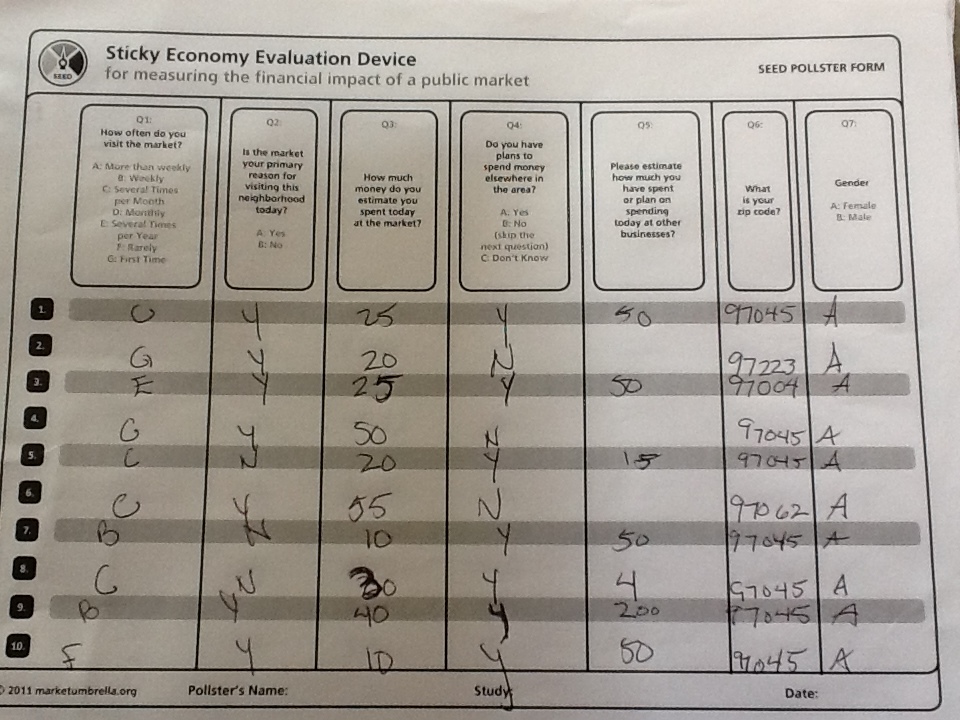
Just finished the first ever SEED http://www.marketumbrella.org/marketshare/
study in Oregon City, Oregon. Market manager Jackie Hammond-Williams puts together an amazing market every few days and has a lot of fun while she does it. Look for my upcoming FMC newsletter story about the study day and how this economic tool measures a markets impact. AND you’ll be able to read the report too – which was ready the next day. I guess we’ll let OCFM look at it first but I’m sure they will have it on their website very soon, and it will be followed by their weekday market SEED report too.
Farm bill update from FMC
Farmers Market Coalition Applauds Bipartisan Leadership on Senate Farm Bill
(Charlottesville, VA) On Thursday, June 21st , the Senate passed the Agriculture Reform, Food and Jobs Act (ARFJA) with a 64-35 vote, after considering several dozen proposed amendments to the bill. The Farmers Market Coalition commends the bipartisan commitment to healthy debate and effective action on long-needed steps to reform and improve the nation’s food policy.
Farmers Market Coalition members were instrumental in reaching out to Senators leading up to the last two days of debate, urging for continuation and expansion of the flagship Farmers Market Promotion Program into the new Farmers Market and Local Foods Promotion Program.
While the Act includes some cuts to conservation programs, the Senate bill does adopt some important amendments, including by Senator Brown (D-OH) on rural development and beginning farmers, by Senator Merkley (D-OR) on crop insurance for organic farmers, by Senator Grassley (R-IA) on commodity payment limit reform, and Senator Wyden (D-OR) on farm to school pilot programs.
As passed, the bill includes the following provisions essential for expanding retail opportunities for small and mid-sized farms while making fresh, nutritious local foods available to communities of all income-levels. Several of the provisions included in the Senate’s bill address the Farmers Market Coalition 2012 Policy Priorities:
● Farmers Market and Local Food Promotion Program – Increases funding to $20 million a year and expands the scope of the highly popular Farmers Market Promotion Program to include additional outlets for processing, marketing, and distributing local foods.
● Specialty Crop Block Grants – Increases funding to $70 million per year for five years from the current level of $55 million per year with provisions to allow for collaborative projects among multiple states.
● Innovations in SNAP Technology – Authorizes pilots of mobile applications and online ordering for authorized SNAP retailers and includes provisions to permit SNAP redemption by community supported agriculture (CSAs).
● Senior Farmers Market Nutrition Program (WIC) – Maintains mandatory funding at $20 million annually to provide assistance to low-income seniors and ensure access to the fresh, local food at farmers markets.
● Hunger-Free Community Incentive Grants – A total of $100 million to create a new grant for incentive programs to increase fruit and vegetable purchases by SNAP customers at farmers markets and other healthy food retailers .
● Community Food Projects – Doubles funding from the current $5 million per year to $10 million per year to support the development of comprehensive projects to fight food insecurity and increase the self-reliance of communities in providing for their food needs.
Sources in the House of Representatives indicate a strong interest in moving forward on a House Farm Bill process after the July 4th recess, with a committee mark-up process scheduled for July 11th. The Farmers Market Coalition encourages House members to follow the Senate’s lead by supporting these innovative, cost-effective, and far-reaching provisions.
“With the current Farm Bill expiring on September 30th, we hope that the House will follow the Senate’s lead on cost-saving reforms that continue to invest in a more resilient, equitable, and diversified food system, ” said Stacy Miller, Executive Director of the Farmers Market Coalition. “We urge the House to retain the Senate’s language on these critical programs, in recognition the economic, social and nutritional impacts farmers markets have in more than 7,000 communities nationwide, for at least 50,000 innovative agricultural producers.”
About Farmers Market CoalitionThe Farmers Market Coalition is a non-profit 501(c)3 organization who seeks to strengthen farmers markets’ capacity to serve farmers, consumers, and communities by providing the rapidly growing movement with information and representation at state and federal levels. FMC is a hub for cross-pollination of best practices and public information, representing more than 3,500 farmers markets through its membership. FMC mobilizes peer leadership and grow farmers market capacity to link sustainable farmers with neighbors seeking healthier relationships to food and their community. For more information, tools, and resources please visit http://www.farmersmarketcoalition.org.
###
dirt adds value
What a great column in the New York Times today. Every time I think we have covered the gamut of what info we need to gather to show how local food systems are working, another imaginative and appropriately scaled data collection point comes along.
Dirt.
In particular, the amount of dirt that farmers and markets are returning to the food system on our just picked products. Dirt that humans used to consume more of (and now in the author’s theory) need in order to reduce the autoimmune issues we have given ourselves from too many antibiotics and scrubbed clean food choices.
Having just consumed handfuls of organic berries, figs and tomatoes straight from the garden this week, I join that chorus.
Environmental factors spread obesity, study shows
If there was ever a study that assisted markets with choosing the right location for markets hoping to incentivize significant nutritional behavior changes…. The well structured analysis simply points out how “Areas with above-average concentrations of food-related businesses had high-than-normal prevalence of obesity and diabetes.” In other words, it might be an example of Tulane Professor Diego Rose’s food swamp language, which explains that large concentration of bad food is much more prevalent than no food (a food desert) where obesity and diabetes is a prevailing issue. If more of this teams’ studies show that the fluctuations found correlate to a socioeconomic disparity (as they think it might), then we might have the data to further the market theory that markets located on “edge communities” serving more than one socioeconomic community will do a great deal for all of those communities.
Top 5 Urban Farms in New York City | Inhabitat New York City
As one of the best entrepreneurial incubators of this century, I think small farms in urban, exurban and suburban areas are extremely useful and appropriate. In NYC, the juxtaposition of industrial or heavily urban areas next to active green space is startling to say the least. I wonder when cities will start to add edible landscaping (especially fruit trees) to their landscaping plans? I understand they won’t be putting them on the middle of busy streetscapes, but why not apple, pear, peach, cherry, citrus, avocado and such in quiet nooks and crannies of the city?
I think market communities could accelerate that by donating trees every year to their city, and even using the market community to work as volunteers to maintain them where appropriate. If every market quietly added some permanent food to their community, we might start another revolution of food returning to public spaces.
Top 5 Urban Farms in New York City | Inhabitat New York City – StumbleUpon.
The amazing collaborative food community of Ontario is coming together to hold a 2 day Urban Agriculture Summit on August 15-18, 2012. Will Allen is their keynote and if you haven’t heard him or had the chance to meet and experience his enthusiastic presence and take in some of his knowledge, this is a great opportunity to do it. Having just traveled up there, I know what I’ll be missing! I wish I could find a way to get back for this and learn more and share more about food systems. If you can make it, do so. You’ll thank me later.
Chicago Outdoor Produce Stands Serving Underserved Areas Approved By City Council
Hopefully, many of you are planning on heading to the Midwest for the PPS September International Public Market Conference on September 21-23, 2012. If you do, it might be worth an extra few days to drive or take the train to Chicago and see their growing local food presence. Every time I go, I find another sustainable project or food system piece to check out. It certainly has to do with the current federal administration’s own interest (and connection to the new mayor) in their home city, and probably also has to do with the last mayor’s interest in greening the city; Daley was the one who put the rooftop garden on city hall after all.
The cart approach that Mayor Emmanuel is offering in the press release attached here has its supporters and detractors. I, for one think before we use these less balanced fixes to try to address food insecurity and sovereignty issues, the farmers market movement needs to be better at knowing how to identify the types of markets that work in these different situations. Or, at least, make sure that the powers that be have farmers needs in mind and have time to build food producers’ long range direct marketing plans. Those types of markets would be collected using the research that myself and others are working on: identifying characteristics, indicators to get typology of markets. My project, using the acronym Market CITY, will be bringing together researchers, practioners and stakeholders to start to build the typology framework. More on that later.
But, do start to plan your Midwestern fact-finding trip and I hope you can find time to seek out these regional farming initiatives when you travel.
Chicago Outdoor Produce Stands Serving Underserved Areas Approved By City Council.
Grants to Increase Mississippi and Alabama The Wallace Center at Winrock International Announces 2012 Request for Applications
The Wallace Center is pleased to announce the 2012 Request for Applications (RFA) for the Increasing Farmer Success in Local Food Markets in the U.S. Deep South: Mississippi and Alabama program. The program, supported by a grant from the Walmart Foundation, is working to strengthen the capacities of limited resource and/or historically disadvantaged farmers, farmer groups, and supporting organizations to meet the fresh produce supply needs of local and regional wholesale markets, and to facilitate farmers’ success in accessing new markets by further developing supply chain relationships. The Wallace Center will accomplish this through strategic investments in Mississippi and Alabama including grants, technical assistance, and the development of a learning network to support local and regional food system development in the Deep South.
The Wallace Center will support 5 to 8 grant projects that will serve as pilot initiatives to demonstrate successful value chain models that can be replicated or expanded through future programs. Successful applicants will engage with farmers and buyers; build capacity; develop or expand the production of fruits and/or vegetables; facilitate the sale of those products into identified markets; and chart a course for sustainability of the project.
Grants range from $20,000 to $75,000 will be made over a 12-month period. Technical assistance will also be available to selected grantees.
Applications are due on Sunday, July 1, 2012 by 6 pm EST (5 pm CST), and should be submitted by email to FarmerSuccess@winrock.org. Mailed applications are accepted with prior permission only and must be postmarked by Saturday, June 30.
Guidelines and further program details for the 2012 Request for Applications can be reviewed and download at http://www.wallacecenter.org/farmersuccess. They are also attached to this email.
Conference Call with Q & A:
The Wallace Center will address questions about the Request for Applications during a conference call on Friday, June 8, 2012, 11 am to 12 pm EST (10 to 11 am CST).
To join the conference call, dial 888-858-6182. When prompted enter this access code: 3742126#. After a presentation on the RFA, callers will have the opportunity to ask questions. Questions may be submitted in advance to farmersuccess@winrock.org. An FAQ from the conference call will be posted on http://www.wallacecenter.org/farmersuccess by June 12.
For Additional Information:
If you have further questions, please call (703) 831-3242 or email farmersuccess@winrock.org. Allow 24 hours for a response. Please share this announcement with interested parties.
