Support the development of the food systems journal to expand applied research

This is Amy Christian and Duncan Hilchey. We are the founders and editors of the Journal of Agriculture, Food Systems, and Community Development, also known as the Food Systems Journal. We are fundraising because we are in the process of transitioning the Food Systems Journal into a nonprofit organization. We boot-strapped the Food Systems Journal three years ago with our own labor and investments, and have continued to subsidize it. Now that we’ve proved the concept of the journal, it’s time to grow and become more sustainable ourselves!

We have recently been accepted as a project of the Center for Transformative Action, an affiliate of Cornell University. The mission of the Journal meshes very well with the Center for Transformative Action’s, which is about making positive change in the world. With your support we are transforming the Food Systems Journal into a nonprofit that can receive grants and donations.

JAFCD

University students use market to educate

Very proud of this initiative as it is in my region and I assisted slightly with it. The students have done a very solid job setting up the market structure, negotiating with the university and the hard work of reaching out to farmers and restaurants. Every one of the three market days (so far) has added a new piece; sometimes its been another farmer and sometimes it’s been some in-depth educational activity. In all cases, the farmers have benefited from good sales and the campus community is learning more about local food challenges and benefits.
No question in my mind that they are building the need and finding the partnerships to get healthy, local food at their university.
http://civileats.com/2012/07/17/the-challenge-of-real-food-at-a-southern-university/#more-15028

I’m Farming and I Grow It

here it is. if you hadn’t heard about it before, now you can show how cool you are.

Office Buildings Add Cash Crops To Their Balance Sheet

From | Co.Exist: World changing ideas and innovation
As those who have met me know, I am determined to see year-round growing (and of course, year-round farmers markets) in every part of North America. When I say that in cold climes, people quickly counter with “”well, you can’t grow here in the winter”, and so I am usually ready with my regular reply: ‘well, someone USED to grow (or can or pickle or hunt) in the winter; are you SURE you can’t?”
Technology is not always the enemy of farming. And in some cases, offbeat ideas have furthered agriculture much more quickly than would have happened without them. Michael Pollan raises that theory in his classic book “The Botany of Desire” with his chapter on marijuana growing. He contends that hydroponics and greenhouse technology was greatly aided by the innovative and yes illegal activities of growers in the Nordic countries in the 1970s. Think of the seed-saving, the homemade lighting systems, watering systems and precise cultivation that now aids farmers growing lettuces, tomatoes and hundreds of other food crops.
With the amount of energy and infrastructure available to urban growers, it makes sense to me that most of them should attempt different farming systems than the rural or exurban farmers who have access to acreage to rotate crops and diverse landscapes. Farming in or on a building seems like a no-brainer as far as what is available. And look folks- this project is starting in Montreal and coming soon to a Northern urban city in the U.S. probably near you.

4 | Office Buildings Add Cash Crops To Their Balance Sheet | Co.Exist: World changing ideas and innovation.

Reclaiming Our Food book review

Reclaiming Our Food: How the Grassroots Food Movement Is Changing the Way We EatReclaiming Our Food: How the Grassroots Food Movement Is Changing the Way We Eat by Tanya Cobb Denckla
My rating: 5 of 5 stars

Useful book that shows a multitude of approaches to building food system pieces, especially garden projects. The stories are well written and best of all, they are followed by a description of the organizing techniques each used for their project.
Easy to pick up and read a profile and then put aside and get something done yourself. Highly recommended for food organizers and city activists.

View all my reviews

New Agtivist: Jenga Mwendo grows community in New Orleans | Grist

I met Jenga when she assisted Sankofa Community Development Corporation with the beginnings of what became the Sankofa Farmers Market. That market is in its third iteration now but still, is the only other farmers market besides Crescent City Farmers Market’s three that exists in New Orleans. I know- only 4 in New Orleans? It seems hard to believe…
She struck me then as a serious yet warm young woman who was committed to her community’s health and to leading the good health and well-being of her own family. In other words, I liked her immediately and expected great things.
What she represents in the lower 9 is almost unfathomable to many Americans-one person who is spending her life helping her small, struggling community without any real gain to herself.And doing it in small, quiet ways that rejoice in the re-discovery of the cultural assets of her home.

New Agtivist: Jenga Mwendo grows community in New Orleans | Grist.

Allergic levels higher for urban kids

Urban kids have more allergies.

Data revealed that the odds of food allergies were significantly higher in more densely populated areas as compared to rural areas and small towns. Rates varied significantly from almost 10 percent prevalence in urban centers to only 6 percent in rural areas. The study also found that the most common food allergy was for peanuts, and milk and soy were two of the most consistent allergies throughout the various demographic areas.

One explanation for a higher prevalence of food allergies in urban areas is that exposure to certain “microbial agents’” or agitants earlier in life may somehow protect a child from developing food allergies later in life. Kind of the same argument for people who use sanitizers too much on their hands and become more susceptible to getting sick as it weakens their immune system. Either way, the association between food allergy prevalence steadily rose as population density rose as well, which makes it clear rural kids are far less likely to suffer from an allergies than their city-dwelling counterparts.

So, once again like in the Dirt Adds Value story from the NYT, linked on this blog, we need to be part of the natural world from the beginning for so many reasons. Farmers and farmers markets contribute to that familiarity and need to be recognized for that.

GMO language taken out of Farm Bill

In case you wondered what the Bernie Sanders (VT) amendment on GMO that failed to pass the Senate was about, here it is:

Co-sponsored by Sens. Barbara Boxer (D-Calif.) and Mark Begich (D-Alaska), Sanders’ amendment would have made clear that states have the authority to require the labeling of foods produced through genetic engineering.
In the United States, Sanders said, food labels already must list more than 3,000 ingredients ranging from high-fructose corn syrup to trans-fats. Unlike 49 countries around the world, however, foods that contain genetically engineered ingredients do not have to be labeled in the U.S.
The measure also would have required the Food and Drug Administration and the U.S. Department of Agriculture to report to Congress within two years on the percentage of food and beverages in the United States that contain genetically engineered ingredients.

http://www.care2.com/greenliving/senate-votes-keep-consumers-in-the-dark-about-gmo-food.html

Seed in Oregon City

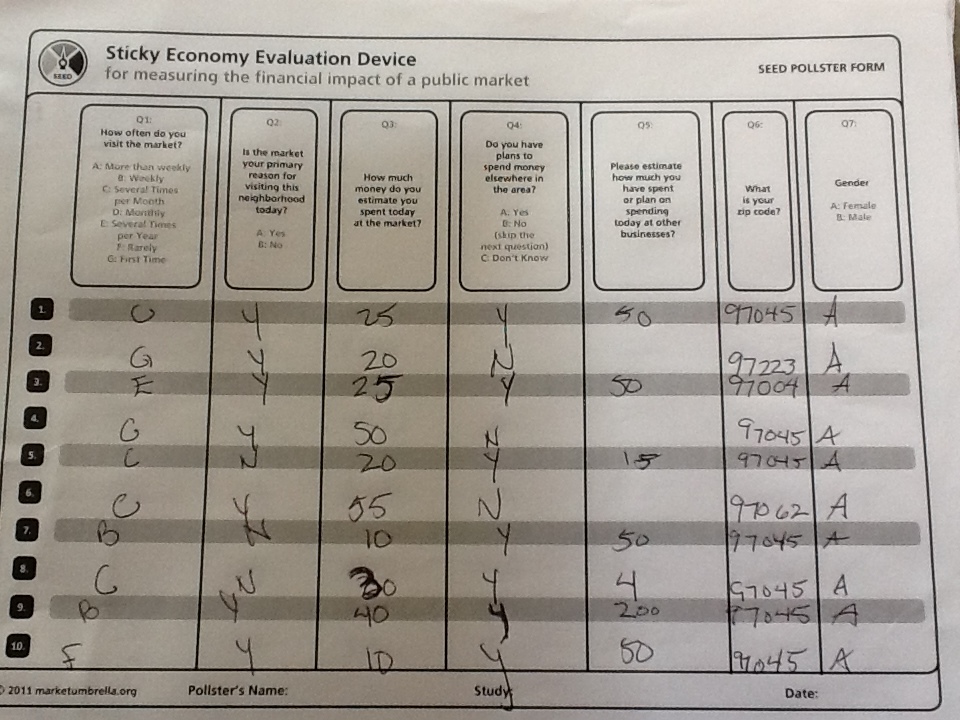
Just finished the first ever SEED http://www.marketumbrella.org/marketshare/
study in Oregon City, Oregon. Market manager Jackie Hammond-Williams puts together an amazing market every few days and has a lot of fun while she does it. Look for my upcoming FMC newsletter story about the study day and how this economic tool measures a markets impact. AND you’ll be able to read the report too – which was ready the next day. I guess we’ll let OCFM look at it first but I’m sure they will have it on their website very soon, and it will be followed by their weekday market SEED report too.

20120626-081822.jpg

Farm bill update from FMC

Farmers Market Coalition Applauds Bipartisan Leadership on Senate Farm Bill

(Charlottesville, VA) On Thursday, June 21st , the Senate passed the Agriculture Reform, Food and Jobs Act (ARFJA) with a 64-35 vote, after considering several dozen proposed amendments to the bill. The Farmers Market Coalition commends the bipartisan commitment to healthy debate and effective action on long-needed steps to reform and improve the nation’s food policy.

Farmers Market Coalition members were instrumental in reaching out to Senators leading up to the last two days of debate, urging for continuation and expansion of the flagship Farmers Market Promotion Program into the new Farmers Market and Local Foods Promotion Program.

While the Act includes some cuts to conservation programs, the Senate bill does adopt some important amendments, including by Senator Brown (D-OH) on rural development and beginning farmers, by Senator Merkley (D-OR) on crop insurance for organic farmers, by Senator Grassley (R-IA) on commodity payment limit reform, and Senator Wyden (D-OR) on farm to school pilot programs.

As passed, the bill includes the following provisions essential for expanding retail opportunities for small and mid-sized farms while making fresh, nutritious local foods available to communities of all income-levels. Several of the provisions included in the Senate’s bill address the Farmers Market Coalition 2012 Policy Priorities:

● Farmers Market and Local Food Promotion Program – Increases funding to $20 million a year and expands the scope of the highly popular Farmers Market Promotion Program to include additional outlets for processing, marketing, and distributing local foods.
● Specialty Crop Block Grants – Increases funding to $70 million per year for five years from the current level of $55 million per year with provisions to allow for collaborative projects among multiple states.
● Innovations in SNAP Technology – Authorizes pilots of mobile applications and online ordering for authorized SNAP retailers and includes provisions to permit SNAP redemption by community supported agriculture (CSAs).
● Senior Farmers Market Nutrition Program (WIC) – Maintains mandatory funding at $20 million annually to provide assistance to low-income seniors and ensure access to the fresh, local food at farmers markets.
● Hunger-Free Community Incentive Grants – A total of $100 million to create a new grant for incentive programs to increase fruit and vegetable purchases by SNAP customers at farmers markets and other healthy food retailers .
● Community Food Projects – Doubles funding from the current $5 million per year to $10 million per year to support the development of comprehensive projects to fight food insecurity and increase the self-reliance of communities in providing for their food needs.

Sources in the House of Representatives indicate a strong interest in moving forward on a House Farm Bill process after the July 4th recess, with a committee mark-up process scheduled for July 11th. The Farmers Market Coalition encourages House members to follow the Senate’s lead by supporting these innovative, cost-effective, and far-reaching provisions.

“With the current Farm Bill expiring on September 30th, we hope that the House will follow the Senate’s lead on cost-saving reforms that continue to invest in a more resilient, equitable, and diversified food system, ” said Stacy Miller, Executive Director of the Farmers Market Coalition. “We urge the House to retain the Senate’s language on these critical programs, in recognition the economic, social and nutritional impacts farmers markets have in more than 7,000 communities nationwide, for at least 50,000 innovative agricultural producers.”

About Farmers Market CoalitionThe Farmers Market Coalition is a non-profit 501(c)3 organization who seeks to strengthen farmers markets’ capacity to serve farmers, consumers, and communities by providing the rapidly growing movement with information and representation at state and federal levels. FMC is a hub for cross-pollination of best practices and public information, representing more than 3,500 farmers markets through its membership. FMC mobilizes peer leadership and grow farmers market capacity to link sustainable farmers with neighbors seeking healthier relationships to food and their community. For more information, tools, and resources please visit http://www.farmersmarketcoalition.org.

###

dirt adds value

What a great column in the New York Times today. Every time I think we have covered the gamut of what info we need to gather to show how local food systems are working, another imaginative and appropriately scaled data collection point comes along.

Dirt.
In particular, the amount of dirt that farmers and markets are returning to the food system on our just picked products. Dirt that humans used to consume more of (and now in the author’s theory) need in order to reduce the autoimmune issues we have given ourselves from too many antibiotics and scrubbed clean food choices.

Having just consumed handfuls of organic berries, figs and tomatoes straight from the garden this week, I join that chorus.

http://www.nytimes.com/2012/06/21/opinion/lets-add-a-little-dirt-to-our-diet.html?_r=1&ref=contributors

Jeff Sessions Argues Food Stamps Increase Not Moral, Mocks Kirsten Gillibrand

In case you sometimes forget that the farm bill is a political fight, and there will many attempts to derail a thoughtful, serious conversation about the type of food we eat, who produces it and who will get access to it.

Jeff Sessions Argues Food Stamps Increase Not Moral, Mocks Kirsten Gillibrand.