Great Places Awards, Fayetteville 2030: Food City Scenario

Big fan of the Fayetteville food work I have seen and heard about.

The EDRA 2015 Place Planning Award recipient, “Fayetteville 2030: Food City Scenario,” asks the question, What if Fayetteville’s projected growth enabled the city to sustain its food budget through a local urban agriculture network? And what kind of infrastructure would a city have to develop if it cultivated a local food system? While the large metropolis sponsors the most efficient carbon footprint per capita, moderate scale cities like Fayetteville are better equipped to evolve resilient food-secure environments given the interconnectedness and metabolic alignment among their natural ecosystems, infrastructure, and urban fabrics. Food City’s transferable set of planning tools, established by the University of Arkansas Community Design Center, not only assists to embed high-quality food production into American urbanism, but shows how urban infrastructure can also deliver important ecosystem services.

All of the 2015 Environmental Design Research Association awards here

Open source gleaning model helps NC market farmers address hunger issues

I had the great pleasure to become acquainted in 2012 with this innovative program that is closely linked to the North Carolina farmers markets and individual farmers to get food flowing to more people- but this model made sure that it was NOT at the expense of farmers businesses. Their Donation Stations allows customers to buy an extra share to donate to those in need and also allowed farmers credit for any donations that they made. Their wholesale work to get more agencies to buy regional food is also extremely important.

Open source model helps NC solve hunger problem | opensource.com.

Food sovereignty is what?

Agrarian Reform
Defense of territory
Agro-ecology
Local food systems

“World-wide, peasants, pastoralists, fisher-folk and other small-scale food producers
provide some 70% percent of the food consumed by humanity, even though we
probably only hold a quarter of all farm land. In Africa, we women farmers do about
70% of farm work, and we grow about 80% of the food. Peasants, and especially
peasant women, feed today’s world”

viacampesina.org/downloads/pdf/en/Elizabeth-The Hague-ISS-25 January 2014.pdf.

The Agrarian Standard | Wendell Berry

Recently, I was working on a piece for The Nature of Cities blog, and wanted to re-read something that Wendell Berry had said about the agrarian culture; I found the 2002 Orion Magazine essay in which he reflects on the 25th year of publication of The Unsettling of America. I think the paragraph below is enormously descriptive of the tension that those of us involved in creating an alternative agrarian world work and live in:
To the corporate and political and academic servants of global industrialism, the small family farm and the small farming community are not known, not imaginable, and therefore unthinkable, except as damaging stereotypes. The people of “the cutting edge” in science, business, education, and politics have no patience with the local love, local loyalty, and local knowledge that make people truly native to their places and therefore good caretakers of their places. This is why one of the primary principles in industrialism has always been to get the worker away from home. From the beginning it has been destructive of home employment and home economies. The economic function of the household has been increasingly the consumption of purchased goods. Under industrialism, the farm too has become increasingly consumptive, and farms fail as the costs of consumption overpower the income from production.

The Agrarian Standard | Wendell Berry | Orion Magazine.

Regional food sez Real Pickles

Sustainability is the balance of the positive and negative environmental, social and economic demands in any sector and across sectors. In the food work we do, regional systems have a better chance to address them together and yet we spend little time defining those demands. In that framework, local food systems by themselves can grow overly ‘muscular” and crowd out others nearby or focus on demand more than supply (or vice versa) or spend too much energy fighting to build systems for every process that could be shared instead.
In that important work, this blogger wrote a very good piece about the regional and sustainable approach to food that is worthwhile to share:

Those of us in rural areas – rich in agricultural resources – thus have an inescapable responsibility. As we do the necessary work of helping to overhaul the food system, we must consider what part we can play in feeding the populations of places like Boston, New York, and Philadelphia. While it is surely tempting (and so much simpler) to focus inwardly and exclusively on how to feed merely ourselves, that is not, in the end, the way to build a better food system. It is essential to be actively promoting and supporting our local farm economies – and, at the same, we need to thinking more broadly.

Resiliency
There’s another strong reason why we need to think regionally as well as locally, one that undermines the notion that it would even be possible for any one town or small state to securely depend on its own agricultural resources. It has to do with things like weather and pests – those unavoidable factors that make farming inevitably risky and unpredictable. Factors which also threaten to make farming even more unpredictable as a result of climate change.

Regional food

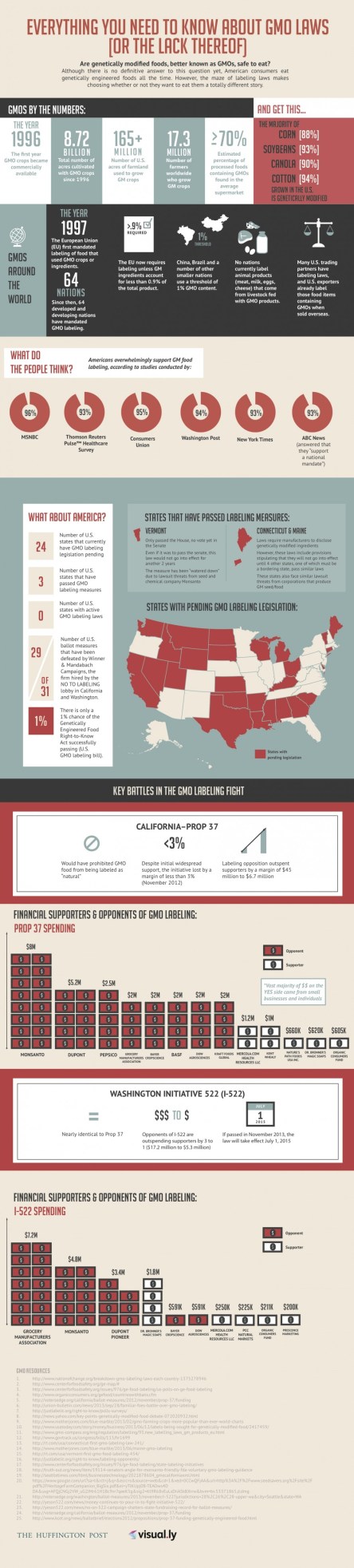
GMO Infographic from HuffPost

GMO Infographic from HuffPost

The MOON magazine | The Future of Food

This month we gather around the topic of food—a subject everyone loves. Food is the great convenor, the global common denominator, the alchemical substance that pulls parties into the kitchen, makes friends out of strangers, puts flesh on our bones and smiles on our faces.

But all is not well in food land, despite the colorful array of products on U.S. grocery store shelves. One third of Americans are overweight; diet-related diseases are skyrocketing; our food is being designed to addict, rather than nourish; bees are dying; biodiversity is being lost; and modern agriculture is based on massive inputs of petroleum—a finite resource.

The MOON magazine | The Future of Food.

Food First

Well done critique of the food politics that we currently live and die with. Yes instead of encouraging “fencerow to fencerow” agriculture (even for seemingly well meaning reasons), we need to assess our true needs and grow the proper food accordingly and grow it well with less inputs and environmental destruction in every succeeding generation. And instead of running into each other over middling legislative issues, we need a movement of big ideas like food sovereignty and human rights to push fairness for all that allows everyone to chime in as needed and to allow us to move past crisis campaigning. When, for example, will the US food organizers work side by side with the rest of the world’s organizers? When will we embrace true import-replacement strategies? When will all pieces of the food chain be valued?

Farm Bill Fiasco: What is Next for the Food Movement?”, a Food First Spring Backgrounder

By Christopher Cook
Deciding how America will nourish itself and sustain its farms would seem a top policy priority— yet as the US Farm Bill demonstrates, sustainably grown, healthy food and livable incomes for farmers and workers remain an afterthought in a process controlled almost entirely by agribusiness and a handful of farm-state legislators. Despite strong public opinion supporting local food, farmer’s markets, organic agriculture, food workers’ rights and access to fresh produce, agribusiness and commodity interests continue to dominate food and farming policy.

That’s largely due to their prodigious lobbying clout: agribusiness spent $137 million last year muscling Congress to do its bidding and another $46.6 million on federal candidates (about 60 percent Republican) in 2010. This phalanx of power includes commodity producer groups like the American Corn Growers Association; corporate food processors and purveyors such as Kraft and Dean Foods; the Farm Bureau; dairy and meat industry giants; and seed and petrochemical corporations like Monsanto.
On the other side, armed with ideas and passion but little money, stand hundreds of groups from across the US pressing Congress on an array of policies—including commodity subsidy reform, fair prices for farmers, public monies for local foods and small farmers, and conservation and nutrition funding. With a handful of lobbyists and diverse interests, they fight doggedly for small wedges of the Farm Bill pie.

But is the Farm Bill a productive venue for food movements to make meaningful change in food and farming policy?

read more

International Day of Peasant’s Struggle, April 17

The peasant movement, La Via Campesina is a bright light in the darkness that is spreading with global corporations controlling more and more of the natural resources across the world. This loose confederation of actions and organizations has its feet solidly in the food sovereignty movement, which I think U.S. activists should identify as our chief food system goal, rather than food security. Food security (availability of good food for all) is important, but more important is when it happens where the local community decides how, when and where to feed itself which is what food sovereignty encompasses.

“The international peasants’ movement La Via Campesina has been defending and expanding the practice and policies of food sovereignty around the world for 20 years. To launch another 20 years of struggle, we are calling for a massive mobilisation day on 17 April, the International Day of Peasants’ Struggles, to reclaim our food system which is being increasingly occupied by transnational capital. We invite everyone to organise activities, protests, art exhibitions, direct actions, discussions, film screenings, farmers markets etc., in your village, school, office, neighbourhood, organisation, community…”

Wherever you are, join this collective celebration on 17 April!

At the World Food Summit in 1996, La Via Campesina (LVC) launched a concept that both challenged the corporate dominated, market driven model of globalised food production and distribution, as well as offering a new paradigm to fight hunger and poverty by developing and strengthening local economies. Since then, food sovereignty has captured the imagination of people the world over – including many governments and multilateral institutions – and has become a global rallying cry for those committed to social, environmental, economic and political justice. Food sovereignty is different from food security in both approach and politics. Food security does not distinguish where food comes from, or the conditions under which it is produced and distributed. National food security targets are often met by sourcing food produced under environmentally destructive and exploitative conditions, and supported by subsidies and policies that destroy local food producers but benefit agribusiness corporations. Food sovereignty emphasizes ecologically appropriate production, distribution and consumption, social-economic justice and local food systems as ways to tackle hunger and poverty and guarantee sustainable food security for all peoples. It advocates trade and investment that serve the collective aspirations of society. It promotes community control of productive resources; agrarian reform and tenure security for small-scale producers; agro-ecology; biodiversity; local knowledge; the rights of peasants, women, indigenous peoples and workers; social protection and climate justice.
Markets in Bogotá

As farmers market organizers, we get busy with our logistical work and our market aches and pains that come from growing too fast. As important as it is to remember what we have in front of us in the U.S., it is as important for us to remember what the rest of the world struggles with and how they see farmers markets as a solution too.
This piece from the Nyéléni newsletter (the Food Sovereignty newsletter for the international movement) tells an inspiring story about market organizers in Columbia that should be read by all North American organizers too.

www.nyeleni.org/DOWNLOADS/newsletters/Nyeleni_Newsletter_Num_13_EN.pdf.

Infographic | Why Land Rights Matter

Once again, this is where I see farmers markets influencing public policy. If this can be understood by the communities that use farmers markets, then we can begin to add supporters to the land rights movement too.

why-land-rights-matter-big_02

Infographic | Why Land Rights Matter.

A Food Atlas For Everyone

Food AtlasFood Atlas by Darin Jensen
My rating: 4 of 5 stars

I love maps. When I travel, I study maps online to have some sense of the geography underfoot, as much to understand who the people might be as not to get lost. It’s amazing how people appreciate that bit of homework when you go to their place.
I have maps of my city (New Orleans) and of my river (Mississippi) on the wall of my house and the Slow Food RAFT map (see below) on my business card.

Slow Food RAFT map

Slow Food RAFT map


I have books of maps authored by favorites such as geographical historian Rich Campanella and activist Rebecca Solnit, whose collaborative map book (“Infinite City”) of her home of San Francisco is a thought-provoking juxtaposition of right and wrong, culture and place.

When I came across the Kickstarter campaign for this Food Atlas, I jumped at the chance to support it. It arrived last week and I have read it while sipping my morning coffee (while reading about Strong Coffee traditions in the Middle East and “Bird Friendly” coffee origins), referred to it while writing about farmers markets (the one on SNAP and farmers markets) and studied the Texas Seafood Landings map after making flounder tacos just north of Lake Pontchartrain, home of most of the seafood catch for my bioregion. It’s a very new book and so won’t be found everywhere yet, but you can buy it from them now at
http://www.guerrillacartography.net/home

It is a wealth of maps on food production, distribution, security, exploration, identities and to pick out my favorites is to shortchange the breadth of this book.
It’s not just for activists, or “foodies” but for everyone and I think it could affect (and galvanize) people just as M. Pollan’s “The Omnivore’s Dilemna” did. I grow tired of long text articles about food (Yes, I do include myself in that finger pointing!) and would hope that this sort of map project could become a new way to educate and illuminate the small world that we live on.

I can’t wait for the editors to follow up on their promise to expand the reach of this series including to add more Asian and African food maps and to get this Atlas in hands everywhere. Its a bit heavy on maps of the West Coast and of the US, so much so that it occurs to me that having a set of food maps that show the lopsided view we have of ourselves in the US versus how others see us or experience us might be a good edition. In any case, hurrah.

..

View all my reviews