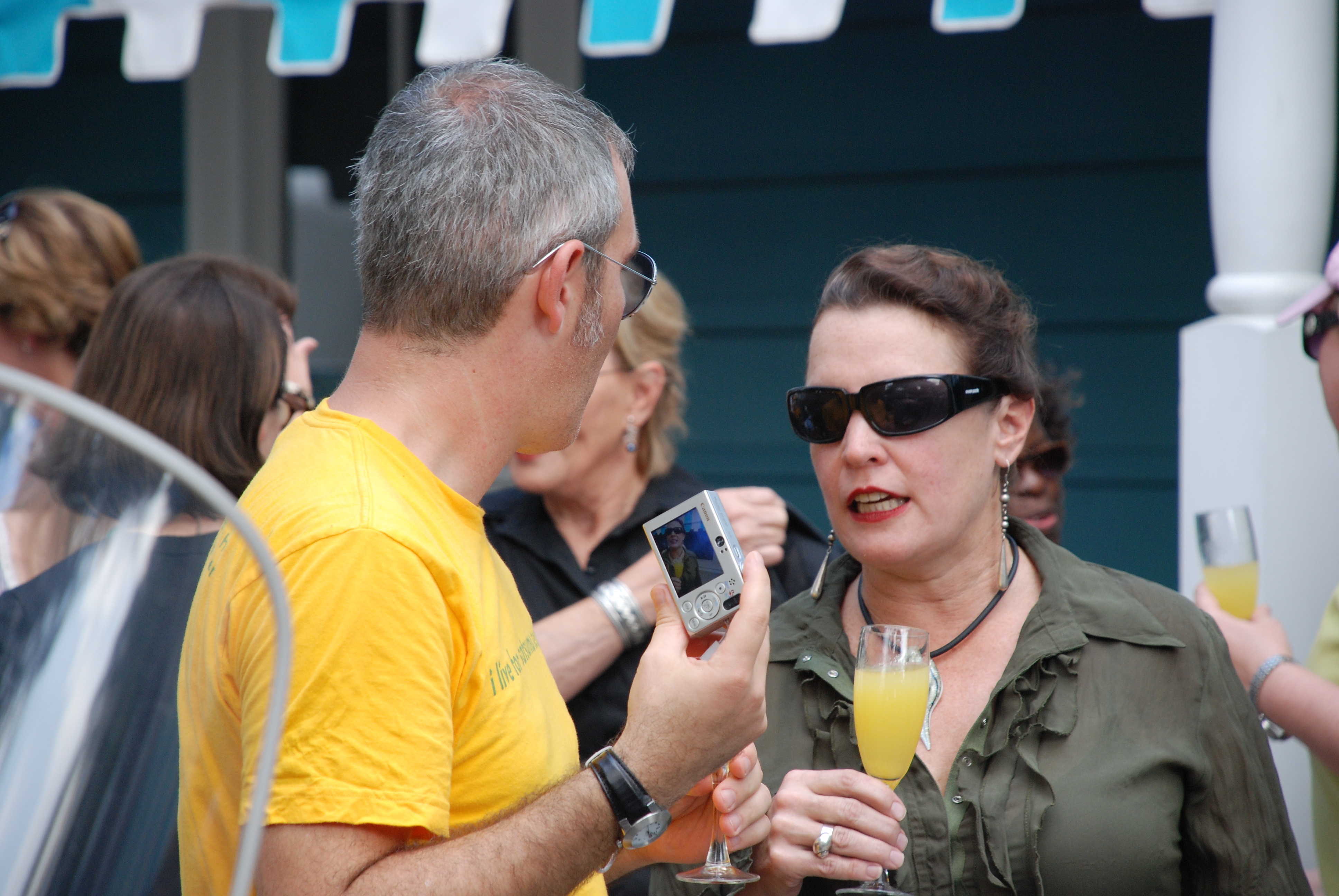
Richard McCarthy and Poppy Tooker at CCFM event circa 2003 or 2004

Richard McCarthy and Poppy Tooker at CCFM event circa 2003 or 2004

A fascinating interview with Richard McCarthy,  one of the founders and the first Executive Director of Market Umbrella and therefore of the Crescent City Farmers Market, Festivus (the fair trade holiday market), Market Match, Marketshare and so many other initiatives devised and run by this disciplined little NGO in New Orleans. This interview was done as McCarthy was leaving for Brooklyn for his new job as Executive Director of Slow Food USA and so is important as a record of the people and ideas that were in place when he devised the groundbreaking work that many of us proudly did under his direction.

Poppy Tooker has been a deep supporter of the organization and as she says, remains a close friend of Richard’s. There is so much detail in this interview about the history of the organization in those days when we existed as a project of Loyola University’s social justice center Twomey Center.

To hear a market founder talk about the plans and dreams of his work and how it was put together seems useful to anyone embarking on their own version.

The Importance of Being Slow

News & Events | VEGGI Farmer’s Cooperative

This is a new Vietnamese-led growers initiative in New Orleans. I hope we begin to see more production cooperatives among farmers, especially urban and peri-urban farmers.

News & Events | VEGGI Farmer's Cooperative.

FMC’s FMPP report

A fascinating report from FMC and MU about the Farmers Market Promotion Program.

Press Release here

Report and more information here:

FMPP Report

Eco-village

Here’s an opportunity to build a sustainable place with significant local food production and public/sales space in its center. I look forward to seeing the choices.

What would you do if you had the opportunity to design and build a new village or city? These opportunities do not come around often, so when one does we have to make the most of it!! The opportunities abound in Christchurch after the devastating earthquakes of 2010 and 2011.

As part of the city rebuild a competition was established. It is called “breathe”—the new urban village project….. an international competition to design and build a new place for living in the Central City.

Introducing the Christchurch Central Recovery Plan from CCDU on Vimeo.

The Dallas Farmers Market is no longer controlled by the city. What happens now?

The Dallas Farmers Market is an interesting version of a public market. Almost a decade ago, I was invited to Dallas for a set of public meetings (along with DC/Fresh Farm founder Ann Yonkers) to help the chefs, farmers and food entrepreneurs get to the next step in reorganizing this market.It seemed then that a lot of competing ideas were on the table and that to get it moving, they would need both deep design options and mission development. This news may signal that they have taken the necessary next step.

The Dallas Farmers Market is no longer controlled by the city. What happens now? (And what becomes of Pecan Lodge?) | City Hall Blog.

Cloud computing is a trap, warns GNU founder

This subject is one that markets must consider as we turn to online accounting and data management systems. Selecting a good offline backup system may be as necessary as finding the right cloud storage or computing system.

Cloud computing is a trap, warns GNU founder | Technology | guardian.co.uk.

6-10 of the Top 10 ingredients

6. To have community-produced energy:
More solar panels on our rooftops. Everyone should be able to invest in solar panels for their homes, apartments and office buildings. The ability to invest our money into solar energy projects is paramount, and our friends at Mosaic are experts in doing both of those things.

Billy Parish, Mosaic: Mainstage speaker

7. To live and work in harmony with the natural world:
There are countless innovations that are inspired by nature. Economic systems can be designed like living systems in which there is no waste, but rather every output becomes a nutrient to another subsystem. Janine Benyus is the expert!
Janine Benyus, The Biomimicry Institute: Vision speaker

8.To adopt a “Buy Local First” purchasing initiatives:
Communities can thrive by thinking “Local First” in every aspect of their purchasing. Alignment of their economic development policies and buying from local sources keeps money in the community. We know there may not be a local option for everything (all you caffeine junkies know what I’m talking about), but if we make it easy for hospitals, universities and other local institutions to connect with local producers and providers, there will be greater impact. These people are all doing it!
Stacy Mitchell, Institute for Local Self-Reliance: Towards a Localist Policy Agenda
Matt Raker, AdvantageWest: Economic Development and Community Capital
Carlos Velasco, Fuerza Local: Local First 2.0

9.To tap into community capital:
We need to unleash local money! We need local banks, investors, and community foundations to drive investment into our local businesses. Many of the most pioneering businesses and farms that are critical to a thriving local economy have the most difficult time gaining access to traditional sources of capital, so we need innovative and relationship-driven solutions for funding. Hear from the people on the ground.
Don Schaffer, RSF Social Finance: Integrated Capital and Connections
Michael Shuman, Cutting Edge Capital: Rethinking Investment
Dawn McGee, Goodworks Ventures: Rethinking Investment
Paul Hogan, John R. Oishei Foundation: Community Foundations and Grassroots Funders

10.To connect leaders and spread solutions:
There will be hundreds of local business networks, incubators, hubs, and people to learn from in your community, so connecting people in meaningful ways to share ideas and spread innovation is key to our learning and momentum. Let’s talk openly about what worked and what didn’t. Create gathering spaces that bring people together and foster collective work at all levels. We are better together! These two dynamic women are making it happen.
Deborah Frieze, The Berkana Institute: Cultivating Leadership for Localism
Angie Hawk Maiden, ACENet: Economic Development and Community Capital

(1-5 are found here in this earlier post)
Learn more at BALLE’s 2013 conference, held in Buffalo NY this year:
http://bealocalist.org/2013-balle-conferenceBALLE 2013

FMC Discover You Can program participants for 2013

• Bellingham Farmers Market, Bellingham WA

• Bushwick Farmers Market, Brooklyn NY

• City Market, Kansas City MO

• CitySeed, New Haven CTCommunity Farmers Market, Bowling Green KY

Countryside Conservancy, Peninsula OH

Downtown Evanston Farmers Market, Evanston IL

Downtown Farmer Market, Salt Lake City UT

Durham Farmers Market, Durham NC

Farmers Market Association of Toledo, Toledo OH

Foodchester, Inc. Pleasantville NY

Greater Springfield Farmers Market, Springfield MO

Green City Market, Chicago IL

Hub City Farmers Market, Spartanburg SC

Lancaster Market, Lancaster NY

Las Vegas Farmers Market, Las Vegas NV

Mainstreet Farmers Market, Statesboro GA

Minnetrista Farmers Market, Muncie IN

Moscow Farmers Market, Moscow ID

Neighborhood Farmers Market, Seattle WA

New Orleans Food & Farm Network, New Orleans LA

North Central Texas Farmers Market/Cowtown Farmers Market, Fort Worth TX Omaha Farmers Market, Omaha NE

Oregon City Farmers Market, Oregon City OR

Rochester Downtown Farmers Market, Rochester MN

SD Weekly Markets, San Diego CA

Seacoast Eat Local, Exeter & Dover NH

Smart Markets, Fairfax VA

Teller County Farmers Market, Woodland Park CO

Ypsilanti Farmers Market, Ypsilanti MI

©2013 Hearthmark, LLC dba Jarden Home Brands. All Rights Reserved. Distributed by Hearthmark, LLC dba Jarden Home Brands, Daleville, IN 47334. Hearthmark, LLC is a subsidiary of Jarden Corporation (NYSE: JAH).


More about this popular program

Impact on neighborhoods must always be considered

One of the reasons that I stress markets over festivals as a tool for building community cohesion (and yes, there are excellent exceptions to that rule) is the negative impact that poorly designed open air festivals often have on their neighborhoods. Since the organizers do not have to be back there for some time after their staged event, it allows them to bypass getting input beforehand or feedback afterward from the surrounding area.
In contrast, when markets run weekly or even more often than that, they must rely on the goodwill of the neighbors to make it work and must fit into the fabric of daily life.

The festival that brought this post on says they are about the greening of my home city, yet they have an event that lasts for more than 10 hours that creates tons of trash, noise pollution and drives the nearby lower income neighbors away from quietly enjoying their tiny slice of bayou on their weekend. Furthermore, the scale of it is immense and the neighborhood itself gets little to no benefit from this event. To be clear: this is NOT a festival ground, but a small green space that is the bank and grassy area of the bayou that runs through the city of New Orleans. There are no parking lots nearby. These three blocks are in a quiet area with four parks less than three miles away, including one of the largest parks in the U.S. that is desperate for events like this to get funds to be viable. Instead, these organizers come to an open space that is managed by the levee district, probably knowing that the agency has no infrastructure to oversee this or to know how to charge them for the repairs needed for the space.

One respected organizer of markets once told me that they preferred markets over festivals because they believed in the transformative power of connecting people through everyday life, through simple public interactions with time and space to talk over asking them to spend a suspended 12 hours recreating (buying?) culture in an inauthentic setting.
Well, I do like festivals – I just attended the French Quarter Festival which has grown from 2 tents in Jackson Square in the first year to a very well attended event in a neighborhood that has the infrastructure to manage it AND still has the smarts to put most of the noisiest stages away from the residential areas. With older family members in the Quarter, I can tell you that the FQF noise does not hamper their weekend enjoyment, which is not true for those directly impacted by this event. I also attend the JazzFest, which started as a block party and then quickly moved to the Fairgrounds when it outgrew its blocks. I don’t attend the JazzFest as often I used to, as the entry fees are prohibitive now for locals, but I do tip my hat to the amount of money and support over the last 40 years that they have given to their constituency – musicians mostly – and for the fact that they manage an extremely professional event that does not severely impact the neighbors, as the fairgrounds have buffer areas for noise control and they have staff that patrol for trash and they manage traffic and parking very well (from someone who lived NEXT to the JF for a few years!)
I simply wish these newer festivals would spend some time realizing proper scale, for how to use proper outdoor events to promote neighborhoods and about the give and take that open air farmers markets and well-run festivals build with their neighbors and attendees.
Festival Info | New Orleans Earth Day Festival & Green Business Expo.

The passing of a volunteer and friend

Just got word that a longtime volunteer of the Crescent City Farmers Market and a personal friend passed away this week. Judy Serice was there near the beginning with the small group that founder Richard McCarthy gathered around him to help him build this dream. Judy was a true fan of the market and for the rest of her life, she always championed it in every way possible. A champion cook herself- she won a category of the Pillsbury Bake-Off with (I believe) her chicken and dumplings recipe. I’m actually angry with myself that I remember neither the details of the year (1970?) or the dish exactly, because I used to send Judy into peals of laughter when I introduced her and knew all of the details.  (She also later won our Orange Julius contest partly because of her making the recipe at market in her “vintage” green mixing blender.)

Judy was a teacher by trade, a chef by talent and a mother by choice. She had a thoroughly modern view of the world, but honored the New Orleans traditions she was raised with and shared with her 3 children (John, Mark and Ashley), one of whom became a professional chef. Her advice to me while I ran the markets was invaluable, especially when it came to matters of literally, taste. Judy was always spot on  with her assessment of vendors products and I actually created a “Mystery Chef” program partly because of her, which asked for anonymous evaluations of products to then share with the vendors to help them continue to refine their table.

Even after she stopped volunteering, Judy and I (and her market buddy, the ever acerbic and delightful Pat) would have lunch and chat and spend a fascinating few hours. To listen and laugh with Judy and Pat were among the best moments of my market management and my larger life in those years.

I’ll miss my buddy and always remember how a volunteer taught me so much.


“I am a river to my people”

Be forewarned- here is another of my odd musings on the nature of organizing….

The quote from Lawrence of Arabia contained in this clip below is my favorite from the movie and one that immediately stuck with me after hearing it years ago.
Later on in life, I realized that it was because Bedouin Shaikh Auda abu Tayi was portrayed as a wily, committed freedom fighter but more than that, as a community organizer. This speech speaks to his leadership style (well, in a violent way) and how outsiders cannot or should not judge it with their own yardstick:

Being a river to his people translated (to me) as simply being the conduit for resources and knowledge while allowing them their cultural identity. So my feeling is that it is the same for great markets: that they are rivers in their community and, as such, need to carry the knowledge and resources forward for their community without impeding the cultural flow.

Now back to your regularly scheduled non-Anthony Quinn life…

The Lessons We Can Learn from France’s Fertile Soil

“Understanding this process is awakening to the simple reality that nothing in this world is ever really new. Only recycled. Soil organisms are the engine of an endless reincarnation process through which land fertility is maintained.”

Wonderful piece on soil; please feel free to share widely with your communities. Again, I take this back to markets: if we as market organizers and producers can reawaken our regional bioregional and watershed communities to regrow our soil and clean our water, then I think we will have served our purpose for the Earth. How can we ensure that our work continues to transfer the knowledge needed? Good soil/bad soil comparison demos? More farm visits for our customers? Soil testing at markets?

The Lessons We Can Learn from France’s Fertile Soil – Environment – Utne Reader.