Forget ‘Whole Paycheck’?

The linked article below tells of Whole Foods’ campaign to let America know of their “cheaper” prices and is interesting news on a few fronts.
One, that the world’s leading natural and organic food store is sharing price comparisons and acknowledging the need to identify costs to their shoppers. Co-CEO Mackay says, “For a long time Whole Foods had the field to ourselves, pretty much. That was nice, but we don’t any longer,” he said on an earnings call with investors. “So we’re adapting to the reality of the marketplace.”

Secondly this: the chain is lowering its prices, particularly on produce.
This may be an indicator of the strength of the farmers market movement that has led WF to become more competitive on fresh produce. That may seem a far jump for some of my readers, but since it was not an issue when they competed only with other grocery stores, I am inclined to partly credit the energy of the increased number of farmers market outlets for fresh produce for one of the reasons for this.
Or, it may be that the chain feels that they can reduce their costs by reducing their waste in produce (reducing spoilage is an area that stores should always be working on to increase profits) or (sigh) maybe the chain feels it can ask for lower prices from farmers/producers more easily than companies from whom they buy value-added products.

I’d love to hear others thoughts on this news and how they think it affects farmers markets and other direct marketing outlets.

Forget ‘Whole Paycheck’—This Grocery Chain Now Beats Many Competitors’ Prices | TakePart” target=”_blank”>Whole Foods Story

Louisiana Eats on seafood issues

Slow Food maven, radio host and author Poppy Tooker did a great show on seafood on Louisiana Eats: Gerard Maras (a giant among chefs in New Orleans) shared his boiling technique, Tenney Flynn who is still the best seafood chef in the French Quarter, talked about fish handling and finally Poppy and her guests discussed the ecological issues facing the harvesting community. Seafood is something Poppy knows a great deal about-she is a fisherwoman herself and one of the champions of fishing families in Louisiana and across North America.

Can you remember to mark “listen to Louisiana Eats” to your Saturday calendar? I’d recommend it.

The Ebb And Flow Of Louisiana Seafood | WWNO.

Monsanto Visits Local School for 47 Minute Propaganda Presentation

“Monsanto told children at his school that they created jobs for people and that they helped to feed the world…
Monsanto also told a fable to children about how one farmer tried to get rid of Monsanto seed and the stuff they spray on their crops and that it caused him great trouble. Additionally, the company warned against saving heirloom, organic seed, though this particular term wasn’t used.
When this child’s parent tried to contact the school about the uncanny way in which the Monsanto Corporation was trying to brainwash his child, he was referred to his child’s handbook. It turns out that the school’s principal was actually the one who set up permission for Monsanto to speak to the children.”

Monsanto Visits Local School for 47 Minute Propaganda Presentation | NationofChange.

Meatonomics

unnamed

Meatonomics is the first book to add up the huge “externalized” costs that the animal food system imposes on taxpayers, animals and the environment, and it finds these costs total about $414 billion yearly. With yearly retail sales of around $250 billion, that means that for every $1 of product they sell, meat and dairy producers impose almost $2 in hidden costs on the rest of us. But if producers were forced to internalize these costs, a $4 Big Mac would cost about $11.

amazon

2014 resolution: Let’s work seriously on erasing the divide

As we move into another year of organizing around regional food and public health in the US, we are facing opposition that has become stronger and more agile at pointing out our weaknesses and adding barriers to those that we already have to erase. That opposition can be found in our towns, at the state legislature, in Congress and even among our fellow citizens who haven’t seen the benefits of healthy local food for themselves yet.

That opposition uses arguments of affordability without measuring that fairly against seasonality or production costs, adds up the energy to get food to local markets while ignoring the huge benefits of farming small plots sustainably, shrugs its shoulders at stories of small victories, pointing past them to large stores taking up space next to off ramps and asks isn’t bigger better for everyone?
Why the opposition to local producers offering their goods to their neighbors, their schools and stores? What would happen to the society as a whole if our projects were allowed to exist and to flourish alongside of the larger industrial system?
I would suggest that very little would change, at least at first. Later on-if we continue to grow our work-it may be another matter and this fear of later is at the core of the opposition. That fear has to do with the day that democratic systems become the norm and necessary information is in the hands of eaters, farmers and organizers. And so we need to address and keep on addressing the divide that keeps that from happening.

The truth that we all know is that there is already two systems-one for the top percent and another for the rest. Writer George Packer gave his framework for this very argument in an eloquent essay written in 2011 called “The Broken Contract.” Packer argues that the divide in America began to take hold in 1978 with the passage of new laws that allowed organized money to influence elected officials in ways not seen before.
Packer points out that the access to Congress meant that labor and owners were not sitting down and working together any longer. That large corporations stopped caring about being good citizens and of supporting the social institutions and turned their entire attention to buying access in Congress and growing their profits and systems beyond any normal levels.

“The surface of life has greatly improved, at least for educated, reasonably comfortable people—say, the top 20 percent, socioeconomically. Yet the deeper structures, the institutions that underpin a healthy democratic society, have fallen into a state of decadence. We have all the information in the universe at our fingertips, while our most basic problems go unsolved year after year: climate change, income inequality, wage stagnation, national debt, immigration, falling educational achievement, deteriorating infrastructure, declining news standards. All around, we see dazzling technological change, but no progress…
…We can upgrade our iPhones, but we can’t fix our roads and bridges. We invented broadband, but we can’t extend it to 35 percent of the public. We can get 300 television channels on the iPad, but in the past decade 20 newspapers closed down all their foreign bureaus. We have touch-screen voting machines, but last year just 40 percent of registered voters turned out, and our political system is more polarized, more choked with its own bile, than at any time since the Civil War.
…when did this start to happen? Any time frame has an element of arbitrariness, and also contains the beginning of a theory. Mine goes back to that shabby, forgettable year of 1978. It is surprising to say that in or around 1978, American life changed—and changed dramatically. It was, like this moment, a time of widespread pessimism—high inflation, high unemployment, high gas prices. And the country reacted to its sense of decline by moving away from the social arrangement that had been in place since the 1930s and 1940s.
What was that arrangement? It is sometimes called “the mixed economy”; the term I prefer is “middle-class democracy.” It was an unwritten social contract among labor, business, and government— between the elites and the masses. It guaranteed that the benefits of the economic growth following World War II were distributed more widely, and with more shared prosperity, than at any time in human history…

…The persistence of this trend toward greater inequality over the past 30 years suggests a kind of feedback loop that cannot be broken by the usual political means. The more wealth accumulates in a few hands at the top, the more influence and favor the well-connected rich acquire, which makes it easier for them and their political allies to cast off restraint without paying a social price. That, in turn, frees them up to amass more money, until cause and effect become impossible to distinguish. Nothing seems to slow this process down—not wars, not technology, not a recession, not a historic election.

The economic divide and the lack of information about it hurts our movement since many still see us as either too small or too elitist and so delays our work getting to more people that need it. I urge everyone to find a copy of this entire essay and share it and discuss it widely.
Meat atlas maps

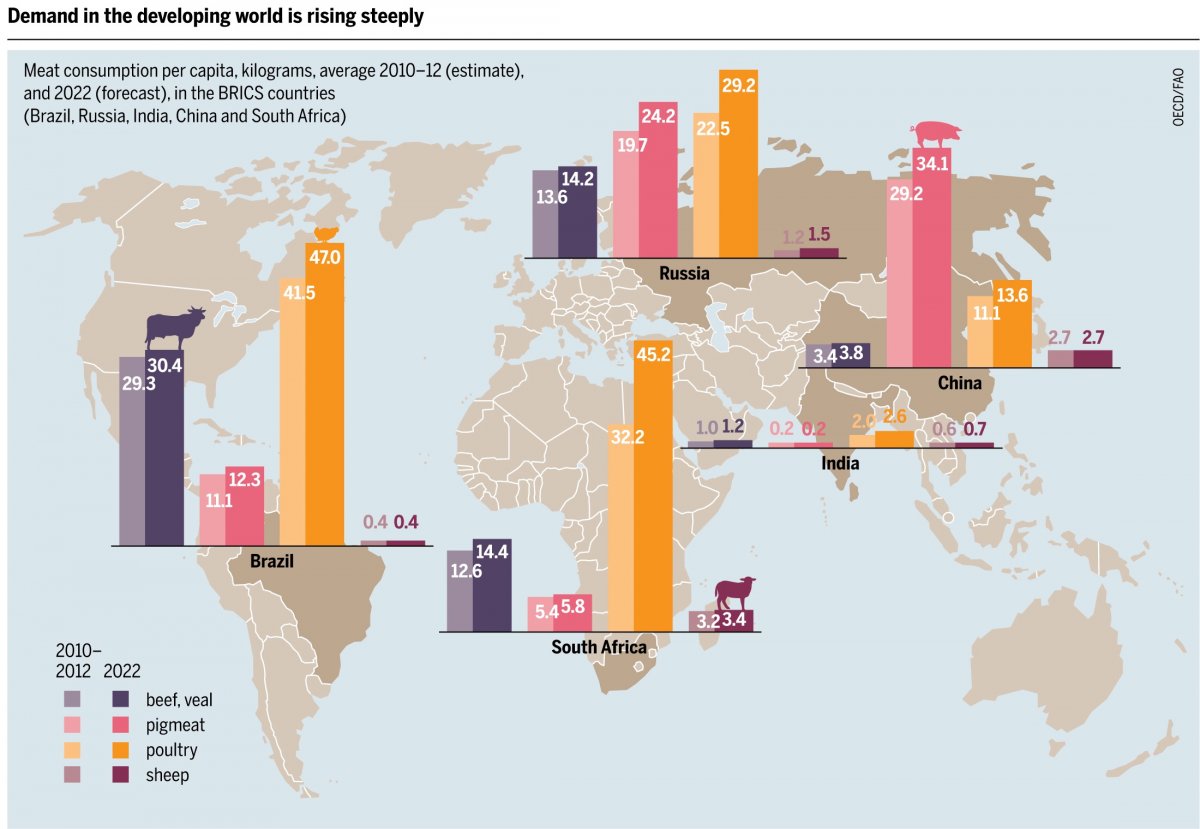
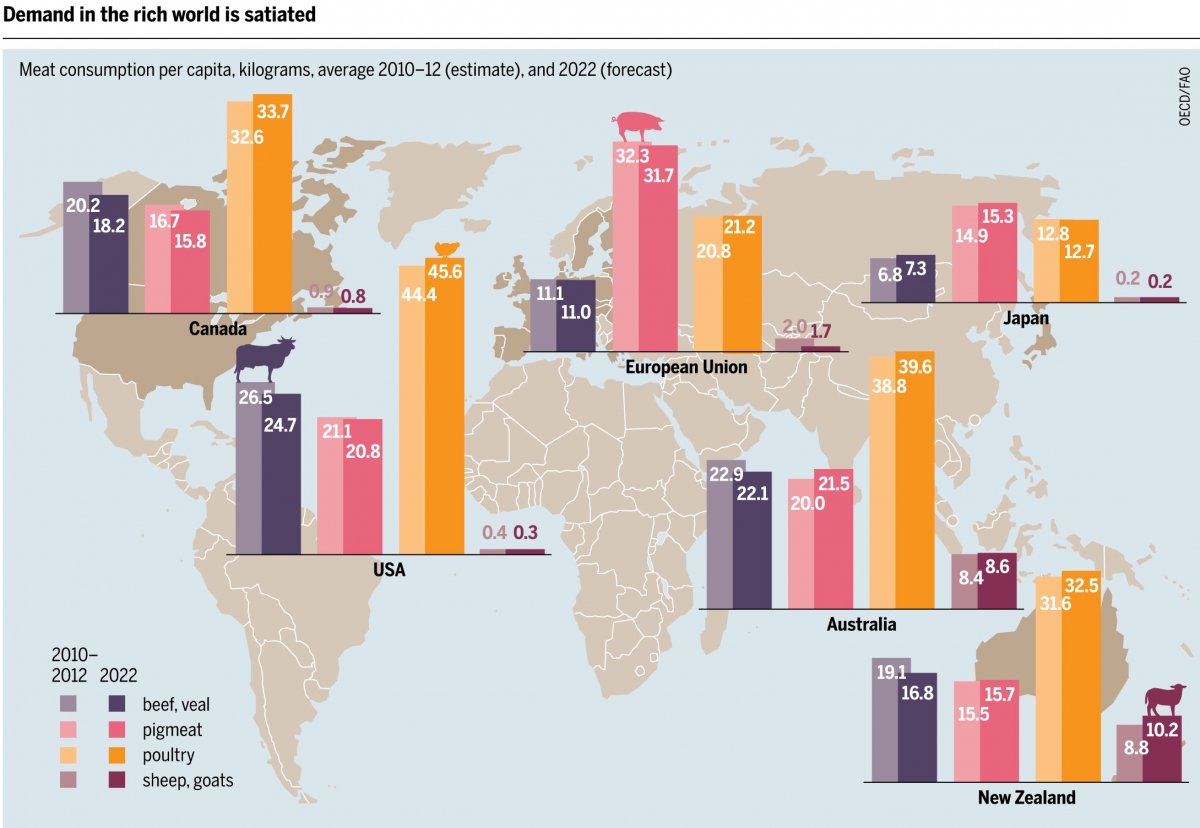
meat 3meat 4meat 2meat 7

Link to atlas

First New Orleans recipient of Fresh Food Retail Initiative closes, puts store on market | The Lens

A Central City grocery store that received a low-interest loan under a city-funded program to bring fresh foods to under-served neighborhoods has been closed and placed on the market.

Owner Doug Kariker said the store was too much work. “I can’t do it anymore,” he said. The store was not profitable, he said, “but in our business plan, we didn’t expect it to be” in the first year.

First recipient of Fresh Food Retail Initiative closes, puts store on market | The Lens.

Sysco to buy US Foods for about $3.5 billion

Feel free to read the details of the press release closely and notice how the deal is trumpeted as a way to cut costs for the companies involved and nothing about their “product” quality.

“Restaurants and other customers tend to want more than one supplier, and Mr. Delaney acknowledged that the merger could cause customers who use both Sysco and US Foods to go elsewhere for some of their products. “In our model, we have factored in that risk,” Mr. Delaney said. “We have been a little more conservative on our sales growth for the first couple years…but we are going to do everything we can to minimize customer flight.”

And this of course:

Sysco estimates the combined company will have about 25% of the U.S. food distribution market, up from about 18% now for Sysco alone.

WSJ

Egads.

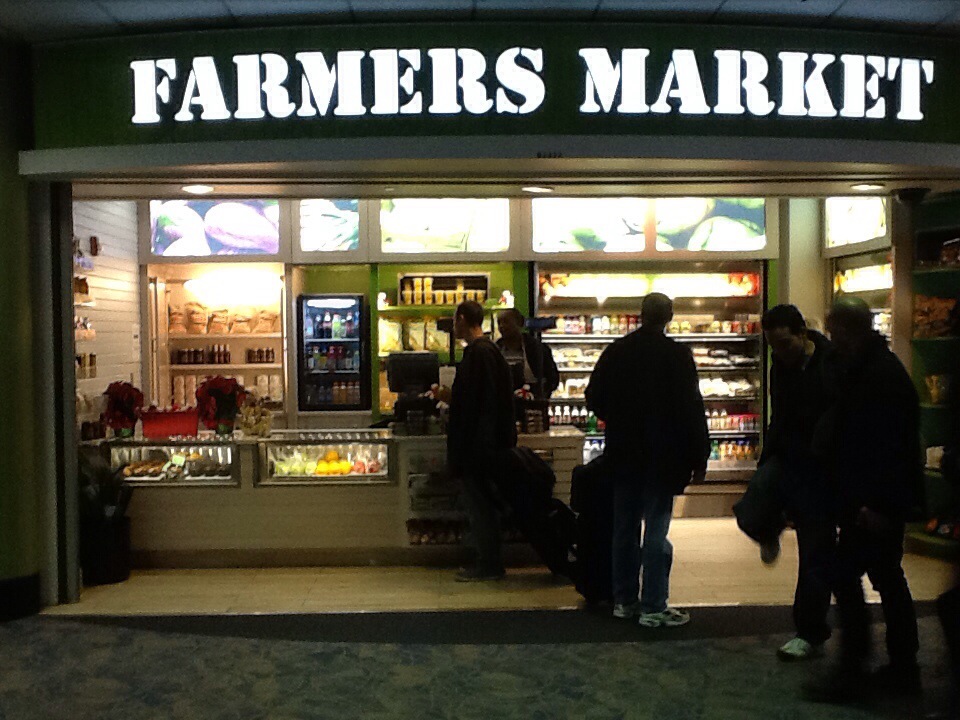
This picture is for anyone that believes that we have effectively gotten our message of how farmers markets stand for local and direct across to the other 97% of America. Clearly, we need to keep on defining our message so as not to be co-opted completely. This, by the way, is the Charlotte, NC airport.

20131202-101107.jpg

As Cost of Importing Food Soars, Jamaica Turns to the Earth – NYTimes.com

…officials across the region say more young people are getting involved, partly because food prices have soared, but also because governments have promised that agriculture means steady work, and not just in the fields.

The Bahamas is building a gleaming food science university to emphasize agricultural best practices.

Haiti, which experienced food riots in 2008, recently broke ground on a series of silos for a “strategic food reserve,” while Jamaica is considering investments in juicing and food preservation start-ups.

“We have idle hands and arable land,” Mr. Clarke said. “We are trying to see how we can bring those two together.”

As Cost of Importing Food Soars, Jamaica Turns to the Earth – NYTimes.com.

As some of you know, I believe that the era of mission-driven farmers markets has just begun and that how we view our work needs to expand to help the farmers and buyers that we work with. In that mindset, we should begin to examine the idea of public markets entirely devoted to restaurant/grocer (then wholesale) sales of local goods, curated with the same intention and mission by those of us that currently manage retail farmers markets.
In order to do that, we should learn from wholesale terminals such as this one in Canada. I found a couple of things within this article about the Ontario Terminal fascinating. My notes are in italics.

In less than 40 seconds, DiLiso has placed his order: cabbage, cipollini onions, bean sprouts and bok choy. Na enters the data on a hand-held digital device then, with a mutual nod, moves on to another client, leaving DiLiso to gather up his vegetables.
That’s how deals are done at The Ontario Food Terminal, the giant U-shaped building on 16 hectares off the Queensway in west Toronto: friendly, no-nonsense, fast.

(Notice the ability to enter sales on a hand held device?)

———————————–

DiLiso and his small crew criss-cross the market to find sellers they trust who have the best deals on vegetables.
“It’s all about relationships,” DiLiso says.

(I dunno- it sounds like it is as much about price?)

Ontario Terminal story

Infographic: Food Stamps, Follow the Money | Eat Drink Politics

From Michelle Simon's excellent report "Follow The Money"

From Michele Simon’s excellent report “Follow The Money”

PDF of report

Fair foods? I’d say not…

Maybe the national farmers market movement needs to do a top 10 food items list. That side-by-side comparison with this one would show once again how the industrial food system is obsessed with caloric count and additives versus alternative food’s obsession with taste and healthy foods.

Wacky Fair Foods