Help Establish the Healthy Farms, Healthy People Coalition’s Priorities

• The Healthy Farms, Healthy People Coalition is setting its priorities and you can help determine what they will be. These immediate priorities will help to establish a framework for the coalition’s longer term agenda. Moving forward, they’ll be engaging with partners in a conversation about longer term priorities.

• The survey should take about 10-15 minutes.

• Please note that only one survey response is permitted per organization and that coalition members’ responses will be weighted more heavily than non-members. You will be given an opportunity to join the coalition at the end of the survey.
http://www.surveymonkey.com/s/HFHP_Survey_1

Join the Healthy Farms, Healthy People Coalition:

You can join the Coalition as an organization or an individual. Joining the Healthy Farms, Healthy People Coalition means that you or your organization is committed to fostering dialogue to improve understanding and identify joint priorities that serve both public health and agriculture. It does NOT mean that you or your organization will automatically be signed on to all actions taken by the Healthy Farms, Healthy People Coalition. It also does NOT mean you will necessarily share the Coalition’s top policy priorities. Members will be provided opportunities to sign on to each activity, letter, etc.

Join the Healthy Farms, Healthy People Coalition online at: http://hfhpcoalition.org/join/

About the Healthy Farms, Healthy People Coalition:

The Healthy Farms, Healthy People Coalition works for policy reform that promotes the health of all Americans while strengthening the economic and environmental viability of the food and agricultural sectors. HFHP focuses on policies that help ensure all Americans have access to a safe, affordable, and healthy diet. Healthy farms and healthy people are essential ingredients for a healthy economy.

Overarching goals:

To identify and articulate the common interests of the agriculture, health, equity, and environmental communities in food and farm policy debates.
To advocate for policies at all levels of government (local, state and federal) that support better nutrition for citizens, a healthier economy for rural communities, and a more resilient and secure farm sector, with justice throughout the food system.
To build a broader-based, more diverse movement, spanning rural and urban interests, to achieve the Coalition’s vision.
Contact Project Coordinator, Holly Calhoun, with any questions at hcalhoun@phi.org or (510) 547-1547.
Food Among the Ruins / Guernica / A Magazine of Art & Politics

I am quite suspicious of media that tries to decree our movement as the answer to a region’s entire set of problems, and as a food activist, I am on record as being uneasy with terms like “urban ag” as I believe in regional ag as the better term to describe entrepreneurial farming in both the urban and rural areas TOGETHER. I mean if a rural farmer came to me and told me to support rural farming, I’d argue for the urban by asking for him or her to consider their regional needs.
And I also like regional ag since it includes existing farmers and appreciates our hinterlands and waterways which we also need to supply food for our beloved cities. I believe in urban farming, let me say that- but as for agriculture, I think we’re best served when we just support family farming and farming as an honorable profession.. Add to that, the power shift that needs to happen to support new farmers should happen today by supporting those existing farmers, some of whom are still stuck deep in in the industrial food system. We can polarize them and point at them as “part of the problem” but it may be better to learn from them and to assist them in gaining knowledge and awareness about why they may want to join us over in the alternative food system.

However, I love these quotes from legendary Detroit activist Grace Lee Boggs from the article linked below about Detroit’s agricultural movement:

“The food riots erupting around the world challenge us to rethink our whole approach to food,” she said, but as communities, not as bodies politic. “Today’s hunger crisis is rooted in the industrialized food system which destroys local food production and forces nations like Kenya, which only twenty-five years ago was food self-sufficient, to import 80 percent of its food because its productive land is being used by global corporations to grow flowers and luxury foods for export.” The same thing happened to Detroit, she says, which was once before a food self-sufficient community.

I asked her whether the city government would support large-scale urban agriculture. “City government is irrelevant,” she answered. “Positive change, leaps forward in the evolution of humankind do not start with governments. They start right here in our living rooms and kitchens. We are the leaders we are looking for.”

Detroit: Farming Paradise?

Food Among the Ruins / Guernica / A Magazine of Art & Politics.

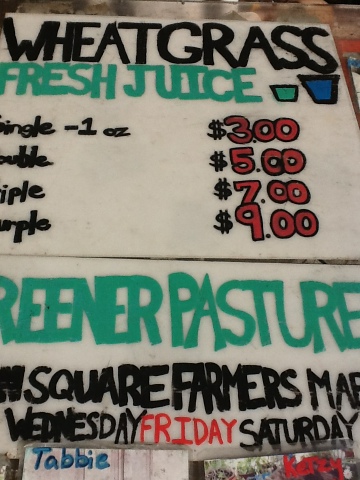
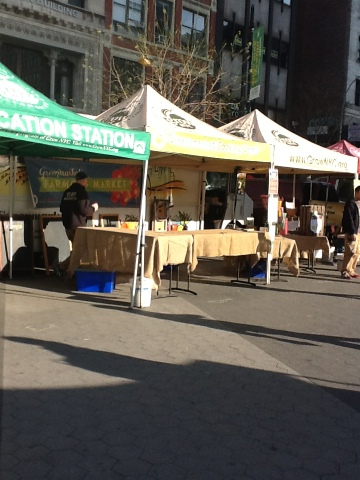
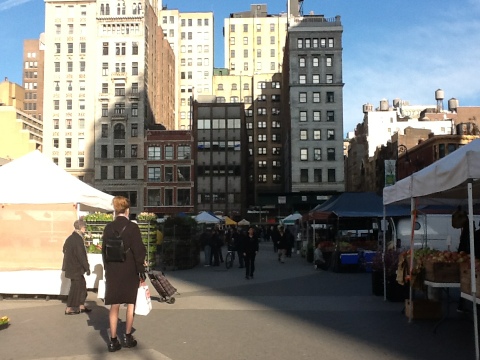
Greenmarket Union Square – Wednesday

On my way to a morning meeting, I had the great fortune to be able to stop at the Greenmarket on a beautiful Wednesday morning. This is the first half hour of opening, and let me tell you, it never looks this quiet again! I didn’t get close ups of vendors this time, but will whenI go back on Friday morning!

20120404-105156.jpg

20120404-105220.jpg

20120404-105233.jpg

20120404-105251.jpg

20120404-105308.jpg

Farmer Federation of New York farmer information day

This week in Manhattan, Diane of the Farmers Federation of New York leads an overview on EBT, WIC, FMNP and food handling for farmers working at farmers markets. The Farmers Federation works with FNS, Dept of Ag and other partners to streamline EBT acceptance for markets in New York. They facilitate the markets receiving free machines, supply each market with their own tokens, reimburse the transaction costs and train market vendors and managers. A very instructive morning for markets and vendors, courtesy of the Farmers Federation. Nice model for other states to check out.

20120404-104921.jpg

Slow Food Replies

We’ll assume you have been following the debate between some long-term Slow Food leaders and the current leadership. If not, check out this link to an earlier story on this blog:

Slow Food Fight

If you have, then you are probably ready to see this reply from Josh Viertel, Slow Food USA president.

The Soul of Slow Food: Fighting for Both Farmers and Eaters – The Atlantic.

Community markets innovating in Central Brooklyn

Am in Central Brooklyn, working with 6 great community organizations who run markets. All 6 are creating innovative projects through their market, such as senior mixed baskets, rooftop gardens, night markets, food pantries and more. They use their market as their welcome wagon and as their laboratory for all of their ideas.
Inspiring to see what low-capital, high-energy activists can do with just a little bit of encouragement and entrepreneurial drive.

If you get to NYC, take the trip to Bed Stuy to see what is going on and share some ideas of your own with these wonderful organizations:

East New York Farms
Brooklyn Rescue Mission
Hattie Catharn Community Garden
Cypress Hills Youthmarket
Brownsville Farmers Market
Bushwick Farmers Market

Queens isn’t done yet

I look forward to hearing a response from Greenmarket about the post at the bottom, especially as I know the Greeenmarket Director lives in Queens, and is truly committed to expanding the good food revolution to every part of the city.

My response would be that,yes California is unique in so many ways, including the amount of year-round produce available. Also, there are food deserts everywhere, including California and farmers markets often stand alone in combating those with healthy food. We need others in the fight, those shops and resellers who pay a fair price for farmers goods, and understand how produce should be displayed and sold properly. This takes time and patience and I hope that every time there is a farmer selling produce that is useful for her daughter, she takes the time to be an early adapter, so that one day, Queens will be a farm paradise.
Link to story

Viva Farmers

Viva Farms tries to help new farmers overcome the many technical and financial barriers they face.

“There are five things every start-up farmer needs,” Mrs. Schaffer says. These include education in farm management, access to land, equipment (like tractors) and infrastructure (like irrigation and cold storage), start-up capital, and marketing and distribution support.
Viva Farms

A Disciplined Approach to Evaluating Ideas – Scott Anthony – Harvard Business Review

An extremely useful article for the market world. Evaluation techniques should represent what is doable in a particular field while it asks people to stretch their imagination and analytical skills. Stepped evaluation (or as it is called in the article, “Stage-gate process”) for markets really is the best idea. marketumbrella.org’s 4M worksheets use that idea, and I know they have more coming along those lines in 2012…

to see the 4M sheet, go to marketumbrella.org and then log in to the marketshare project. View it under Shares.

A Disciplined Approach to Evaluating Ideas – Scott Anthony – Harvard Business Review.

The Sourlands

Another film from the director of “The Farmer and The Horse” to back:

http://www.kickstarter.com/projects/1480255348/sourlands-stories-from-the-fight-for-sustainabilit/widget/video.html

Food organizers march in support

Another way that Community Food Security Coalition supports the movement. When the conference can link and throw attention to worker rights or immigrant issues or food sovereignty issues.
In our market context, I believe we need to consider these issues more often and think of how we can support other parts of the movement that are not clearly tied yet to farmers markets.

Trader Joe’s March

There’s still time…

To join the Farmers Market Coalition’s webinar today at 11 EST, “Markets As Business Incubators: Strategies To Grow Your Vendor Base” with a simple registration on their website.
To register
Young Kim from Fondy Food Center in Milwaukee WI and Peter Marks from Appalachian Sustainable Agriculture Project in Asheville North Carolina will present some case studies and recommendations for markets to increase the benefits for vendors to participate, large or small.
The archives of the webinar will be available to review for FMC members after the call.