The Idea Village Launches “Food Challenge” for New Orleans Entrepreneurs

The Idea Village announces that New Orleans-based entrepreneurs Creole Crackers, Feed Me Eat Pretty, Garden District Bloody Marys, NOLA Pie Guy (DBA Sugah), and Taryn’s Crab Cakes Factory have been selected to participate in its inaugural New Orleans Food Challenge. The Food Challenge, a pilot program which will take place during the 2014 Entrepreneur Season, is an effort to boost entrepreneurial activity in the food and beverage industry, in partnership with Reily Foods and Rouses Markets.

“Each year, The Idea Village hosts a variety of Strategic Challenges in an effort to elevate key local industries and strengthen partnerships across the entrepreneurial community,” said Tim Williamson, Co-founder and CEO of The Idea Village. “New to the Challenge lineup this year, the Food Challenge will mirror other successful vertical challenges, including Water and Education, providing access to unbelievable networks and strategic business consulting.”

“When it comes to innovation within the food and beverage industry, New Orleans has a longstanding competitive advantage,” said David Darragh, CEO of Reily Foods Company and Chairman of The Idea Village Board of Directors. “The Food Challenge will help us sustain this reputation by identifying and supporting some of the industry’s emerging businesses.”

“Rouses is one of the largest independent grocers in the United States and we are fully committed to supporting local farmers, fisherman, and food entrepreneurs.” said Allison Rouse, Rouses Markets. “The Food Challenge aligns perfectly with our buy local focus and we are a proud supporter of this initiative.”

The Food Challenge will be led by Idea Village Entrepreneurs-in-Residence Lisa Lloyd and J. Anthony Miguez, who have a combined 30+ years of experience working with early stage companies. Lisa and J. will provide customized coaching and manage the program’s mentor and advisor networks in order to accelerate the growth of participating companies.

Mentors include: Billy Bosch (Iconic), Erik Frank (Your Nutrition Delivered), Sal LaMartina (Cordina), and Lovey Wakefield (NOLAcajun.com). Advisors include: David Darragh (Reily Foods Company), John Elstrott (Whole Foods), Ti Martin (Commander’s Palace), Marcy Nathan (Advertising and PR), Allison Rouse (Rouses Markets), Robbie Vitrano (Naked Pizza), and Sandy Whann (Leidenheimer Baking Company).

During this nine-week program, entrepreneurs will receive over 40 hours of strategic consulting across customer development, risk mitigation, product validation, and business model optimization, along with the opportunity to network with other emerging local food ventures and local industry authorities. The program will culminate in a ‘Demo Day’ on December 17th, when two entrepreneurs will be selected to present during the 6th annual New Orleans Entrepreneur Week (NOEW), March 22-28, 2014, the culmination of The Idea Village’s annual Entrepreneur Season.

To learn more about The Idea Village, The Idea Village’s 2014 Entrepreneur Season, and the inaugural New Orleans Food Challenge, visit http://www.ideavillage.org.

Grazing with goats in the Crescent City

Goats for grazing is a super idea for the many open, untended sites we have in New Orleans and throughout the U.S. This is a simple fundraising idea for an New Orleans entrepreneur that wants to use goats to graze public and private green space. She has already been contracted to use goats on a park in the city (Brechtel Park) starting in 2014 and needs support to get her business prepared for the work ahead.
I see she also sees this as public art, which I’d have to hear more about to understand I guess, but the goat grazing is by itself an idea that I can certainly support. Maybe you can too?

YHerd?

…To comment further on the public art point, I’d rather this be seen chiefly as a serious farming and open space issue that helps urban people see that livestock can safely serve many roles in the larger natural survival loop, even in our ordered urban environment.

First New Orleans recipient of Fresh Food Retail Initiative closes, puts store on market | The Lens

A Central City grocery store that received a low-interest loan under a city-funded program to bring fresh foods to under-served neighborhoods has been closed and placed on the market.

Owner Doug Kariker said the store was too much work. “I can’t do it anymore,” he said. The store was not profitable, he said, “but in our business plan, we didn’t expect it to be” in the first year.

First recipient of Fresh Food Retail Initiative closes, puts store on market | The Lens.

Food Day

Check out the “Big Easy Peel” event, a satsuma-peeling event starting at 11:30am on Oct. 24th at the Washington Artillery Park across from Jackson Square! Dr. DeSalvo, the health commissioner of New Orleans, will be there to speak and endorse Food Day. There’s more information about the event here: We’re looking to invite as many people as possible, so please spread the word!

Events Calendar | Nola Food Day.

Book Review: Louisiana Eats

13328918-mmmainFull disclosure: Poppy is my pal. She is someone who calls me up and then shows up, with a gift, thoughtful questions and always hilarious stories.
What made me a fan of hers early on was her razor-sharp take on people and situations, sometimes devastatingly so. Yet she is enormously kind and open to those people who ring true. No one that receives her wrath  is ever underserving. If they get it, they usually have made one of two unforgivable sins: either they underestimated HER or they underestimated her city, her state or her people.

Another disclosure: I believe Poppy deserves as much credit as anyone in my region for rebuilding the New Orleans food system after the federal levee breaks in 2005. Too many stories to tell here, but come on over and if you care, I’ll tell you some of them over a drink. Or two. There are a lot of them to tell. Some of them are funny, some are sweet, some even a bit crazy.

These two points are linked since her life’s work is to actively promote entrepreneurs and real ideas that will build (or rebuild when necessary) the culture of her place, Louisiana. In doing that work, she extended her range to all authentic food systems across the globe through her Slow Food International connection that  meant that New Orleans gained the Slow Food vibe from the mid 1990s on.
Let me also say that most of the SFUSA folks understand her range, giving her much early credit for shaping the U.S. work that she built with others-that is, until she had to unleash her wrath on previous Slow Food leadership over the (mis) direction of a crucial program that she had helped shepherd. Luckily, she and SF made up.
Remember, I warned you that she is a fierce opponent when she feels it’s necessary.

When she started the Louisiana Eats show, she had already done a great deal of writing and television. Her talents really came to light when she began this show; her intense enjoyment and knowledge of the people and history of food and culture through one-on-one conversations on our local NPR station and now in this book. I remember a glorious Saturday morning on Louisiana Eats when she and Rien Fertel talked about praline sellers and another when she talked with Miss Linda Green, The Yakamein lady, and another when she talked with French bread baker John Gendusa among many others. Each time, I would stop what I was doing and literally stand there and listen intently to her intricate questions and always learn something. And her interaction with the dean of New Orleans Creole food, Leah Chase which is always touching and amazing since you get to hear two chefs with great respect for each other just banter and share stories.  And when she has on young activists or farmers (like Nick Usner who is in the book), you can hear the hope in her voice for the new energy coming along…
So this book is a reminder of many lovely Saturdays  and is indicative of the tone that I myself have adopted for much of my food activism: wild enthusiasm, critical assessment and a deep appreciation of the stories and background of those unique people that tell of our culture and food. Because of her, I know to seek them out, and maybe I’ll find some new folks from those Poppy has brought to us on her show and in this book. The book itself (lovely photos and recipes) is informative and a great companion to her show and I know that it will stand the test of time as a true record of some of the people that we have in our world. And of my pal who contributes so much to our place.

<a href=”http://www.goodreads.com/review/list/635646-blue-collar-mind”>View all my reviews</a>


On Being a Boss: Kristen Essig Takes Over at Sainte Marie – Eater Interviews – Eater NOLA

Below, is a link to an interview with a New Orleans chef who has embedded local purchasing into the very DNA of her kitchen.

The day I met Kristen was the day (2002? 2003?) that she interviewed to be our Crescent City Farmers Market (CCFM) Tuesday/Thursday market manager. She came to the interview with a slate of ideas and opinions backed up with a vitality that could not be denied. We were surprised that someone with her fine dining experience (and obvious ambition) wanted to work for our little organization, but she explained that she wanted to know all facets of the food system.
During her tenure, she can be credited with building our Green Plate Special program, which allows restaurants to come for a full month of Tuesdays to sell plate lunches to the shoppers at the CCFM and, of course, allows those chefs to understand the farmers and fishers better and to have long stretches to watch market vending in person.

As a chef, she came with a “shoot from the hip” framework and never stopped running the entire time she worked with us. Like anyone who has worked on the line at top restaurants, she was intimidating to some but we knew that she always led with what was in the best interest of our farmers and fishers. Through her, we understood the psyche of the chef better and started to realize that we should get to know the sous chefs and line cooks that were more often at the market and were on their way to the top position. Many of those have now become leaders of their own restaurant (why, like our friend Kristen Essig!) and almost all have become fierce supporters of those markets.

“As a line cook, you develop a relationship with vendors as they come in the back door, but actually working with the vendors at the market was a totally different thing. You’re working, really, with 20 small businesses, and they’re all trying to make certain quotas, and they all have certain amounts of product that they have to move. You develop strong relationships with these people—you learn that they have bills to pay, whose kid needs braces, etc.”

On Being a Boss: Kristen Essig Takes Over at Sainte Marie – Eater Interviews – Eater NOLA.

News & Events | VEGGI Farmer’s Cooperative

This is a new Vietnamese-led growers initiative in New Orleans. I hope we begin to see more production cooperatives among farmers, especially urban and peri-urban farmers.

News & Events | VEGGI Farmer's Cooperative.

Indicating health

Windowsill Pies, New Orleans LA pie makers

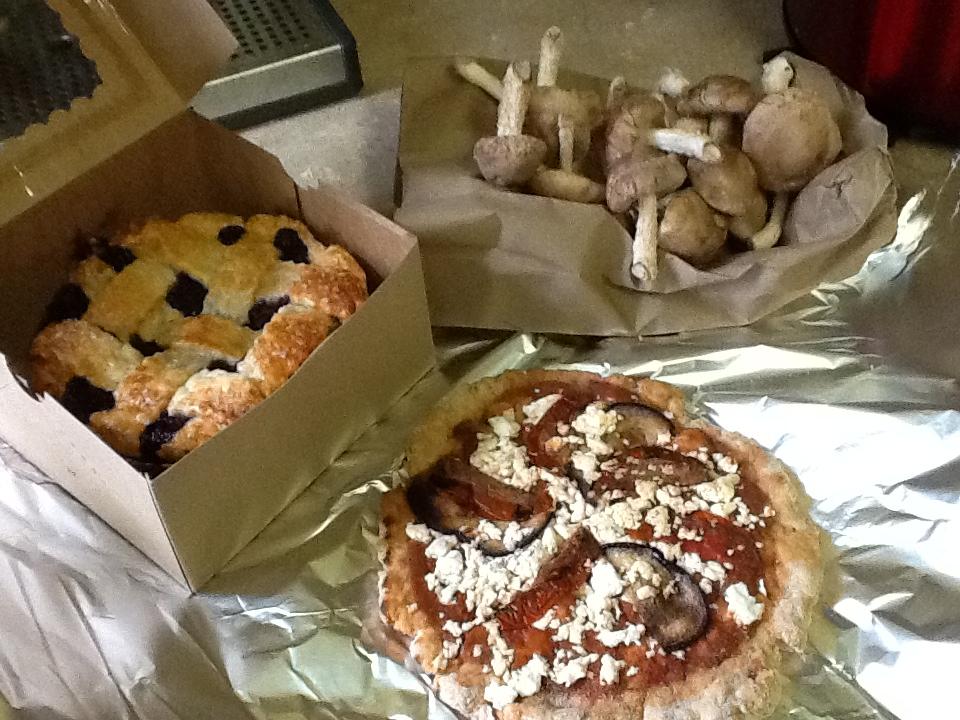
Blueberry pie from Windowsill Pies and gluten-free pizza and shrooms from the Rue family, all from Covington Farmers Market..

Take a long look at that picture. To many, it may only show another dang food picture that was posted online but to me it represents something else entirely.
All of those goods came from the Covington Farmers Market, which is a parish (to most of you outside of Louisiana, parish=county) seat market located 40 miles from downtown New Orleans and across Lake Pontchartrain in an area of what used to be called the Ozone Belt for its pine tree greenery.
The gluten-free pizza was sold to me by a teen who was selling them on behalf of her family business and could tell me what was in their pizzas and why, could take my money and offer change with a genuine smile and good wishes. The mushrooms were on their table too and collected as a side option to their prepared food sales, as well as used in their goods.

The pie was sold to me by 2 entrepreneurs that buy their ingredients locally as often as possible (literally pointing to the honey seller that provided the basis of this pie’s lack of refined sugar). This vendor’s artistic tendencies suit their product list well, all of the way to the windowed boxes for their pies and their oil cloth tablecloth and vintage aprons presentation.
What is important to me as a shopper about this picture is that it represents a (still) unusual way of buying food; I can ask each of them exactly what is in their goods and how they were made. They are working to replace industrial ingredients with natural and closer-to-home versions that offer more taste. And of course, not only did I get a chance to talk directly with the makers of these goods and to encourage them further, but that I was able to buy from young women, all just beginning farmers market sales. All of the made goods were delicious and will be bought many times again. I may buy them for myself on a week in which I know I am just not going to feel like cooking or they may be used to share with friends when they come to spend the day at the pool or may even be brought to a party I am invited to as my gift.

Market managers know that farmers markets are THE incubator for businesses that are not ready for or do not want storefronts. The chance to take a small idea and grow it slowly and carefully is a necessary step for any entrepreneur, yet the places one can do this are so limited that markets are among the only ones that regularly offer that opportunity. Many experienced market shoppers know that when they see new goods at markets that are advanced in their ingredients and presentation, they must immediately support them vigorously and talk them up to their friends. In turn, market managers need to monitor these vendors and introduce them to those shoppers (as this market’s manager did to me) as well as search for those vendors’ new shoppers, who may not already be present.
In other words, these vendors often represent a new age in a market. Its important to remember that young vendors trying items that can only be sold at farmers markets are who we want to see more of in markets. These folks cannot (or do not) sell their goods to Whole Foods or ship them worldwide; they design products for the type of person who stops and asks about their ingredients and their process. Therefore, they are an indicator species, which is defined beautifully in the Encyclopædia Brittanica as an organism that serves as a measure of the environmental conditions that exist in a given locale.

If indicator species show the health of an environment, then their low activity can alert to danger in a market’s health or when increasing, can show vitality. Encouragement of diversity of products, gender, age, ethnicity and business goals is exactly what each market must be setting as a goal daily, weekly, monthly and so on. To me, the presence of these indicator vendors and others at this little market show its emerging strength. And offers some damn tasty research at the same time.

“Anti-Food Truck Meddling Ends Up Ruining Miami Farmer’s Market”

I know many markets are using food trucks as a way to get more traffic to markets, especially weekday and evening markets. Based on this and other articles that I run across, it sounds like food trucks should be specifically written into market rules to head off this sort of unwelcome publicity.
In New Orleans, we added a “Green Plate Special” many years ago so a restaurant could come and sell for a month of Tuesdays at one of our tents (it was a 10 am-2 pm market then, now it’s 9-1), as long as they had entrees under 10 bucks, sourced from the vendors when possible and followed the specific risk and vendor rules for serving prepared food.

This added amenity was to help us to draw office lunch traffic and it has done that and much more over the years, although I have to admit it killed off a lot of the prepared food items that the other vendors were selling, but maybe that was a blessing in disguise after all. It made those vendors concentrate on their fruits and veg staples and to stop trying to corner the sandwich business at the market.
And even though it was a difficult start (can I tell you the number of restaurants and chefs that I haunted in those early years?) 99% of those that participated over the years that I ran the markets asked to be able to return.

We wrote guidelines for that spot and asked them to pay double what our regular vendors paid which was still a bargain for what they received: shoppers already amassing needing food and meals, in a market with seating and local producers willing to sell items for the menu. So I recommend that markets think about how to include caterers, restaurants and food trucks into their market, but to do it without upsetting the balance of the market too much.
By the way, this article seems to suggest that this is not a “true” farmers market as most of us across the U.S.  define that term, but is more of a food and artisan market. I know Florida has many of those and they seem to be an appropriate market type and serve their shoppers and vendors well in many case but maybe we need a type to describe the market that offers prepared food as its main offering. As I often say to markets when they ask me if a rule is “okay,” it’s only important that the market can defend and explain their rules to their community. If they can, if people around there understand and most agree, then I say full steam ahead.
Okay, one story about the Green Plate. When we developed the idea, we would talk about how we wanted restaurants like Commander’s Palace to do this (often rated as the #1 fine dining restaurant in New Orleans) and although we asked them in the beginning, they quickly sent their regrets (as they are very polite folks). We were seen as a quirky little food event and hadn’t moved to “beloved institution” phase at that point…
After the levee breaks of Katrina 2005, this 100 year old+ restaurant had some damage, needed time to repair and to the great sadness of many New Orleanians, did not reopen that year. However, in 2006, they asked us if they could come to do the GPS, brought their A-team and spread the word that they would sell quarts of their famous turtle soup and a few beloved entrees. So that first day (right after we ring the bell to open the market) we hear a cheer from their tent and see the celebrated chef and owner holding a ten dollar bill over their heads while saying with great emotion, “Our first sale since Katrina!”
The next week, they brought their Maitre d’to manage the line that went out of the market.

So I’ll never forget how our little market helped this great establishment and how our original dream came true all at once. All because we always thought: “what if…”

Anti-Food Truck Meddling Ends Up Ruining Miami Farmer’s Market – Hit & Run : Reason.com.

The Nature of Cities

A friend to New Orleans, Mary Rowe gives an eloquent description of the natural organizing within a city as seen when passing through a period of destruction. The lessons of city work can certainly hold a mirror to the lessons of food system organizing.

The Nature of Cities – powered by FeedBurner.

Louisiana Farmer Honored

Each year the Crescent City Farmers Market selects a local food hero to feature on wooden tokens that may be purchased at the market welcome tent using credit or debit cards, then spent with vendors at the market. Other local food heroes memorialized on CCFM tokens include Commander Palace Chef Jamie Shannon (1961-2001), Mississippi farmer and CCFM vendor James “Billy Corn” Burkett (1928-1995) and cooking school pioneer Lee Barnes (1951-1992) and Eula Mae Doré (1929-2008).

2013’s token honors Jim Core, who passed away during 2012 after a long illness. His wife Gladys and grandson A.J. continue to run the family market business, assisted by sister-in-law Gay. The Cores are anchor vendors at both the Crescent City Farmers Market and the Covington Farmers Market.

Gladys Core, Jim's widow and herself a mainstay at the markets for their farm's many years as anchor vendors.

Gladys Core, Jim’s widow and herself a mainstay at the markets for their farm’s many years as anchor vendors.

Jim Core, LA farmer honored on 2013 CCFM token

Jim Core, LA farmer honored on 2013 CCFM token