Since the Community Food Project RFP is out and proposals are due November 28, this handy new guide should be very useful. As someone who has written one and had it funded, I will say that this grant program is a very useful way to pull off an in-depth pilot for extending and expanding food systems. Good luck to anyone that is working on one.
USDA
“A market and a sentiment are not a movement”
Love this article from Sunday’s NYT which was sent to me by a non-foodie friend. As always, I appreciate Pollan’s clarity and honesty, but I do disagree that this election season is a litmus test for our work.
The present administration has not made localized healthy food systems a core part of its mandate yet and as much as I appreciate the First Lady’s resolve and leadership on good food, lets be honest: it’s not the only flag (or even the main flag) that they are flying. As for initiatives, ballot referendums in California have yet to have serious impact on the rest of the nation. Trust me-I worked on Ohio’s Issue 5 back in the 1990s that was modeled on California’s labeling law of cancer and birth defect-causing ingredients: talk about a bloodbath.
I also say that the issues centrally addressed by this referendum are exactly what we are NOT about: refashioning the industrial food system at its edges. Our work is life and death on every front and about creating an alternative food system that by its very life means death to poisonous, fake foods controlled by a few dozen monolithic corporations. (Asking them to refashion their products for approval is like Al Capone being asked to use a 6 shooter rather than a Tommy gun-everyone would still be in danger and he would still have become richer and more powerful.)
I’d say that the true test of this system as an election kingmaker will be when there are actually candidates that stump for office using localized healthy food systems for all as their mandate. Unfortunately, that has little chance of happening on its own.
The other way we can test this system is when we actually reach across race and class lines and age groups to find one day that the majority of the country has 1) successfully shopped at a farmers market more than once 2) went to a school that regularly served healthy food that was culturally recognizable 3) honors farmers and harvesters by refusing to vote for developments that drive up prices of farmland or waterfront property and 3) choose brands that don’t pollute, use dangerous ingredients or undercut workers to bring you the best price on a product.
Then, the mandate in DC will not depend on the weak resolve of a privately funded politician, but on the goodwill of the electorate. And yeah, until then, it’s a damn good article about movements.
“One of the more interesting things we will learn on Nov. 6 is whether or not there is a “food movement” in America worthy of the name — that is, an organized force in our politics capable of demanding change in the food system. People like me throw the term around loosely, partly because we sense the gathering of such a force, and partly (to be honest) to help wish it into being by sheer dint of repetition. Clearly there is growing sentiment in favor of reforming American agriculture and interest in questions about where our food comes from and how it was produced. And certainly we can see an alternative food economy rising around us: local and organic agriculture is growing far faster than the food market as a whole. But a market and a sentiment are not quite the same thing as a political movement — something capable of frightening politicians and propelling its concerns onto the national agenda.”
Southern SSAWG conference news
The 2013 conference program and registration information is now available on the Southern SAWG website. You will love the program we have put together for this year’s Practical Tools and Solutions for Sustaining Family Farms conference. There are even more sessions and pre-conference events this year!
Pre-Conference Offerings:
Wed & Thurs – Jan. 23-24
Short Courses
Our popular 1½ day pre-conference short courses are intensive learning experiences that provide comprehensive information on whole farming enterprises. With the in-class presentations and the extensive take-home materials, they give you the knowledge you most need to be successful with your enterprise.
Program info here
Mini Courses
Our ½ day pre-conference mini courses provide in-depth information on specific topics in greater depth than is possible in our regular conference sessions. Our expert presenters provide you the latest information and answer your pressing questions on the topics you requested.
Mini Courses Here
Field Trips
For those who learn best by getting out in the field, we offer five outstanding field trips this year. Our ½ day pre-conference field trips are geared toward organic and sustainable production and marketing of horticultural crops and livestock and community food initiatives. Click here to learn more about these outstanding field trips.
General Conference Info:
Fri & Sat – Jan. 25-26
Expert Presenters
Each year conference participants tell us the great line-up of presenters with their practical experience is what makes our conference program so valuable. These people know their stuff and are willing to share their expertise. One older farmer said “I sure wish I had had access to this kind of expertise when I got started. I’d have gotten a lot further a lot faster!”
Presenters Here
62 Educational Sessions
The general conference, running all day Friday and Saturday, offers more choices: 62, 1½-hour sessions on a broad range of topics for start-up and seasoned producers alike. Sessions include; sustainable and organic production and marketing information for commercial horticultural and livestock producers, enterprise management lessons, farm policy education and community food systems development information.
Registration and Fee Waivers
The Southern SAWG conference is always a great bargain, given the quality of the information to be gained and the networking opportunities that come with such a large turnout of the South’s most innovative and successful producers, organizers and advocates in sustainable agriculture. Your farming operation or local foods organization can’t afford to miss this event.
This year we have three options for those looking for a fee waiver to participate in this conference.
Fee Waivers here
Be a 2012 Conference Sponsor
Your presence as a sponsor will help hundreds of farmers, community food advocates, educators and researchers across the South, and with the visibility this event affords, it will distinguish you as a supporter of the sustainable agriculture movement.
Note to organizational and institutional leaders: We can provide letters of support to your potential funders if you are seeking funds for producers in your area to participate in the pre-conference and conference activities. Just contact us with the details.
Keep up with Southern SAWG through Facebook and Twitter. Show your support for Southern SAWG by liking and following us!
Letter to a fellow food organizer
a colleague asked me to give her my opinion on trends and jobs in the alternative food system retail sector. Here is the beginning of my response:
Okay,
Here’s a few of my cents as requested:
As you know, the food hub conversation has taken a lot of the oxygen in the room (and a lot of the funding) away from direct farmer support and farmers markets and as a result, it feels like we are simply treading water in a lot of instances. Spread too thin. Certainly in the expansion of direct marketing farming or in getting any serious cross-sector analysis, we’re not jumping ahead much of where we were 5 years ago.
It’s not that I’m against food hubs, but some of them sound a lot like city governments’ “one-stop shops” which I am not sure has worked either. And it smacks of “scaling up” which is a suspect phrase to someone like me who has seen how long it takes a market farmer to really be ready to price at his or her comfort level and to innovate products. The Cliff Notes version of the market vendor lifespan is that it takes years of a market organizations time and “expertise” to patiently get a farmer to an economic and social comfort level where they actually tell you that they are about to go bankrupt or get divorced or get ready for a kid to go to college and so thats why their business is changing so you can help it change for the better. And that those folks are RETAIL vendors, with tables and tents and signs designed to help them sell retail, and not necessarily the same ones to approach or to change to wholesale vendors seems to be missed by some wholesale organizers.
Sometimes, it also feel that we are extrapolating the wrong lessons of what has worked to build food retail points of entry. Let me say I’m probably not “up” on all of the good work being done, although I do know and learn from original thinkers like Anthony Flaccavento’s and M. Shuman’s excellent research and analysis work. It’s just that the a lot of the scaling up and institutional buying conversation seems wildly uneven from case to case and the skills are simply not embedded into the host area to keep the thing moving forward once a founder leaves or a project fails.
What is true in the food system is that currently the public health sector rules, so therefore the conversation around low-income and at-risk end users of healthy food is the main thing being funded, which is a glorious turn around for those who always had the plan to take the food system there (meaning to everyone) no matter what anti-localvore writers try to say.<
10 years ago, the talk was all about social cohesion and dynamic Main Streets and 15 years before THAT, it was all about farmers extending seasons and growing sustainably, and it was always about doing it for everyone.
The public health sector is staying put, and learning more and more about how to use our points of entry to get results in true behavior change. That sector has changed farmers markets more than any other stakeholder (and that includes government stakeholders) because there are so many levels of public health intervention that they are willing to try wild ideas which often work and because they measure everything they do. However, I expect that the needle will move again-what will be the next issue that leads food system work- environmental impacts or immigrant issues or racial inequities or food safety or civic planning? Who knows really. Of course, it will depend on the crisis that shows up.
As for careers and jobs, it is my biased opinion that the open-air farmers market continues to rule the hearts (if not the minds) of most of the public while inside the food system, organizers favor the urban farm as the winning hand. Oddly, no one has brought these two together in any meaningful way or even examined the impacts of the two combined or separately beyond simple economic data or numbers of projects, as if quantity of projects really mean anything.
I think you know my obsession is with measuring the economic, social, human and natural capital of markets AND also with finding a way to make markets the entry point for training food organizers on all aspects of food system work. I foresee a national training program with skills trained in the first 6 months which are transferrable to all parts of the food system and beyond. Along those lines, there is already a push for a voluntary market manager accreditation system (which is beginning in places like Michigan) that might be similar in neighboring states so someone would have a leg up regionally if they have taken the training.
Add to that a yearly networking session for market managers and for those in my mythical training program and you may have the beginning of a movement, instead of rising and falling tide of new markets and projects every year.
And after all, the farmers markets remain the best fulcrum for food systems, so what happens there should matter to everyone else.
What also seems true is in the last 2-3 years the terrain has shifted a great deal, away from larger “big tent” orgs partnering on everything to much more nimble entrepreneurial types sharing knowledge on common problems and tactics. Regionality may once again become the strongest card we can use to strengthen our systems across state lines and across single issue campaigns to truly achieve success. Interestingly, this seems to also true in DC, where there is not one national policy shop office that truly represents the entire membership of most food organizers. Collaboration there has been somewhat successful.
But to leave markets for a minute (hate to do it but I will) I also believe that the wholesale food system is ready for a boost. And no, food hubs so far ain’t cutting it, as far as really reshaping buying habits of purchasers and institutions like the farmers markets HAVE been successful in re shaping the consumer’s buying habits- the 2-3 percent that listen, that is. THAT, of course, is another looming issue-98% of the public who have not used alternative food systems much. And even for the 2-3 percent, what is the actual change-one season? Farmers market shoppers become CSA members or vice versa? What about how they feel about the environment or local businesses after they stick to the market?
So research is needed in examining what is actually been done and not just the PROJECTS, but the efforts of stakeholders, the typology of successful farmers, and the efficient host organizations.
I would also say that as CFSC struggles with it’s post-strategic planning transition (speaking as a Board member for a few more months that assures you that that info is not secret but quite transparent and shared within the CFSC community) and Slow Food reexamines it’s work and searches for a new leader and FMC searches for a new leader, it may turn out all of the national organizations turn more to each other and others to collaborate more closely along with racial equity orgs like GFJI and Alliance for Building Capacity and IATP.
They might. So the collaboration points are a good place to look for work. Chapters? Maybe. Community unionism? Maybe. Or simply skill building and shared measurement in all partnerships. That would help. However, as we strengthen the regional orgs and multi-sector orgs more -since I’m sure im not the only one thinking this way- that may be where the jobs end up too.
In any case or in all cases, what seems clear to be missing in many cases is the entrepreneur’s point of view, whether its a farmer, or a baker or the neighboring business that needs that market or even the market or other food retail organization itself that seem to be considered built already and left out of the capacity building money. (I guess many feel we had our money moment, huh?) So maybe we need more innovative financing too, like CSEs or granny accounts or even to attempt the other part of a currency system-loans and massive fundraising in the market community itself, using the wooden token system as a starting point.
After all, its the entrepreneur is who needs to be encouraged. The entrepreneurs are who need to be analyzed. And entrepreneurs will be multiplying as corporations shut down and lay off more and more, and so seems like the most obvious point of expansion for work opportunities.
So to paraphrase Abigail Adams, …remember the entrepreneurs and be more generous and favorable to them than your ancestors.
Hope that helps, Darlene
Jeff Sessions Argues Food Stamps Increase Not Moral, Mocks Kirsten Gillibrand
In case you sometimes forget that the farm bill is a political fight, and there will many attempts to derail a thoughtful, serious conversation about the type of food we eat, who produces it and who will get access to it.
Jeff Sessions Argues Food Stamps Increase Not Moral, Mocks Kirsten Gillibrand.
Food Stamp Subsidies for Junk Food Makers, Big Box Retailers, and Banks?
As 2012 Farm Bill debate rages in Congress, a new investigative report demands SNAP program transparency
Oakland, CA, June 12, 2012 — Are food stamps lining the pockets of the nation’s wealthiest corporations instead of closing the hunger gap in the United States? Why does Walmart benefit from more than $200 million in annual food stamp purchases in Oklahoma alone? Why does one bank, J.P. Morgan Chase, hold exclusive contracts in 24 states to administer public benefits?
These are a few of the questions explored in a new report called: “Food Stamps, Follow the Money: Are Corporations Profiting from Hungry Americans?” from Michele Simon, president of Eat Drink Politics, a watchdog consulting group. This first-of-its kind investigation details how the food stamp program—originally designed to help farmers and those in need—lines the pockets of junk food makers, food retailers, and banks.
Right now, Congress is debating the farm bill, including significant cuts to the Supplemental Nutrition Assistance Program (or SNAP, formerly known as food stamps). Much attention has focused on how agricultural subsidies fuel our cheap, unhealthy food supply. In reality, the largest and most overlooked taxpayer subsidy to the food industry is SNAP, which comprised two-thirds of the farm bill budget in 2008.
“Michele Simon’s well-researched, credible investigation breaks new ground and exposes who else stands to gain from the government’s largest food assistance program,” said New York University Professor Marion Nestle, author of Food Politics. “While reauthorizing the farm bill, Congress needs to make sure that the poor get their fair share of SNAP benefits,” she added.
Food Stamps, Follow the Money examines what we know and don’t know about how much the food industry and large banks benefit from a tax-payer program that has grown to $78 billion in 2011, up from $30 billion just four years earlier, and projected to increase further due to current economic conditions.
“Transparency should be mandatory. The people have a right to know where our money is going, plain and simple,” said Anthony Smukall, a SNAP participant living in Buffalo, New York. He says his fellow residents are “facing cuts year after year, with no sustainable jobs to be able to get off of programs such as SNAP.” Smukall added, “J.P. Morgan is shaking state pockets, which then rolls down to every tax paying citizen. I am disgusted with the numbers in this report. If people knew how such programs were run, and how money is taken in by some of the world’s conglomerates, there would be outrage on a grand scale.”
As the largest government-funded agriculture program in the nation, SNAP presents a tremendous opportunity to help tens of millions of Americans be better nourished and to reshape our food system in a positive way. SNAP dollars now represent more than 10 percent of all grocery store purchases.
“Every year, tens of billions of SNAP dollars are propping up corporations that are exploiting their workers and producing foods that are making America sick,” said Andy Fisher, founder and former executive director of the Community Food Security Coalition, who is currently writing a book about the anti-hunger movement. “It’s high time we stopped this madness, and returned the food stamp program to its original purpose: providing needy Americans healthy real food grown by farmers,” he added.
“I hope Congress does not cut SNAP. Food prices have been skyrocketing while salaries remain unchanged, and many people I know have two jobs to try to make ends meet,” said Jennifer L., a SNAP participant living in Massachusetts. “As a single mom who has only recently re-entered the workforce, the SNAP assistance I receive makes a huge difference in my ability to support my children,” she added. “I am in favor of making retailers’ and banks’ information regarding SNAP public. What are they hiding?”
Food Stamps, Follow the Money offers several recommendations on how to improve SNAP in order to maximize government benefits for those in need. These include:
· Congress should maintain SNAP funding in this time of need for millions of Americans;
· Congress should require collection and disclosure of SNAP product purchase data, retailer redemptions, and national data on bank fees;
· USDA should evaluate state EBT contracts to determine if banks are taking undue advantage of taxpayer funds.
“Congress should make SNAP more transparent by mandating accurate tracking of SNAP expenditures. Why should only the likes of Walmart, Coca-Cola, and J.P. Morgan know how many billions of our tax dollars are spent each year?” said Ms. Simon.
About: Michele Simon is a public health lawyer specializing in industry marketing and lobbying tactics. She is president of Eat Drink Politics, a consulting group that helps advocates counter corporate tactics and advance food and alcohol policy. http://www.eatdrinkpolitics.com Twitter: @MicheleRSimon
Farmers Market Promotion Program Grants Available
AMS No. 021-12
Gwen Sparks (202) 260-8210
gwen.sparks@ams.usda.gov
WASHINGTON, April 5, 2012 – Agriculture Deputy Secretary Kathleen Merrigan announced today that the U.S. Department of Agriculture (USDA) is seeking grant applicants for the 2012 Farmers Market Promotion Program.
Approximately $10 million is available for marketing operations such as farmers markets, community supported agriculture and road-side stands. The grants, which are administered by USDA’s Agricultural Marketing Service (AMS), are available through a competitive application process on http://www.grants.gov. The grants aim to increase the availability of local agricultural products in communities throughout the county. They will also help strengthen farmer-to-consumer marketing efforts.
“These grants will put resources into rural and urban economies, and help strengthen efforts to provide access to nutritious and affordable foods,” said Agriculture Deputy Secretary Kathleen Merrigan. “This program not only supports the health and well-being of local communities but also the economic health of their farms and businesses.”
Projects that expand healthy food choices in food deserts or low-income areas (where the percentage of the population living in poverty is 20 percent or above) will receive additional consideration. USDA, in coordination with the Departments of the Treasury and Health and Human Services, seeks to increase access to fresh, healthy and affordable food choices for all Americans, while expanding market opportunities for farmers and ranchers.
Information on applying for a Farmers Market Promotion Program grant will be published in the April 6, 2012, Federal Register and available online at http://www.ams.usda.gov/FMPP. Applications will only be accepted via grants.gov and must be received by May 21, 2012. Applications that are incomplete, hand-delivered, or sent via U.S. mail will not be considered. Applicants should start the grants.gov registration process as soon as possible to meet the deadline. Contact Carmen Humphrey, Program Manager, by phone: (202) 720-8317, or e-mail: usdafmppquestions@ams.usda.gov for more information.
Authorized by the Farmer-to-Consumer Direct Marketing Act of 1976 and amended by the Food, Conservation and Energy Act of 2008 (the Farm Bill), the Farmers Market Promotion Program is in the seventh year of funding direct markets that benefit local and regional economies.
The Farmers Market Promotion Program is part of USDA’s commitment to support local and regional communities. These investments are highlighted in USDA’s Know Your Farmer, Know Your Food (KYF) Compass. The KYF Compass is a digital guide to USDA resources related to local and regional food systems. The Compass consists of an interactive U.S. map showing local and regional food projects and an accompanying narrative documenting the results of this work through case studies, photos and video content.
A large selection of USDA-supported programs and projects is also visible on the KYF Map, which can be displayed by theme, program, or recipient type. Both the KYF Compass and map will be regularly refreshed with new data and case studies.
#
Get the latest AMS news at http://www.ams.usda.gov/news or follow us on Twitter @USDA_AMS. You can also read about us on the USDA blog.
Know Your Farmer, Know Your Food webinar
Thursday, I attended the USDA & Regional Food Systems: Navigating the Know Your Farmer, Know Your Food Initiative – an NGFN webinar held by Winrock International. Nice overview of the new site that highlights the programs and case studies that have been supported by USDA in the last few years that benefit regional food. The Compass pdf is excellent and connects programs, farmers and funding so that people can see the entire scope. Do realize this is what has been funded through the USDA and not a list of all food projects in the US. Take a look at the webinar at a later date, it will remain available and do remember to download and share the pdf:
PDF
I think the enthusiasm over the site and the use of social media is fantastic, but I do hope that we can keep some paper and pen activists involved as well. So many of our networks do not have easy access to the internet or social networking-I asked how they might involve those without broadband and Wendy answered that they are working with the land grant universities and the extension service in every region and also working with partners that can spread the word. So please, visionary food system folks, set up a computer at the market or in your office and show your farmers, fellow organizers and stakeholders the site and make sure your stories are told on this excellent new site.
Raw milk farmer closes dairy
“Allgyer operated Rainbow Acres Farm, a small dairy farm in Kinzers, in Lancaster County, Pa., that packaged raw milk and sold it to a group of suburban Washington, D.C., consumers called Grassfed On The Hill. FDA agents infiltrated the buyers’ group by posing as customers and placing orders for delivery across state lines.”
So glad they stopped that crime wave.
Market Map
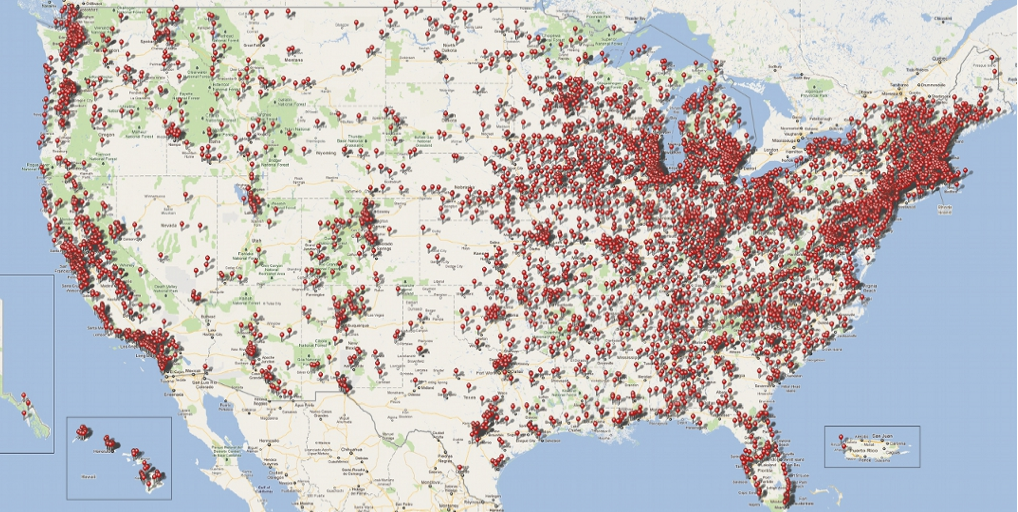
most recent map of farmers markets in US according to the USDA.
HR 2112
On June 16, the House approved H.R. 2112, the fiscal year 2012 (FY 2012) agriculture appropriations bill, by a vote of 217-203. The House voted to cut nutritional assistance, conservation, and renewable energy programs significantly. Overall, the FY 2012 agriculture appropriations bill would cut $2.7 billion (13.4 percent) in annual discretionary spending from the U.S. Department of Agriculture (USDA) below current FY 2011 funding levels. These reductions, if enacted, would follow deep cuts Congress recently enacted in the USDA’s FY 2011 budget. Funding for food and agriculture programs in FY 2012 would be cut more than 25 percent below FY 2010 spending levels on average.
Top 10 Things You Should Know About The Farm Bill | Environmental Working Group
Or it’s all about corn, cotton, rice, wheat and soybeans.
Top 10 Things You Should Know About The Farm Bill | Environmental Working Group.
 Helping Farmers Markets Grow