Keeping Agricultural Land Prices Affordable for Farmers in the UK

“The idea goes back to 2005, when members of various groups involved in ecological land management and cooperative development got to talking. Inspired by a vision for what would become the Ecological Land Cooperative (ELC), they sketched out a plan to buy degraded agricultural land and lease it to people with the desire and skill—but not enough cash—to start small-scale farms with regenerative practices (think permaculture and agro-forestry).”

Keeping Agricultural Land Prices Affordable for Farmers – Economy – Utne Reader.

Be a sign up genius

Whenever I get to farmers market conferences, I learn a few new things: this time, I learned about signupgenius.com from Jaime Moore, Columbus area market manager, Ohio Farmers Market Management Network Board member AND “Central Ohio’s Agricultural Queen” with farm Wayward Seed.

Jaime uses it to manage her three area farmers markets volunteers and based on her to-do list, she needs it…
It looks like a great tool to use (and is free) for market organizations of many sizes and types.

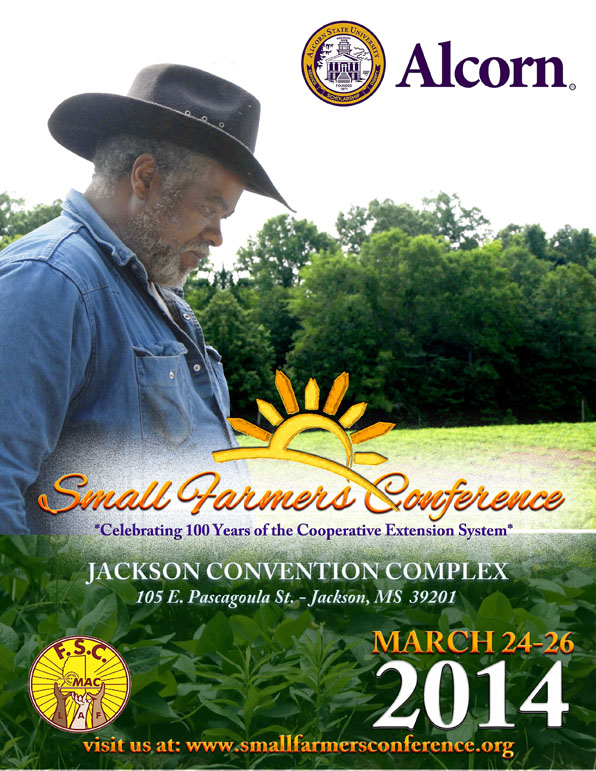
2014 Small Farmers Conference in Jackson MS

The 23rd annual Alcorn State University Extension Program (ASUEP) Small Farmers Conference, slated for March 24-26, 2014, will be held at the Jackson Convention Complex, 105 E. Pascagoula St., Jackson, Miss.
“Using Smarter Innovations to Strengthen Agriculture” is this year’s conference theme. The event is co-sponsored by ASUEP and the Mississippi Association of Cooperatives (MAC).
2014 SFC Web Registration

Free Human-Centered Design Workshop Offered

IDEO.org is happy to announce the second iteration of Human-Centered Design for Social Innovation, a course that we’ve created in conjunction with Acumen. This seven-week course will get you started using the human-centered design process to create innovative, effective, and sustainable solutions for social change in your community. Last year, we had over 13,000 people sign up for this course. They formed over 4,200 design teams bringing human-centered design to 134 countries. Want to learn more? Watch this short video.

How does the course work? This course is designed with a group-guided learning structure. This means that in order to participate, you’ll need to form a team of between two and six people. Once you have your team, you’ll meet each week to learn the human-centered design process via the readings and workshop materials that we’ve created for you. Along the way, you’ll also tackle a social sector design challenge in your own community.

How much does the course cost? The course is free. 

When does the course start and how long does it last? The course begins on March 31, 2014 and is designed to be conducted over a minimum of seven weeks. However, you can also choose to do the course over a longer period of time if a different pace is right for your team.  

Do I need to be a designer to sign-up for the course? This course is open to all and does NOT require any prior design experience.

What if I’ve taken the course already? We’ve created a bonus chapter for those who want to scope their own design challenge. Even if you learned with us last summer, please consider furthering your knowledge of human-centered design by joining us again!

Who else is taking the course? You’ll join teams from around the world taking this course as part of the leadership classes offered by Acumen. Last year, many participants found it valuable to take the course with their coworkers and explore how human-centered design can add new perspectives to their work–whether it be applied to nonprofits, social enterprises, educational institutions, or international aid organizations. In addition, you’ll have the opportunity to share your learnings, ask questions, and get to know other course participants from around the world via an online Google+ community.

Interested in signing up? Register by March 30th at: http://plusacumen.org/courses/hcd-for-social-innovation/

More information? +Acumen course ambassadors are holding precourse Meetups in cities around the world. Attend a Meetup to learn more and to meet other human-centered designers interested in taking the course. More questions? Email HCDCourse@IDEO.org


First Taste

Pass the Virginia Food Freedom Act

Hey Virginians (or friends of Virginians): Please sign or forward this to those who can help influence the legislature to enact a cottage industry law that other states including my own Louisiana and nearby Mississippi passed recently.

Pass the Virginia Food Freedom Act! | Peers.

Fat Tuesday food

Today is a holiday in my city and region, combining the best parts of tradition and public spectacle, and food is an important part of the tradition of Carnival. Our own Poppy Tooker talked about it on NPR last week.
Happy Mardi Gras everyone.

Rex decrees:
“I do hereby ordain decree the following…that during the great celebration all commercial endeavors be suspended. That the children of the realm be freed from their studies and be permitted to participate in the pageantry.”
And to the city’s political leaders, he added:
“That the mayor and City Council cease and desist from governance.
“We will fulfill the will of the people and turn over the key to the city to you, so that tomorrow in New Orleans will be a day of abandon,” Mayor Landrieu said. “Happy Mardi Gras.”

all to eat on a Mardi Gras day…

The evolution of fresh food — Back to the land — or at least to the farmers’ market :: by Amy Halloran :: Culinate

A well done piece by a former farmers market manager and constant supporter of farms about the evolution of markets and healthy food alternatives.

The evolution of fresh food — Back to the land — or at least to the farmers' market :: by Amy Halloran :: Culinate.

As Farm to Plate movement blooms, Vermont food and farm jobs help drive economy

In January 2011, when the Farm to Plate Strategic Plan was released, an economic analysis indicated that with every five percent increase in food production in the state, 1,700 new jobs would be created. Goal #1 of the Farm to Plate Strategic Plan is to increase Vermonters’ local food consumption from five to ten percent over ten years.

As Farm to Plate movement blooms, Vermont food and farm jobs help drive economy – Burlington Sustainable Agriculture | Examiner.com.

Giving Business the Incentive to Promote Healthy Lifestyles

Love the article linked below; it’s an overview of incentives given to business to encourage healthy behaviors. For those of you that have heard my spiel on how the 1970s emergence of the farmers markets movement has focused on incentivizing behavior changes of all kinds with buying rewards (frequent shopper cards, raffles/giveaways), added social interaction (music or entertainment), knowledge increase (cooking demos) and so on you might see how the most recent addition of cash incentives for low-income citizens to find their way to us is simply another example of that strategy.

This article shows that many businesses are using the same strategy when adding benefits to their community and therefore, markets should see that they stand proudly as innovative leaders in incentivizing good health and wealth. AND markets should use this strategy in as many ways as they can to continue to increase everyone’s changes, including vendors, neighbors, and shoppers in every socioeconomic strata.

Giving Business the Incentive to Promote Healthy Lifestyles | Community Commons.

Credit Card Payments Market Competition

Here is a link to an excerpt on the politics of credit card systems. It illuminates how startups companies wanting to provide services face difficulties, including this:

Two pieces in the chain are particularly vulnerable to disruption: the makers of the actual hardware — basically card readers and registers — that are used to physically accept card payments at stores, and the hundreds of vendors known as merchant service providers, or MSPs, which set businesses up to accept credit cards.

The entire article (unfortunately you must pay to get it) speaks to some of the issues we are facing with MobileMarket et al in expanding technology to lower capacity markets and farmers. It also shows the need for the food movement to embed knowledge on card and currency issues so that we stay ahead or at least on the curve of changes, rather than being pawns of the very small set of multi-national players in technology and card processing. If, like me, you accessed the entire article (or others like it) and want to have a conversation, I’m interested in talking about these issues in more depth. Feel free to contact me…

Credit Card Payments Market Competition 2 – Business Insider.

an excerpt from another article on the subject raises many of the same questions:

“…with the global roll-out of mobile payment services comes uncertainty for both banks and consumers, and this is evident in the lack of standardization in mobile payments technology. Financial institutions are facing a major dilemma. When planning mobile payment services, they need to select one of the available technologies in the hope that it will become the dominant standard, or they risk being left behind.”

On-Farm Slaughter May Be Legal, But It’s Complicated

H-515, the Agency of Agriculture, Food and Markets housekeeping bill, made it legal for farmers to facilitate on-farm slaughter, but not conduct it themselves. The limitations – and wording – of the rule are causing some frustration and confusion.

On-Farm Slaughter May Be Legal, But It's Complicated | Vermont Public Radio.

10 New Orleans chefs share their culinary hopes for the 2014 New Orleans restaurant scene

More ethnic, more niche and available in every neighborhood and supportive of farmers and producers:

10 New Orleans chefs share their culinary hopes for the 2014 New Orleans restaurant scene | NOLA.com.