How the Bitcoin protocol actually works and what that means for us

Complementary currencies fascinate me and recently, the crypto currency bitcoin especially. Its an example of a decentralized example designed to reduce  inflation (although maybe not deflation) and the need to have a central authority. I agree with many that the bitcoin seems unlikely to be a replacement for fiat currency (government-decreed legal currency) and I also agree with the concern over the ultimate role of this currency that has a limit to how much can be “mined.” Still, important to remember that gold has very close to the same values and limits and has flourished as a protection against only using a national currency.

The reason why this should be so important to food system organizers-especially to direct marketing outlets-is that many of these outlets are operating what is essentially a debiting system with tokens,  yet doing it without the robust and transparent nature of a currency system, or without a fair and openly discussed exchange rate that asks everyone possible to share the costs. In other words, we have built systems that allow people to begin to depend on the market to supply a debiting system so as not to have to stop and get cash before coming to market, or from vendors from having their own machine and costs, yet are not extending the reach of that system to find ways to pay and find support for it. What seems to be the goal for most involved is to dream of the day that we can hand these systems off to the farmers to run themselves. I would say that for many reasons this is unlikely in any near future as these systems will remain unwieldy to manage.
Those reasons for the delay or impossibility of the vendor hand off happening include (but are not limited to):
-the lack of easy-to-manage back office systems
-the wide variations of card fees and systems needed to swipe cards
-the costs for each vendor to purchase and maintain these systems. Add to that the very nature of pop up markets without access to good wifi or mobile phone signals, the low number of transactions per vendor and complication of a high number of customer transactions on any one day with many small businesses that will confuse and alert card processors.
To me, what comes first is solving these problems and extending this system’s reach to savings and loans pilots. What about allowing restaurants that source locally to accept the tokens during slow months? Or working with banks to help provide some accounting or backing? What about establishing micro loans to encourage more people to use this as a sticky currency working through a local food system? The Berkshares system in Great Barrington area is an uniquely designed currency that is experimenting with these ideas and more and has added hundreds of outlets at which their currency can be used; it is surely one that should be studied closely by our field, if nothing else.
There are examples of different token pilots at markets, such as MarketUmbrella’s Crescent Fund and Massachusetts’ pilot of electronic wallet (an example here of an electronic wallet) but these pilots are still so limited and information is not widely available. I would love to see some deep analysis of the impact of these systems and some prototyping of entire systems, especially with the emergence of these popular electronic currency such as bitcoins and vibrant complementary currencies such as the Berkshares.

How the Bitcoin protocol actually works | DDI.

Overstock says they’ll take Bitcoin

Grazing with goats in the Crescent City

Goats for grazing is a super idea for the many open, untended sites we have in New Orleans and throughout the U.S. This is a simple fundraising idea for an New Orleans entrepreneur that wants to use goats to graze public and private green space. She has already been contracted to use goats on a park in the city (Brechtel Park) starting in 2014 and needs support to get her business prepared for the work ahead.
I see she also sees this as public art, which I’d have to hear more about to understand I guess, but the goat grazing is by itself an idea that I can certainly support. Maybe you can too?

YHerd?

…To comment further on the public art point, I’d rather this be seen chiefly as a serious farming and open space issue that helps urban people see that livestock can safely serve many roles in the larger natural survival loop, even in our ordered urban environment.

“Where Farmers Markets and CSAs Fall Short” An interview with Mary Berry

Be forewarned-if you know me, you are going to hear and see excerpts from this link many, many times in the future. An articulate and necessary interview with Mary Berry of the Berry Center (yes, daughter of our agrarian apostle* Wendell Berry) on the shortcomings (or pitfalls if you prefer) of our good food work so far. I think all of her points are spot on and all have potential actions to take to push forward.
In These Times

*Don’t worry-The term “apostle” is used here in the Classical Greek context of messenger. No idle idolatry intended.

Economic Opportunity Is Lowest In the Republican Bible Belt, Major Study Finds | Alternet

I suspected as much, based on the struggle that our community food systems here still have in front of them to reach any decent economic plateau. And, of course, this is another easy way to track where large swaths of institutional racism are still at work.

Economic Opportunity Is Lowest In the Republican Bible Belt, Major Study Finds | Alternet.

Study calls for expanding the state’s local produce economy – The Post and Courier

Another excellent report by Ken Meter of Crossroads Resource Center:

Study calls for expanding the state's local produce economy – The Post and Courier.

Report link

VT Currency Report wins a 2013 American Graphic Design Award

Our Vermont Market Currency Report won a national design award, thanks to our amazing and patient designer Matt Hannigan, now working with GoodThree Design. I heartily recommend working with them on your next report.

American Graphic Design Awards 2013.

VT Market Currency

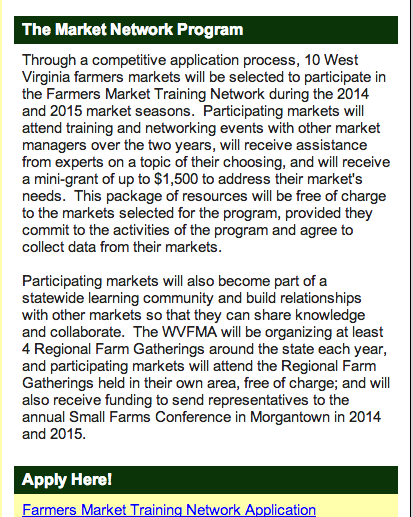
West Virginia Training Program for Markets

Another fascinating statewide training program for markets is being developed, this time in West Virginia. Much excellent work seems to be going on there.

unnamedWVTraining FMs

Program information

Better Eats for All | Belt Magazine | Dispatches From The Rust Belt

A commentary from yours truly on the food system found in my first hometown of Cleveland Ohio. Whenever I return to it, I am struck by the unusual underpinnings of their food work, being as it is deeply embedded within the community organizing/social justice strategy that is alive and well in many of their neighborhoods, as well as in the larger reality of figuring out what to do with their post-industrial inner core. Combine that with enthusiastic corporate greening, municipal support and the awareness of the need to combat the foreclosure crisis with innovative small business and residential reclamations and you get a dynamic little system coming to maturation there.

Better Eats for All | Belt Magazine | Dispatches From The Rust Belt.

Why Some Communities Police Themselves, While Others Don’t – Mike Riggs – The Atlantic Cities

Certainly, this article is talking more about how third parties help with prevention of crime but the very concept is highly adaptable to our work.The subject of rules and how they are established and maintained is an important topic in community food systems where so much is self-regulated. If we continue to advocate for “home rule” as it were, how do we embed the appropriate levels of control into these tiny volunteer-led markets and entrepreneurial food system projects? And beyond that, what levels of certification are truly necessary without killing innovation or democracy?
I think a big part of the answer is how well we understand the social ties that we have within each project and how they can be best utilized to maintain quality and openness.

Gelfand et al’s model says that having third party punishers in your neighborhood or workplace is dependent largely on “high average strength-of-ties and low mobility.” Or put more simply, knowing the people around you and not being likely to leave. The higher the strength of ties and the lower the mobility, the more third party punishment you’re likely to see. In these situations, Gelfand’s question (why are these people intervening?) has a logical answer: “Punishing responsibly fosters a culture of cooperation in the neighborhood, by signaling that defection is not tolerated.”

So what happens if we have low strength of ties and high mobility, which is sometimes the case in melting-pot cities such as D.C.? In highly transient communities where few people know their neighbors, third party punishers are far and few between. “It’s really difficult for responsible third party punishers unless there’s a few of them around a neighborhood,” Patrick Roos says. For those of you who consider yourselves white knights, this also means that “a single third party punisher is unlikely to remain one for a very long time.” (Unless that third party is, say, Jackie Chan’s character from Rumble in the Bronx.)

Why Some Communities Police Themselves, While Others Don't – Mike Riggs – The Atlantic Cities.

First New Orleans recipient of Fresh Food Retail Initiative closes, puts store on market | The Lens

A Central City grocery store that received a low-interest loan under a city-funded program to bring fresh foods to under-served neighborhoods has been closed and placed on the market.

Owner Doug Kariker said the store was too much work. “I can’t do it anymore,” he said. The store was not profitable, he said, “but in our business plan, we didn’t expect it to be” in the first year.

First recipient of Fresh Food Retail Initiative closes, puts store on market | The Lens.

Using food stamps at farmers’ market in limbo

Although this story from Madison is a bit sobering (and was probably meant to be an alarming title by the writer, good work there Lindsay), it is also a well-reported one about the issues that we currently face in the hard work of encouraging benefit dollars to be spent on healthy food with farmers at markets. Clearly, by working closely with municipal partners these excellent markets have already begun to build deep understanding and support among those officials. We are still searching for an answer (or answers) to the costs and time needed to administer these programs, but there is no doubt that the success in attracting low-income shoppers has impressed our potential partners. I believe these programs will be rewarded in the long run with sustainable funding or with cooperative administration for managing the financials and outreach pieces if we keep telling our story in as many ways as we can.
What seems clear to me is that markets cannot continue to knock on doors for small amounts every season to fund these programs, but must instead find income streams that will maintain these programs over years. That work must happen even as we band together to fight for better technology and back office systems on a regional and national level. We can do both of those things if we collect and share data (good and bad) and talk often to each other about these issues.

The city has expressed significant support for EBT at farmers’ markets as well. In August through October of this year, grants from several local hospitals made $8,000 available in “MadMarket Double Dollars” at four smaller markets on the north side, the Eastside market at the Wil-Mar Neighborhood Center and two on the south side. For every $1 in Quest benefits, the user got another $1 from the grant.

City officials want to expand that program.

“We saw incredible growth of SNAP use at those (smaller) markets,” said Mark Woulf, the city’s alcohol and food policy coordinator. “That’s something we don’t want to lose. … Hopefully we can work through a solution.”

Woulf said financial support of the DCFM’s FoodShare program would require City Council approval, but it “would be on the table.” He conducted some of the follow-up surveys after the Double Dollars pilot program and was encouraged by what he heard.

“The Eastside market did something unprompted, which was give us a break down of (SNAP use at) individual vendors,” Woulf said. “I was impressed by how well spread out it was.”

Using food stamps at farmers' market in limbo : Ct.

The Botany of Desire review by Ronstadt

This is one of my favorite books-and is a great one to share with those yet unfamiliar with the issues of GMOs and why less variety in the stores is bad-but I always feel like my description of it to others is wanting. Today, I read Linda Ronstadt’s USAToday review of her favorite books to give for gifts and finally, I have a good 30 second description to share for this book:
The Botany of Desire by Michael Pollan: Four essays about plants’ ability to domesticate humans based on our desires for sweetness, beauty, intoxication and control of the food supply. Thought-provoking and at times hilarious, this book is so enjoyable that when I finished it, I turned back to the first page and read it straight through a second time.