Dear Southern Farmers: The product is a solar cell that can be painted onto surfaces to generate and conduct electricity to power electronic devices. The paint generates the electricity and conducts it as well. The electricity generated can be used right away or stored for later use. This paint will lower the carbon footprint, energy bills, gasoline consumption, and energy dependence on international countries. Your participation would be greatly appreciated. The survey is short, easy and should take about 5 minutes!
Online Fundraising Assessment Webinar
Tell The Truth Today, Raise More Tomorrow:
Assessing Your Online Fundraising Capacity
Thu, October 18th, 2012 1:00 PM – 2:00 PM EDT
Presented by: Debra Askanase, Community Organizer 2.0
In this webinar, we will walk you through a comprehensive evaluation of the state of your organization’s online fundraising strategy. Assessments are not a judgment, but rather a statement of where you are along a continuum of practice, and can offer practical insights into your online fundraising execution and effectiveness.
Prior to the webinar, we will send an anonymous, brief survey to all webinar attendees asking you to evaluate the state of optimization of your current online fundraising capabilities. We will share the aggregated survey answers during the webinar, and what that means for the state of online fundraising in the nonprofit industry.
“A market and a sentiment are not a movement”
Love this article from Sunday’s NYT which was sent to me by a non-foodie friend. As always, I appreciate Pollan’s clarity and honesty, but I do disagree that this election season is a litmus test for our work.
The present administration has not made localized healthy food systems a core part of its mandate yet and as much as I appreciate the First Lady’s resolve and leadership on good food, lets be honest: it’s not the only flag (or even the main flag) that they are flying. As for initiatives, ballot referendums in California have yet to have serious impact on the rest of the nation. Trust me-I worked on Ohio’s Issue 5 back in the 1990s that was modeled on California’s labeling law of cancer and birth defect-causing ingredients: talk about a bloodbath.
I also say that the issues centrally addressed by this referendum are exactly what we are NOT about: refashioning the industrial food system at its edges. Our work is life and death on every front and about creating an alternative food system that by its very life means death to poisonous, fake foods controlled by a few dozen monolithic corporations. (Asking them to refashion their products for approval is like Al Capone being asked to use a 6 shooter rather than a Tommy gun-everyone would still be in danger and he would still have become richer and more powerful.)
I’d say that the true test of this system as an election kingmaker will be when there are actually candidates that stump for office using localized healthy food systems for all as their mandate. Unfortunately, that has little chance of happening on its own.
The other way we can test this system is when we actually reach across race and class lines and age groups to find one day that the majority of the country has 1) successfully shopped at a farmers market more than once 2) went to a school that regularly served healthy food that was culturally recognizable 3) honors farmers and harvesters by refusing to vote for developments that drive up prices of farmland or waterfront property and 3) choose brands that don’t pollute, use dangerous ingredients or undercut workers to bring you the best price on a product.
Then, the mandate in DC will not depend on the weak resolve of a privately funded politician, but on the goodwill of the electorate. And yeah, until then, it’s a damn good article about movements.
“One of the more interesting things we will learn on Nov. 6 is whether or not there is a “food movement” in America worthy of the name — that is, an organized force in our politics capable of demanding change in the food system. People like me throw the term around loosely, partly because we sense the gathering of such a force, and partly (to be honest) to help wish it into being by sheer dint of repetition. Clearly there is growing sentiment in favor of reforming American agriculture and interest in questions about where our food comes from and how it was produced. And certainly we can see an alternative food economy rising around us: local and organic agriculture is growing far faster than the food market as a whole. But a market and a sentiment are not quite the same thing as a political movement — something capable of frightening politicians and propelling its concerns onto the national agenda.”
Complaints feed Santa Rosa farmers market feud
Certification is a great idea. Associations are a great idea. Feuds are not a great idea.
If You Build It, Will They Come? Consumer Behavior Concepts for Effective Marketing of Healthy Food – an NGFN webinar
Thursday, October 18, 2012 3:30 PM – 5:00 PM EDT
Connecting all the dots to ensure a good supply of healthy food is challenging, particularity in underserved and limited resource populations. Creating access to Good Food alone does not necessarily guarantee community members will purchase and eat it. Increasing food access is good, but increasing the consumption of healthy food is even better.
To “close the deal” with the consumer, we must truly and respectfully understand several factors including, how people in the community live, the constraints they live with, and how they shop. This information, when handled in a sensitive and thoughtful way is critical to creating an effective healthy food marketplace that considers what products should be marketed, at what price and to which specific consumers.
Farmers Market Coalition Farmers Market Training Programs Webinar
Wed, Oct 10, 2012 1:00 PM – 2:00 PM EDT
Register at:
https://attendee.gotowebinar.com/register/2490526123394749184
Please share with market state or network leaders that are interested in developing models of accreditation or training programs.
5 minutes – Welcome and logistical overview of webinar from Elizabeth Comiskey, FMC Membership Coordinator
10 minutes – Bernie Prince, FMC Board President and co-founder and co-director of Fresh Farm Markets will give an overview of how FMC can help networks build training programs: no need for a “one-size-fits-all” model!.
20 minutes – Dru Montri, Director of Michigan Farmers Market Association (MIFMA) will share their model: a market manager certification program
5 minutes –Darlene Wolnik, FMC Market Programs Advisor and Independent Market Consultant will share general evaluation success measures that could be used in training market managers and vendors
20 minutes – Q&A/open discussion- Moderated by Darlene
Questions can be typed in at any time; Liz and Darlene will make a list and ask each of them (as time permits) during the Q&A period. Webinars of other models will be presented in upcoming months, so questions should be focused on the model presented.
Vegetarian Awareness Month
One way that markets can spike their vendors sales is to use these widespread marketing campaigns for their own. Vegetarian Awareness Month sounds like a fine series of events to hold every October, maybe followed by Fish for the Brain Month and so on….
Food as an organizing tool…
In an email today, I referenced the birth of the New Orleans sandwich that we call the po-boy, so I thought I would share the story more fully. The po-boy is a french bread sandwich loaded with seafood, meat or believe it or not, potatoes and gravy inside. The origin of this sandwich has to do with the streetcar strike in New Orleans in 1929: baker John Gendusa and restaurant owners Bennie and Clovis Martin made this sandwich and sold it as cheaply as possible to its customers and gave it for free to the “poor boys” on strike.
The telegram that the Martin Brothers sent the strikers is legendary in New Orleans:
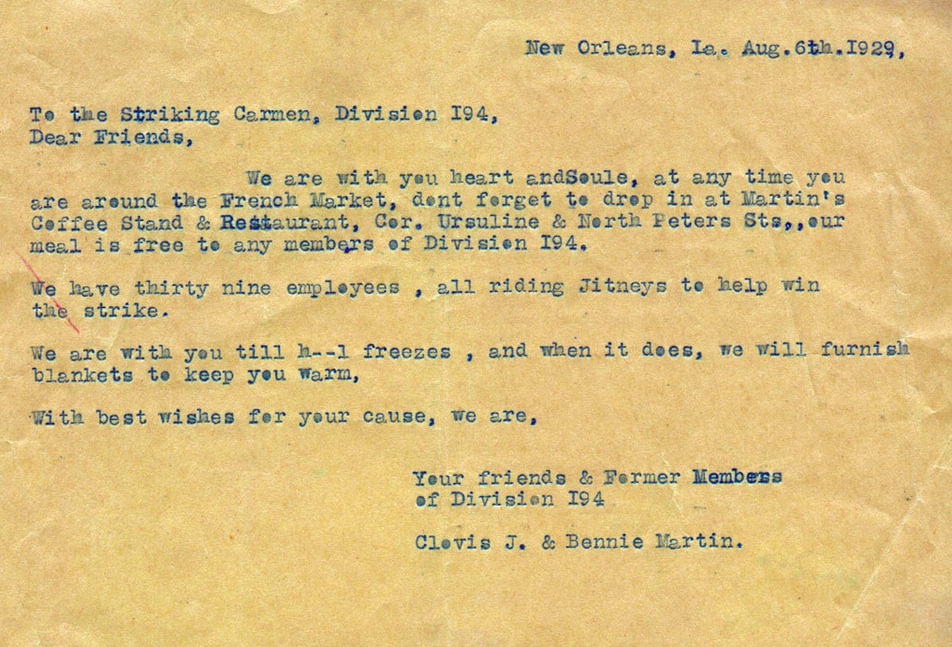
Remember how the food world can support larger issues as an inspiration or simply as an economic haven for those on the front lines. Lucky for me, po-boys are still available everywhere in New Orleans, although the Martin Brothers restaurant closed in the 1970s: however, the Gendusa Bakery remains one of our beloved French bread bakeries in the city still.
Forms of Community Wealth
Often, I talk about forms of capital and how it’s a great framework for defining local food systems. I use the forms of capital for the Indicator Matrix framework that I have been working on Farmers Market Coalition (FMC). I thought I would share the handout given to me that defines a great many of them; I believe this is a Ford Foundation handout done by Yellow Wood Associates, an excellent consulting firm that is focusing on the same outcomes that our market field is hoping to achieve.
Here is the list of capitals that the handout defines:
Intellectual (FMC refers to this as human)
Social
Individual
Natural
Built
Political
Financial
Barry Commoner Dies at 95
Barry Commoner, crusading scientist for the last 50 years has passed away. His work was crucial to the evolution of the environmental movement, starting with his work to bring to light the effects of fallout of nuclear radiation in the 1950s.
He linked environmental concerns to poverty, public health and global unrest and unraveled the DNA of political influence of corporate polluters and bad government science. As a young organizer in the Midwest in the 80s and 90s, I read a great deal of Commoner and was glad for the clarity.
I encourage food organizers that have not gone back and read some of these early works of the sustainable sector to take the time to do so. Read about what he termed the three Es that were plaguing the United States in the 1970s: “First there was the threat to environmental survival; then there was the apparent shortage of energy; and now there is the unexpected decline of the economy.”
And this of course:
His four laws of ecology:
Everything is connected to everything else.
Everything must go somewhere.
Nature knows best.
There is no such thing as a free lunch
Southern SSAWG conference news
The 2013 conference program and registration information is now available on the Southern SAWG website. You will love the program we have put together for this year’s Practical Tools and Solutions for Sustaining Family Farms conference. There are even more sessions and pre-conference events this year!
Pre-Conference Offerings:
Wed & Thurs – Jan. 23-24
Short Courses
Our popular 1½ day pre-conference short courses are intensive learning experiences that provide comprehensive information on whole farming enterprises. With the in-class presentations and the extensive take-home materials, they give you the knowledge you most need to be successful with your enterprise.
Program info here
Mini Courses
Our ½ day pre-conference mini courses provide in-depth information on specific topics in greater depth than is possible in our regular conference sessions. Our expert presenters provide you the latest information and answer your pressing questions on the topics you requested.
Mini Courses Here
Field Trips
For those who learn best by getting out in the field, we offer five outstanding field trips this year. Our ½ day pre-conference field trips are geared toward organic and sustainable production and marketing of horticultural crops and livestock and community food initiatives. Click here to learn more about these outstanding field trips.
General Conference Info:
Fri & Sat – Jan. 25-26
Expert Presenters
Each year conference participants tell us the great line-up of presenters with their practical experience is what makes our conference program so valuable. These people know their stuff and are willing to share their expertise. One older farmer said “I sure wish I had had access to this kind of expertise when I got started. I’d have gotten a lot further a lot faster!”
Presenters Here
62 Educational Sessions
The general conference, running all day Friday and Saturday, offers more choices: 62, 1½-hour sessions on a broad range of topics for start-up and seasoned producers alike. Sessions include; sustainable and organic production and marketing information for commercial horticultural and livestock producers, enterprise management lessons, farm policy education and community food systems development information.
Registration and Fee Waivers
The Southern SAWG conference is always a great bargain, given the quality of the information to be gained and the networking opportunities that come with such a large turnout of the South’s most innovative and successful producers, organizers and advocates in sustainable agriculture. Your farming operation or local foods organization can’t afford to miss this event.
This year we have three options for those looking for a fee waiver to participate in this conference.
Fee Waivers here
Be a 2012 Conference Sponsor
Your presence as a sponsor will help hundreds of farmers, community food advocates, educators and researchers across the South, and with the visibility this event affords, it will distinguish you as a supporter of the sustainable agriculture movement.
Note to organizational and institutional leaders: We can provide letters of support to your potential funders if you are seeking funds for producers in your area to participate in the pre-conference and conference activities. Just contact us with the details.
Keep up with Southern SAWG through Facebook and Twitter. Show your support for Southern SAWG by liking and following us!
“Phony” farmers markets studied
A very interesting, albeit small study about customer perception and local produce at farmers markets. I would argue however that perception and awareness needs depend on the community the market sits in. In other words, types of markets differ and therefore the expectations of the market success differ. All that really matters is if the market manager and the vending and shopping community are making sure everyone knows the same information; such if there is reselling happening and it’s for a reason that is to do with the intention of the market. As long as everyone knows about it and accepts it, I think it’s doing its job. Of course, whether it should be called a farmers market if its all resellers is another story…
In any case, I would suggest that every market community survey the perceptions of their shoppers about different items that are available at markets.
 Helping Farmers Markets Grow