Toronto Market profile-Dufferin Grove Farmers Market

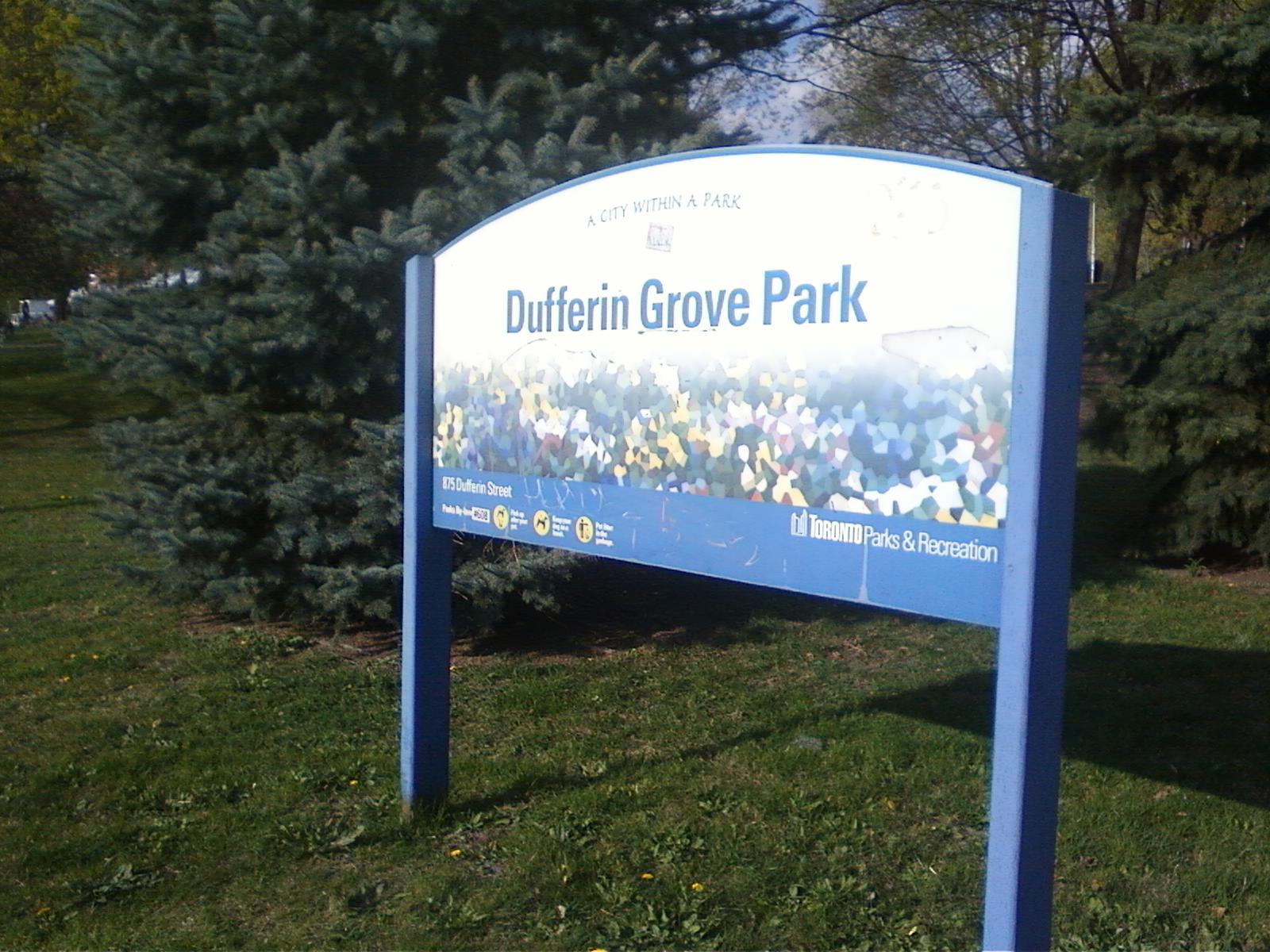
I had the pleasure of visiting our food community in Toronto in mid April, courtesy of the Greenbelt Farmers Market Network and its organizers, Anne Freeman and Sara Udow. Before I left, I was able to visit Anne’s well established, highly respected market (many people I chatted with throughout the city mentioned this market to me when they found I work with public markets), the Dufferin Grove Farmers Market.
The Dufferin Grove Park is a study in itself, and deserves to be used as an example by other neighborhoods that want to be a bridge for their residents and to use their space to inspire and share. I had the great fortune (thanks to Anne Freeman) to sit down with Jutta Mason who has dedicated much of her time to the evolution of this park and its activities. I could say more nice things about Jutta, how market organizers should be so lucky to have a partner like her, but she’d just find this lionizing of her quite odd probably.
But do take some time to see the wealth of resources and activities this informal group has brought to their area:
Friends of DGP

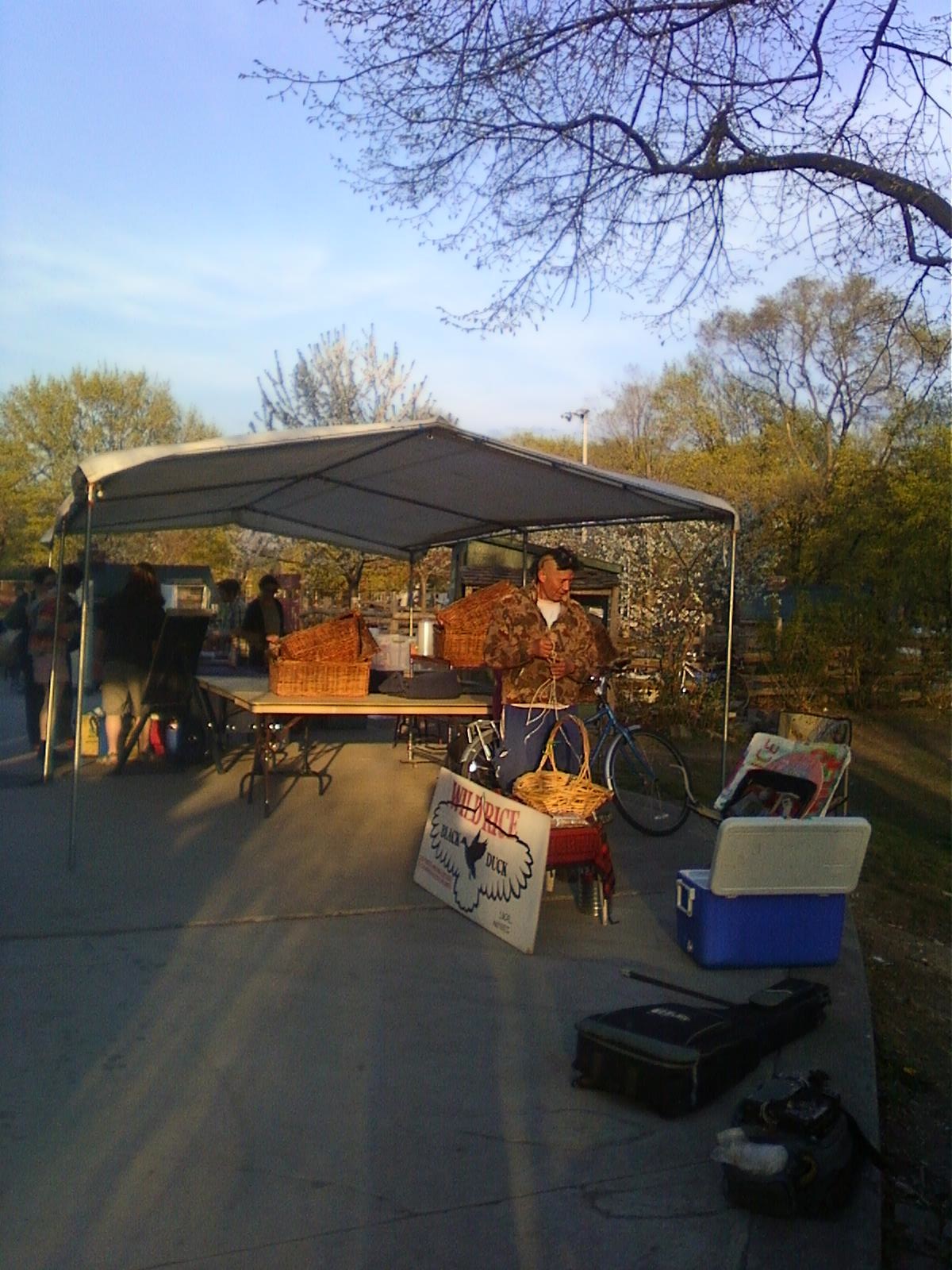
The market itself runs year-round (take that, northerners that say it can’t be done!) and has focused on organic producers, but does have farmers that represent non-organic farming as well. A good mix of small and large vendors. The wild rice vendor is a good example of the mix of season and scale of the vendors- he was sold out for the year after I bought some of his rice and would be back to his regular work until he harvested rice next year. (He told me to throw some of his rice into the swamps down in New Orleans- I might take that idea for an old creek bed on my family property…)
In any case, this is a fantastic Thursday evening farmers market that has been around for a decade already and will be there for future generations….

Black Duck Wild Rice-Toronto

Toronto CA community park


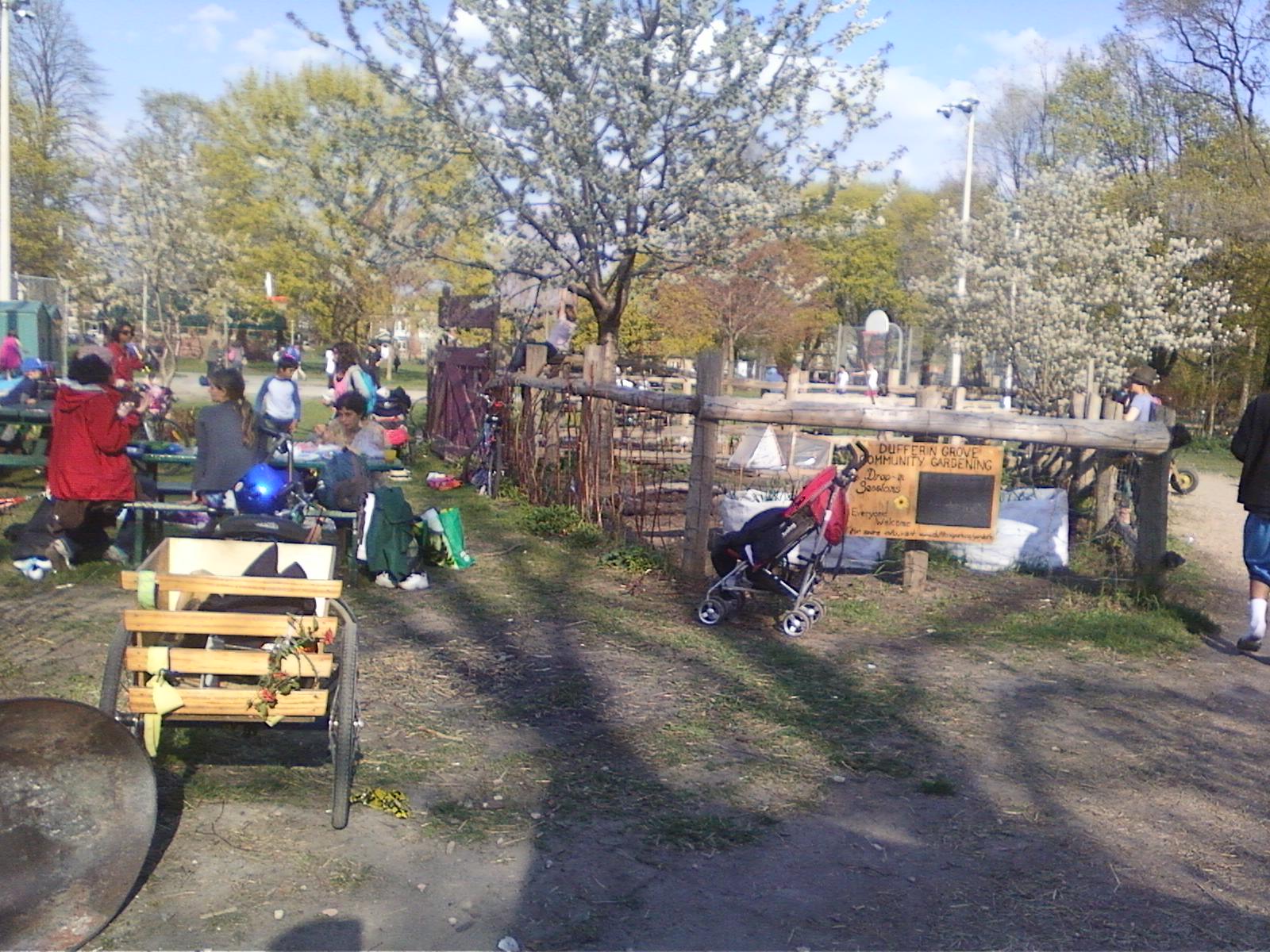
The community garden at the Dufferin Grove Park in Toronto. Sits right next to the weekly farmers market...


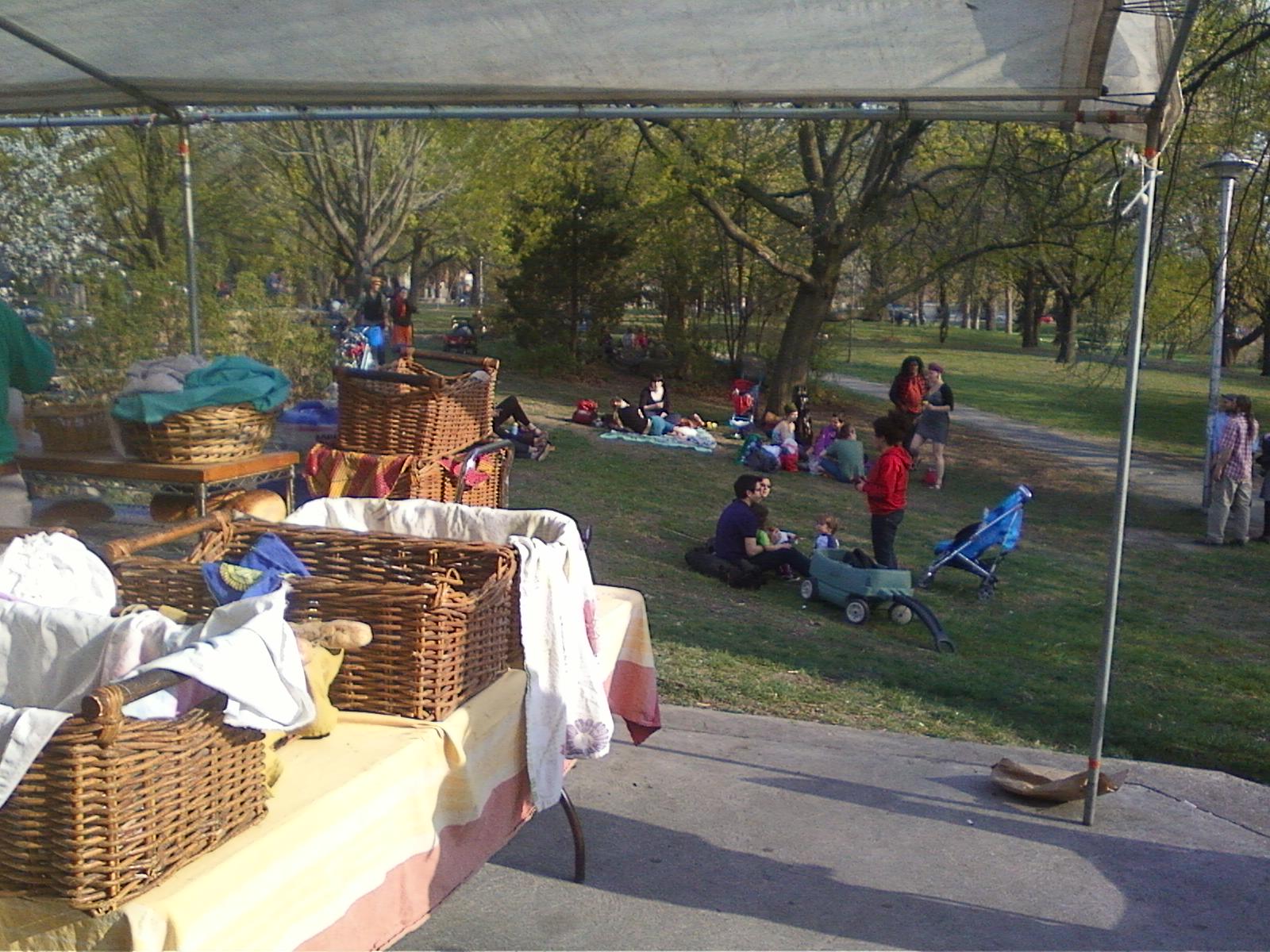
Folks sitting on the grass in Dufferin Grove Park next to the weekly farmers market.


Anne Freeman, the manager of the Dufferin Grove Park Farmers Market is seen here (in pink shirt) talking with one of her vendors in the Zamboni storage area (it is Canada after all!) where the market camps out in the winter and then spills out into the walkway for the rest of the year.


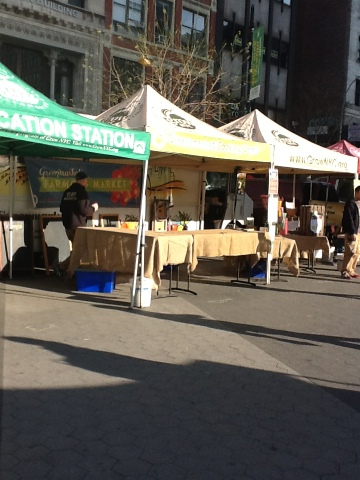
The market sets up this cleaning station for shoppers to add condiments and to clean their plates. A very attractive set up..


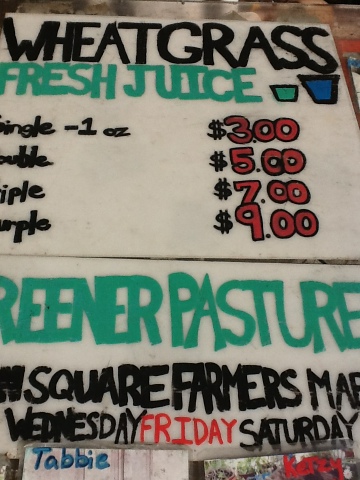
The market sale board for the park folks who make bread and food in their bake ovens and have a Friday night dinner as well.

Toronto trip #1

I just returned from giving the keynote at the Greenbelt Farmers Market Network Market Manager Day in Toronto Canada. I know, how lucky does one person get…

Spending four days with my peers to the north taught me a great many things and confirmed some others. I will post a few different stories and highlights about the trip this week, but let me start today with some generalities:
1. The deep awareness of the importance of civil society in Canada serves the market and food system well. Those working on these issues know that in order for change to be calibrated correctly, it is important for citizens to constantly act as “civic agents.” They are not afraid to be oppositional when needed (when dealing with government especially) but also understand that they need to “assist each department in achieving their particular mandate” as eloquently stated by Barbara Emanuel, Manager of the Food Strategy at Toronto Public Health. (That civic agent term was defined again for me in an article I read on the way home in the latest Democracy: A Journal of Ideas in a series called Reclaiming Citizenship which I heartily recommend as well.)
2. Every food organizer I met on that trip understood that the farmer/producer needs to remain as the central partner in all projects. In other words, I didn’t come across lip service to the needs of the farmer. That lip service is usually found in code words or phrases such as “scaling up” or “elitist farmers markets” in food system conversations that I find myself in across North America and in other Western countries. Those code words tell you that the sayers are content to ignore the facts of the relative age and sophistication of our work and the intractable nature of the industrial food system so far.
I instead heard complex, thoughtful responses to the needs of farmers while balancing health equity needs for shoppers. I wish I found that more often in my travels.
3. A set of organizers who recognize that they all must remain at the same table. More specifically, that they all sit at the table but may not have the same menu of choices in front of them. Debbie Fields, the extraordinary Executive Director of FoodShare Toronto said as much to me about her colleague Anne Freeman (my host, the organizer of the Greenbelt Farmers Market Network and founder of the Dufferin Grove Farmers Market) “Anne and I understand that we have the same goal but have to use different avenues to get there.”
4. Internal evaluation is becoming known and necessary. I can’t wait to tell you more about the dynamic presentation (and later meeting of the mind) I experienced through Helene St. Jacques, a Food Share board member and marketing research professional showing results of the research done on behalf of the markets. . And, I look forward to doing some of that US/Canada evaluation sharing with Helene as well.

So much to tell you….

Earth Day FMC radio interview

Stacy Miller, Executive Director of Farmers Market Coalition and Michael Hurwitz, Greenmarket Executive Director (and FMC Board member) talk about markets and food systems.
Good quotes for all of you to use in your annual reports and grants proposals:
(Stacy)
“The myth that somehow that supermarkets are this gleaming beacon of healthy choices…”
“in 2006 that first year of the (FMPP) grant program, they spent a million on promoting farmers markets…that same year, McDonald’s spent 850 million on its traditional media advertising…”
“We’re really in the early stages for fighting for health and equity…”
“I see farmers markets as the ultimate food hub”

in response to the assertion that food deserts are a myth:
(Michael) “Don’t get me started..”

“Our greatest competition are subsidies and advertising”

“Institutional buyers are trying to pay as little as they can”

Straight, No Chaser

Charming piece about European public squares

Our belief that farmers markets are for public good is based partly on this concept that many of our founders took from the European marche rather than the American. This describes the public space in Europe well in a few sentences.

http://usat.ly/IF45Py

An Open Letter to the Food Policy Council

Dear colleagues,

I appreciated the time and courtesy you showed me today in the middle of your packed agenda. I am even more hopeful about the future of a healthy food system after listening in on your hard work. I thank you for all that you have done and promise to do.
As I traveled back home this afternoon, I decided to write out a few major points of what I attempted to get across today, in case some of it was missed by me or simply not clear in our short time together.
My work will continue to be focused on how to build public markets into a movement and their role in the larger food system. I hope my work will benefit you as I gather and analyze data to understand the typology of markets through their characteristics so that we can all better understand how to sustain them and build healthy systems through them.

In the meantime, I want to share what I know about farmers market activists; such as that the reasons for starting or managing a market are wide ranging. It could be economic need in that community or a desire to reconnect citizens or it might be to build an entire food system. In all cases, what each farmers market learns sooner or later is that balance is the key to success. Balancing producers, shoppers and community members’ needs and changing campaigns to meet those needs is the only way to lift barriers and keep people coming back to the same place to continue to have an evolving conversation. As I said today, all great markets have one thing in common: their ability to create and maintain extensive partnerships. The more partnerships (at the appropriate time!) the better.

In the serious work you have before you, you may ask how do farmers markets fit into this health and social equity paradigm you are creating. Here is what I would like you to remember:

•In every conversation we have about food systems, there is one constant. The profound need for successful producers able to work within the human scale of our emerging system. For that need, farmers markets are the best point of entry yet found for encouraging the farmer. A market can work for one, two, or more years with a farmer, patiently letting them find their level of comfort and their own skill set.
•The incredible set of skills within a market (in the farmers, managers, shoppers and partners) can ensure that innovative and (sometimes risky) food system ideas make it past pilot stage. In other words, we experiment well and as we learn to measure those experiments, sensible policy ideas appear.
•The open, democratic, nature of markets mean that true bridging and bonding happen when they are managed well. Can you think of another place the bank president and the bus driver are on the same footing and see each other as often?
•Entry-level positions are necessary for the food system to grow. As we continue to professionalize farmers market management, we will begin to see generations of food system activists in every region with real experience and know-how.

I hope we can all agree on those. The reason I bring them up is to encourage your food leaders to make those things happen. Here’s how:

•Support farmers markets ability to work over many seasons with their producers. Understand that a market farmer is often just beginning the thinking that will often take him or her to complete immersion into larger food system sales. But also grow sisters to your farmers market points of entry by encouraging other types of farmers that might be interested in wholesale or quasi wholesale. Promote CSAs, CSFs, investor circles like Slow Money, marketing cooperatives and other ideas. Realize that markets are encouraging retail farming for one set of farmers, which leaves a piece of the farming pie still covered. Who is encouraging direct marketing of wholesale farm goods at a respectable income level with the same set of criteria that farmers markets demand? (By the way, it might end up being farmers markets again- wholesale markets are cropping up in every region run by the very same organizations that manage the farmers markets.)
•Support action organizations like the Farmers Market Coalition, which is working to build and support comprehensive training for market managers and state associations. Advocate for markets to become members and avail themselves of the webinars, the Resource Library and its advocacy work. And, of course, support practioner/ research organizations like marketumbrella.org.
•Encourage the markets to get to their most useful form. Expect your markets to have proper governance, rules and regulations BUT make sure that all of it fits in with the characteristics of your state’s farmers markets. Each region comes at this slightly differently and policy should reflect that reality. And give it time to get there.
•Professionalize market management by advocating for it. All of the lofty ideas I put forth here are based on someone or a group of someones staying in one place and building it. Let me be clear- yes paid positions must be a priority, but board training and market project planning are just as important, as are sustainable income streams.
•Use the market to address the barriers that the industrial food system and surrounding systems have put in place. Issues like racial equity and the rural-urban divide can be addressed by connecting through food sovereignty. Where better to lead the nation on these issues but here? Look at http://www.foodsecurity.org and http://www.growingfoodandjustice.org to see how to address those issues.

Lastly, policy that will last will come from those markets and roadside stands and school gardens, especially if the measurement is built properly. In that vein, I am attaching the draft of the Indicator matrix that I am working on with the Farmers Market Coalition. It comes from markets and farmers, public health activists and planners. I’d love to hear your feedback and look for ways that you can pilot pieces of it.

In closing, I heartily recommend that you think about success first in terms of your front line – your farmers and market managers. I promise you – they will help you get to the finish line.

Sincerely,

Darlene Wolnik
Food Among the Ruins / Guernica / A Magazine of Art & Politics

I am quite suspicious of media that tries to decree our movement as the answer to a region’s entire set of problems, and as a food activist, I am on record as being uneasy with terms like “urban ag” as I believe in regional ag as the better term to describe entrepreneurial farming in both the urban and rural areas TOGETHER. I mean if a rural farmer came to me and told me to support rural farming, I’d argue for the urban by asking for him or her to consider their regional needs.
And I also like regional ag since it includes existing farmers and appreciates our hinterlands and waterways which we also need to supply food for our beloved cities. I believe in urban farming, let me say that- but as for agriculture, I think we’re best served when we just support family farming and farming as an honorable profession.. Add to that, the power shift that needs to happen to support new farmers should happen today by supporting those existing farmers, some of whom are still stuck deep in in the industrial food system. We can polarize them and point at them as “part of the problem” but it may be better to learn from them and to assist them in gaining knowledge and awareness about why they may want to join us over in the alternative food system.

However, I love these quotes from legendary Detroit activist Grace Lee Boggs from the article linked below about Detroit’s agricultural movement:

“The food riots erupting around the world challenge us to rethink our whole approach to food,” she said, but as communities, not as bodies politic. “Today’s hunger crisis is rooted in the industrialized food system which destroys local food production and forces nations like Kenya, which only twenty-five years ago was food self-sufficient, to import 80 percent of its food because its productive land is being used by global corporations to grow flowers and luxury foods for export.” The same thing happened to Detroit, she says, which was once before a food self-sufficient community.

I asked her whether the city government would support large-scale urban agriculture. “City government is irrelevant,” she answered. “Positive change, leaps forward in the evolution of humankind do not start with governments. They start right here in our living rooms and kitchens. We are the leaders we are looking for.”

Detroit: Farming Paradise?

Food Among the Ruins / Guernica / A Magazine of Art & Politics.

Facing Race

Within our food system work, we need to face and address it. Within our own communities, we need to face it and address it.

Facing Race Conference

Farmers Market Promotion Program Grants Available

AMS No. 021-12

Gwen Sparks (202) 260-8210
gwen.sparks@ams.usda.gov

WASHINGTON, April 5, 2012 – Agriculture Deputy Secretary Kathleen Merrigan announced today that the U.S. Department of Agriculture (USDA) is seeking grant applicants for the 2012 Farmers Market Promotion Program.

Approximately $10 million is available for marketing operations such as farmers markets, community supported agriculture and road-side stands. The grants, which are administered by USDA’s Agricultural Marketing Service (AMS), are available through a competitive application process on http://www.grants.gov. The grants aim to increase the availability of local agricultural products in communities throughout the county. They will also help strengthen farmer-to-consumer marketing efforts.

“These grants will put resources into rural and urban economies, and help strengthen efforts to provide access to nutritious and affordable foods,” said Agriculture Deputy Secretary Kathleen Merrigan. “This program not only supports the health and well-being of local communities but also the economic health of their farms and businesses.”

Projects that expand healthy food choices in food deserts or low-income areas (where the percentage of the population living in poverty is 20 percent or above) will receive additional consideration. USDA, in coordination with the Departments of the Treasury and Health and Human Services, seeks to increase access to fresh, healthy and affordable food choices for all Americans, while expanding market opportunities for farmers and ranchers.

Information on applying for a Farmers Market Promotion Program grant will be published in the April 6, 2012, Federal Register and available online at http://www.ams.usda.gov/FMPP. Applications will only be accepted via grants.gov and must be received by May 21, 2012. Applications that are incomplete, hand-delivered, or sent via U.S. mail will not be considered. Applicants should start the grants.gov registration process as soon as possible to meet the deadline. Contact Carmen Humphrey, Program Manager, by phone: (202) 720-8317, or e-mail: usdafmppquestions@ams.usda.gov for more information.

Authorized by the Farmer-to-Consumer Direct Marketing Act of 1976 and amended by the Food, Conservation and Energy Act of 2008 (the Farm Bill), the Farmers Market Promotion Program is in the seventh year of funding direct markets that benefit local and regional economies.

The Farmers Market Promotion Program is part of USDA’s commitment to support local and regional communities. These investments are highlighted in USDA’s Know Your Farmer, Know Your Food (KYF) Compass. The KYF Compass is a digital guide to USDA resources related to local and regional food systems. The Compass consists of an interactive U.S. map showing local and regional food projects and an accompanying narrative documenting the results of this work through case studies, photos and video content.

A large selection of USDA-supported programs and projects is also visible on the KYF Map, which can be displayed by theme, program, or recipient type. Both the KYF Compass and map will be regularly refreshed with new data and case studies.

#

Get the latest AMS news at http://www.ams.usda.gov/news or follow us on Twitter @USDA_AMS. You can also read about us on the USDA blog.

Gleaning is good.

I appreciate when markets can measure how many pounds of food are given to food banks each year by their farmers. Gleaning is another way to use the productivity of the farms in your area. In both cases, markets should assist their farmers in knowing how to record the amount of food their business donates and how they might invite gleaners to their farms without a major disruption to those businesses during harvest season. The markets should also thank those farmers in annual reports or marketing literature, both their own and any beneficiary like the food banks.
http://civileats.com/2012/04/06/gleaning-for-good-an-old-idea-is-new-again/

Hollywood Farmers Market CEO is fired

Pompea Smith, founder and director of the Hollywood Farmers Market and 7 others, has been let go by her board of directors. Without detailed information, nothing can be inferred from this decision, but I will say, the commercial kitchen the organization had recently built worried me a great deal. It’s unfortunate that somehow open air markets suffer from the perception of being difficult (or for some) impossible to maintain funding for their operation, when often it is the ancillary projects and added staff for those other projects that reduce the markets’ financial health. To be clear, I am not saying what contributed to this particular change as I have no idea, but the economic future of markets is something I work on for many communities and assume that sooner or later every board is having this type of economic future conversation with its market leadership.

I know and admire Pompea, having worked with her on some research a few years ago. She deserves the thanks of her community and the entire market movement. I also support the need of this board and staff to move forward with new leadership. It’s time to welcome the next generation of leaders.

http://www.latimes.com/features/food/la-fo-marketwatch-online-20120406,0,434699.story

Greenmarket Union Square – Wednesday

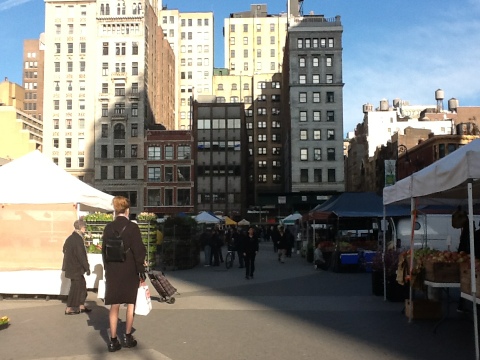
On my way to a morning meeting, I had the great fortune to be able to stop at the Greenmarket on a beautiful Wednesday morning. This is the first half hour of opening, and let me tell you, it never looks this quiet again! I didn’t get close ups of vendors this time, but will whenI go back on Friday morning!

20120404-105156.jpg

20120404-105220.jpg

20120404-105233.jpg

20120404-105251.jpg

20120404-105308.jpg

Farmer Federation of New York farmer information day

This week in Manhattan, Diane of the Farmers Federation of New York leads an overview on EBT, WIC, FMNP and food handling for farmers working at farmers markets. The Farmers Federation works with FNS, Dept of Ag and other partners to streamline EBT acceptance for markets in New York. They facilitate the markets receiving free machines, supply each market with their own tokens, reimburse the transaction costs and train market vendors and managers. A very instructive morning for markets and vendors, courtesy of the Farmers Federation. Nice model for other states to check out.

20120404-104921.jpg

WIC’s Fresh Produce Program Cut 30 Percent – NYTimes.com

Education is part of almost every market’s mission. Explain to your vendors and shoppers that when food assistance programs include regionally sourced food and farmers, it benefits everyone. HOWEVER, do remember those of you that are 50(c)3 organizations, you must not use your organization’s resources to lobby for legislation.
From the IRS website:
… may not attempt to influence legislation as a substantial part of its activities and it may not participate in any campaign activity for or against political candidates.

For those of you NOT 501(c) 3 organizations, a letter writing campaign might be in order!

WIC's Fresh Produce Program Cut 30 Percent – NYTimes.com.

Vendor’s 360 degree view

Recently, I noticed that this vendor at the New Orleans Road Food Festival had thought through their entire setup-both from the front and from the back. It’s a great idea when vendors walk the space they use to see how people will view their setup from a less obvious vantage point.

Not only does this vendor have a 2-sided sign up, the entire group has t-shirts on that identify their site. AND, the whole thing looks pretty organized.
If a shopper happens to see mess, or can’t tell what what is being sold from whatever side they are on, they may just keep on walking…
and by the way, they had great gumbo. And had another great idea- they offered a 2-dollar “tasting size”!