As the movement grows robust, many shoots are growing from unlikely and likely places to support local place-based organizers of alternative food systems. I myself have become one of those, and the folks at Seed and Cycle are there too, offering smart resources for urban growing. Goals such as extending the growing season and soil building are imperative for small space farmers to utilize, but reading books alone will not give you the skills needed. Look for your version of Seed and Cycle in your community or, maybe, encourage a market volunteer or partner agency to start one.
Seed and Cycle
Women Farmers Feed the World
The Alliance for a Green Revolution in Africa (AGRA) is a Gates Foundation-funded initiative based in Nairobi and spearheaded by Kofi Annan, former secretary general of the U.N. It’s a multimillion-dollar project that seeks to increase food production in Africa by implementing vigorous Western-style agricultural techniques, promising high-yield results for food-insecure populations.
According to the Gates Foundation and other supporters, it’s an African-led endeavor, modeled on the previous Green Revolutions of Latin America and the Indian sub-continent but placed in the hands of Africans. It sounds like a good idea.
But a growing movement of local farmers—largely led by women—argue that the surest path to food security is securing food sovereignty. It’s a concept that was put forward in the early 90’s by Via Campesina, an international alliance of peasant, indigenous, and women’s organizations that advocates for communities’ control over how food is produced, and who gets to eat it.
Women Farmers
No “Fundamental Right to Produce and Consume Foods”
In case you forget, food system organizers live and work in a parallel universe of food sovereignty . That other world is held in trust for the corporations who get to feed off our innovations and human-scaled ideas.
CSA=Community Supported ARTS
How nice to see the alternative food system innovation spread to other cultural institutions.
Then Altheimer had her breakthrough. On an otherwise ordinary day, she rose from her cubicle. Racing across the office, Altheimer found her boss and blurted: “We should just do a CSA!” – only this time the “a” would stand for “art.”
Springboard partnered with advocacy group mnartists.org, and just months later, in May 2010, offered shares to Twin Cities collectors in the world’s first-ever arts CSA. Since then, the model has been reproduced in Chicago and Cambridge, Massachusetts. It’s headed for arts organizations in Detroit, Miami, and Philadelphia this year; next year it’s slated for Akron, Ohio; San Jose, California; and Charlotte, North Carolina.
CSA
Southern Food
Although we have many barriers yet to remove in the South, we are lucky to have valued and retained a great deal of our food culture. We are also lucky to have Southern Foodways Alliance diligently working to capture history and help create new history too. Their website is a treasure trove of stories, recipes and facts of southern food. Their events often sell out quickly-for good reason.
One of the projects they have begun is a movie. Here is the filmmaker’s story:
Hey, I’m Joe York. I make documentaries for the Southern Foodways Alliance and the University of Mississippi’s Media & Documentary Projects Center. In early 2010, we began production of a feature-length documentary film with the oh so original working title of “Southern Food: The Movie”.
Read more about his project:
Movie
And become a member to stay in touch with all of their excellent work.
Leave it to them to use tokens this way…
The McDonald’s restaurant on South Claiborne Avenue in New Orleans is utilizing a token system for customers who need to use the latrine….
The bathroom door now has a token meter for which customers will have to request to use the facilities. The token is free upon request.
You know, maybe I’m thick-headed; how is giving a token out to use their bathroom going to reduce trash or encourage good behavior?
Japanese farmers market visit
What a treat to go along with this writer for her farmers market trip in Tokyo. Her purchases alone are worth the peek:
What we bought:
Ginger syrup kit from Tokaji Farm
White, brown, and black rice from Shigeyuki Kanai
Mochi, rice flour, and genmai meal from Kaya no Sato
Carrot jam from Tanno Farm
Edamame from Sanosuke Farm joined gifts of sweet potatoes and togarashi
Akagawa Amaguri winter squash from Kosaka Nouen
Her descriptions of the samples and products available are lively and show you the vendors pride in offering lovely offerings of basic human needs.
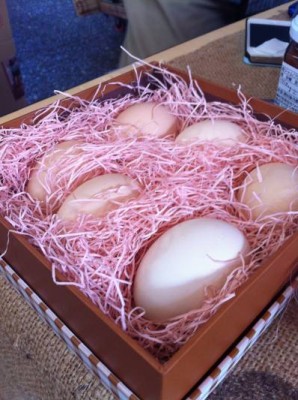
Just take a look at how eggs are displayed as if jewelry:
Japanese market
Someday, I’d like to see it for myself.
All of Louisiana declared an agricultural disaster area
Floods, drought and other nasty weather have made all of Louisiana — and 27 adjacent counties in Mississippi, Arkansas and Texas — an agricultural disaster area for 2011. The U.S. Department of Agriculture says its declaration is based on combined effects of severe storms, tornadoes, severe spring flooding, Tropical Storm Lee, widespread drought and excessive heat since Jan. 1.
Immigrant farmers
“Mr. Kim, who witnessed mass starvation in Cambodia, losing a brother, refers to his two-acre plot as “my plenty.” His fellow farmer Sinikiwe Makarutsa grew up in Zimbabwe and now grows maize on land rented from a local church. She made enough money to buy a tractor and rototiller.”
We’re not buying it.
Watch the video and sign up to support the project:
Sign petition
Australian interview on markets
Australian farmers, Garry Stephenson Coordinator of the Small Farms Program at Oregon State University, Stacy Miller, Farmers Market Coalition Executive Director and Jane Adams, the Australian farmers market organization founder talk about the growth of farmers markets in both countries. The market movement in Australia has grown in their first 10 years to 150 markets nationwide and this interview examines the growth concerns in both countries. Jane Adams speaks well on the criteria Aussie markets employ and being able to “buy dinner” and on the size of the markets versus diversity of products. Australian organizers will be in the U.S. at the end of the month to share their lessons and will attend the Community Food Security Coalition conference November 5-8 in Oakland CA.
Agripedians Wanted for Food System Wiki
(For subscribers of the Journal of Agriculture, Food Systems, and Community Development and/or as a member of AgDevONLINE):
The local food movement is growing dramatically, and with it is emerging new lingo and jargon. The Food System Wiki — a collaboration of the Department of Urban and Regional Planning at the University of Wisconsin Madison and the Journal of Agriculture, Food Systems, and Community Development — is designed as a user-friendly and evolving repository of food system lexicon. This is a place where you can contribute new words and definitions, show how the terms are used, and fine-tune those of existing words.
There are several dozen agripedians contributing currently to the Food System Wiki. We would like to see greater participation from nutritionists, community development professionals, Extension agents, faculty, students, public officials, agency representatives, and, of course, farmers and food entrepreneurs.
Please join in the project! SIGNING UP to use the Food System Wiki is easy. After approval, follow the simple instructions to get started. Start by being a member of JAFSCD:
agdevjournal