Louisiana Update # 8: The natural cost


14079492_10153806953867060_6009672677636791922_n.jpg

The flood leaves a watermark stain on the tree’s leaves as U.S. Geological Survey surveyor Scott Hedgecock works to survey the water levels along the Tangipahoa River along Highway 190 just west of Robert, Louisiana. (Photo by Ted Jackson NOLA.com )

Climate change is not entirely accepted, even by those for whom it should be obvious possibly because it is not entirely understood.  People don’t feel its effects as they move in comfort from their air-conditioned personal vehicle to living amid a span of concrete around their glass-enclosed home away from coasts or forests, getting most of their information through a thumbnail headline or from friends who work and live in the very same setting. In other words, industrialized countries.

Another culprit may be the environmental work done in the 1970s and 1980s, which often used unfamiliar phrases that lacked relevancy such as global warming (or even the term used at the beginning of this post, climate change) and focused mostly on national policy changes or in shaming users of resources without compelling evidence of the effect of that reduction. Environmentalists were seen as “do-gooders” who meant well but lacked realistic goals (this was actual feedback from focus groups at an organization I worked at in the 1980s.)

The strong pushback showed the fallacy of engaging ordinary citizens using lofty or scientific terms and  led to many turning to food as an organizing tool. After all, what could be better as an impetus to understanding and sharing the repair of the natural world but food?

Yet in the roll call of environmentalists circa 2016, food system organizers are usually in the middle of the pack. Most can certainly outline the issues involved with food production that both imperil and reboot Mother Nature, but are rarely working directly on those issues in concert with environmental organizations. Farmers markets have done an admirable job on promoting entrepreneurial activity and improving access, but efforts to highlight the stewardship of the natural world by market farmers has fallen a little behind.

I hear our great writer Wendell Berry exhorting us to remember the farmers:

“Good farmers, who take seriously their duties as stewards of Creation and of their land’s inheritors, contribute to the welfare of society in more ways than society usually acknowledges, or even knows. These farmers produce valuable goods, of course; but they also conserve soil, they conserve water, they conserve wildlife, they conserve open space, they conserve scenery.”

The  “eyes to acres” ratio suggested by Berry and Wes Jackson needs to be included in regional planning theory and in the metrics that assess our work. Within the framework of disaster, the acknowledgment of the need for that ratio could mean”deputizing” farmers to supply immediate indicators of the level of destruction.

Disasters point out the fragility of a place and at the same time remind us of the strength of human ties and the resolve of communities. Following that line of thinking, deeper knowledge of local and regional systems would help knit everyone more closely together, allow for rescue and recovery to happen faster even as it is offering a narrative with more relevancy to those in far-off but similarly sized food systems.  If the watershed or the regional system for food production were one such way to describe the need among those participating in food initiatives, assistance could be met one farm, one family or even one small town at a time.

Continue reading

Kellogg Foundation funds fruits and veggies for FitNOLa participants

The city of New Orleans has received a $700,000 grant from the W.K. Kellogg Foundation to continue supporting the community’s health and wellness, Mayor Mitch Landrieu announced July 11, adding that the grant will fund a partnership between the city Health Department’s FIT NOLA initiative, the New Orleans Recreation Development Commission, the New Orleans Recreation Development Foundation, Market Umbrella, Louisiana Public Health Institute, and community wellness programs through 2018.

Community wellness programs at clinics and other sites will refer patients in disease management groups to Fit NOLA Live Well; participants will get an NORDC key card for free fitness activities at 12 NORDC recreation centers, 12 summer and three year-round pools, and several playgrounds…and can receive vouchers for fresh fruit and vegetables (at local farmers markets).

Source: Foundation Extends Community Wellness Grant to New Orleans


Up next: New Orleans, Vermont, Massachusetts

Over the last ten years, my travel schedule has remained pretty constant in the late winter and spring: a.k.a. farmers market/agricultural conference season. Sometimes it means that I am leaving New Orleans during Carnival season, (or my fav festival event) the Tennessee Williams Literary Festival or just at the loveliest time of year. Still, I am honored to be invited to participate in so many market development workshops and say yes to as many as I can manage.

This year my conference travel has taken me to North Carolina, Atlanta and Illinois and next up are three meetings, two in places I know and love, and one new to me:

New Orleans: AFRI-funded “Indicators for Impact” project team/market pilot sites meeting.

Vermont: NOFA-VT Farmers Market meeting

Massachusetts: Mass Farmers Markets meeting

• In New Orleans, I will serve as the host team member and support the FMC team in presentations, facilitating open discussion among participating markets and in absorbing those markets feedback on their first year of gathering and compiling data. This University of Wisconsin-led research is informing the development of Farmers Market Metrics.

• In Vermont, I return for the 5th or 6th year to support my colleague Erin Buckwalter in her work at NOFA-VT to build capacity for direct marketing outlets and to support VFMA. I’ll be presenting some retail anthropology techniques for markets to consider when refreshing their markets. Sounds like I’ll also be called on to facilitate a open session on EBT issues, which should be helpful to the Center for Agriculture and Food Systems at the Vermont Law School (CAFS). The students are leading the design of a Legal Market Toolkit along with project partners NOFA-VT and FMC. Exciting stuff coming out of this project, I promise.

• Final stop of the season is to one of the most established state associations and to work with one of the longest serving state leaders, Jeff Cole. I remember well that in the formation days of Farmers Market Coalition, our Market Umbrella E.D. always came back from those meetings with great respect for Jeff’s input. Since then, I have called on him to offer analysis in some of my projects (shout out to some of my other informal advisor mainstays: Stacy Miller, Amy Crone, Sarah Blacklin, Ben Burkett, Colleen Donovan, Copper Alvarez, Kelly Verel, Suzanne Briggs, Helena St. Jacques, Richard McCarthy, Beth Knorr, Leslie Schaller, Jean Hamilton, Paul Freedman, Devona Sherwood  along with a whole bunch of others..)   Jeff has asked me to do an overview on market measurement history (RMA, SEED, PPS audits) and recent evolutions like FM Tracks, Demonstrating Value, and of course Farmers Market Metrics.

So, keep yourself busy on other blogs while I sit in meetings, learning and sharing for the next few weeks. And if you are attending any of these meetings, please say hello and share your news or ideas with me. Maybe it’ll be the next best practice that I post on my return to these pages.


Downtown development leaves Crescent City Farmers Market searching for new home new

The Saturday morning market has been at Magazine and Girod streets for 20 years but is being displaced by a new development.

Unfortunately,this sort of situation is happening across the US, even with markets that have been diligent about making the case for their space. Here is some of the anecdotal background I learned when I joined the organization in 2001 and some that I experienced in my decade there.

When this location was chosen more than 20 years ago, the neighborhood was somnolent and even slightly sketchy. Some of the supporters were concerned about the supposed danger and even advocated for security to be on site every Saturday. Yet, the lack of attention is partly why the founders chose the location. That underused space would allow them to grow as needed in the first few years without too much intrusion on residential areas and could illustrate how markets were social spaces as well as economic drivers for the community. The use of the inside parking area made it especially appealing and allowed for the market to be bustling even when raining.  And of course, security staff was never needed.

As the market grew in size and attention, the founders made another decision: instead of expanding the space into the street or searching for larger spaces to host the Saturday market, the organization opened other markets in other locations, determined to serve as many neighborhoods as possible.  In the spring of 2000, Market Umbrella opened the Tuesday market Uptown which drew weekday shoppers who rarely made the Saturday market. That Uptown market also allowed senior centers and community centers to become partners as they could shuttle their clients to a regular market while they had staff to drive them and could use their new FMNP coupons (the market started around the time when the Senior FMNP began in Louisiana). The Saturday market however, continued to draw residents from across the city and was packed from end to end from the opening bell at 8 am ’til the closing bell at 12 noon.The owners of the lot even built a small permanent toilet for the market and repaired the roof of the indoor space.

In 2003, Market Umbrella added “Festivus, the Holiday Market for the Rest of Us” a fair-trade locally made craft market, held for three days every December next to the Saturday market.  Market Umbrella offered this non-food, pop up market as another way to animate the location and as a way to increase sales at the usually quiet December farmers market. Festivus was a success, drawing 2000 or more shoppers on most of its days, many of whom had never made it to the Saturday market before Festivus.

Even in 2005, Festivus was held for one post-Katrina day on December 10th; that highly successful market day also brought a never-ending succession of long-time CCFM shoppers asking when the market would return to the location. (CCFM was open as of November 22, 2005 but only at the Tuesday location uptown. The original location would return in March of 2006.)

Four or five years after the market opened,  the neighborhood added a major amenity: the D-Day museum opened down the street and quickly grew in size. That museum has added a series of regular weekend events and significant tourism to the corridor (and is now named the National World War 2 Museum) which has had both a positive and a negative affect on the market. It has been joined by  the Ogden Museum, and in the last few years, significant residential  development as well as blocks of retail and even a full-sized grocery store have been added to this old warehouse and office building area.

With all of that new activity, the reality may be that the market should have expected it would need a new location and begin to plan for it long ago. In other words, open-air farmers markets that operate on a handshake and disappear from sight as soon as the bell rings at the end of the market may need to seek out new underused space once enough permanent development becomes attracted to the space originally animated by the market. Or,  it may mean that flagship markets that are determined to stay in their original space may have to do a capital campaign to build some sort of permanent infrastructure and still may expect they have to negotiate for parking, event space and attention, which would require added staff savvy in lobbying and in working with neighborhood groups and developers. Either way, it seems to show the need for strategic planning and constant communication about location at a very early stage of market development.

CCFM has started to search for its new location and hopes to stay near to the original area. However it may not be possible, given the new demand. Either way, Market Umbrella has a new future in store.


What may also be helpful is for markets to do a location scan every five years,  checking in on the changes in the market area and maintaining an eye out for other locations. Source: Downtown development leaves Crescent City Farmers Market searching for new home | NOLA.com

NOLa ‘food port’ Roux Carré opened Nov. 27 

I’m a big fan of the entity that operates this project in Central City. What is interesting on a sytem level is that, just like another neighborhood in town, there are actually two different projects focused on food access there. (In the other neighborhood you can view St. Roch Market and Mardi Gras Zone to see what I mean. And compare the NOLA Food Coop for good measure, as all three are within 8-9 blocks of each other.)

On OCH, the Roux Carre project shares the street with another project that I wrote of recently, the Dryades Public Market. On paper, it might seem that these two have a lot in common, but in reality I think how they were formed, and by whom and what items they sell are quite different. I plan on spending some time there this month to check them both out and will post some pictures.

And how do you like the term “food port”?

Caribbean, Latin and Southern-inspired food court on Oretha Castle Haley Boulevard

Each vendor has a 175-square-foot “pod” to set up its operation, and a retractable window opens into the space from where they can sell their food. A large, industrial-size communal kitchen includes ovens, a flat grill, stoves and prep space and storage.

By getting low-cost and low-overhead entry, aspiring restaurant owners are able to build a following for their food while receiving training in food service, retailing, accounting and payroll. There is no limit to how long a vendor may stay at the location, although Cassidy suspects most want to take off on their own eventually.

“It’s really an incubator for these small businesses,” Cassidy says. “They’re all really good cooks; we want them to learn how to really run a restaurant, so, if they want, they can leave here and do that.”

Source: Central City ‘food port’ Roux Carré opens Nov. 27 | Blog of New Orleans | Gambit – New Orleans News and Entertainment

Atlanta

Like any market leader worth her salt, my North Carolina pal Salem told me on the first day of the Wholesome Wave Summit in Atlanta that she was going to check out two of the public market projects around town, the Dekalb Market and the Ponce City Market. Of course, I invited myself along immediately. Once done with the days sessions and networking, and with her smartphone barking directions at us, we finally found our way to the first without too many wrong turns as the twilight became evening.

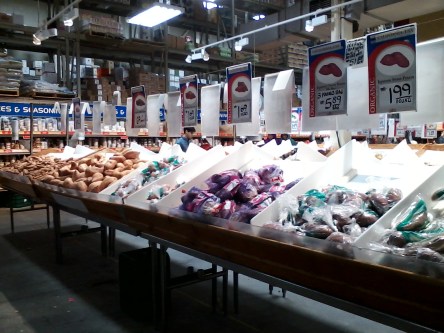
The Dekalb market is actually titled “Your Dekalb Farmers Market” and is in its 39th year of operation. Still managed by the same husband and wife that started it as a produce stand, it is more than 100,000 square feet of sales space of produce, meat, seafood, herbs, cheese, beer and wine and even a recycling center. Whether farmers have much if any relationship with it is not clear, but certainly, it serves a respectable amount of diverse needs, including offering meat prepared for multiple religious and cultural requirements and a wide selection of herbs and oils for varied ethnic meals.

It’s only a few miles outside of Atlanta and easily accessible for the 7 days per week that it is open. The parking lot is large and well lit, with the lot and the market set off from the road by itself. Once inside, the signs are many and include warnings for no photography being allowed. So do note that the photos that I include here were taken inadvertently by er…someone else.

0111161855-00

Lots of nice tomatoes available and they do sell by box too, although the price didn’t seem like any break at that amount.

0111161853-00

I counted 10 varieties of sweet potatoes

0111161847-00

Nice signage at the Dekalb Market

We bought a few items at YDFM,  with Salem noting as we left that each staff person had which languages that they were fluent in on their nametag. Shoppers were diverse and buying large amounts.

The second market isn’t far from the first, although this one is within the city of Atlanta proper. This “market” is brand new and clearly designed as a festival marketplace and situated within a larger (fancy) retail and housing development in an old Sears headquarters building. Parking was complicated, as some of the closer spaces were marked as 30 minutes or less (with signs firmly promising that towing strictly enforced, even after 7 p.m.) and others were allowed with paid parking from the parking station. Interestingly, the development had staff positioned at each pay station to assist and even though it was near freezing outside, they were extremely helpful and polite!

Once inside, we found that the space was still under construction, with small restaurants or prepared food stalls  lined up along the perimeter. The middle of the space looks to be on its way to becoming an office tower. Pictures wouldn’t do much, as the space was large and any picture would have shown lots of still under construction areas so I took no interior shots.

Those eating in the Ponce City Market were mostly of a type: young, white and informally dressed. We perused some of the eating places quickly, but as we were hungry, we found a warm and cheerful taco place with cocktails. Good staff, food excellent.

0111161928-00 (1)

2nd market: the Ponce City Market in Atlanta


Story about the amusement park opening on the roof in 2016 inspired by the original that was replaced by Sears.

Carnival food 101

The post below was from 2014 but is reposted for the kickoff today of Carnival 2016 in New Orleans. Our holiday season really begins today and runs through the first weekend of May when JazzFest ends.  It includes St. Patrick’s Day and St. Joseph’s Day in mid March so it is a ongoing parade route season! What that means is friends visiting, parties at various homes and listening to music and dancing and eating are on our schedule for the next few months. Don’t be fooled by the media’s focus on Bourbon Street or on bead-throwers: Carnival is a street celebration that allows citizens the chance to gather and offer satirical pokes at the powers that be. It even includes a demand by Rex on Mardi Gras Day that the city cease functions on its day:

“I do hereby ordain decree the following,” Rex says, “that during the great celebration all commercial endeavors be suspended. That the children of the realm be freed from their studies and be permitted to participate in the pageantry.”
And to the city’s political leaders, he adds:
“That the mayor and City Council cease and desist from governance.”

The mayor responds: “We will fulfill the will of the people and turn over the key to the city to you, so that tomorrow in New Orleans will be a day of abandon; Happy Mardi Gras.”

The Carnival season ends on Mardi Gras Day, February 9,  which is a very early end to Carnival this year.

We have officially begun the 2014 Carnival season in Louisiana. The season starts on the Feast of the Epiphany, Jan 6th and runs through Fat Tuesday, the day before Ash Wednesday,

Interestingly, January 6th is also the birthday of the Maid of Orleans, Joan of Arc who is honored in New Orleans with a startlingly gold statue and her own lovely parade today. That parade along with the Phunny Phorty Phellows parade held on the St. Charles streetcar line tonight are the first parades of our season. As you probably can tell, all of this is closely linked to the Catholic tradition deeply embedded in French Louisiana.

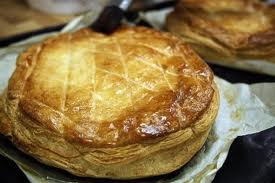
The link to the video shows how a commercial king cake is made, which is the cake we eat throughout the season. The tradition is explained well in the video, so I’ll just add that with the surge in local and artisanal foods, many more types of king cake are now available in the area. Whole wheat cakes, french-style Galette des Rois cakes and more can be found at markets, at stores and bakeries. Happy Carnival!

The best ones ( I think) are made of brioche and have a cinnamon flavor, but there are so many kinds to choose from these days

The best ones ( I think) are made of brioche and have a cinnamon flavor, but there are so many kinds to choose from these days

Yes that is a plastic baby in there- If you get that in your piece of cake, you buy the next.

Yes that is a plastic baby in there- If you get that in your piece of cake, you buy the next.

Galete des Rois

Galete des Rois

How a king cake is made

From 0 to 35 in MS

I have worked with markets and farmers in Mississippi for a dozen years and have found more barriers to getting regional food accepted than in most other areas of the US, yet also have met some of the most optimistic and capable people  working on it there.
What’s interesting is that in going from a deeply (still) entrenched commodity/plantation culture of farming directly to a new economy of small family farming for markets and restaurants can mean that some of the middle steps can be skipped, which is beneficial to innovative growers.

In other words, the situations is similar to what has happened in many non-industrialized or colonized countries in regards to technology; having skipped the landline era, the new users adapt much more quickly to the technology of mobility*.
I can see this leapfrogging in play for sustainable farming in the Gulf States with new farmers pushing the envelope with pesticide-free and heirloom varieties at markets and in CSAs, rather than  being influenced by the less inspiring midcentury distribution system that hardened growers’ experience into growing the hardiest and tasteless products to ship.
The area around Oxford MS is one that is ready for takeoff. The small farmer markets offer organic products at a higher rate than the New Orleans farmers markets for example, and the average age of the vendors seems markedly less than the US average, to my unscientific eye. The chef quoted in the article below is a pal of mine and had been the Board President of the New Orleans-based Market Umbrella before Katrina, and now is a leader in the regional food movement in Oxford. He offers his knowledge to the markets and farmers around the area as well supporting the leading agricultural advocates, Mississippi Sustainable Agriculture Network (MSAN), which was founded with Wallace Center support a few years back. Corbin and MSAN are good example of the quiet revolution happening up there.

Additionally, the folks in Hernando MS (north of Oxford, closer to Memphis TN) are leading the state in innovative healthy living strategies and thinking deeply about how to expand regional farming to support those strategies. Their weekly market is large enough to attract serious attention from regional funders and even policy makers, and I have hopes that they might soon attempt to create a year round market.

Continue reading

Joanne Clevenger: A Girl Scout with Gumption

One of the great restauranteurs of our age, and found right here in New Orleans. She speaks of her work with such love and respect, yet clearly suffers no fools. And yes, she is a supporter of local farmers and fishers with countless sightings at area farmers markets to her credit.

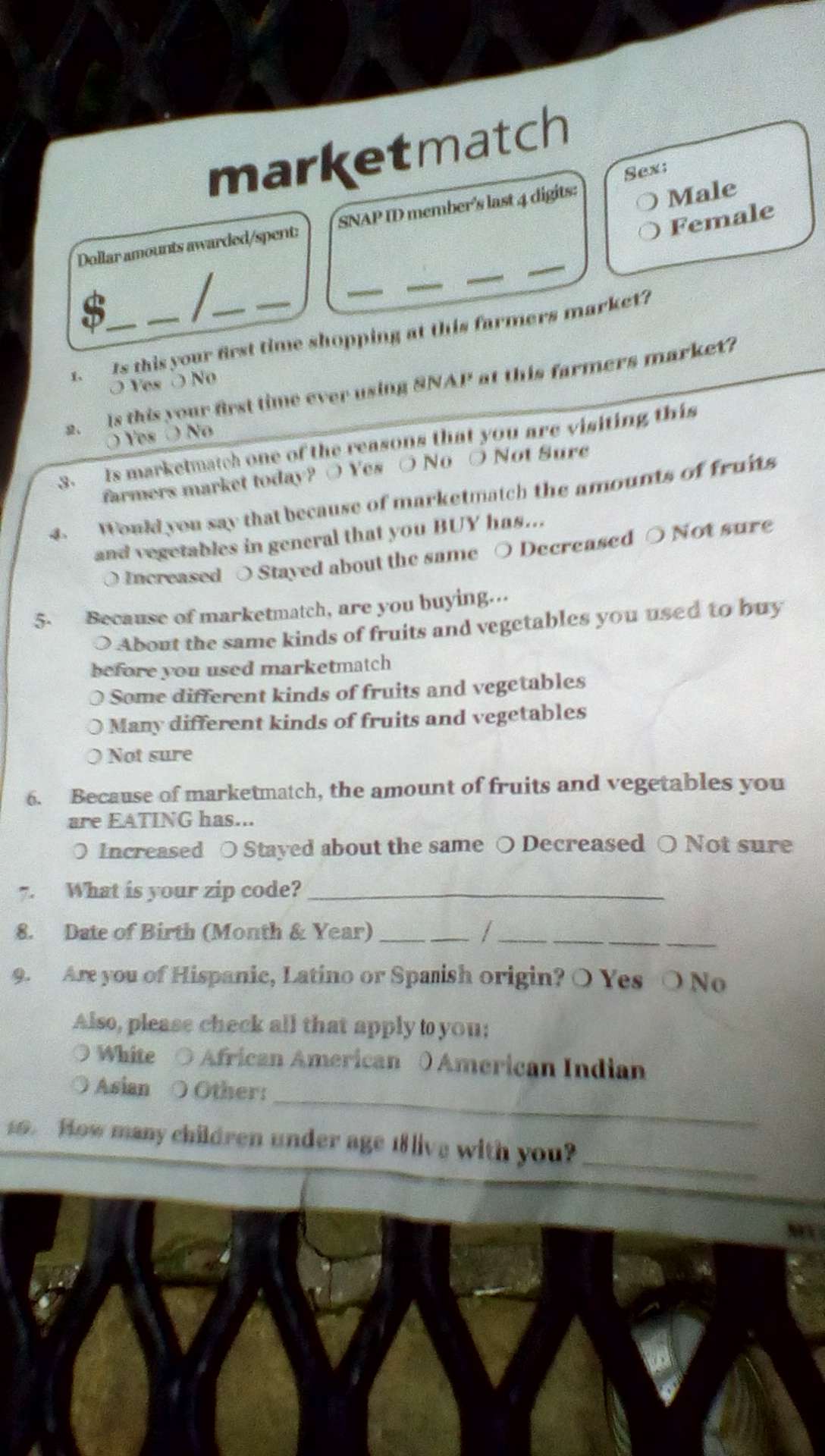
Self-administered survey-New Orleans Market Match user

This is (basically) the same system that Crescent City Farmers Market (CCFM) in New Orleans has used to gather data from incentive users (incentiv-ers?) since they began doing them some years back. They call their incentive Market Match.

As one of the staff who was responsible for doing it when it began and was part of the discussion about it, I really liked it. It is on a pad that is pulled off to have the person fill out and then each slip is added to the clipboard (or put in a container) to be entered into spreadsheets at a later time. The darker grey is filled out by the market staff person after the other part is completed by the shopper. What I know is that the system was designed with both the shopper and the market staff needs in minds, which as we all know is important and yet not always done. I’d like them to be numbered chronologically so as to know that none were lost. Maybe they are numbered, I’ll check to see.

Sorry for the wrinkles- it ended up in my market bag under the citrus. I’ll get some more pics of their system-including a better version of this and maybe the other collection forms if they will allow me to continue to peek over their shoulder.

MMtracking form_CCFM

It was 20 years ago today…

…that Crescent City Farmers Market began to have it’s say. September 30, 1995 is remembered by many as the first day of the food and market movement in New Orleans and really, the entire region. And it all began with a market of 12 vendors (about half rural farmers and the rest urban growers), most of whom sold out in an hour or two.

Founded by three local activists of varied interests and backgrounds, John Abajian, Sharon Litwin and Richard McCarthy, CCFM has grown into a four-day per week, year-round anchor for regional food and public health activism with an impact in the tens of millions.

To get a sense of the evolution here are some of the most significant moments captured among the many past press releases and some of my own memories:

circa 2000 (the second location at Uptown Square had opened only a few months earlier):

The Saturday and Tuesday Markets’ combined now average over 65 small-scale farmers, fishermen, community gardeners, food producers and over 2,000 shoppers each week. The farmers are now coming from three states and fishing families from all over southeast Louisiana. In a June 1999 economic impact study conducted by students at the A.B Freeman School of Business at Tulane University, it reveals that the Saturday morning market generates over $1 million in direct economic impact benefiting market vendors and downtown businesses, thus creating a new vision of regional cooperation.”

circa 2006 (the original plan to celebrate the 10th anniversary in 2005 was lost in the aftermath of the levee breaks of Hurricane Katrina, so the “Re10th” was held in 2006):

“On Saturday, August 27, 2005, market staffers Richard McCarthy and Darlene Wolnik were at the Saturday Market mapping out plans for autumn 2005: Saturday Market’s tenth anniversary… Plans were interrupted by the anxious talk of a little known storm that had just entered the Gulf of Mexico — Katrina. …On this anniversary date, the Saturday Market invites members of the culinary diaspora to return home to the mother of all markets in the region. While the family of Crescent City Farmers Markets is half of its pre-storm size of four, co-founder Richard McCarthy explains, “Give it time; we now have twice the verve.

circa 2010 (The market had reopened its third market earlier in the year, the first in a previously flooded neighborhood and created the first of its kind, a market incentive program for fishing community families undone by the April BP oil spill, funded by Wholesome Wave.

Interestingly, at this anniversary Market Umbrella was just a baby, as it had finally became its own 501(c) organization in 2008 after spending the first 14 years at Loyola University as the ECOnomics Institute, housed at the Twomey Center for Peace Through Justice):

As it celebrates its 15th anniversary, Crescent City Farmers Market (CCFM) hosts a four-course dinner at Emeril’s Delmonico  Wednesday, Sept. 29 at 6:30 p.m. Chef Spencer Minch will use seasonal ingredients from CCFM farmers to prepare the meal.

circa 2015 (market organizers gave buttons to the vendors noting how long each had been a vendor of the market to wear on the 20th anniversary. A few of those):

“Can you believe it’s been 20 years since we first opened our umbrellas at the muraled Reily parking lot at Magazine and Girod? When Richard McCarthy, Sharon Litwin and John Abajian co-founded the Crescent City Farmers Market in 1995, they aimed to create a public space where New Orleanians could meet, greet, and make groceries that were fresh and produced locally…Join us this Saturday as we raise a toast to 20 years of the Crescent City Farmers Market. We’ll have music from the Roamin’ Jasmine starting at 9 a.m. and cake from Rivista and beet lemonade from Amanda to pass around at 10 a.m. You may even see some old faces coming out to make an appearance.”

Raise your glass to another 20 years.

3-Course Interview: Joel Hitchcock-Tilton | 3-Course Interview | Gambit – New Orleans News and Entertainment

Proud to say that two of the three chefs in the Paradigm Gardens worked with me at MarketUmbrella as staff during each of their transitional periods to running their own kitchens. Both are absolutely committed to regional products and working as partners with their producers. Glad to see this being attempted by this smart group.

Best quote:

Urban farming and growing vegetables is in no way very lucrative, unfortunately. There are a number of great nonprofits and community gardens in the city but it’s not a great business model. We put about $25,000 of our own money into building and maintaining everything here. So we thought about how we could make it work. The idea was to create a functioning, sustainable plan for an urban garden. So we came up with the idea of the concert series and have started using the space for events. We’ll be doing field trips with kids; we’ve had some art gallery and food truck nights and people can rent the space if they want for any type of event, including weddings or parties…

Source: 3-Course Interview: Joel Hitchcock-Tilton | 3-Course Interview | Gambit – New Orleans News and Entertainment

Green Pave: Tulane’s New Food Truck | NOLA DEFENDER

I wonder what spurred Sodexho to do this? And how about that language in the press release “will not be denied the opportunity to indulge”?

Tulane students are often accused of an ivory tower lifestyle removed from the actual City of New Orleans. However, today international food services giant Sodexo announced that Tulane kids will not be denied the opportunity to indulge in the food truck trend. On Monday (8.31), the University is rolling their own food truck, only for meal plan subscribers.

Source: Green Pave: Tulane’s New Food Truck | NOLA DEFENDER

Waterloo, Louisiana: An Open Letter to New Orleans – Antigravity Magazine

The published letter linked below was written by one of our region’s most innovative direct marketing bakers, and (obviously) one with a great deal of sensitivity and wisdom. Graison has struggled with getting the ends to meet in his tiny business (even while he is unquestionably the region’s preeminent bread baker), much less in it pulling him to the place he dreams his business should be.
He and I have talked a few times about the lack of support for small producers in our region and I can assure you that he is ready to talk with or work with anyone willing to further the needs of he and his peers, but to little avail.
I recommend that people read his essay and also read between the lines of what would drive a full-time baker to spend his time writing and publishing this. If you want my response now, it is because he knows what is at stake is his entire future and the future of the healthy food revolution that may never reach maturity unless we deal with the issues that small businesses face everyday: the lack of infrastructure support, duplicative regulations, half-hearted allegiance to local ingredient sourcing among shoppers, refusal by many (most?) to address vital environmental concerns in food work, commodity-type products taking most of the shelf space-if and when local is even invited, the lack of skilled workers available, necessary policy changes not handled by organizers of food initiatives and so on.
So ask yourself-are you doing everything you can as often as you can for your anchor vendors?
Waterloo, Louisiana: An Open Letter to New Orleans – Antigravity Magazine.