NOLA Vietnamese Farmers on the Beeb

I’ve written about the Vietnamese community in New Orleans in this blog as well as in my New Orleans blog and so am always glad when I see a news story on it, especially one on an international site.

http://bbc.in/1SOnYd0

Some background about our Vietnamese neighbors: the community was settled by the Catholic archdiocese and was made up of (originally) two North Vietnamese fishing villages. The land they settled was largely unused and is in the east along the waterways, where fishers have long made their living. The community kept to itself almost entirely until Katrina when their activist priest Father Vien challenged the city of New Orleans to rebuild as quickly as they wanted.

The Vietnamese fishers were active in the fight to get restitution after Hurricanes Katrina and Rita and even more so after the 2010 BP oil spill. It is important to note that for fishers, one of the biggest barriers they have for making a living is the massive amount of seafood imported into the US; the standards that local fishers follow, especially those family fishers that largely operate in the “inside waters,” are not expected of those corporations that operate in China and elsewhere. The inside waters fishing seasons are opened and closed based on the size and quality of the catch and so limit overfishing. It is also important to note that many of the fleets operating in the Gulf in the federally-controlled waters are not primarily family or one-boat fishers but instead large companies scooping up your Red Lobster all-you-can-eat buffet items.

The Viet farming community in the East had been less visible pre-2005 with most of the elders growing food only for themselves and for their small Saturday morning farmers market, held from 6 am to 8:30 am or so on Alcee Fortier Blvd. After 2005, the community began to organize efforts and had grand plans to build a community/cooperative farm along the levee, but had some bad counsel and finally, government agencies as well as some cultural barriers (communication style with funders, generational politics etc)  stalled those efforts.

The Veggi Coop is a wonderful initiative and deserves lots of attention; to be clear, cooperative farming initiatives had been in the works there for some years and farming cooperatives like Mississippi Association of Cooperatives have led the way since the 1970s. So, for the focus of the BBC story to be on socialist or communist fears as the barrier seems like a red herring compared to the real concerns farmers and fishers have about organizing with their competitors, no matter from where they hail.

I don’t want to denigrate this story as I appreciate the attention, but the issues for small-scale farmers whether urban, suburban or rural, is profit, not just sales and long term infrastructure support, not just access to markets. What is exciting to see publicized is the cooperative itself; the addition of another cooperative is extremely welcome and in my mind, creating more of them is necessary in order to grow more regional food systems.

What coops like this have done admirably well is to reduce the costs of marketing; my hope is that these fine folks can gain support to next tackle infrastructure and policy issues and to connect their efforts to the rural farmers and fishers across the Lake Pontchartrain watershed. The Veggi Cooperative is one of the few outright success stories in urban agriculture since Katrina (along with Grow Dat Youth Farm) and both should be celebrated for making it in a very turbulent and uncertain time.

*Here is one of the Go Fish/Go Market/Go Farm films of the 30 or so that I made for Market Umbrella with Kellogg funding. This one was about the Vietnamese community:

See all of the films made in that series here.

The American Scholar: Local Fare

Here is a piece in The American Scholar from a New Orleans writer on the argument over what constitutes local when it coms to restaurant fare. I do think his “gated community” comment seems misplaced and overwrought, since the French Quarter remains the most dynamic and constantly evolving neighborhoods in town. However, his suggestion that we need to maintain some perspective is apt:

…But when you take the long view, that alarm may be misplaced. After all, much of the city’s most beloved fare today resulted from an invasion followed by hybridization. New Orleans loves to talk about food, and after considerable argument, many newcomer dishes are eventually given a seat at the table. Restaurants that serve “red gravy,” like Pascal Manale’s and Mandina’s, are artifacts of a Sicilian influx in the latter half of the 19th century. What’s today considered classic Cajun (itself imported from western Louisiana) emerged when African fare favored by slaves met Acadian French. Even the city’s vaunted Creole dishes emerged out of a cultural meeting ground once populated by French, Spanish, Caribbean islanders, Africans and their descendants, and Native Americans.

Clearly, what we mean by local is elastic and that elasticity is a big part of what confuses the eaters who don’t read the blogs or follow producers by name on social media or talk regularly with them at markets. That confusions seems magnified as an active value in the restaurant field, so describing what is indigenous/native versus what is inspired by the cultural mores of the place seems to need better words to describe the steps in the chain. Maybe market organizations can write some grants to create a “brand” that can be shared by those restaurants that truly support local producers and harvesters and help to define what it means to be serving local fare versus locally sourced.
The American Scholar: Local Fare – Wayne Curtis.

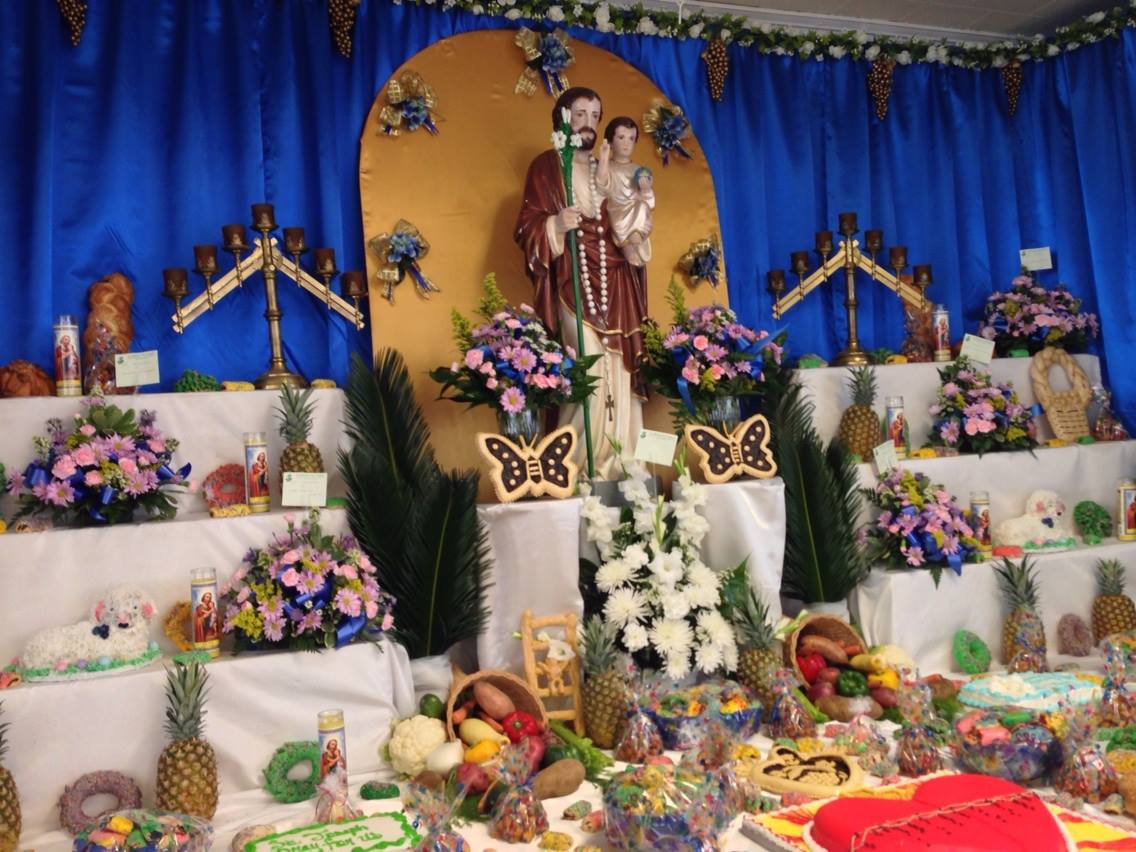
St. Joseph’s Day-New Orleans style (March 19)

I thought I would share some pictures uploaded by our recently retired newspaper food editor Judy Walker (seen in one picture in the hat with altar host, Subil Prosper) of her visits to St. Joseph’s Day altars around town. There are also pics of Mardi Gras Indians -taken by local photographer Roy Guste- as St. Joseph’s Day is also a public day for showing off their beadwork and parading.

The holiday is one of my favorites as it is a true New Orleans experience and involves food, superstition (or faith depending on how you look at it),  “visiting” and tradition. Really, this is an extra-extraordinary day among many extraordinary days in New Orleans. The farmers market itself has hosted beautiful altars in years past, courtesy of food maven, media star, and Slow Food founder Poppy Tooker. Each item on the altar has meaning, some to honor different saints or the Trinity or local or family traditions.

Fava Beans
The fava bean was the main food that kept families in Sicily alive during the drought. Italians would carry this “lucky bean” with them for good fortune. If you pick up a dried bean from an altar on this day, you will receive good luck all year.

(I carry one in my wallet.)
Fish
The 12 fish represent the 12 apostles.
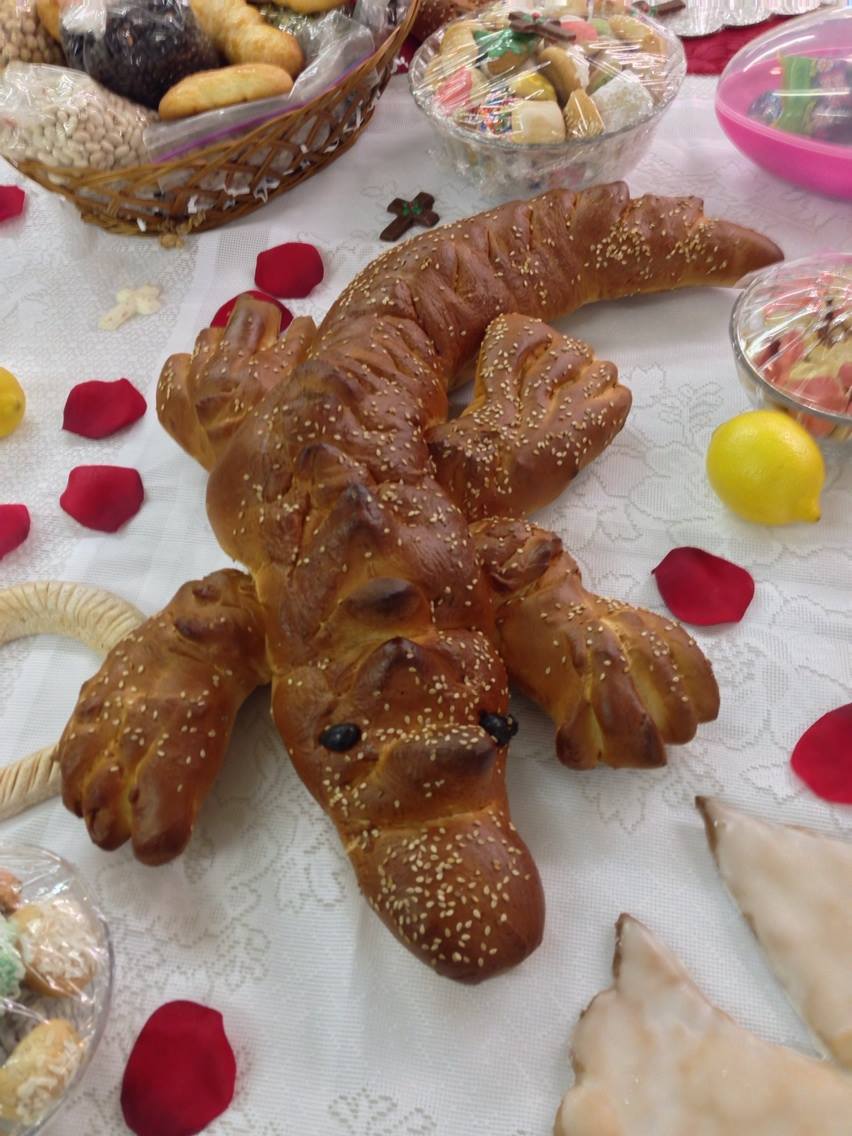
Breads Shaped into Symbols
Several breads are made that represent both Jesus and St. Joseph. The symbols include ladders, hammers, nails, saws, lilies, and a staff for St. Joseph; and crosses, palms and wreaths (for the crown of thorns) for Jesus.
Olive Oil and Wine
These serve as a reminder of the many vineyards and orchards in Sicily.
The altar is broken up on St. Joseph’s day and food and donations are then distributed to the poor.

March 19th marks the Catholic celebration of St. Josephs Day where Catholic New Orleanians construct elaborate altars in honor of this saint. The tradition, commemorating the relief St. Joseph provided during a famine in Sicily, began in the late 1800’s when Sicilian immigrants settled in New Orleans. Altars are found at local New Orleans churches, especially those with strong Italian roots, but they are also constructed in private homes, halls, Italian restaurants, and public spaces in different communities throughout the city. If you happen to see a fresh green branch over a local’s doorway, it means you’re invited to participate in the altar ceremony and to share the food.

11012839_10204180055916576_8945360241617603885_o

10560279_10204180068036879_7961606005508740920_o

10551672_10204180068116881_4664508284392355640_o

11049462_10204180075557067_8350118677762870682_o

11050202_10204180078717146_4797496216301078140_o

11079560_10204180060516691_6211015693237136837_o

11053110_10204180060556692_2618619971169178936_o

11054815_10204180060636694_8581993614339307653_o

I’ve also heard raves from friends about this altar.

New Orleans had a large influx of Sicilians in the 19th century who celebrate their patron saint but it is also an important day for the Mardi Gras Indians for more obscure reasons. The Indians activities defy easy description as do their amazing handmade regalia, stitched by the wearers themselves on many a night after getting off their day job. The Indians’s traditions can be viewed at the Backstreet Cultural Museum in Treme and if you are lucky to be in New Orleans on Fat Tuesday and around St. Joseph’s Day or on the Sunday before, you can view these amazing artists on the streets of New Orleans.

this excerpt gives one explanation:

St. Joseph’s Night with the Wild Indians is not an experience to be taken lightly in any measure. It’s the living manifestation of an age-old ritual, preserved and practiced by the descendants of the African slaves, which goes back to the perambulating societies of West Africa and their call-and-response chants, the secret societies of masked warriors which are common to both African and native American cultures, and the unsanctioned moonlight ceremonies conducted by African slaves under pain of death on the plantations of the American South.


photo by Roy Guste

photo by Roy Guste

Joyce Montana (Widow of Big Chief Tootie Montana) and son Darryl Montana. photo by Roy Guste

Joyce Montana (Widow of Big Chief Tootie Montana) and son Darryl Montana. Photo by Roy Guste


Crescent City Farmers Market | 2015 Lenten Louisiana Seafood CSF

New Orleans, of course, has a Community Supported Fisheries program at their markets which is a byproduct of the White Boot Brigades that the organization ran pre and post Katrina to help fishermen sell more catch at the height of season. We (we because I was staff back then) first heard about CSF programs from (if memory serves) the Los Angeles chef Mary Sue Milliken at a Share Our Strength Rebuilding New Orleans discussion at the French Market in 2006. And, of course, the New Orleans CSF program runs through Lent-so clever.Crescent City Farmers Market | 2015 Lenten Louisiana Seafood CSF.

Farm Shares | Grow Dat Youth Farm

A recent success story in New Orleans for urban farming and school-aged youth, Grow Dat has sold their produce through at their City Park farmstand, at farmers markets, through online ordering/home delivery services and now with this CSA method. GDYF is a well-regarded project that has produced very real outcomes in a challenging funding and food environment. The success of Grow Dat’s project work along with their constant advocacy for urban farmers has truly risen all boats.

Farm Shares | Grow Dat Youth Farm.

A bittersweet thanks from a market vendor

One of the great market bakers over the last many years in New Orleans wrote the letter below telling of his decision to leave the Tuesday market in New Orleans to his customers via Facebook and his website. (He remains at their Saturday market still.) This vendor is an extremely creative and dedicated artisan and one with diversified marketing and product ideas. Unfortunately in his estimation, the potential for sales are diminishing, especially at the weekday markets. That view is not his alone; it is shared by some other vendors. This is the first comment after his Facebook post and happened to be from another past market baker: “This is sad to hear for me because this is why I had to stop being a farmer’s market baker full time 5 years ago. I miss my CCFM family and wish everyone the best.”

When markets go through this, it can be a painful and messy break up or it can be a mature parting with lessons learned for all. Everyone has to agree to be careful with their language (spoken, written and body) and to be intentionally fair as the weeks and months go on.

I think this letter does a great job not to assign any blame and offers some good starting points for talking this through with shoppers, other vendors and the staff of the market organization. This is a volatile time for markets in New Orleans and the small businesses contained within feel the brunt of that ebb and flow.  I also well remember the pressure of being a market organizer, remembering every minute that good men and women and their families and employees rely on your estimations of the numbers of happy return shoppers, where to find inquisitive new shoppers, devising events that work and don’t detract from sales, outreach and marketing dollars spent well, locations remaining stable, partnerships adding value and so on while trying to calm fears and add excitement among the vendors while you do it.

As a market advocate and a member of this community, I worry along with all of them and show up at every market and event that I can and share information freely to help everyone move forward. Because our purpose in building a community food system is to offer new opportunities that offer sustained value and multiple types of benefits along every step of the chain, and honor the producers who are building this on their backs and with their many talents, supported by the hard work and talent of market and other food system organizers. Let’s all keep momentum moving forward to reduce the quantity of these type of letters.

==================================================================

25 November 2014

Dear Farmers Market Customers:

It is with a heavy heart that we are announcing our departure from Tuesday’s Crescent City Farmers Market (CCFM). Due to a sustained erosion of sales over the course of the past eights months, and to the unpredictably of future markets, we are forced to withdraw our booth from this cherished market. Our last TUESDAY market will be the 25th of November.

Although Bellegarde Bakery, in its original gestation as “Babcia Kubiak’s Breads”, began at CCFM five years ago, we have found that the current status of public markets in New Orleans is extremely volatile. There is an overwhelming consensus among vendors at CCFM that “business is not what it used to be”: due to the nature of Bellegarde’s craft, and our commitment to quality, we do not have a “product” which we can freeze, store, or transfer once market is over. We make fresh bread, day in and day out, in heat and in cold, on weekends and on holidays, so that our customers can understand the integrity of fresh food.

We are extremely vulnerable—physically and financially—to capricious weather, shopping habits, and other food ‘trends’ that degrade the quality and consistency of farmers markets. Vendors at farmers markets are at the bottom of the proverbial food chain: we do all the sowing and receive little of the harvest. The current food economy of America is such that money, respect, and stability trickle down from celebrity chefs, supermarkets, and restaurants to the bottom of the pool—fishermen, beekeepers, bakers, farmers: the people that actually make food have trouble making a living at their primary venue of sales: the farmers market. Without any institutional or municipal support through grants, press, mentorship, or subsidy, we vendors suffer the modern whims of that most basic human gesture: the eating and sharing food.

By the vendors, for the vendors: it’s a motto we still live by. We have an implacable commitment to rebuilding the edible architecture of New Orleans through grains and breads. We will remain at our SATURDAY booth and you can find us in a litany of retail locations—from Rouses and Whole Foods to St James Cheese and Faubourg Wines. Please follow the “retail” tab on our website, bellegardebakery.com, or call the shop with any questions about where to find our bread. Thank you, sincerely, for your continued support and faith.

Gulf Coast, 9 years later: Still unfinished.

The link below is from my New Orleans blog that details our life here post Katrina: today August 29th, it will be 9 years since that terrible day when our region suffered through the hurricane and then through the much larger federal levee disaster.

We community organizers learned that we needed to be constantly available to our family, our friends and neighbors (including our farmers and fishers) as they rebuilt their lives and businesses. And we had to carry the story of citizen-led recovery to our colleagues in other places while remaining vigilant when home to help combat bad ideas from our decision makers.
We still need to do that work unfortunately.
Some of this piece may be too local, but the sentiment is clear I think. Basically, the years of 2010/2011 were when we really began to really feel the pressure from corporations trying to find deals; this post tells some of what we were going through:

“We are now coming up to 6 years after the federal levee system disintegrated in New Orleans. When we look around, do we see our old neighbors, a resurgence in small mom and pop businesses, and a generally more livable city than before?
I’d say no….”

Complete post from New Orleans Can Thrive

Swamp Savior: Can a 72-Year-Old Inventor Rescue The Sinking Bayou?

Louisianians like this are my heroes:

“Pierce, however, would argue that swamp ingenuity is nothing new…
‘It’s in my nature to invent things,” say Pierce, a white eyebrow raised playfully as he explains that he’s never had any formal training as an engineer. “It runs through my blood.”

The Goldring Center for Culinary Medicine-New Orleans

One of the most exciting developments in food and health is happening in my own town of New Orleans and right in my neighborhood. Very proud of this work being done by “Dr. Gourmet” (who happens to be my mom’s doctor), Tulane University and the good people of Broad Community Connections.

The Goldring Center for Culinary Medicine is a first-of-its kind center dedicated to comprehensively integrating nutrition and dietary intervention strategies into medical school curriculum,” said Dr. Benjamin Sachs, senior vice president and dean of Tulane University School of Medicine. “The goal is to train doctors not only how food choices affect health and disease progression but also how to translate this information in practical ways that empower patients to lead healthier lives.”

Inside Tulane Med.

Louisiana Eats on seafood issues

Slow Food maven, radio host and author Poppy Tooker did a great show on seafood on Louisiana Eats: Gerard Maras (a giant among chefs in New Orleans) shared his boiling technique, Tenney Flynn who is still the best seafood chef in the French Quarter, talked about fish handling and finally Poppy and her guests discussed the ecological issues facing the harvesting community. Seafood is something Poppy knows a great deal about-she is a fisherwoman herself and one of the champions of fishing families in Louisiana and across North America.

Can you remember to mark “listen to Louisiana Eats” to your Saturday calendar? I’d recommend it.

The Ebb And Flow Of Louisiana Seafood | WWNO.

Chef gives back Louisiana farming community – CSMonitor.com

(Another story about a New Orleans chef!)
Huge fan of John Besh and his amazing team. There is no question he has put his money back in the community and has done amazing work.
I will say (and certainly not meant as criticism to Chef Besh and his team) that even with this excellent help, many farmers here still lack the full resources to increase their capacity. Since sustainable agriculture advocates are few and support for sales outside of the city are quite limited, many still falter with the expansion of their business. Business assistance must be matched with policy changes on production and regional connections that diversify each farm appropriately, since it is important that every farmer is not led only to intermediate and wholesale sales as their big expansion opportunity.
Still, there is no question that his foundation is a huge step in the right directional our region’s producers.

CSM Story and link:

The Foundation’s most recent initiative selects local farmers to provide with financial loans, while also delivering valuable training in marketing and business strategy. Many regional farmers have delicious products, the Foundation shares, but lack the finances or business knowledge to market those products to a wider audience. Working with Hope Credit Union, the Foundation evaluates loan applications and designs customized repayment plans. Then, MBA candidates from Tulane University’s Net Impact business advisory program, support loan recipients in setting goals and creating a long-term business plan.

Loans ranging from US$1,000 to US$20,000 are available to farmers within a 200-mile radius of New Orleans. Acknowledging the challenges farmers face in acquiring loans from traditional sources, Besh has yet to set a limit on the number of recipients. “The more we lend the better it is for these guys and gals out working to produce all the wonderful products that make my life wonderful,” Besh said. “We hope to do as many as possible.”

Chef gives back Louisiana farming community – CSMonitor.com.

Diana Pinckley remembered

The event listed below is to happen this week and was excerpted from my home Crescent City Farmers Market “morsel” as they call their weekly email:
Diana Pinckley passed away in 2012; she was an irreplaceable member of our community and one sorely missed for her leadership and her friendship, both always given easily to so many.
The regard for her found on any market day in New Orleans can and should be multiplied in the thousands to stand in for all of the many initiatives or events that she supported across our region. The people I know through her represent her well: willing to give their time and talent and always remembering to be joyful.
Thanks, Pinckley. I’m honored to raise a glass for you this weekend and pleased to represent farmers markets where we remember and honor our people.

Raise a Glass to Pinckley with CCFM! |
FRESH & LOCAL
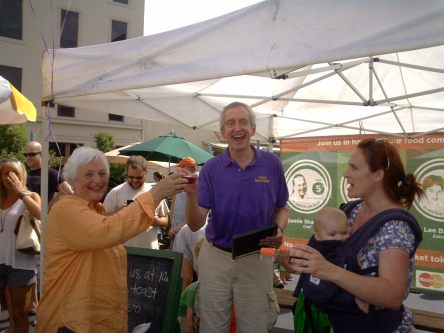
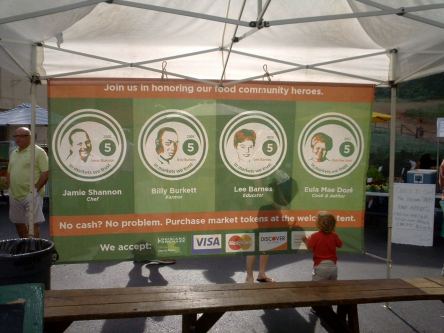
Each year we choose one of our local food heroes – a farmer, chef, culinary educator, devoted farmers market shopper or local food system champion – to be the face of our market tokens. This Saturday, we’ll unveil our 2014 market token and celebrate the life of long-time CCFM shopper and supporter, community activist and mentor to so many working to rebuild New Orleans and the Gulf Coast, Diana Pinckley. “Pinckley”, as she was known to close friends, loved mystery novels, bluegrass and the color purple. In addition to her work as a public relations executive, communications strategist and book reviewer, Pinckley shared her time and talent with many New Orleans civic organizations. She was a member of “Women of the Storm” and one of CityBusiness‘s Women of the Year in 2006. She served on the New Orleans Council for Young Children, the Committee of 21, the board of the Foundation for Science and Mathematics Education, the Edible Schoolyard New Orleans task force and was chairwoman of the board of the CCFM. She raised money for WWNO-FM and was an active volunteer at WWOZ-FM. She passed away in September 2012. New Orleans is a better place because of Diana Pinckley. Please join us, her husband John Pope and friends to raise a glass at 10am, tap your toes to the music of Lost in the Holler and celebrate the life of one of the CCFM’s most cherished friends. Purple attire encouraged.