The opening of the 2010 Portland Farmers Market is filmed and then found on Hulu.
Farmers market from a farmers perspective
Cooking Up A Story
0 CommentsLeave a comment
The opening of the 2010 Portland Farmers Market is filmed and then found on Hulu.
Farmers market from a farmers perspective
this map shows smaller food deserts in the summer, when farmers markets are open. I find the new graduate student focus on farmers markets fascinating. It seems since so many probably grew up with the latest iterations, they assume their longevity. Glad of that.
Not sure its news that food deserts shrink when markets are open. Although, if it helps officialdom realize that we open farmers markets where they are needed, it could help.
I do prefer the Diego Rose (Louisiana Public Health Institute) definition of “food swamps” rather than food deserts to be more descriptive usually. Meaning areas swamped with bad food, rather than no food.
How did I miss this movie?
A must-see movie for all food organizers. Farmer’s mind, farmer’s point of view.
Commodity farming, artist colonies, devil cult paranoia, homeopathic remedies, Rudolf Steiner, CSAs, body image remade by picking tomatoes, cancer, love, Mexico, giant bee costumes, community barn raising, and John’s mother Anna Peterson are all shared.
Independent Lens
A movie that looks at industrial design through designers explanations and theories. Well worth your time. You might be asking, why is this a post on a public market blog?
I believe that engineering of the market space itself is something in which many market organizers and vendors excel. Add to that how many innovate by designing/inventing new systems or appropriate tools when necessary.
So, designers? Yes, another title for a market organizer…
Two great quotes from the movie:
“If we understand what the extremes are, the middle will take care of itself.”
“Let’s put great design into everyday things.”
A study by The NPD Group reveals that when dining out, Americans do not expect to pay more for healthier food. According to the study, nine percent of all restaurant visits are based on a customers’ desire for lighter or healthier fare (down from 10 percent in 2007). The results did vary a bit by generation, with over half of consumers aged 25 to 49 years old expecting to pay the same price for healthier items and standard fare. Thirty percent of consumers aged 18 to 24 would be willing to pay more for healthy menu items.
Am reading a new book by Martin A. Nowak titled “Super Cooperators” which explores the ways and reasons humans cooperate. I picked this up because it seemed to correlate to the work I was involved with when at marketumbrella.org, measuring social capital with their NEED tool. NEED (still in pilot but I believe getting closer to an online tool like SEED) measures the quality and quantity of transactions within market communities (included neighbors who feel its impact) to get at levels of trust. Trust is a proxy for social capital. Adding social capital to markets is important because it means behavior change is possible.
So, in markets, engineering cooperation is the main activity used to add trust. The market organization is essentially using direct reciprocity, indirect reciprocity, and spatial laws to add levels of cooperation-all terms learned from this book.
I like the author’s definition of cooperation:
The willingness to give something up in order for someone else to receive a benefit.
In a sentence, this may describe the positive transactional nature of markets rather than a roadside stand or a storefront. The multiplicity of vendors often directly competing yet cooperating, shows a sophisticated awareness of the need to offer choice to shoppers and on another level, cooperating as a community to add innovation or programs lead markets to a more successful future.
I suggested Groupon earlier in the year for the Crescent City Farmers Market in New Orleans as the way to sign people up for the CSF (community supported fishery) that they ran at their Thursday market. They didn’t use my idea this year, but knowing them, they will use it or a version of it and use it well. I’d love to see a market fully embrace the idea of using these coupons for a pre-sell item at a farmers market. Maybe for a Thanksgiving turkey sale?
Groupon
If you came to the blog because of an email I sent out, then you probably know me as the past director of the marketshare program at marketumbrella.org, or as the market manager at Crescent City Farmers Market, or as the White Boot Brigade staff or the Festivus, The Holiday Market For The Rest Of Us manager or the Go Fish on Film “producer.” Now, you’ll know me as an independent organizer, consulting with many market organizations throughout the US.
I have worn many hats in my 9.5 years with the wonderful marketumbrella.org. I enjoyed every minute of my work there and believe our relationship is just moving to a new definition.
But why?
It has been my belief for some time that we (the market community) need to continue to be as nimble and as brave as the generation of market founders that started this movement were, back in the 1970s-1990s. They did the impossible sometimes, the slightly difficult often, and the nutty more often than they would like to admit.
But what they did do was to build a wide foundation. They allowed a lot of new ideas to come together under one tent (pardon my market analogy) and kept innovating as needed. Some of those folks are still around running markets:
Ann Yonkers and Bernie Prince in DC
Donita Anderson in Cleveland OH
Leslie Schaller in Athens OH
Richard McCarthy in New Orleans LA
Chris Curtis in Seattle LA
Pompea Smith in Los Angeles CA
Just to name a few. I am sure there are many more that I am forgetting. Or don’t even know. Folks that are still around and deserve your appreciation and if you do get a chance to sit and pick their brain, take it.
But many others have moved on to other work or initiatives, leaving their markets in good hands they hoped. So this is our question: what is the legacy for those of us in the second and third generations of market organizers and market trainers?
I hope it’s to understand how markets sit within the larger alternative food system, within the larger public space movement, how they support newer markets and other initiatives. I hope it’s to continue to be brave and add difficult ideas to our markets and to welcome new people every week. I hope it’s to change the way we ALL live but with dignity and fun. And it better be to keep on honoring the farmer, the fisher, the harvester, the forager, the entrepreneur. They are our partner in this and yet are left out of the decision-making too often.
This is one of the reasons I am now on my own. I want to build this as a movement and to do that, we need to move even faster to connect to more ideas and to share more skills and to make some decisions about what we believe in, what we stand for in the public market movement. My old employer marketumbrella.org, will be there at the forefront with me, this I know. Farmers Market Coalition will be there too. Community Food Security Coalition, Food and Water Watch, National Campaign for Sustainable Agriculture, the SAWGs, Federation of Southern Cooperatives, ALBA, Native American Farmers Associations, Food Secure Canada, Projects for Public Spaces, APA, APHA… again to name just a few of the many, will be there too.
Share your stories here, and call on me if I can help you.
Dar Wolnik
dar wolnik at gmail
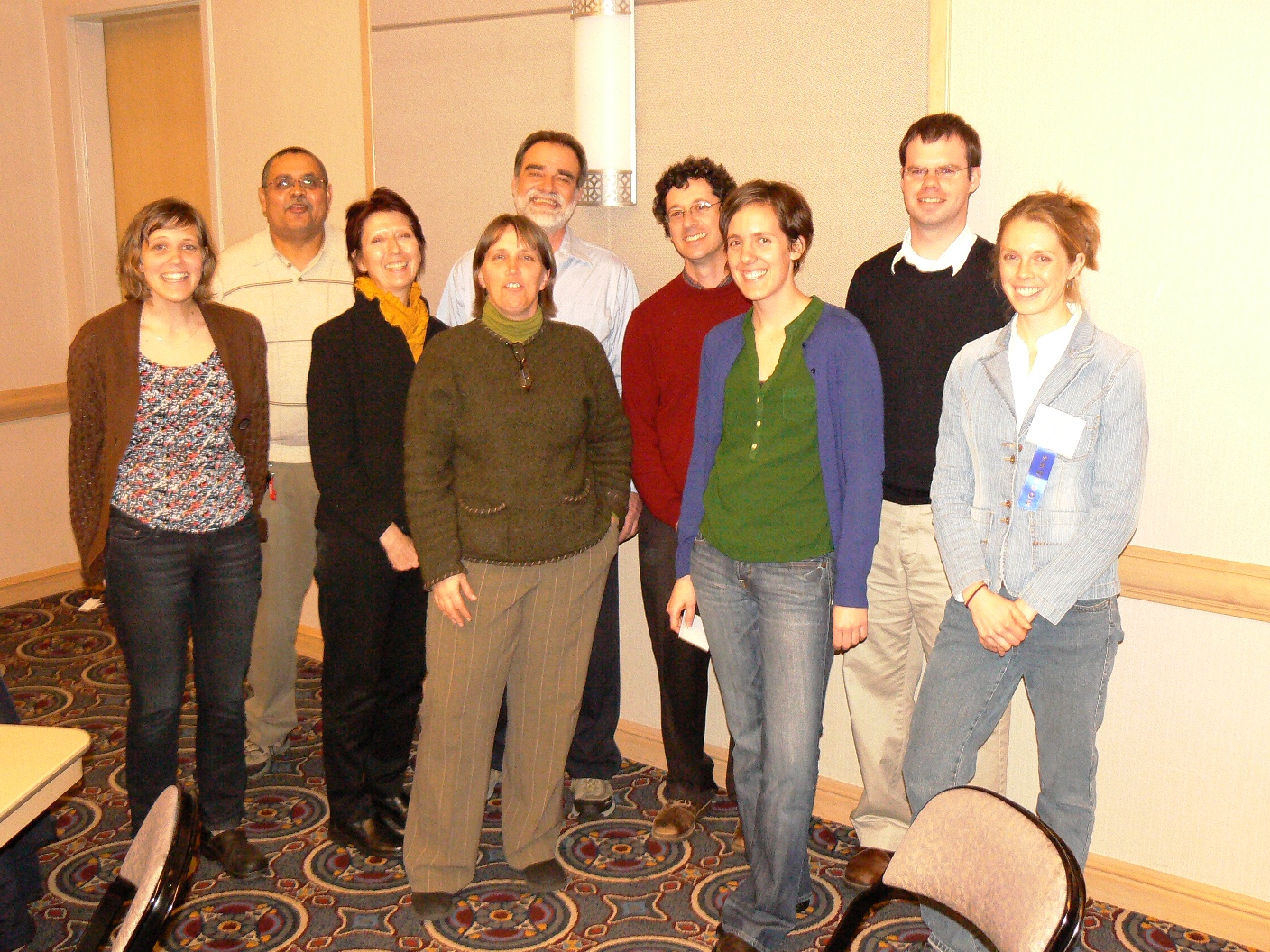
My favorite place to be- among my peers. Well, if there was a market around us, that would be best...Sarah Blacklin Mkt Mgr Carrboro NC, Cliff Slade VA farmer, Bernie Prince Co-Director Fresh Farms DC, Darlene Wolnik, Mike McCreary Mkt Mgr Asheville NC, Peter Marks Director Appalachian Sustainable Agriculture Project, Erin Kauffman Mkt Mgr Durham NC, Matt Kurlanski of Wallace Center, Stacy Miller Executive Director FMC.
from com-food list-serve
Organic Farm Education Paid Apprenticeship Live Earth Farm, Watsonville, CA
Apprenticeship Posting
Garden Educator and Manager, MUSE School, Malibu, CA
Malibu Posting
Product Review Coordinator, OMRI, Eugene, OR
Deadline: June 17, 2011, 5pm PST
Product Reviewer Posting
Instructional Technician, Life Lab, Santa Cruz City Schools
Santa Cruz Posting
Deadline 6/10/11
Edible Schoolyard, Berkeley, CA
Two open positions: ESY Berkeley Posting
Good Luck!
The Brooklyn Grange (Queens, New York)
Sunday, June 12th, 4pm-8:30pm
Free for NOFA-NY members/$15 for non-members
Looking for insight on starting or improving your urban farm? Join us on June 12th in Queens, NY to delve into the challenging yet rewarding business of rooftop farming & production for urban markets. The Brooklyn Grange is a working farm on a rooftop in Long Island City, Queens, New York. Ben Flanner is the founding farmer and CEO of the 1-acre farm, which uses 750 cubic yards of soil to produce vegetables for farmers’ markets, restaurants and a 25-member CSA. The farm is actively expanding to incorporate educational efforts, in the form of their City Growers program. They are also planning to include bees and chickens into their rooftop environment. During our Beginning Farmer Workshop, the farmers at The Brooklyn Grange will discuss the philosophical and technical aspects of their farming operation, including the process of site selection, rooftop farm installation & funding. Through a thorough exploration of the 1-acre farm, we will see space-saving intercropping, crop rotations, soil fertility management, the unique aspects of farming a formerly non-agricultural acre of space & much more! To celebrate the revival of city agriculture, we will end the day with a rooftop potluck picnic & social hour (please bring food to share & your own place settings). This event is free for NOFA-NY members, $15 for non-members- some scholarships may be available. For more information, visit https://www.nofany.org/events/field-days or call Rachel at (585) 271-1979 ext. 511. Space is limited to 30 attendees, so pre-register by June 6th to guarantee your spot! If you are looking to share transportation or lodging to attend this event, please see our newly-launched virtual bulletin board at https://www.nofany.org/bfam/bulletin-board
As many in the farmers market have figured out, funders come with expectations attached to the check. It is important to remember that when markets ask for financial support, they need to return a completed project and some learning that forwards the funders goals. So it’s important to talk now about HOW, WHAT, WHY we measure our work, so that those measurements make sense for our mission and our part of the movement.
This quote is from a philanthropy newsletter:
Wouldn’t it be fun – fun being a big incentive these days — to extend the Consumers Union model into the philanthropic worlds of charity, development, and justice? Wearing our consumer hats, we could impartially and rigorously “test” our neighborhood soup kitchen, for example, and compare them with others. We could do the same with our nearby job training and employment service. And our state coalition for (or against) our favorite cause.
Instead of Consumers Union, we could have a Clients Union, or a Beneficiaries Union. What about a Members Union? Me, I’d like to be part of a Stakeholders Union.

