Review of “Black, White and Green: Farmers Markets, Race and the Green Economy”

Black, White, and Green: Farmers Markets, Race, and the Green EconomyBlack, White, and Green: Farmers Markets, Race, and the Green Economy by Alison Hope Alkon
My rating: 3 of 5 stars

Very well done snapshot of a piece of the Northern California local food system, especially its history. As much as I thought I knew, I learned some more about how it began from this book. I appreciated that this book was centered around these two farmers markets and their environmental and social justice leanings, which is a great lens to view multiple types of organizing, intentions and sets of outcomes.
I especially like the time she takes to link the work in each market to their larger community goals AND to the economic goals of the green economy.

here are some wonderful passages on the tensions and values of this emerging alternative system:

“One becomes an environmentalist, for example, through the consumption of green products such as organic food rather than the traditional means of voting, lobbying or attending protests. While this strategy allows supporters to inscribe their social movement goals into their everyday life practices. it also creates individuals who infuse the logic of the market into both their ordinary behavior and their desires for social change (Larner and Craig 1999)”

“The promise of the green economy is that the market can be made to value, and therefore to protect, humans and the environment.”

“In these markets, actors choose from among competing narratives to envision and emphasize the spaces where buying and selling green products leads to environmental protection and social justice.”

“Furthermore, proponents of the social change potential of the green economy attempt to redefine capitalism not as an exploitative system that must be overcome or restricted in order to protect people and the environment but as a tool to create a more just and sustainable world.”

“…Working towards these goals (environmental sustainability and social justice) becomes possible, in part, because participants in each farmers markets define environment and justice in ways that render them compatible with one another.”

“The compatibility between sustainability and justice achieved at these farmers markets is not inherent. Farmers market managers, as well as some vendors and regular customers, actively work to conceptualize strategies that speak to both goals.”
>As a community food system organizer, I believe this book is a necessary whistle stop on anyone’s travels to successful organizing around food.
Take the time to read this thoughtful book and then pass it along to your friends and comrades.
View all my reviews

Community Wealth Workshop

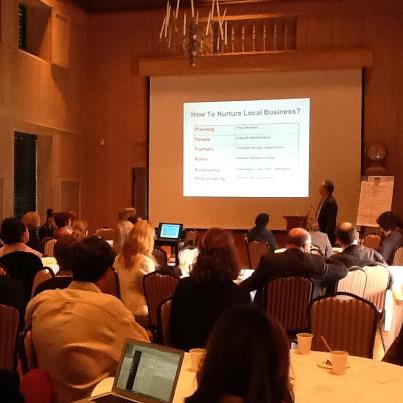
Spent most of Wednesday in a lovely room at historic LongueVue House and Gardens in New Orleans with bankers, community development coordinators and cooperative activists listening to economist/writer Michael Shuman describe different ways to encourage investment in localized systems.
His latest book, Local Dollars, Local Sense details strategies for creating investment in local systems as well as measuring the power of these systems. Michael is available to come to your community and have the same talk with YOUR investors and to expand your community’s knowledge about capital. I strongly encourage you to do that.

Shuman in New Orleans leading his Community Wealth Workshop

Shuman in New Orleans leading his Community Wealth Workshop

Race, Class, and Community in San Francisco’s Mission District – “A Time of Skinny Cows”

Great article about the (negative) relationship of the food movement to gentrification and therefore culture. We have to know the entire history of our movement (including its elitist characteristics) and acknowledge how our work has positive and negative implications on the less fortunate even as we continue to push its boundaries.
Some quotes from the article that I found useful:

“We think of gentrification principally in terms of real estate, race, and class, but I more often find that food is the thermometer reading the temperature of gentrification.”

“Much of what we call food politics today—buying local, farming organic, eating vegetarian—originally came from collectives that wanted to raise awareness about industrially produced food. The People’s Food System of the mid-’70s was a network of community food stores and small-scale food collectives that organized to take back control of food from large agricultural and chemical companies; they built direct connections to farmers to establish the first farmers’ markets. Meanwhile, the Black Panthers were hosting free community breakfasts in their neighborhoods, and Alice Walters opened Chez Panisse partly as a space to talk about politics. Various collectives shared the urban farm known as the Crossroads Community (The Farm) on Potrero Avenue at the edge of the Mission.
All this activity resulted in a paradox: as radical food politics succeeded, healthy food became commodified as elite food, proving that successful social movements can be gentrified, just like neighborhoods. The best farmers’ market in San Francisco, at the Ferry Building, is also the least affordable, and Waters’ Chez Panisse, the standard-bearer of locally grown, seasonal food, has become one of the most expensive restaurants in Berkeley.”

Read more: http://www.utne.com/arts-culture/san-franciscos-mission-district-zm0z13mazwil.aspx?page=5#ixzz2LGcdfe6r

Rural Co-ops Show the Way to Urban Job Growth – Politics – Utne Reader

Recently, I have worked with US Federation of Worker Cooperatives as a way to further my efforts as a trainer for markets and food systems. Thankfully, the USF0W is willing to share skills and resources from their excellent DAWN network with other sectors. Worker cooperatives differ from marketing cooperatives in that their very definition is about workers being involved in the decision-making in their workplaces. Marketing cooperatives are often a loose confederation of separately owned businesses marketing products or services together. Both types exists within the market movement, and both types need to be understood better so they can be encouraged more.
The article below talks about rural co-ops and their effect on urban job growth. Effective language and one finds some practical language for markets interested in using co-op techniques to encourage real growth, just as urban communities have done by learning from their rural neighbors.

Rural Co-ops Show the Way to Urban Job Growth – Politics – Utne Reader.

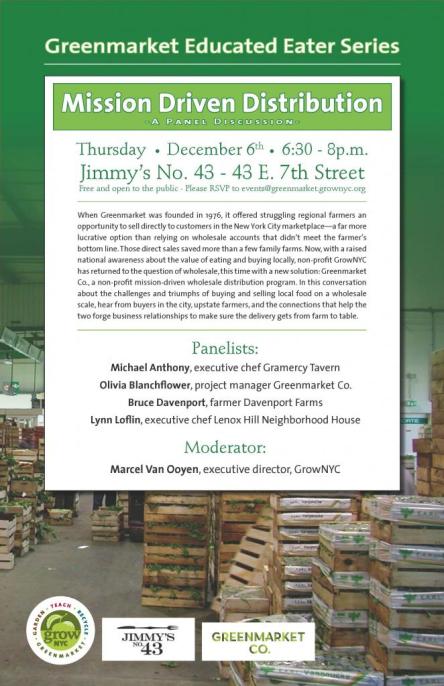
Greenmarket Co.

If I was around, I'd go....

If I was around, I’d go….

TED by Stacy Mitchell

Why We Can’t Shop Our Way To A Better Economy

Growing gardens

I am fascinated by the evolving role of urban ag in the community food system movement. It certainly has changed since its splashy beginnings in the 1980s and 1990s but what this story in the Sunday’s NYT points out is what I have also noticed: the belief that a large number of urban citizens want to grow their own food – and grow it every year – is not proven. I think the successful versions found anywhere are to scale and appropriate for the climate and demographic nearby. This might mean gardeners have a fallow season or maybe even a full year to recover and plan for the next planting or use their land for fruit trees. Here in New Orleans, we have a year-round growing culture with the most brutal weather in the summer: therefore, the idea of cover crops and soil solarization should be encouraged during June-September which gives people time to think and prepare for the fall planting.

The article quotes John Ameroso, who they interestingly call the “Johnny Appleseed of NY gardens” as someone who has that evolving view, he:

espouses more of what he calls an “urban agriculture” model: a food garden with a dedicated farmers’ market or a C.S.A. These amenities make stakeholders out of neighbors who may not like dirt under their nails and rural farmers who drive in every weekend.

“The urban-agriculture ones are flourishing,” he said. “There’s a lot of excitement. They’re active eight days a week.” But “community gardens, as such, where people come in to take care of their own boxes — those are not flourishing.”

It’s almost a cliché to point out that this new green model seems to have attracted tillers with a different skin tone. “Back then,” Mr. Ameroso said of his earlier career, “when we worked in Bronx or Bed-Stuy, it was mostly communities of color. Now when we talk about the urban agriculture stuff, it’s white people in their 30s.”

Production is the purpose of commercial agriculture and even for a community garden, it should be the goal. That production could be for a single home, or for donation or for income, but in every case a plan to produce food or plants should be required each year for every community garden space.

NYT growing growers


Here is a link to the excellent 5 Boroughs work to outline inclusive evaluation and strategic planning for projects.

Makin’ Groceries in Lower Nine | NolaVie – Life and Culture in New Orleans

I’ve written about Jenga Mwendo before. She is a dedicated activist for lower 9. This idea is a fantastic one and one that I’ll make sure to support.

Makin’ Groceries in Lower Nine | NolaVie – Life and Culture in New Orleans.

“A market and a sentiment are not a movement”

Love this article from Sunday’s NYT which was sent to me by a non-foodie friend. As always, I appreciate Pollan’s clarity and honesty, but I do disagree that this election season is a litmus test for our work.
The present administration has not made localized healthy food systems a core part of its mandate yet and as much as I appreciate the First Lady’s resolve and leadership on good food, lets be honest: it’s not the only flag (or even the main flag) that they are flying. As for initiatives, ballot referendums in California have yet to have serious impact on the rest of the nation. Trust me-I worked on Ohio’s Issue 5 back in the 1990s that was modeled on California’s labeling law of cancer and birth defect-causing ingredients: talk about a bloodbath.
I also say that the issues centrally addressed by this referendum are exactly what we are NOT about: refashioning the industrial food system at its edges. Our work is life and death on every front and about creating an alternative food system that by its very life means death to poisonous, fake foods controlled by a few dozen monolithic corporations. (Asking them to refashion their products for approval is like Al Capone being asked to use a 6 shooter rather than a Tommy gun-everyone would still be in danger and he would still have become richer and more powerful.)
I’d say that the true test of this system as an election kingmaker will be when there are actually candidates that stump for office using localized healthy food systems for all as their mandate. Unfortunately, that has little chance of happening on its own.
The other way we can test this system is when we actually reach across race and class lines and age groups to find one day that the majority of the country has 1) successfully shopped at a farmers market more than once 2) went to a school that regularly served healthy food that was culturally recognizable 3) honors farmers and harvesters by refusing to vote for developments that drive up prices of farmland or waterfront property and 3) choose brands that don’t pollute, use dangerous ingredients or undercut workers to bring you the best price on a product.
Then, the mandate in DC will not depend on the weak resolve of a privately funded politician, but on the goodwill of the electorate. And yeah, until then, it’s a damn good article about movements.

“One of the more interesting things we will learn on Nov. 6 is whether or not there is a “food movement” in America worthy of the name — that is, an organized force in our politics capable of demanding change in the food system. People like me throw the term around loosely, partly because we sense the gathering of such a force, and partly (to be honest) to help wish it into being by sheer dint of repetition. Clearly there is growing sentiment in favor of reforming American agriculture and interest in questions about where our food comes from and how it was produced. And certainly we can see an alternative food economy rising around us: local and organic agriculture is growing far faster than the food market as a whole. But a market and a sentiment are not quite the same thing as a political movement — something capable of frightening politicians and propelling its concerns onto the national agenda.”

NYT

Still time to join the PPS conference…

About every two years, Projects for Public Spaces hosts a dynamic public market conference that draws a wide selection of market organizers, researchers and municipal officials. This time, this it’s being hosted by my other home town of Cleveland, Ohio. The city worked hard to get the conference to showcase their 100-year-old market West Side Market AND its vibrant alternative food system. If you haven’t been to what USED to be called “the mistake on the lake” ever or recently, you would be amazed at some of the changes around town. Those of us who have done community organizing there shouldn’t be: the long tradition of neighborhood and issue organizing on issues like housing, utility reform and brownfields has been expanded to excellent food campaigns.
I can’t wait to see my colleagues, to hear about what they are up to and to see more of the Northeast Ohio food and farming system. If you haven’t checked out PPS’ website and excellent work to support public space and markets role in them, please take the time.

PPS

INTERVIEW: Zoning for Food Access in New York Neighborhoods – Next American City

A must read for any food organizer. Understanding how cities are using zoning and tax incentives to encourage businesses to sell food is important. And it’s important to remember that city governments work with a “broad brush” when it comes to encouraging growth so that the most innovative entrepreneurial initiatives will most likely come from other stakeholders in food systems.
In other words, its up to us to define food system sustainability and success and for cities to remove barriers for us to do that.

INTERVIEW: Zoning for Food Access in New York Neighborhoods – Next American City.

How Veggie Co-ops and Ice Cream Collaboratives Could Save the Economy | Mother Jones

This entrepreneur throws some great numbers out in this excellent blog post and also entices us all with visions of local ice cream and veggies at what he, very interestingly calls a winter food bazaar. That typology term may fit in quite nicely to the project that we call Market CITY (Characteristics, Indicators and Typology)
His reference to Civic Economics and Ken Meter’s work is not surprising, since their reports (along with Michael Shuman at BALLE and Jeffrey O’Hara at Union of Concerned Scientists) make up much of the data that we are using to build the economic argument for local food systems.

How Veggie Co-ops and Ice Cream Collaboratives Could Save the Economy | Mother Jones.