No Piece of the Pie

From ACORN International organizer Wade Rathke:

The Food Chain Workers’ Alliance released an updated state of the industry report entitled “No Piece of the Pie,” and it’s not just sobering, it’s depressing, because even as employment is soaring in this critical industry, the workers are falling farther and farther behind. There is no way to separate the precariousness of the workforce from any final conclusions about food quality and safety.

The report’s executive summary speaks for itself and includes the following findings:

· Fourteen percent of the nation’s workforce is employed in the food chain, over one in seven of all workers in the U.S. The number of food chain workers grew by 13 percent from 2010 to 2016.
· The food chain pays the lowest hourly median wage to frontline workers compared to workers in all other industries. The annual median wage for food chain workers is $16,000 and the hourly median wage is $10, well below the median wages across all industries of $36,468 and $17.53.
· Thirteen percent of all food workers, nearly 2.8 million workers, relied on Supplemental Nutrition Assistance Program benefits (food stamps) to feed their household in 2016.
· Eight-two percent of food chain workers are in frontline positions with few opportunities at the top.
· For every dollar earned by white men working in the food chain, Latino men earn 76 cents, Black men 60 cents, Asian men 81 cents, and Native men 44 cents.1 White women earn less than half of their white male counterparts, at 47 cents to every dollar. Women of color face both a racial and a gender penalty: Black women earn 42 cents, Latina women 45 cents, Asian women 58 cents, and Native women 36 cents for every dollar earned by white men.
· Injuries are up and union protection is down.


CSAs: We Have a Problem

A thoughtful post about CSAs from Small Farm Central’s Simon Huntley is excerpted and linked below. His questions mirror some of the same that are being asked in the farmers market field about sales levels and how to build a regular, return shopper out of an occasional user or even some (of the majority) non-users. I am interested in his CSA research as the relationship between CSAs and farmers markets has yet to be studied in order to more fully understand farmers markets. The market box programs that he mentions are one great example of the shared characteristics that CSAs and farmers markets have that need to be better understood. I remember seeing this for the first time a few years back at the Lakewood Ohio LEAF market that used a CSA vendor as the anchor market vendor. That vendor had signs for their CSA members (how much of an item to take per share) but also a price for walk up non-CSA shoppers with a barter table at the end for CSA members to trade in items they didn’t want. The other vendors benefited greatly from this farmer being on site at this tiny weekday evening market. The last time I was there, the CSA/market vendor was only doing CSA shares (still managed by the volunteer market leadership) as the demand was high enough and other producers had been added to take care of market sales of produce. The whole thing was extremely well-managed, with a lot of opportunities for interactions for shoppers and vendors.
That is an example of a local organization using strategic thinking to build a market appropriately sized and structured for its growers and its shoppers. That thinking led to the organizers using the right type of place, products, people and procedures for their intention.
If only we had a list of the characteristics and projects for each type, we could shorten the learning curve and assist more partners interested in using markets as part of their program goals, and help producers by giving them better information on the outlets they can choose from, able to position themselves better to create the right business plan for those outlets.
As those who read here know, I am devoting my time to assisting FMC in building the Farmers Market Metrics program in order to gather data from the markets themselves that can help all of us find those answers. Certainly, the same framework can be used for CSAs and other direct marketing outlets to allow us to share the impacts on producers, shoppers and the larger community.

Exactly 30 years from the founding season of CSA in the United States, I think we are at an inflection point. Anecdotally, many farms are reporting declining CSA sales, though I should note that this decline has not yet shown up in our data.

Will CSA exist in its current form in 5 or 10 years? I honestly don’t know. I think it could easily go either way: CSA could grow substantially or membership may continue to shrivel…

I believe we need “CSA 2.0” for CSA to thrive over the next 10 years. There likely will continue to be room for traditional CSAs in the marketplace, but to grow the number of families that participate in CSA, we need to become more customer focused. We need to serve eaters better because that is what makes happy members, keeps them coming back, and recommending CSA to their social circles. I know change is hard, but I hope to be a part of modernizing CSA and helping you be profitable with your CSA.

My research leads me to believe that it is fundamentally about providing more choice to members about what is in their box. There are many models out there already that provide that already.

.

Source: CSA: We Have a Problem

Update your market

Hopefully, all market leaders know that the USDA directory is the go-to list for farmers markets for those within the department, for market advocates and for researchers and funders. Most media stories about markets use this link to direct shoppers to us. Additionally, all of the evaluation about markets is calculated from this directory and so if your market is not listed, the true impacts of your producers hard work and of your organizational projects cannot be measured.

Do yourself and all of us a favor: take a breather from outside for a few minutes this week and sit down with a cup of coffee or a glass of tea to update the directory for your market. Market vendors: ask your market manager or lead volunteer if they have updated the list recently.


Dear Farmers Market Colleagues, 

Get ready, get listed! National Farmers Market week is coming (Aug 7-13) and you want people to find your market! USDA’s Local Food Directories can help you promote your farmers market. This tool will allow shoppers to quickly identify you as a supplier of the local food. It takes less than 10 minutes to add or update your listing.


USDA will share the number of farmers markets listed in the directory with media and stakeholders across the country during National Farmers Market Week. We want you to be counted! Time is running out!  New listings or updated information must be entered by July 15, 2016, to be included in the national numbers, so don’t delay.


It’s easier than ever to register!  If this is your first time listing your market in the Directory, go towww.usdadirectoryupdate.com to add your market. In less than 10 minutes you’re done.  That’s all it takes.


If you do not know if your farmers market is listed, then you can search the National Farmers Market Directory database to find out. If your market was in the Directory last year, we sent an e-mail during the week of June 27th that has a direct link to update your market listing.


Even if you listed your market last year, you should check the directory again to make sure all your information is still correct.


Here is how the Directory can help you

The USDA National Farmers Market Directory helps you tell customers what they want to know about your market:

  • Where and when your market opens
  • Second and third market locations that you operate
  • What products your market sells
  • If your market  accepts:
    • Supplemental Nutrition Assistance Program (SNAP)
    • Women, Infants and Children Farmers Market Nutrition Program (WIC-FMNP)
    • Women, Infant and Children, Cash Value Vouchers (WIC-CVV)
    • Senior Farmers Market Nutrition Program (SFMNP)
  • Whether or not the market acceptances debit/credit cards
  • Consumers can even get:
    • Driving directions to the market they choose to visit
    • Map markets within a radius of their current location
    • Get a state or national map of farmers markets


The USDA National Farmers Market Directory used by mobile application developers to help consumers find you or other markets across the nation.


The Directory attracted over 400,000 page views from users last year.  It’s the “go-to” resource for consumers, researchers, community planners and more to better understand the size of farmers markets across the nation.


Don’t delay, please be counted by including your market by July 15.


Thank you.

USDA’s National Farmers Market Directory Team

Up next: New Orleans, Vermont, Massachusetts

Over the last ten years, my travel schedule has remained pretty constant in the late winter and spring: a.k.a. farmers market/agricultural conference season. Sometimes it means that I am leaving New Orleans during Carnival season, (or my fav festival event) the Tennessee Williams Literary Festival or just at the loveliest time of year. Still, I am honored to be invited to participate in so many market development workshops and say yes to as many as I can manage.

This year my conference travel has taken me to North Carolina, Atlanta and Illinois and next up are three meetings, two in places I know and love, and one new to me:

New Orleans: AFRI-funded “Indicators for Impact” project team/market pilot sites meeting.

Vermont: NOFA-VT Farmers Market meeting

Massachusetts: Mass Farmers Markets meeting

• In New Orleans, I will serve as the host team member and support the FMC team in presentations, facilitating open discussion among participating markets and in absorbing those markets feedback on their first year of gathering and compiling data. This University of Wisconsin-led research is informing the development of Farmers Market Metrics.

• In Vermont, I return for the 5th or 6th year to support my colleague Erin Buckwalter in her work at NOFA-VT to build capacity for direct marketing outlets and to support VFMA. I’ll be presenting some retail anthropology techniques for markets to consider when refreshing their markets. Sounds like I’ll also be called on to facilitate a open session on EBT issues, which should be helpful to the Center for Agriculture and Food Systems at the Vermont Law School (CAFS). The students are leading the design of a Legal Market Toolkit along with project partners NOFA-VT and FMC. Exciting stuff coming out of this project, I promise.

• Final stop of the season is to one of the most established state associations and to work with one of the longest serving state leaders, Jeff Cole. I remember well that in the formation days of Farmers Market Coalition, our Market Umbrella E.D. always came back from those meetings with great respect for Jeff’s input. Since then, I have called on him to offer analysis in some of my projects (shout out to some of my other informal advisor mainstays: Stacy Miller, Amy Crone, Sarah Blacklin, Ben Burkett, Colleen Donovan, Copper Alvarez, Kelly Verel, Suzanne Briggs, Helena St. Jacques, Richard McCarthy, Beth Knorr, Leslie Schaller, Jean Hamilton, Paul Freedman, Devona Sherwood  along with a whole bunch of others..)   Jeff has asked me to do an overview on market measurement history (RMA, SEED, PPS audits) and recent evolutions like FM Tracks, Demonstrating Value, and of course Farmers Market Metrics.

So, keep yourself busy on other blogs while I sit in meetings, learning and sharing for the next few weeks. And if you are attending any of these meetings, please say hello and share your news or ideas with me. Maybe it’ll be the next best practice that I post on my return to these pages.


Food companies distort nutrition science says Nestle

…So Nestle decided to document the problem: On her blog, Food Politics, she began tracking all the industry-funded food and nutrition research she came across, paying particular attention to the number of studies that had positive results (i.e., favoring the funder).

Her findings so far are remarkable. Of the 152 industry-funded studies she has examined, 140 boast results that favor the funder. That’s more than 90 percent.


Source: Food companies distort nutrition science. Here’s how to stop them. – Vox

Salvation Army Is Measuring Poverty In Real Time

Here is an example of an innovative community-level data project that will lead to better policy decisions and increased support for the many services that SA offers. I can easily relate this to farmers markets data collection and found particular interest in the key indicators chosen and in this line: “a result due in part to the lack of information in the public domain, but also, the lack of uniform reporting that exists on both a national and local scale”, which also remains a problem for grassroots markets and other food initiatives.

This story also illustrates what could very well be the next step to Farmers Market Metrics: collected indexes that show a larger system inequity or effect,  possible once we establish which metrics are best compiled for different system measures. Those system measures can come from the work done by Center for Whole Communities and their Whole Measures, which were part of the initial research done for FMM.


The Salvation Army has rolled out a new tool for measuring poverty across time and geographic regions.

Out of the 600-plus services that the Salvation Army tracks — everything from the number of toys given out at centers across the country — the team of 30 researchers selected seven indicators of poverty for the index: meals, groceries, assistance for medical needs, utility payments, furniture, clothing and housing…

The index enlists Salvation Army data collected from the roughly 30 million Americans who receive assistance with the organization each year. Out of the 600-plus services that the Salvation Army tracks — everything from the number of toys given out at centers across the country — the team of 30 researchers selected seven indicators of poverty for the index: meals, groceries, assistance for medical needs, utility payments, furniture, clothing and housing. Together, these data points form a score within the index that’s been plotted to show month-to-month changes both nationwide and within each state, between 2004 and 2015. The result is a highly interactive graphic that shows a number of interesting trends, including which states haven’t returned to pre-recession levels of need: Pennsylvania, Indiana, Nevada, Michigan Kansas and Minnesota…

A decade’s worth of data in the index revealed a number of curious trends, including a consistent uptick in demand for assistance on utility bills in springtime. “You’d think it’d be the opposite, because it’s warmer weather,” says Osili. The data analysts at Indiana University went to their colleagues at the Salvation Army, who soon enough arrived at an explanation. “In many communities, particularly in the Northern part of the United States, it’s against the law to turn off somebody’s utilities during cold weather,” says Lt. Colonel Ron Busroe of the Salvation Army. “So in April, when it is springtime, people are coming to us to get their utilities paid.”

Another observation illuminated by the index: a September back-to-school bump in service needs at Salvation Army centers everywhere. Those are just a couple of the discoveries that have Dr. Osili excited about what could blossom from this collaboration between university researchers and a sprawling service provider. “It was a revelation and showed the need for these kinds of partnerships, because on our own we would not have immediately or intuitively thought of that.”

Source: Salvation Army Is Measuring Poverty In Real Time – Next City

Counting cases and flats

IMG_20151215_093657

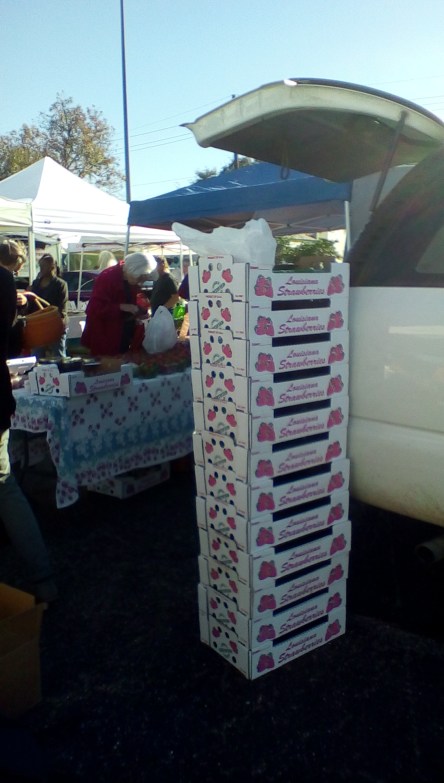
As Farmers Market Coalition and University of Wisconsin delve ever more into the design and the research around Indicators for Impacts, others interested in this work continue to ask for informal help in adding common-sense evaluation to their market work. In a recent conversation with a state market leader, we discussed testing new methods for evaluating vendor success besides just asking for sales numbers. One of those could be counting flats or boxes stacked, once sold. This is certainly not an exact science, but as an indicator of trends or of seasonal spikes, it could prove to be very handy.

For those vendors who sell a single product like these strawberries currently available at New Orleans markets, a market manager can easily note the stacked empty boxes or flats (the unsold flats remain in the truck out of the sun and away from harm). Currently, this vendor sells a pint for 4.00 and is not offering many quantity breaks yet as this is the very beginning of the season; of course, they will offer quarts, half flats and flats at different prices once the season begins in earnest.

Here we can see that she has already sold (around 2.5 hours into the market) 12 flats with 12 pints at 4.00 for a total of 566.00. Let’s assume that she sold a few flats to chefs and maybe offered samples and maybe a price break to a few of her regulars, or even to the market as it had school tour events that Tuesday, so let’s round it off to a day so far of around 700-750 in sales. She only has a few left, so maybe she brings in in the ballpark of 1000.00 on this market day. She also sells honey and some strawberry preserves, but those sales are minimal from my estimation, and are more about extending her visibility at markets on rainy weeks when she cannot pick or when the cold keeps her early berries under wraps.

We won’t make the mistake of assuming any of this is profit but it is helpful to monitor how some of the anchor vendors are doing at different points of the season. Their shoppers may very well travel to market primarily for their goods and then stop at other stalls to purchase more. No doubt that fruit vendors attract seasonal shoppers, especially at the  beginning, the height and at the very end of their fruit season when either specific types (early adopters, chefs, canners) or just more fruit lovers seek them out. Knowing who is drawn to the market by which anchor vendors and when can help pinpoint the marketing in future seasons.

The flat or case count also allows managers to understand the production strategy for a vendor and may help that vendor evolve it over time. For example, when this vendor does move to flat pricing later in the season, is that a moment for the market to add events and messaging to let more people know?  Or, should the market wait until the crowd begins to slow and then begin messaging? How much is planted and expected to be sold at different points in the season? What does the vendor consider a good day at these points: everything sold as quickly as possible or having enough for her regular shoppers? Can the market can handle more berries?

Additionally, can the market position like products nearby, like dairy, or at least add signage that points from one to the other on spikey days?

Lastly of course, this can be seen as another way to show sales among vendors that offers some contextual information too:

One vendor sold an average of 200 pints of local berries at every Tuesday market during the good weather of November and early December. The availability of berries that early in the season is due to this vendor adding a cold-hardy Canadian variety to their crop plan to extend berry availability at the market by two more months.

Or the picture can tell the story and be added to the report to the community at the end of the year.

The point is to think of gathering and using data as doable and as human-scaled as the market itself…

…and to get to that berry vendor early in the day.

Big data doesn’t have to be Big Brother

This article easily says what I attempted to do in my 3-part Big Data, Little Farmers Markets posts earlier in the year.

The same data and algorithms that wreak havoc on workers’ lives could just as easily be repurposed to improve them. Worker cooperatives or strong, radical unions could use the same algorithms to maximize workers’ well being…

…Big data, like all technology, is imbued within social relations. Despite the rhetoric of its boosters and detractors, there is nothing inherently progressive or draconian about big data. Like all technology, its uses reflect the values of the society we live in.

Under our present system, the military and government use big data to suppress populations and spy on civilians. Corporations use it to boost profits, increase productivity, and extend the process of commodification ever deeper into our lives. But data and statistical algorithms don’t produce these outcomes — capitalism does. To realize the potentially amazing benefits of big data, we must fight against the undemocratic forces that seek to turn it into a tool of commodification and oppression.

Big Data article

Farmers Market Metrics site updated

We are pleased to present an updated version of Farmers Market Coalition’s Farmers Market Metrics (FMM) website. We have streamlined and organized information about the current efforts, and will use this site to offer background information and project updates on all of the components of FMM that are underway. The final set of resources and tools will be available on a separate portal in development, expected in 2016.
Some highlights include:
Unique pages for current and past projects
Information on our project partnerships and funding sources
Examples of some of the resources being developed (currently in draft phase)
We hope you will take some time visiting and exploring our new pages. Please contact me with any questions.
Thank you for your ongoing support and enthusiasm for Farmers Market Metrics and the Indicators for Impact project.
Sara

Sara Padilla, FMC Project Manager

Big Data on Shopping and Transportation

Some of you may remember the 3-part Big Data and farmers market posts I did a few months back. Here is another article from Next City that talks of a Big Data partnership for city planners to understand how people move about, to shop and to work.

What is great about this type of big data is that many markets can be a part of this data since a significant number of them accept MasterCard cards, either at the Welcome Booth or among vendors. Think about a funder doing this, using the number of and dollar amount of transaction metrics to analyze with transportation data; it could illuminate the need for more buses during market hours or simply to show the cluster patterns of market shopping among card users. That data could then pinpoint outreach.

By combining MasterCard’s transactions data (they process 43 billion per year) with Cubic’s transportation data, analytics and visualization technology, the platform — dubbed the Urbanomics Mobility Project — will yield insight into the way transit and economic activity are linked in cities.

https://nextcity.org/daily/entry/how-human-is-big-datas-newest-city-planning-tool

Hernando Farmers Market Data Collection Day

I kicked off my summer of market travel in northern Mississippi this year, which is one of my favorite places to work and to visit in the U.S.

Hernando is in DeSoto County (someone had to point out to me the appropriate alignment of the names of the city & county, honoring the first European known to cross the Mississippi) and it ranks highest in most indicators for good health in Mississippi, but is next door to a slew of counties that are at the very bottom of that same list, in what is called the Delta.

I first got to to know the Hernando Market when I was doing research a few years back for a report for The Wallace Center on existing challenges for direct and intermediate marketing farmers in Mississippi. Everyone told me to go talk to this market to see what impressive work was being done there. And so I went up and met with Shelly Johnstone, who founded and ran the market while working as the Community Development Director of the city. The market had been running for only a few years by the time of my visit but already was one of the largest and most productive in economic terms for area producers. I remember well what she told me about being Hernando as a  regional leader during that visit: “We’re grateful to be leading the state in healthy behavior but we know we need to assist our fellow counties and get those folks in the same situation. It won’t be enough to fix Hernando.”

She invited me back up to see the kickoff for her weekday local food market box program called 4Rivers, created in partnership with the Northwest Mississippi Community Foundation, which has done a great deal in food and active living projects for the area. She also discussed her work to provide technical assistance to neighboring markets and to support the expansion of organic/sustainable farmers through the Mississippi Sustainable Agriculture Network. All of this and more happened because of the leadership of Mayor Chip Johnson, who remains a strong proponent of the weekly farmers market.

I left impressed with the mayor and Shelly’s connections and drive, looking forward to many years of their leadership. Of course, news came to me within a year that she was retiring from the city and her post(s), but would stay involved with the efforts in her area. Unfortunately, circumstances have not allowed her to be as visible as she would probably have liked, but the good news is that her successor at the city, Gia Matheny, has the same drive and empathy for her fellow citizens. Of course, coming into the market some years after its founding has meant some catch up for Matheny, but luckily, she has deep skills, an open personality and is willing to ask about what she doesn’t know.

So when the request was sent out by Farmers Market Coalition for markets in MS to become a pilot site of the Farmers Market Metrics work, I was pleased when this market asked to be considered as one of the sites. The 3-year data collection project would teach the research team at University of Wisconsin-Madison a great deal about the unique qualities of markets and regions and so having this strong market in the mix for Mississippi was going to be beneficial for everyone.

Hernando (like the other 8 pilot markets) was instructed to choose metrics that best represented the current impact that the market was having on its vendors, its visitors/shoppers, its neighbors and the larger community.

Here are their choices:

Dollars spent at neighboring businesses by market shoppers on market days

Percent of customers who were first time visitors

Average number of SNAP transactions per year

Total dollar amount of Senior FMNP redeemed annually

Number of different fruit and vegetable crops available for sale annually

Percentage of shoppers walking,bicycling, carpooling, driving or taking

public transportation to the market (estimated annually)

Percentage of shoppers from represented zip codes (estimated

annually)

Additionally, all 9 markets were asked to collect the same data on these metrics (called the Common Metrics):

Average number of visitors per market day:

Total annual vendor sales at market

Average distance in miles traveled from product origin to market

Acres in agricultural production by market vendors

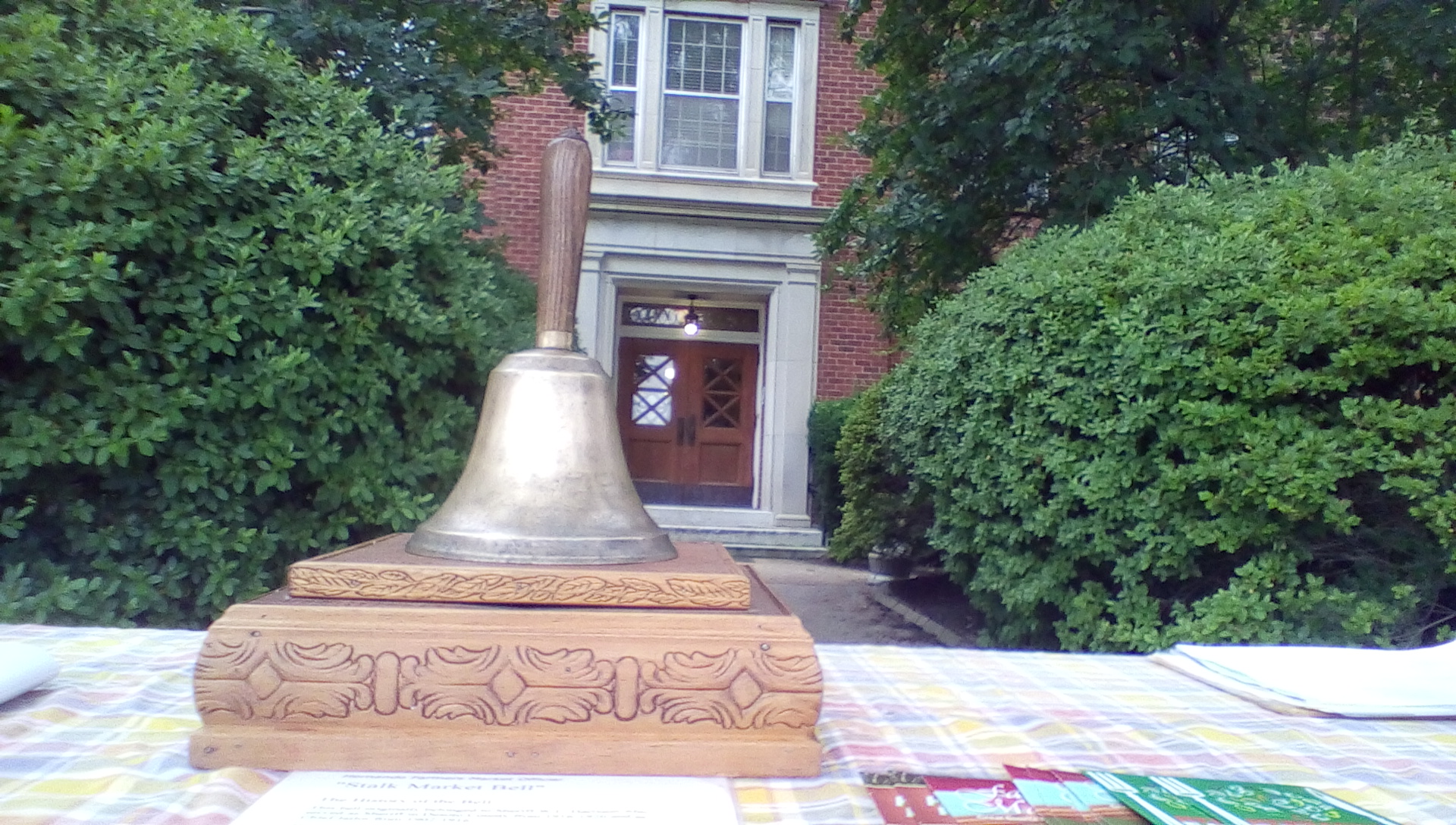
Once the metrics were selected in the fall of 2014, the UW research team created a unique Data Collection Package (DCP) for each market detailing how and when they would collect the data for each metric. Each market then chose their collection days for the summer/fall of 2015 and searched for and scheduled volunteers accordingly. June 13th was one of Hernando’s four scheduled dates for visitor surveys and visitor counts and so I drove up to observe the day and offer any assistance I could. I was also lucky enough to be asked to ring their 100-year old market bell to open the market:

The 100-year old Hernando Market bell

The 100-year old Hernando Market bell

FMC FB post of the video of me ringing the bell

Gia mapping out the day

Gia mapping out the day

GiaMHernCollectors

The Hernando Market Welcome Table

The Hernando Market Welcome Table

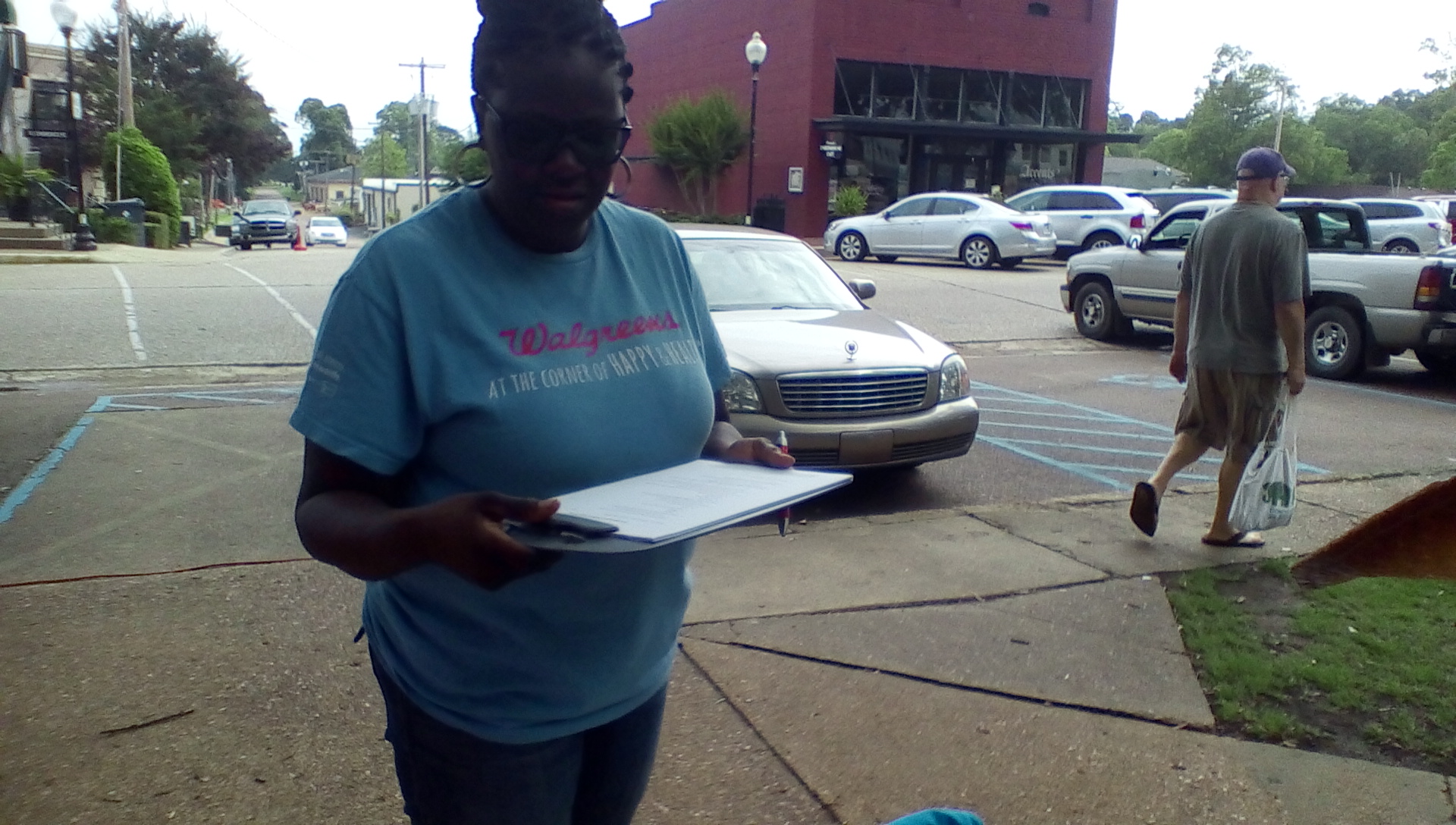
One of the two team members that would be doing the visitor surveys

One of the two team members that would be doing the visitor surveys

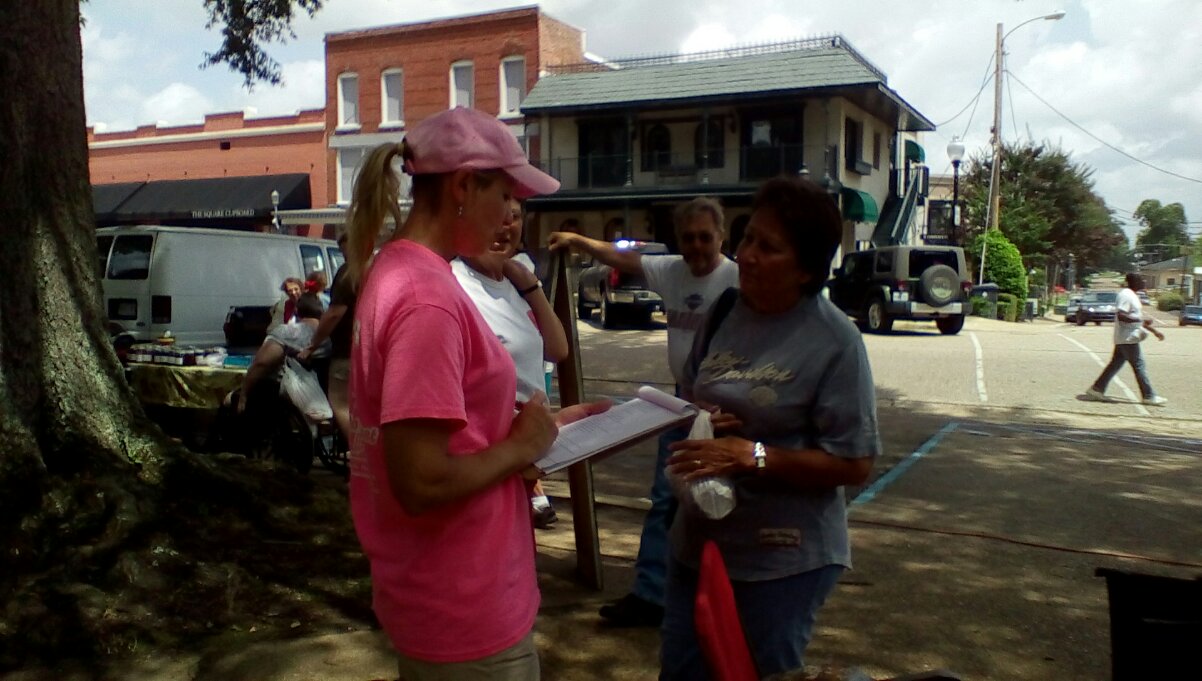
The other member of the team conducting the visitor surveys- yes that is an iPad which was being tested for use in doing surveys; unfortunately, the WiFi signal was not strong enough to use and so paper surveys were used instead.

The other member of the team conducting the visitor surveys- yes that is an iPad which was being tested for use in doing surveys; unfortunately, the WiFi signal was not strong enough to use and so paper surveys were used instead.

The set of clickers to be used for Counting Day
The set of clickers to be used for Counting Day

Gia doing a survey

Gia doing a survey

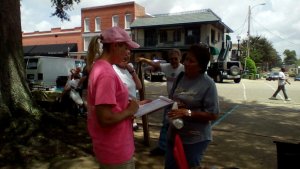
Some of the team were assigned at advantageous locations to count the visitors, while others were to complete visitor surveys. The volunteers were a mix of folks, from corporate volunteers (Walgreens corporate office staff for this Saturday) arranged through Volunteer NW Mississippi, to a city youth leader and Gia’s daughter and her friend. They picked up on the tasks easily and (and something that is not unusual in my experience) offered good feedback throughout the day and even gladly volunteered to take on more data collection tasks when necessary.

Overall, the data collection went extremely well and the immediate and ongoing analysis of it will mean an even smoother day for the next round for  the market leaders. It was impressive to see how many city officials, visitors and vendors wanted to know more about the pilot and and were eager to discuss the market in measurement terms with me.

Next up: Chillicothe and Athens OH
Farmers Market Metrics May Be Coming To Your Town

This is a reprint of a blog that I wrote for the Farmers Market Metrics page on Farmers Market Coalition’s site. There is a growing need for food and civic systems evaluation that is designed and implemented in partnership with the grassroots organization and uses contextual and disciplined metrics that are useful to that organization and to their partners. The new pilots and research happening at FMC and their partners, such as University of Wisconsin-Madison, are hoping to address that need.
ecocities emerging

Another detractor and another clear need for better data and reporting

The article found here

For those of you who have read my “Big Data, Little Farmers Markets” blog posts linked here, and the Farmers Market Metrics pilots many of us have worked on, you know this is the kind of media that concerns me. I will fully agree that farmers markets have limits to their ability in carrying food equity on their shoulders, although I am not sure that markets ever promised that.

The findings extracted for this article lack necessary context and since the original academic article is behind a paywall, many are left to wonder how closely this piece extrapolated the best ideas from the study. However, I won’t be surprised if this small study did say exactly what has been used here, but I’d hope it made allowances for the small scope of the research and the lack of comparable metrics between community food systems and the industrial retail sector.

Farmers’ markets offered 26.4 fewer fresh produce items, on average, than stores.
Compared to stores, items sold at farmers’ markets were more expensive on average, “even for more commonplace and ‘conventional’ produce.”
Fully 32.8 percent of what farmers’ markets offered was not fresh produce at all, but refined or processed products such as jams, pies, cakes, and cookies.

As those of us know that are working constantly to expand the reach of good food, there has never been a belief among those that run markets that our role was to replace stores, especially the small stores and bodegas likely to be present in many of the boroughs of NYC. Instead, the lever of markets is meant to offer alternatives AND to influence traditional retail by changing everyone’s goals to include health and wealth measures that benefit regional producers, all eaters and the natural world around us.
As far as being more expensive, one might wonder if that the study did not compare the same quality of goods; these price comparisons often compare older produce with less shelf life to just-picked and carefully raised regional goods. I have bought much lettuce this year from a few of my neighboring markets that lasted 3-4 weeks in my refrigerator, which I have never been able to match with the conventional trucked-in produce seen in my lovely little stores that I frequent for many of the staples I need. Additionally, the price comparisons I have conducted or have seen have shown most market goods to be competitively priced or cheaper in season, so this study may need a larger data set or maybe a longer study period.
Generally speaking, refined or processed foods available from cottage producers at a market are markedly different from what is seen in the list of ingredients in most items on a grocery store shelf. Using fruit or vegetable seconds for fresh fruit spread or salsa is common among market vendors and extends the use of regional goods. And of course, balancing one’s diet means allowing for a treat on the table after that good dinner and may actually lead to less junk food later.

And finally, the article does not even consider the positive impacts found in markets for regional producers or neighborhood entrepreneurs; that omission in these type of articles is always a warning to me that we are reading an author who has spent little or no time quantifying the needs of the entire community being served in the market. If you require proof of the need to show the multiple impacts of farmers markets, the author’s curt conclusion should make that need clear:

Sure, they’re a great place to mingle. But as to whether they are a net nutritional plus for the neighborhood, the answer appears to be: Not so much.

(someone needs to introduce this guy to the idea of social determinants of health.)

Even so, as mentioned in those Big Data and FMM posts (a new Big Data post is coming soon), even these weak arguments are still based on data and analysis which means WE need to do a better job as well. It’s high time that we started to publish regular reports from the front lines of farmers markets, CSAs and other food and civic projects that use our own good data to show the impact that we are making everywhere rather than just keep rebutting these viral pieces that offer incomplete or inaccurate snapshots.