My new role

Since many people have written to me with congratulations on accepting a staff job with FMC (see below), while others emailed with surprise because they thought I was already on staff, I  thought I’d post something about the news, but really more about my feelings about FMC, as I have had a unique vantage point to observe its evolution.

But first the news here: after many years in an outside support role with FMC, I arrived at the conclusion that the opportunity to work daily on the Farmers Market Metrics and other resource development for markets could be best done as an employee when offered that opportunity by Jen Cheek, our able Executive Director.

I also felt that the organization was at a key moment in its growth and being included in that work was right for my skills to assist and to learn. And since I am going to keep my consulting for markets going, it becomes even simpler for me to share news and ideas and looming issues heard from markets with my FMC team and then even easier to dream up or seek solutions.

What made the personal decision become an employee relatively easy was that I know first hand how thoughtfully and carefully FMC has been built by its two Executive Directors, first Stacy Miller and then Jen, supported and led by its talented and committed volunteer board. To illustrate how committed, I remember how the early versions of the board (made up of market leaders) were so vigilant about designing it in such a way to ensure its continued stability and relevancy for serving the independent market community that they even jettisoned a few early passes at it until it seemed right.

Back in the first days of being the first staff hired, Stacy asked a lot of questions (well she still does that), and I observed her as she gladly checked in with anyone and everyone who was open to talking or working with FMC on farmers market advocacy. That sort of openness to building relationships is crucial for an organization, especially one that hopes to represent a wide range of members. Out of those informal one-on-one conversations and early collaborations, she (later with membership and outreach coordinator Liz Comiskey) slowly built a respected young organization, one with some discipline and good relationships.

(I wonder how many remember those early days when the necessity of having a national organization for markets was not shared by everyone and how, when many of us would discuss the idea with outside stakeholders, we would often be politely rebuffed. How (in some circles) markets were often seen as an anachronism or at least as having found their highest level already and therefore any talk of ongoing support to expand them was largely met with indifference. That tide was turned by the valiant push to expand EBT and access to underserved populations and by constantly stretching the reach of markets as fulcrums of food systems and civic engagement. That work was done by the markets themselves with tiny funds and with a whole bunch of sharing between those early leaders and continues to this day.)

One of Stacy’s regular activities was working closely with the state and network leaders who were building resources, analyzing trends and expanding pilots within markets. It was in that part of her work that I got to know her as we both crisscrossed the US appearing at conferences or working in groups like the Wallace Center Farmers Market Working Group or supporting efforts like Projects For Public Spaces’ Farmers Market Mini-Grant program. Back then, my job at Market Umbrella was to pilot the imaginative set of regional ideas our founder had written into grants and to strategize with him and our advisors how to build the field of markets through replicating those ideas or extracting lessons or analysis.  And after I became a consultant, she stayed in touch, hired me and  was one of the few people back then who agreed that the Farmers Market Metrics work was necessary, letting me talk incessantly about it (well I still do that), relentlessly questioning me when needed.

When she told me of her decision to step down in preparation for the birth of her son, I was a bit deflated, knowing how hard it would be to maintain the supportive energy that FMC was beginning to take advantage of to grow its funded activities. Lucky for us, the right person found FMC next and kept the momentum going, and expanding its reach and depth rather quickly. Whether the timing was just right or Jen visualized it all, she did a speedy job adding the right components while listening to those with opinions or ideas about markets and now, with opinions about FMC itself. And that is a crucial point to make: each ED had a very different primary challenge to overcome and Jen’s was to exponentially grow the income and programs at the same pace as the number of members and partners, while managing the expectations of an emerging organization with its own personality and inertia. All of which is harder to do than it may seem. Far too often, organizations have too many programs at once and members can feel left out, or not enough money for non-project staff and therefore calls and issues are not handled in real time. Having served more than three decades in non-profits, I have seen more entities fail than succeed at being true membership organizations, not guarding against duplicating what is better done by the members or partners, or losing sight as of the issues and remaining barriers that must be addressed at the grassroots level.

Well long story short (although, as my friend Roger would say, it’s too late for that), FMC has ably managed its core purpose without failing its membership on any critical tasks and has important long-term programs in place to support partners and ideas big and small, all the while tirelessly advocating from the seat next to, not in front of markets. Jen also grasped the potential of the Farmers Market Metrics and asked clear questions of Stacy and I (and our early measurement advisors like Paul Freedman of University of Virginia and Alfonso Morales at University of Wisconsin-Madison) and led us in thinking through our plan and kept fundraising to get the ball truly rolling.

Add to that, she had a plan and the skills for staffing with first-rate minds and caring individuals in order to manage its work while asking everyone to remain available for a call or email from a market in need of a reality check or a solution. She also had the maturity and tact to keep Stacy on to assist with analysis and resource writing and Stacy reciprocated with the same and so FMC has had the benefit of her continued presence in crucial ways.

So, when I tell you that I am grateful and honored to be on staff at FMC, I think you can see why. Market Umbrella under Richard McCarthy’s leadership was a tough act to follow and I think somewhere in my mind, I always suspected that FMC might welcome me sooner or later for a spell. Of course, I will remain a roving and critical eye in the market field, offering comfort and strategy to any market or food system that needs my help, but for now, expect that the FMC resource and capacity building work that I gladly get to do these days for (at least) half of my time will continue without interruption for the foreseeable future.

And welcome to my fellow FMC newbie, Honesta.


FMC’s Team is Enjoying Spring Growth!

FMC’s long time consultant, Darlene Wolnik, is now officially an FMC staffer. As Senior Research Associate, Darlene is busily working on the FMC Farmers Market Metrics Project, assisting the Vermont Law School in creating a legal toolkit forfarmers markets, and she is also maintaining her private consulting practice. You can read the full bio for Darlene here.

New to FMC with strong roots in agriculture and nonprofits, Honesta Romberger is our new Communications Associate. Prior to joining the FMC team, Honesta was a member of consulting staff at The Food Trust, a non-profit located in Philadelphia, PA, where she provided expertise and capacity for multiple projects surrounding healthy food access to schools and homeless shelters. Read more about Honesta.

Welcome to FMC!

Fashion at farmers markets

The blue-smocked Bill Cunningham, aka the fashion eye of NYC, has turned his gaze to the farmers markets scene (finally). The village “mahket” style of dress was on display for Cunningham this past Saturday at Union Square in Manhattan. He also captures dog interactions, wisteria-wearing women, and pigeon style in his own charming manner.

His street fashion commentary in his weekly video is both avant-garde and anachronistic (meant fondly of course) and worth following even if you don’t focus on clothes.

Thanks to Farmers Market Coalition for sharing this on Facebook on Sunday.

Ala. couple to give away goat cheese farm to essay winner

An Alabama couple will give away their beloved goat cheese farm to the lucky winner of an essay contest who can properly pen why they’re the right person to run the creamery.

Contest rules and entry form

Ala. couple to give away goat cheese farm to essay winner – NY Daily News.

Marijuana Is A Gateway Drug–To Urban Hippie Farming Utopia

This is such a good interview with farmers that covers much more than the growing of marijuana, including what seems to be the interviewer’s introduction to a farm, discussion of free-range livestock, rehabilitation of incarcerated people, direct action organizing, racist policing and farming/feeding as a community effort.

Marijuana cultivation is a felony under California law, although growers are eligible for diversion if there is no evidence they intended to sell their crop.Region Lewis said they soon began growing other crops when they were in season, and decided that farming was something they wanted to do with the rest of their lives.

Bittman on Food in NYT

I’ll believe there’s a food movement when Hillary Clinton and Jeb Bush are forced to talk directly about food issues. I’ll believe we’re effective when I see the routine use of antibiotics outlawed and when that first CAFO closes. I’ll know we’ve started to win when anyone who wants to farm real food has land on which to do it, when there are high-quality school lunches that are free for all, when we’ve started talking about providing that same quality dinner to anyone who needs it. Until then, we have a lot of work to do.

Here is the link to Dr. Nestle’s original column that Bittman references.

And a sobering reflection from someone in the comments of Nestle’s piece:

When will the food movement take up issues of farmer justice aka fair wages and some degree of security for those who grow food (at much higher risks than most other careers)? The food movement has left farmers behind in its quest to improve the food system. We aren’t heard. We aren’t even asked what our priorities are. If folks want their food grown “better,” farmers need to be paid for their work. And that includes farmworkers, some of the most mistreated and underpaid people in our food system. Pay us more. We work much longer days and get paid much worse than the academics, policymakers, and activists who are agitating for all this change in the food system, yet we reap no benefits. If anything, farmers must work harder to accommodate these changes, and often the benefits accrue to the top (aka the corporations). Unless the goal of the food movement is to further marginalize farmers, then it is definitely NOT winning. It is merely overseeing changes at the margins in a system that devalues the hard work and labor that goes into growing food, that pumps big money into the hands of the few, and that keeps people unhealthy. These so-called winning efforts are a distraction from the big pictures issues. If the food movement isn’t winning, who is? Corporations who will make even more money from consumers AND farmers as they “healthwash” their images while further consolidating control over the choices we make.

FMC’s SNAP EBT Equipment Program is Open

The United States Department of Agriculture (USDA) Food and Nutrition Service (FNS) has partnered with the Farmers Market Coalition (FMC) to provide eligible farmers markets and direct marketing farmers with electronic benefit transfer (EBT) equipment necessary to process Supplemental Nutrition Assistance Program (SNAP) benefits.

WHAT


FMC will cover the costs of purchasing or renting SNAP EBT equipment and services (set-up costs, monthly service fees, and wireless fees) for up to three years. After their application has been approved, eligible farmers and farmers markets will choose their own SNAP EBT service provider from a list of participating companies. Transaction fees (for SNAP EBT, credit, and debit payments) will not be covered.

WHEN

The application is now open. This is a first-come, first-serve opportunity, which will be over when all the funds have been allocated.

WHO

SNAP-authorized farmers markets and direct marketing farmers (who sell at one or more farmers markets) are eligible for funding if they became authorized before Nov. 18, 2011, AND fall into one of the following categories:

They do not currently possess functioning EBT equipment;
OR They currently possess functioning EBT equipment, but received that equipment before May 2, 2012.
Wondering what qualifies as ‘not currently possessing functioning EBT equipment?’ Markets and farmers do not currently possess functioning EBT equipment if:

They currently rely on manual/paper vouchers to accept SNAP,
They do not currently accept SNAP and have never possessed functioning SNAP EBT equipment,
-OR-

They do not currently accept SNAP because their EBT equipment is
:

Damaged beyond repair.
Non-operational because their SNAP EBT service provider no longer offers SNAP EBT processing in their state.
Stolen or lost.
For more information on the program, including frequently asked questions, an eligibility chart, background information and application instructions, visit HERE.

After Winter, Spring showing in DC and VT

UPCOMING SCREENINGS

WASHINGTON, DC

Special Event Screening (w/ Q&A)
Mon, May 4, 2015 – 8pm
Avalon Theatre, 5612 Connecticut Avenue Northwest, Washington DC 20015

The screening will be followed by a discussion with the filmmaker. The event will be a partial fundraiser for the National Family Farm Coalition, and is presented in partnership with the Alliance Française of Washington, the Institut Français, and the Goethe-Institut as a part of their “Forging the Future” series.

BURLINGTON, VT

Vermont Premiere (w/ Q&A & reception)
Wed, May 6, 2015 – 7pm
Merrill’s Roxy Cinema, 222 College Street, Burlington VT 05401

The screening will be followed by a discussion with the filmmaker and a reception sponsored by City Market. The event will be a partial fundraiser for the Northeast Organic Farmers Association-Vermont.

To purchase DVDs or to inquire about a screening copy, click here.

After Winter, Spring – Synopsis.

Big Data and Little Farmers Markets, Part 3

I used these examples in Part 2 of this series, but wanted to use them again for this post. To review:

Market A (which runs on Saturday morning downtown) is asked by its city to participate in a traffic planning project that will offer recommendations for car-free weekend days in the city center. The city will also review the requirement for parking lots in every new downtown development and possibly recalibrate where parking meters are located. To do this, the city will add driving strips to the areas around the market to count the cars and will monitor the meters and parking lot uses over the weekend. The market is being asked for its farmers to track their driving for all trips to the city and ask shoppers to do Dot Surveys on their driving experiences to the market on the weekend. Public transportation use will be gathered by university students.

Market B is partnering with an agricultural organization and other environmental organizations to measure the level of knowledge and awareness about farming in the greater metropolitan area. For one summer month, the market and other organizations will ask their supporters and farmers to use the hashtag #Junefarminfo on social media to share any news about markets, farm visits, gardening data or any other seasonal agricultural news.

Market C is working with its Main Street stores to understand shopping patterns by gathering data on average sales for credit and debit users. The Chamber of Commerce will also set up observation stations at key intersections to monitor Main Street shopper behavior such as where they congregate.

Market D has a grant with a health care corporation to offer incentives and will ask those voucher users to track their personal health care stats and their purchase and consumption of fresh foods. The users will get digital tools such as cameras to record their meals, voice recorders to record their children’s opinions about the menus (to upload on an online log) with their health stats such as BP, exercise regimen. That data will be compared to the larger Census population.

So all those ideas show how markets and their partners might be able to begin to use the world of Big Data. In those examples, one can see how the market benefits from having data that is (mostly) collected without a lot of work on the market’s part and yet is useful for them and for the larger community that the market also serves.

However, one of the best ways that markets can benefit from Big Data is slightly closer to home and even more useful to the stability and growth of the market itself. That is: to analyze and map the networks that markets foster and maintain, which is also known as network theory.
Network theory is a relatively new science that rose to prominence in the 1980s and 1990s and is about exploring and defining the relationships that a person or a community has and how, through their influence, their behavior is altered. What’s especially exciting about this work is that it combines many disciplines from mathematics to economics to social sciences.

A social network perspective can mean that data about relationships between the individuals can be as useful as the data about individuals themselves. Some people talk about this work in terms of strong ties and weak ties. Strong ties are the close relationships that we use with greater frequency and offer support and weak ties are those acquaintances who offer new information and connect us to other networks. The key is that in order to really understand a network, it is important to analyze the behavior of any member of the network in relation to other members action. This has a lot to do with incentives, which is obviously something markets have a lot of interest in.
From the book Networks, Crowds, and Markets: Reasoning about a Highly Connected World. By David Easley and Jon Kleinberg. Cambridge University Press, 2010. Complete preprint on-line at http://www.cs.cornell.edu/home/kleinber/networks-book/

From the book Networks, Crowds, and Markets: Reasoning about a Highly Connected World.
By David Easley and Jon Kleinberg. Cambridge University Press, 2010.
Complete preprint on-line at http://www.cs.cornell.edu/home/kleinber/networks-book/

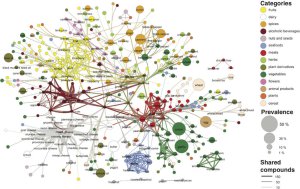
From the foodsystemsnetwork.org website

From the foodsystemsnetwork.org website

network analysis

network analysis

I could go on and on about different theories and updates and critiques on these ideas, but the point to make here is this is science that is so very useful to the type of networks that food systems are propagating. Almost all of the work that farmers markets do rely on network theory without directly ascribing to it.

Think about a typical market day: a market could map each vendors booth to understand what people come to each table, using Dot Surveys or intercept surveys. That data could assist the vendor and the market. The market will benefit in knowing which are the anchor vendors of the market, which vendors constantly attract new shoppers, which vendors share shoppers etc. The market could also find out who among their shoppers bring information and ideas into the market and who carrries them out to the larger world from the market. All of this data would be mapped visually and would allow the market to be strategic with its efforts, connecting the appropriate type of shoppers to the vendors, expanding the product list for the shoppers likely to purchase new goods and so on.

Network theory would be quite beneficial to markets in their work to expand the reach to benefit program users and in the use of incentives. Since these market pilots began around 2005/2006, it has been a struggle to understand how to create a regular, return user of markets among those who have many barriers to adding this style of health and civic engagement. Those early markets created campaigns designed to offer the multiple and unique benefits of markets as a reason for benefit program shoppers to spend their few dollars there. Those markets also worked to reduce the barriers whenever possible by working with agencies on providing shuttles, offering activities for children while shopping, and adding non-traditional hours and locations for markets. Those efforts in New York, Arizona, California, Maryland, Massachusetts and Louisiana (among others) were positive but the early results were very small, attracting only a few of the shoppers desired. When the outcomes were analyzed by those organizations, it seemed that a few issues were cropping up again and again:
1. The agency that distributed the news of these market programs didn’t understand markets or did not have a relationship of trust with their clients that encouraged introduction of new ideas or acceptance of advice in changing their habits.
2. The market itself was not ready to welcome new benefit program shoppers- too few items were available or the market was not always welcoming to new shoppers who required extra steps and new payment systems.
3. Targeting the right group of “early adopters” among the large benefit program shopping base was impossible to decipher.
4. Some barriers remained and were too large for markets alone to address (lack of transportation or distance for example).
4. Finding the time for staff to do all of that work.

Over time, markets did their best to address these concerns, which has led to the expansion of these systems into every state and a combined impact in the millions for SNAP purchases at markets alone. The cash incentives assisted a great deal, especially with #2 and #4. However, this work would be made so much easier and the impact so much larger if network theory was applied.
Consider:
Market A is going to add a centralized card processing system and has funds to offer a cash incentive. But how to spend it? And how to prepare the market for the program?

If the market joined forces with a public health agency and a social science research team from a nearby university, it might begin by mapping the networks in that market to understand the strong and weak ties it contains as well as the structural holes in its network. It might find out that its vendors attract few new shoppers regularly or that the market’s staff is not connected to many outside actors in the larger network, thereby reducing the chance for information to flow.
It might also see that younger shoppers are not coming to the market and therefore conclude that focusing its efforts on attracting older benefit program shoppers (especially at first) might be a strategic move. If the market has a great many low-income shoppers using FMNP coupons already, the mapping of those shoppers may offer much data about how the market supports benefit program shoppers already and how it might expand with an audience already at market
The public health agency might do the same mapping for the agencies that are meant to offer the news of the market’s program. That mapping might find certain agencies or centers are better at introducing new ideas or have a population that is aligned already with the market’s demographic and therefore likely to feel welcomed.

As for incentives, what markets and their partners routinely tell me is more money is not always the answer. Not knowing what is expected from the use of the incentives or how to reach the best audience for that incentive is exhausting them or at least, puzzling them.
If markets knew their networks and knew where the holes were, they could use their incentive dollars much more efficiently and run their markets without burning out their staff or partners.
They might offer different incentives for their different locations, based on the barriers or offerings for each location. (They may also offer incentives to their vendors to test out new crops.)
If connectors are seen in large numbers in a market, then a “bring a friend” incentive might be offered, or if the mapping shows a large number of families entering the system in that area, then an incentive for a family level shopping experience may be useful.
One of the most important hypotheses that markets should use in their incentive strategy is how can they create a regular shopper through the use of the incentive. Of course, it is not the only hypothesis for a market; a large flagship market might identify their role as introducing new shoppers to their markets every month and use their funds to do just that. But for many markets with limited staff and small populations in and around the market, a never-ending cycle of new shoppers coming in for a few months and then not returning may not be the most efficient way to spend those dollars or their time. So this is also where network theory could be helpful.
By asking those using their EBT card to tell in detail where and how they heard about the program and by also tracking the number of visits they have after their introduction, we could begin to see which introductions work the best. Or by asking a small group of new EBT shoppers to be members of a long-term shopping focus group to track what happens during their visit (how many vendors they purchase from and how long they stay) and after (see Market D example at the top), we could learn about what EBT shoppers in that area value in their market experience. We may also find out that the market has few long-term return shoppers from the EBT population or we may find out that connectors become easy to spot and therefore they can be rewarded when sharing information on the market’s behalf.
In all of these cases, it will be easier for the staff to know what to do and when to do it if they understand their networks both in and around the market.
And of course, mapping the larger food systems around the markets’ systems would be exciting and could move policy issues to action sooner and allow funding to be increased for initiatives to fill the holes found.

However markets do it, what seems necessary is to know specifically who is using markets and how and why they decided to begin to use them and to whom those folks are connected. Network theory can be the best and widest use of the world of Big Data, especially to accomplish what Farmers Market Coalition has set as their call to action: that markets are for everyone.

Some reading, if you are interested:

http://www.foodsystemnetworks.org

http://gladwell.com/the-tipping-point

Click to access networks-book-ch03.pdf

Click to access 827.full.pdf

Click to access kadushin.pdf

Reclaiming, Relocalizing, Reconnecting: The Power of Taking Back Local Food Systems

A rare Wednesday post on the 45th anniversary of Earth Day.
A new report by Friends of the Earth Europe looks at five examples of European communities successfully taking on the challenge of creating new systems that honor wise stewardship, local wealth and health and civic engagement. Its an inspiring report; share it widely.

.

ALDI Is A Growing Menace To America’s Grocery Retailers – Forbes

It’s always good to know what the grocery store sector is worried about. By the way, Trader Joes is part of the same company.

‘ALDI has accidentally reinvented pantry stocking in America by subversively eliminating the variable brand and the shopper marketing that goes along with it. They have also eliminated the variable of price, for there are no price comparisons in a store with only one offering in every category. They have made it radically simpler, cognitively, to execute a shopping trip. No thinking about brands, BOGOs, deals, price comps, coupons, sudden endcap promotions or in-aisle shopper marketing. The trip is also super-fast, because the stores are only about 18-20,000 square feet.’

ALDI Is A Growing Menace To America’s Grocery Retailers – Forbes.

Square Reveals A Reader For Chip Payment Cards

If any of your vendors or your markets have not begun to upgrade debit/cc card processor to be emv compliant, do remember that as of October 2015, if any breaches happen, the merchant will be liable, NOT the card processor if the merchant is still using old machines without the chip and pin tech or as the card companies and feds’ legalese has it stated: “the liability for card-present fraud will shift to whichever party is the least EMV-compliant in a fraudulent transaction.” Here is how Square is updating their machines…

A badge, a gun and a box of oatmeal | Minnesota Public Radio News

hmmm, maybe this will lead to expanding farmers market incentives coupons for police or EMT to carry with them to hand out when they see fit? Adding locations and specific instructions on the coupon face as to how to use them?
A badge, a gun and a box of oatmeal | Minnesota Public Radio News.

Farmers Market Jobs in Berkeley

The Ecology Center, a 45-year-old nonprofit located in west Berkeley, is seeking a Farmers’ Market Program Manager and a Farmers’ Markets Access & Equity Program Coordinator.

The Farmers’ Market Program Manager works under the supervision of the Food and Farming Program Director to oversee all Ecology Center Farmers’ Markets activities. The Farmers’ Market Program Manager is responsible for overseeing all market operations as well as directly managing the Tuesday and Saturday Farmers’ Markets. This is a full-time position with a Tuesday through Saturday work week which involves approximately 19 hours at market and 21 hours in the office every week.

The Farmers’ Markets Access & Equity (FMAE) Program Coordinator works to establish, implement, promote, and incentivize Federal Assistance Benefit use at farmers’ markets and other direct marketing outlets statewide. The goal of the program is to create greater healthy food choices for low-income and underserved populations and drive additional customers/income to farmers at farmers’ markets.

For more information, and to download an application for employment, please visit: http://ecologycenter.org/jobs/

Crossroads Community Food Network video

Great video from Crossroads Community Food Network, which runs the wonderful Crossroads Farmers Market in Takoma Park Maryland. It produced by the daughter of one of their board members as a Spanish project for high school.

Just shows what kind of smart and inclusive outreach can be done by community members when they are encouraged.