No, not THAT Tabasco. Clever market.
http://www.thesttammanynews.com/news/article_8e7cb9e2-c6ef-11e1-961a-0019bb2963f4.html
No, not THAT Tabasco. Clever market.
http://www.thesttammanynews.com/news/article_8e7cb9e2-c6ef-11e1-961a-0019bb2963f4.html
One of my ideas for building the movement is for network leaders to think about how to alternate or expand manager trainings. For experienced managers that have attended (and maybe even presented?) at their own state conference, maybe there is way to save some of that funding for those managers to be able to go visit another market instead. There are markets operating year round in every region now and so finding the appropriate market for these managers to learn from has become much easier.
For example, here in Southeastern Louisiana this early spring, we are in the middle of one of our best seasons already; strawberries, citrus, greens and generally full tables since mid January.
Covington Louisiana market this last weekend; 40 miles from New Orleans, this is a classic rural neighborhood-style market. They have about 35 vendors all of which live within 30 miles of the market. The market is held in a green space downtown in the city that is the parish (county) seat which allows plenty of parking nearby on Saturday morning; the market does almost no paid marketing and has no plans to offer credit, debit or EBT sales at all. The vendors can send their teenagers to sell or bring their toddlers because they are more comfortable with its small town air than they would be in the city. All in all, this would be a very good market to visit for a manager of a similar rural area.

Covington Louisiana, 40 miles from New Orleans. This Saturday market has thrived in recent years.
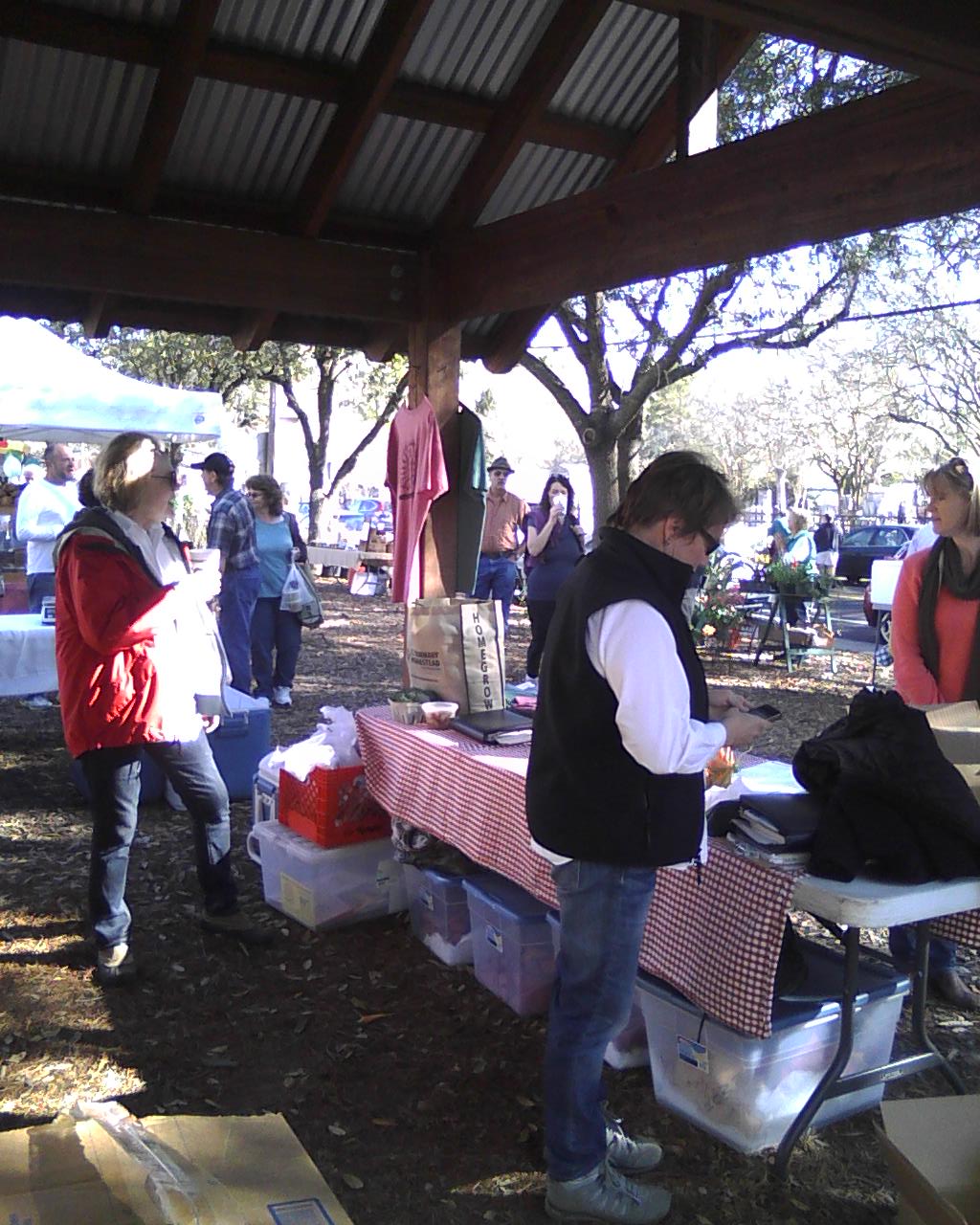
Jan (in vest) is the long time market manager and has a great attitude about her rural parish seat farmers market. Her sister Ann (in the red jacket) helps with logistics and announcements.

a few of the vendors at the St. Paddy’s weekend farmers market in Covington LA.
I’ve always been very proud of the very active way that my old workplace promoted FMNP in Louisiana. Since FMNP’s inception in Louisiana, MU’s markets have been at the forefront of expanding the program’s reach and redemption levels.
The FMNP incentive idea is a great one and allows seniors to continue shopping after their booklet was spent: they bring their empty booklet to the Welcome Booth and get 24.00 more in tokens to spend throughout the year, on any item.
With amenities like senior bingo, guided trips through the market and lots of assistance from staff, senior numbers continue to grow (by more than a thousand seniors!) at all three of their markets and their Field Note shows how the staff made it happen. Medium to large markets can certainly benefit from this report.
Like most Americans, New Orleanians too celebrate St. Patrick’s Day, although here in New Orleans we also celebrate St. Joseph’s Day. There already was a parade through the Quarter in St. Joseph’s honor and March 19 (St. Joseph’s actual feast day) will be quite the day for viewing of the altars throughout the city.
The tradition, which is Sicilian in origin but carried on locally by Italian-Americans and people of all nationalities and faiths, includes baking cookies and cakes and preparing foods for the altar. According to a legend, a drought and famine during the Middle Ages caused much suffering in Sicily. People prayed to St. Joseph, the husband of Mary, and promised to thank him with food altars on his feast day, March 19, and give away the food to all. Supposedly on midnight of March 19, it started to rain and broke the Sicilian drought. Many now create altars to thank St. Joseph for their personal prayers as well.
Over the years, the Crescent City Farmers Market has done many altars, with local media legend and Slow Food Chapter founder Poppy Tooker leading the design and collection of the goods. At least 3 altars have been created to be viewed on market day and one even included 19th century prayer benches borrowed from the Ursuline nuns who are the founding order of the city and have been here since the 1720s tending to their duties which includes their venerable girls school, the oldest operating Catholic school in the US.
The altars are found in churches, businesses and homes throughout the city and when you leave after viewing, you will receive a fava bean. The fava bean will bring you luck throughout the year. Part of the tradition requires that no money be spent on the altar, so its creators must beg for all items. Once the day is over, the altar is broken down and its content donated to the poor.
St. Joseph’s Day has another connection to food: it is also traditionally considered to be the last day to plant summer tomatoes for this region.
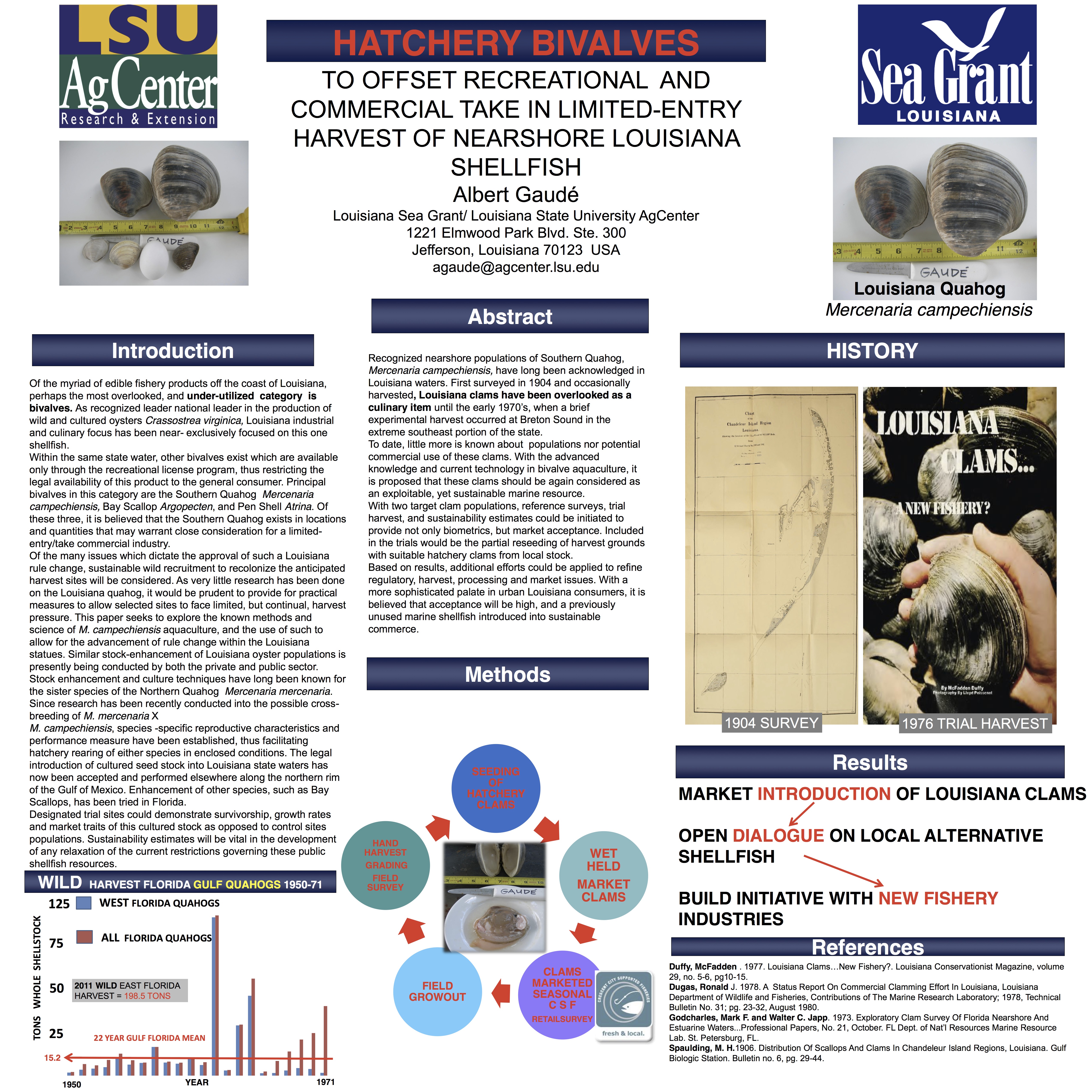
Fisheries Agent Rusty Gaude has long advocated for more production of the Southern Quahog, Mercenaria campechiensis and sees it as a possible new direction of direct marketing to offset the reduced output of oyster production in Southeast Louisiana. He has served on the New Orleans farmers market board and is advocating that the bivalve test be carried out as part of the Crescent City Supported Fisheries project. This project is done during Lent each year, where Crescent City Farmers Market shoppers can preorder a bag each week of seafood caught by the family fishers at the market.
Here in New Orleans, we have one of the largest Vietnamese communities in the US, although few non-Vietnamese enter it. Centered in New Orleans East, it started as a refugee settlement of 2 North Vietnamese fishing villages that had resettled in South Vietnam after the Communist takeover. Those villages then left Vietnam after the fall of Saigon and were brought to New Orleans from refugee camps by Archbishop Hannan in the mid 1970s.
The largely Catholic community (the Buddhist Vietnamese community is mostly settled on the West Bank of New Orleans) runs the gamut of socio-economic statuses from low-income rentals to middle class stability all of the way to large homes in cul-de-sacs. They even have a traditional market on Saturday mornings from 6 am til 8 or so, with elders squatting behind their produce, arranged on blankets or bamboo mats on the ground with the church holding a place of honor in the middle of it all.
New Orleans East was hammered hard by Katrina, both with high winds and water. It is surrounded by water and therefore although a perfect home for the fishers who dock their boat at their door or at a commercial dock down the street, it is a cruel place during storms. Of course,the rebuilding was difficult and without a major fundraising and political push from the activist priest of the church Father Vien, the area would not have rebounded so quickly. Interestingly, Father Vien is no longer in the parish; some rumor that he was removed for too much media attention while fighting (what he called) BP’s paltry settlements that did little to rebuild the fishing communities after it was destroyed by the spill.
In any case, the community HAS rebounded and seeing it during Tet festivities is always a treat. If you get a chance to come to New Orleans, ask me the way to Alcee Fortier Blvd. so you can see the village for yourself..
Until then, here is a short video (featuring the aforementioned Father Vien) that I did while working at MarketUmbrella that tells some of the Vietnamese history in New Orleans:
Tet New Year Festival starts Friday at Mary Queen of Vietnam church | NOLA.com.
Just to show how important food can be to a good campaign. This report shows what it takes to become Mardi Gras royalty in an interview with the 2013 Zulu King, Cedric Givens.
Mardi Gras 2013: Becoming King Zulu takes a little campaigning and seafood – Video | NOLA.com.
And Happy Mardi Gras everyone.
One of the 35 or so short films I did for MarketUmbrella a few years ago to show the resiliency and enterprise in our farmers, fishers and markets. This one was designed for new vendors to watch so that they could understand what “setting up” at the market meant.
All are available on YouTube.
Another great idea from my hometown market, Crescent City Farmers Market. They have come to the realization that their annual fundraiser takes so much energy and time away from their markets and in a very busy holiday event season, has a limited return. Truly, for an non-profit of their size to do these type of events and make less than 20 grand means it’s not usually worth the wear and tear on the market community. Some markets see their event as their educational event each year, and if it’s used to expand the reach of the market as well, then the return can be less. But for a market like CCFM, which is well-known already, going another way to raise unrestricted income seems appropriate.
Instead, they have worked with some of their close supporters and vendors to offer skills and experience for a price. The list is great and should shake out some good cash for the markets.
Always innovating over there at Market Umbrella…
I’ve written about Jenga Mwendo before. She is a dedicated activist for lower 9. This idea is a fantastic one and one that I’ll make sure to support.
Makin’ Groceries in Lower Nine | NolaVie – Life and Culture in New Orleans.
In an email today, I referenced the birth of the New Orleans sandwich that we call the po-boy, so I thought I would share the story more fully. The po-boy is a french bread sandwich loaded with seafood, meat or believe it or not, potatoes and gravy inside. The origin of this sandwich has to do with the streetcar strike in New Orleans in 1929: baker John Gendusa and restaurant owners Bennie and Clovis Martin made this sandwich and sold it as cheaply as possible to its customers and gave it for free to the “poor boys” on strike.
The telegram that the Martin Brothers sent the strikers is legendary in New Orleans:
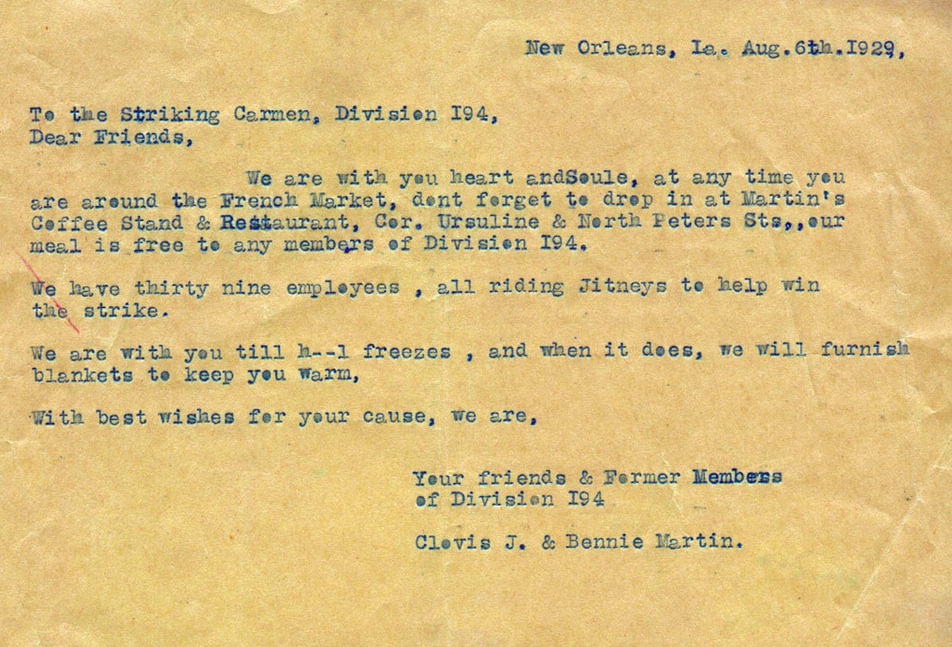
Remember how the food world can support larger issues as an inspiration or simply as an economic haven for those on the front lines. Lucky for me, po-boys are still available everywhere in New Orleans, although the Martin Brothers restaurant closed in the 1970s: however, the Gendusa Bakery remains one of our beloved French bread bakeries in the city still.
Outlying areas update:
Middendorf’s in Manchac, home of the best catfish in the region reopens less than 2 weeks after being submerged in water. The Middendorf story is amazing-owners Horst and Karen relocated there after damage to their French Quarter restaurant from Katrina.
http://www.wwltv.com/news/local/northshore/Although-storm-surge-damaged-Middendorfs-eatery-opens-two-weeks-later-169493016.html
Unfortunately, the news in Braithewaite is not as good for our fellow citizens and citrus center:
more bad news
As reported earlier, the first market post-Isaac on Saturday was low-keyed but a real boost to the spirits. Much of the city was still without power and starting the post-hurricane work in the form of repairing tree and house damage. My friend and I biked from MidCity through Treme to the CBD. The market was small, small enough to allow those vendors that came to be able to work off the back of their trucks, but it was well designed. The only other Saturday market that exists in the city did not open so this was the only game in town for food, conviviality and news of farmers and fishers. These vendors have been through weather drama before, so when you come to their table and raise an eyebrow, they know to come to you and give you a short breakdown of any damage. Board President Margaret Beer was not only there as always on a Saturday, but making a point to ask each vendor how they did and taking a minute to discuss with me what she was going to do to comfort the family of the recently passed Jim Core, anchor farmer. Doing her job in other words.
After shopping and talking and visiting with everyone, we went across the street to the chocolatiers/coffeehouse Bittersweet Confections. Bittersweet is the first previous market vendor that has opened a storefront near a market. The owner had applied to be a vendor many times at the farmers market, but the committee (and myself, as the acting market manager at the time) had long worried about how the chocolates would last in the heat and other challenges of an open air market, so had regretfully turned her down more than once. Lucky for her, we began a winter fair trade/handmade/ recycled goods market that we called “Festivus, the Holiday Market for the Rest of Us” in 2003, where she was finally accepted as a vendor. Her goods and retail demeanor were so outstanding that the farmers market reconsidered and allowed her to come as a vendor, which has led to an well-loved full time business. This very Saturday was the first time I had spent time in her new location which is directly across the street from the Saturday market and the crush of market shoppers having coffee and waffles in their welcome a/c was a delight to see.
One of the faces in the crowd was Robin Barnes, who has become a very dear member of the market community since her arrival in Louisiana post-Katrina. She originally came to help with recovery as VP of an organization called Seedco Financial Services, which had helped small businesses find new locations, funds and a plan in post 9-11 lower Manhattan. Her insight and deep empathy for the plight of small businesses after disaster led her to Louisiana and to the market community where she was instrumental in the recovery of most of the family fishing businesses in our lower parishes and to African-American owned businesses throughout the city. Since her early days living in a sublet out of a suitcase, she has bought a house, made a life in our city and even named her lovely orange cat Satsuma L’Hoste after one of her favorite products and market families!
Now a Executive VP at GNOInc, she continues to find ways to include market small businesses in her multi-parish fight for economic viability. Seeing her this Saturday means that these stories will be shared with government leaders and more good advice will be given to the market from one of the few regional leaders we have.
The Tuesday market was slightly bigger, and included seafood for the first time since Isaac. 4 Winds Seafood was there (1 of the seafood vendors out of the regular 3) and said she did fine. Of course, she did fine because she and her family have moved away from their pre-Katrina parish St. Bernard to a slightly higher one (St. Tammany) where they are not in the flood-prone zone in their new parish. Also, her husband Ray had docked the boat well before high winds came. She brought some shrimp that had been harvested right before the storm and kept frozen with generators after freezing directly after harvest. This is how most of our shrimp is kept: a good way to see it directly is to watch one of the short videos I made while at marketumbrella.org under the Go Fish project name:
GoFish
I also noticed that the markets were having one of their market incentive campaigns, probably for SNAP users. The organization runs their matching programs very artfully I think: they work closely with their farmers product timing and their event plan to maximize small pots of money to bring new shoppers in and get some return visits in quickly. They usually run 4-8 different incentive campaigns each year and this year, even used Groupon to raise money for one of those campaigns. The Groupon funded the kids activities at the market-how it ties into incentives is that the organization runs one of their incentive programs year-round for kids; called Marketeers, kids receive a birthday postcard in the mail and they bring it to the market booth and get a 5.00 token. The Marketeers have an event on the first Saturday of every month.
Thursday’s market was also small but as welcome as one or two of these vendors only come to Thursday’s market so it was the first time they could check in. This is the smallest of all of the markets and still struggling to get its critical mass, as it’s the most recently opened (only a few years). Still, it’s across the bayou from my house and I appreciate the chance for a 3rd market day so always try to support it.
I ended the market week with cilantro hummus, Mississippi apples, Mississippi ground lamb, St. John parish tomatoes, St. Tammany baked goods and fresh watermelon juice, Mississippi goat cheese and fresh beans, Orleans parish peppers and honey and some strong CDM iced coffee. Now back to cutting those banana trees and picking up debris from the surrounding streets..
More news will slowly trickle from the lower parishes over the next few months, but only if someone is actively seeking that information. Of course, the market community will be among those staying in touch. I’ll be sure to share here too. Meanwhile, here is some early video from the edge of America’s land, Grand Isle.
Grand Isle
By Sunday last, we were all on edge but making the hard decisions. Because by Tuesday, we had to be where we were going to wait out Isaac. Isaac: the 2012 tropical storm, then hurricane that confounded all of the experts to its future path and strength and was unbelievably destined to make landfall 7 years to the day that Katrina came. So complicated and difficult Isaac proved to be to track that they were talking about retiring its name long before it hit land, which they only do when there should be one storm of that name to remember.
Later that day (Tuesday), when it seemed to make landfall in Plaquemines Parish with more ferocity than expected, bad news seemed sure to follow. In other words, someone in our watery region was definitely now going to have a big storm over them. The city has long feared a “direct hit”, or to be more explicit, a hurricane that came up the Mississippi River side of New Orleans. Lucky for us, the core strength of Isaac remained minimal and the track actually ended up slightly west of the city and the river. Unlucky for our region, this storm stayed put. Stalled more than once, dumping rain and punishing us with 60-80 mph wind for 48 hours. Imagine that formula.
“Shelter in place” is what the mayors call it when they don’t call for evacuation and want people to stay put and not expect that the city will open shelters. We mostly shelter in place for anything less than a Category 2 Hurricane. This one wasn’t even going to surely reach hurricane strength, so the cost and strain of evacuating 500 miles or more is unlikely for most of us city folks. And for those who grow our food, it is impossible to leave since their livelihoods not to mention animals would stay while they left…
For only a few of us, electricity stayed on throughout and allowed us to keep everyone that was literally in the dark up to date. Here is what I remember:
For the first 24 hours, all the news was wind and rain and worry. Like many storms (including Katrina) the bad news can often come after the eye has passed and inhabitants feels safe. Or, bad news can be much farther out from the center with the rain bands that come off the right upper quadrant of a storm which are often the most devastating. Hurricanes also come with storm surge from its days gathering speed on open water which is often the worst of the damage when it reaches areas like Lake Pontchartrain, which is actually an inlet of the gulf and not really even a lake, so you can see why the concern…..
So, by Thursday midday when the city was mostly over the worst of it, and impatiently waiting for the electricity lottery to be started up (oh, that is a WHOLE ‘nother story), the news came in that levees below the city were compromised (not the federally managed river ones, but interior levees) and when I heard Braithewaite, my blood ran cold. Citrus vendors that have been with the Crescent City Farmers Market since its beginning were possibly in trouble.
The video of boats with rescuers using axes to rescue people from their attic was so reminiscent of Katrina, I found myself sobbing, remembering 7 years ago to the day the arrival of Katrina. (Although the levee breaks of that terrible week were not known for a day or even two after the landfall of that storm, because authorities were not paying close attention to the water protection system!)
Slight difference-this time, it looks like those stranded were (mostly) being found in time, I firmly reminded myself. By the way, Google Plaquemines Parish President Billy Nungesser to hear about what a real character and leader does during times of disaster…
That water rose to the tops of raised 2 story house down there and continued throughout the day, while gubernatorial talk of deliberately blowing holes in levees to reduce the pressure on flooded areas was seriously discussed and finally decided in favor. If you haven’t seen “Beast of the Southern Wild”, do so to see the artistic (albeit anarchistic in that case) explanation of this idea. Actually, see that film for one of the best examples of the environmental destruction that coastal people handle and still overcome to maintain and build community. Just see it please.
Then Friday we started to hear about the North Shore getting the rain and wind that they had been waiting for-those outer rain bands on the right hand side of a hurricane. Storm surge did as promised and pushed the Gulf and Lake Pontchartrain into the small rivers and creeks north of the city. This area is where the majority of our farmers live and grow the food to bring to the city and its markets. I had been texting the founder and director of the New Orleans markets Richard McCarthy throughout, who shared news as he received it from his farmers and fishers. When the dam in Percy Quin State park in Mississippi (due north of many Louisiana farmers) was compromised, the folks along the Tangipahoa River were told to leave and leave quickly. Farmers dot the towns in that parish, although most had high ground. Nonetheless, crops were no doubt being flooded and we texted our concern back and forth. News remains limited at this point, as flood waters continue to rise actually as of this writing, Saturday evening.
He also shared with me the (expected) news that they would open the Saturday market with whatever vendors could make it. “Cheese and popsicles” is what he gallantly promised. Much more than that showed up, meat, milk, cheese, honey, beans, tomatoes, squash and apples….
A lovely welcome back to those who made it to Girod and Magazine, as for those who made it to the Red Stick Market in Baton Rouge and to the Covington Farmers Market on the aforementioned North Shore on that same market day. And for those who we have not yet been seen, the market community awaits your return.
Continued soon….
 Helping Farmers Markets Grow
