Racial Justice webinars

One of the areas in which farmers market organizers need to examine their own biases and be open and honest about the barriers in our part of the movement is on racial equity. We should tip our hat to the community farm movement, because these issues are being raised in many more communities that work on urban ag and with immigrant farmers but unfortunately, in my experience it happens much less often in the general farmers market movement.
We can begin to learn how to address issues by attending webinars like this. This series was brought to my attention by my colleague Oklahoma farmer, market organizer and food activist Demalda Newsome who is leading the way in her own community and also throughout the U.S. as a board member of the Community Food Security Coalition and SSAWG.

Webinar Series Registration
Register now for both sessions, and save $5 per webinar!
“Changing the Conversation on Race”
March 15, 1pm ET/10am PT
Avoid circular conversations around race that only lead to frustration and hurt. This session will help you move the discussion around racial justice past stalemate and towards one that’s more productive.
Presenters Kai Wright, Editorial Director of Colorlines.com, and Terry Keleher, Director of ARC’s Racial Justice Leadership Action Network will use examples from the award-winning Colorlines.com on framing sensitive topics.

“Taking Real Steps Towards Racial Justice”
April 19, 1pm ET/10am PT
Most people want to eliminate racism, but are not sure what to do or how to do it. Racism often occurs without consciousness or malice, but creating racial justice requires clarity and methodology.
Presenter Terry Keleher, Director of ARC’s Racial Justice Leadership Action Network will draw on examples of legal, policy and budgetary initiatives that have changed communities across the country.
In this interactive training, you’ll get practical tools to:
Talk effectively about racism
Keep conversations constructive and productive
Move from conversation towards actions and solutions
In this webinar, you’ll learn how to:
Counteract unconscious bias
Identify everyday opportunities for advancing racial justice
Move from institutional racism to “institutionalizing racial equity

If you want even more in-depth learning, save the date for November 15-17. ARC’s 2012 Facing Race Conference brings the most exciting thinkers, leaders, and activists together in Baltimore, MD. Early Bird registration is open now!

Link to registration

“Perception, taste and people’s priorities in unexpected contexts”

‎
This seems appropriate for us to think about as we work to change perceptions in the food system. I have found that some shoppers have an elevated perception of the food for sale in our pop up cities (“the food here is so incredible!”), and some think the food must be less than what the supermarkets have (“why not take over a store so you don’t have to be in a parking lot?”) Over the years, I have watched markets become experts at providing the right mood for the proper staging of their vendors products.

“In Washington DC , at a Metro Station, on a cold January morning in 2007, a man with a violin played six Bach pieces for about 45 minutes. During that time, approximately 2000 people went through the station, most of them on their way to work. After about four minutes, a middle-aged man noticed that there was a musician playing. He slowed his pace and stopped for a few seconds, and then he hurried on to meet his schedule. About four minutes later, the violinist received his first dollar. A woman threw money in the hat and, without stopping, continued to walk. At six minutes, a young man leaned against the wall to listen to him, then looked at his watch and started to walk again. At ten minutes, a three-year old boy stopped, but his mother tugged him along hurriedly. The kid stopped to look at the violinist again, but the mother pushed hard and the child continued to walk, turning his head the whole time. This action was repeated by several other children, but every parent – without exception – forced their children to move on quickly. At forty-five minutes: The musician played continuously. Only six people stopped and listened for a short while. About twenty gave money but continued to walk at their normal pace. The man collected a total of $32. After one hour: He finished playing and silence took over. No one noticed and no one applauded. There was no recognition at all. No one knew this, but the violinist was Joshua Bell, one of the greatest musicians in the world. He played one of the most intricate pieces ever written, with a violin worth $3.5 million dollars. Two days before, Joshua Bell sold-out a theater in Boston where the seats averaged $100 each to sit and listen to him play the same music. This is a true story. Joshua Bell, playing incognito in the D.C. Metro Station, was organized by the Washington Post as part of a social experiment about perception, taste and people’s priorities. This experiment raised several questions: In a common-place environment, at an inappropriate hour, do we perceive beauty? If so, do we stop to appreciate it? Do we recognize talent in an unexpected context? One possible conclusion reached from this experiment could be this: If we do not have a moment to stop and listen to one of the best musicians in the world, playing some of the finest music ever written, with one of the most beautiful instruments ever made… How many other things are we missing as we rush through life?” YouTube

Kitchen Gardener pods

Markets can do well to encourage kitchen gardeners to socialize and find ways to encourage share information – maybe even to curate those discussions at the market.

kitchen gardeners

Vendor neighbors

Yeah, there are some differences between art vendors and farmers market vendors, but still, there is something here for all market managers to understand.

Food Swap

Another way for small markets to grow their social time might be to encourage a small (member-only) food swap once a month. If controlled well, it could be a boon to community markets that lack the critical mass of shoppers so far.
Food Swap Network

Occupy our time

The latest newsletter from the Farmers Market Coalition (FMC) came out last Wednesday and it strikes a whole bunch of the same notes as the orchestration being played by hundreds of thousands of individuals in Zuccotti Park and many other public spaces around the world these days.
FMC points out that economy of scale arguments (“Get Big or Get out” for those who know their post WW agriculture history) and words like efficiency and scale have (for years) been used against those of us who prefer to work towards diversity, shared wealth, sufficiency and innovation in our movement. And that human-scaled movements that work are messy and hard to quantify or even to see, but there they are, in booking places to stay or quietly sharing knowledge…
FMC inspired me and probably lots of you too while they reminded us to take the time to measure success in our world in accordance with the values we fight for and, as importantly, to keep at it. Sometimes those words are necessary even for zealots like food organizers…
FMC Newsletter

Immigrant farmers

“Mr. Kim, who witnessed mass starvation in Cambodia, losing a brother, refers to his two-acre plot as “my plenty.” His fellow farmer Sinikiwe Makarutsa grew up in Zimbabwe and now grows maize on land rented from a local church. She made enough money to buy a tractor and rototiller.”

NYT

Time Banking for Markets?

Next week, citizens in New Orleans will hold their first Time Banking informational meeting. For those new to the idea:
here are hundreds of TimeBanks around the world. TimeBanking is based on the belief that our communities work better when all of our contributions are valued. It rejects the notion that we belong in separate classes of “givers” and “receivers” and establishes a way to reward all types of work — caring for our children, elders, and others who need it, building community, helping out our neighbors.

TimeBanking is about spending an hour doing something for somebody in your community. That hour is counted as a TimeBank Hour that you can spend on having someone in the network do something for you. You earn TimeBank Hours for each service you perform. Instead of members “owing” the one person who helped them individually, we can choose to give and receive the many talents and skills of all the members.

TimeBanking connects you to the best in people because it creates a system that connects unmet needs with untapped resources. It provides ways for us all to contribute and benefit.

Timebanking can be a very effective way to bridge gaps across different demographics, bring people together as a community, build a resource base to solve problems or realize dreams, connect people with needed goods and services, and give people a way to feel valued and do what they like to do.
This seems like a natural fit for a market to take on for their own community or maybe even for the larger community they reside in. Anyone out there who has a Time Bank in their market, do let me know…

And for those who want more information, check out:timebanks.org

Santa Rosa dispute

Wow. This article gives some information on a dispute between vendors and management at a California market that has, sadly, gone to court. The article (which certainly needs more information from both sides) and the ensuing comments show that this issue has been coming for a while in this community.
Long ago, when I was learning non-profit management, I proudly related to my supervisor at the end of the day just how I had stopped an argument between 2 senior staff while the entire staff was driving to a site. I expected congratulations, but instead my excellent boss said to me: “Well, I’m glad you stopped it, but I would expect you to have seen the argument escalating long BEFORE that point and steered the conversation and tone to other directions before it got to inflammatory words that now everyone remembers throughout their day. So, next time plan ahead and try to orchestrate good interactions from the beginning. It’s your job to give everyone the best chance to succeed at their job and that also means reducing tensions that are unnecessary.”

Good advice still.

Santa Rosa Market dispute

Measuring happiness

article

Markets as safe havens

In the Alley of Straw Sellers:

Afghan market

Diversity is the key

Once again, the social construct of our larger state or nation can reflect the work we are doing in our market communities. The question of why we have seen a reduction in crime is studied in this article. Recently I read (from Freakonomics author Steven Levitt and others) that when crime rates first began to fall in the 1990s, they pointed to the passing of Roe V Wade as causality, believing that children not growing up unwanted and without resources reduced later criminal behavior. This piece is pointed out in the article, along with other theories.
However, this article adds the argument that increasing diversity through the encouragement of a more varied ethnic, racial and demographic population in our cities and towns is the more direct cause of crime reduction.
The diversity issue is key for markets too, although probably not through the tabulation of crime stats! Still, if we add trust and encourage everyone to come to our markets, we’re bound to make more dynamic places that thrive.
The Atlantic

A simple way a market can help

The Crescent City Farmers Market in New Orleans has had a disaster this week; their iconic dairy farmers, Warren And Sandra Smith of Smith Creamery in Mount Hermann, LA had a huge explosion on the farm. Luckily, no one was hurt including the cows) but the damage to the processing plant is massive and will take months to repair.
Besides being the conduit for information for the community, the market staff is collecting donations and getting signatures on a card for the Smiths. The table is manned by community advisory and board members of the market, and if someone gets there early enough, they can also have a free I (heart) Creole Cream Cheese t-shirt (which was being phased out of the market merchandise and so has come in handy!).
The important thing is the channels of communication are kept open by the market and any media or support requests can be channeled through or facilitated by the skilled staff on behalf of the farmers. Therefore, the time the Smiths spend answering the phone, explaining their plan and deciding how and when to accept donations is reduced and instead they can spend their time rebuilding.
Once again, a market, its shoppers and farmers share a social contract that is not written down but it understood and expanded when needed.

I Heart Smith Creamery


Smith Creamery Facebook page

Fleas welcome

Flea markets are fascinating to people watch at and someday we’ll figure out how they and open-air farmers markets are related.Like any public market geek, I follow the flea market news regularly and years ago, set up at a venerable old one in Ohio (Hartville for those of you in Buckeye Land). Wow, was that fascinating…. The pre-dawn culture was even more traditional than any farmers market I have watched. Of course, that market had been running for over 60 years…
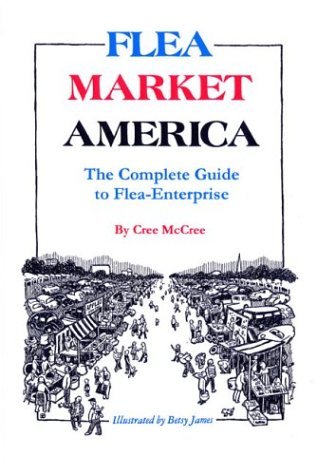
It is also my honor to count among my friends, Cree McCree author of “Flea Market America” and a regular art and flea market maven here in New Orleans. (I call her Cree McCree, Godmother of Flea).

Cree McCree's book. available for purchase everywhere


She was a prized Festivus vendor of mine (when I ran both farmers markets and a holiday fair trade market from 2002-2007 for marketumbrella.org). She is always working to find new venues and ideas to get more street vending out there.
Maybe we’ll even see a true producer-only farmers market and a criteria-based flea market in the same location with the same manager. Why not?
Their missions may be different from farmers markets, but its easy to see some similarities:
1. Many flea markets have rules about products that can be sold.This is often to keep out dangerous goods, but in any case, it speaks to the need for a manager/organizer curating the deal.
2. They have return shoppers and regular vendors.
3. There is a decidedly social air about them.
4. They attract a wide range of shoppers.

Here’s an example of one that works to engineer a total experience:

Uvalde Market Days will be open for shoppers on June 25th, 2011

It is one of the most unique open air markets in southwest Texas
June 15, 2011- Hundreds of dealers showcase their merchandize in tree shaded park. The visitors can enjoy shopping at Uvalde Market Days in the afternoons.
Visitors can enjoy music while they shop. The dealers at the market will be displaying huge variety of arts and crafts, plants, jewelry, wearable, collectibles, home décor, antiques, carpets, kitchen accessories, clothes, hats for men, women & children and lot more.
Uvalde Market Days is open for public on every fourth Saturday of the month.
It is open from 10 am to 5 pm.
It is located at:
Uvalde Plaza
Main Street And North Getty
Uvalde, Texas
Parking and admission is absolutely free.