Marché international de Rungis

Here’s a sneak peek inside Paris’ massive market with 450 types of cheese and more.

You’ll also notice a box of carrots, scrubbed clean, but then sprinkled with a fine dusting of dirt for aesthetic reasons — to reflect the increased demand for organic products. “Parisians buy with their eyes,” one vendor explains.

You can find everything at Rungis, even exotic foodstuffs like ostrich, zebra and crocodile. Interestingly, you’ll never see prices displayed at Rungis as they’re negotiated based on the buyer-seller relationship.

Traceability is really important — you know exactly where your products are coming from — and trailblazing initiatives include an impressive recycling program which provides energy and heating for Orly airport.

Beyond the magnificent goods, you’ll marvel at the work culture. Just under 12,000 people work at Rungis and it’s a jovial, jolly place. Folks love what they do, and you can see merchants socializing over coffee or verres de vin (glasses of wine) in the early morning hours. In fact, the café Saint-Aubert outside the poultry pavilion sells the most cups of coffee in France: 3,000 a day.

Source: Marché international de Rungis

What Data Can Do to Fight Poverty – The New York Times

I wonder if this research can is useful for food assistance incentive strategies: If allowing shoppers to use their incentive for any item at a market (rather than a hard commitment to just F&V) would ultimately create a more active (regular) marketgoer? And what about the search for food system leaders?

IF social scientists and policy makers have learned anything about how to help the world’s poorest people, it’s not to trust our intuitions or anecdotal evidence about what kinds of antipoverty programs are effective. Rigorous randomized evaluations of policies, however, can show us what works and what doesn’t.

Public primary school students were given the chance to deposit money weekly into a lockbox, and they were informed that their accumulated savings would be returned to them at a school-supplies fair at the beginning of the next trimester. Schools were randomly assigned to one of three groups. In the first group, students were offered a “hard” commitment: Their accumulated savings would be returned in the form of a voucher that had to be spent on school supplies. In the second group, students got a “soft” commitment: Their savings would be returned in cash, and could be spent as they wished. The third group of schools continued as normal, serving as a comparison group whose savings and spending money were also observed…. Students who got their savings back in cash saved more, and when the program was combined with parental involvement (which was also randomized), the students also bought more school supplies and achieved higher test scores.

The researchers randomly assigned some rural communities to receive advertisements for the jobs that announced opportunities for career advancement, whereas in other areas, the advertisements were silent on this issue. Contrary to expectation, the researchers reported in a working paper released last year, those recruited with “career” advertisements were more qualified and scored higher on exams during training, and also exhibited the same degree of emphasis on community service. The “go-getters” also outperformed the “do-gooders” on the job, seeing the same number of patients in their health clinics while conducting 29 percent more home visits and twice as many community health meetings.

These two insights — committing to cash savings, recruiting “go-getters” for community service jobs — are just the tip of the iceberg. We have found that pairing experts in behavioral science with “on the ground” teams of researchers and field workers has yielded many good ideas about how to address the problems of poverty. Hope and rhetoric are great for motivation, but not for figuring out what to do. There you need data.


Source: What Data Can Do to Fight Poverty – The New York Times

In the U.S. Suburbs, More Americans Need Food Assistance 

The same outreach lessons that our anti-hunger partners must learn to reach their target population in the suburbs can be very helpful for market organizers. And of course, for our goal in reaching more of that 99.97% who are not yet buying regional food regularly, organizers need to better understand those areas that are not yet replete with markets, including suburbs.

Nationally, according to a September report from the advocacy group Fairshare, hunger increased more rapidly in suburbs than in cities during the Great Recession. Between 2006 and 2013, large cities saw the number of students eligible for free or subsidized lunch rise by 5 percent. In the suburbs, that number grew by 11 percent.

The shifting demographics of many of those zip codes also needs to be considered when opening new markets. Some suburban census tracts are seeing high increases in newly arrived residents and as a result, becoming more racially diverse.

The more than 6,500 suburban communities and 22,000 census tracts in the 50 largest metropolitan areas are divided into four types based on their racial composition and urbanization, and data for the period 1980-2010 are used to examine racial change and to evaluate the stability of different types of communities. By 2010, just 39% of suburban residents in these metropolitan areas lived in “traditional” suburbs-predominantly white communities or developing exurban areas. This is much lower than in 2000 when 51% of suburban residents lived in these types of suburbs. At the same time, the percentage of suburban residents living in racially diverse suburbs increased from 38% to 44%, and another 17% lived in predominantly nonwhite suburbs by 2010.

Transportation is the primary challenge of getting food—and anything else—to the poor in the suburbs. “No one walks in Rockland County,” Serratore said. In any case, the distances are too far. More than 4,000 patrons of People to People, for example, come from Haverstraw, a faded industrial town on the Hudson, nine miles north of the pantry. “Rent comes first,” explained Charleen Borchers, a Rockland resident who works at McDonald’s. “Car insurance comes second. Then, at the bottom of the list, is food.” Some don’t have cars, so they come in taxi cabs. What might seem an indulgence to an urbanite is a necessity in the suburbs, even if it cuts into the money saved by getting free groceries. Others carpool with family or neighbors, or take the bus.

Source: In the U.S. Suburbs, More Americans Need Food Assistance – CityLab

Lucky’s Market looking for niche in Lexington grocery market by demystifying good food

For those about to head to the SSAWG conference this week, you might want to check out this store…

Source: Lucky’s Market looking for niche in Lexington grocery market by demystifying good food | Lexington Herald-Leader

Drilling down into what solutions are right for you

One of my “side” jobs (meaning outside of being FMC’s Senior Research Associate some hours per week) is working as an independent consultant with individual markets and with networks or state associations on their projects. Often, this comes through FMPP funding or through another grant meant to increase capacity for that market.

This past weekend I went and worked with one of those projects. The board of the market took 3 hours from their off-season Saturday to discuss the strategies they have for increasing their capacity. This funded project (I’ll let them decide if they want to name themselves in this post) has 3 parts: to create a paid position for a market manager and to increase vendor and customer participation.

So to assist them with that thinking, one of the tasks was to lead them in an exercise that they will continue in the next few weeks on their own to decide what and why and how they want to do.

The exercise called Abstract Laddering is one of the human-centered design exercises that I saw and tested at a training in Pittsburgh a few years back, thanks to Knight Foundation funding given to FMC. The training was designed and led by the folks at Luma Institute and if you can convince a funder to pay for your way, I promise it is worth it. The course is offered in different cities and is an engaging and practical course.  Additionally, they offer their materials for purchase which are easy to use, even for a novice. This is similar to the Ideo firm whose work I have followed for some time and also offers their materials which I have read and employed on my own. They actually offer their courses online for much less than Luma but not having taken them, I cannot vouch for the training.

Human-centered design is an excellent way for markets to strategize and to include more people in the decision making. At Luma, the tools they work with are in 3 stages: “Looking, Understanding and Making” and each of those stages has a set of exercises to choose from which allows for dozens of different combinations. The main point to make about this type of design is that it is meant to be iterative, which in design means to allow constant input to alter the course of design and even to go back to square one if the design is not working for people who will use the solution.

The Abstract Laddering exercise is mean to help “reconsider a problem statement by broadening and/or narrowing its focus.”

Markets write lofty goals that are often quite broad into their grants.  This weekend, we focused on one of those: “to expand product variety and amount” which is a typical market goal. However, there are many things to consider in this goal, including what products, and how to encourage this.

The exercise has you write the problem to the right in the middle of a sheet of paper and draw a ladder on the left extending up and down. The up is Why and the down is How.

It is easy to see that this allows for a communication message to emerge in the How but it also encourages a team to expand their question if necessary. What if the expansion of the product goal requires the market to work on policy changes in their city or state? Or if to encourage their vendors to increase their products means resource development for product development is necessary?

The other way allows a team to narrow the focus of the problem  through open discussion. What kind of products? Immediately a board member asked if everyone thought this meant fruits and vegetables only or should they consider valued added or even producer crafts. That question is exactly why this exercise can be helpful.

Using post it notes, they each wrote and placed their ideas for how and why and once done, had a good start to that goal. I promised to transcribe their sheet and then they may create steps and assignments (WHO does this is also to be considered) for How, and for Why to see the many ways one could see this problem.

This entire exercise took less than 30 minutes and offered the board a simple path to designing a solution to their stated problem. They will continue this for the other stated goals and out of that, find a set of steps for each goal that will work within their current capacity.

And if it turns out that their solutions are not to the scale and pace of their market, why then we have other exercises to do that will help them get there.  After all, my goal is to assist them in creating a system that allows for clear and transparent decision making; human-centered design principles certainly help me in that work.


A summit for us: Atlanta 2016

A whirlwind of a week in Atlanta with Wholesome Wave and its “surfers”: markets, market advocates and food system organizers. Held at the Emory Conference Center in Atlanta GA, just down the road a block or two from the CDC offices. WW did a great job with the week: well-organized, great food and drink (thumbs up for the smoothies available each day) and plenty of space for networking and meetings. Atlanta was lovely and the rare off-site food and drink I had was excellent, but I gotta say that the traffic is as unholy of a mess as I have experienced in any US city. Talk about needing a quality of life intervention!

Highlights for the Summit for me included:

The WW Georgia market shopper who turned to good food to beat her cancer; she was charming in telling a very personal story on a panel and brave to share her still-emotional reaction to using SNAP, even while sharing her appreciation for the program.

Organizing for State Nutrition Incentive Policies : all of the presenters had unique input on their state’s strategy: Ecology Center (CA), Experimental Station (IL), Maryland Farmers Market Association and New Mexico Farming Market Association. This group: Martin, Connie, Amy and Denise have a lot to contribute to any discussion of how to move the dial at the state level.  Check out their varied work on their respective websites and if you have a chance to buttonhole any of them at a conference, tell them I told you to do it. And the short answer is to have a creative and flexible strategy that includes how to pay for it and a constant champion in your statehouse.

Clinic-Community Initiatives-Pathways to Sustainability: what I got out of this session was one of those unintended consequences: the analysis that MANNA has done of their program as a handout was one that responded to a question that our new FMC Research and Education Director Alex Canepa had just been asking earlier that day: can we get data that actually indicates positive health changes from medical nutrition therapy  strategies that offset traditional medical costs? See the Examining Health Care Costs Among MANNA Clients and a Comparison Group report…

The Role of Technology in Supporting Nutrition Incentives: For those of us gamely working on technology solutions for markets that support the range of no-tech, low-tech to high-tech markets out there, this was an in-depth and honest conversation. I sincerely appreciated Darcy Freedman from Case Western Reserve University talking about how the tool is half of the puzzle; the TA is the other half.

Measuring the Impact of Vouchers at Farmers Markets: I think the title threw some people off this one as well as the description. This covered the evaluation being done by University of Delaware/CRESP and led by Allison Karpyn on the incentives and vouchers funded by WW. Her powerpoint is available to those who request it (check with them or with WW) and I’d recommend that you get a copy. Allison shared some of the early data and was game to listen to input from the attendees about what they thought about it so far.

Measuring Markets Economic, Ecological, Human and Social Capital: Of course I chose this one. FMC Project Director Sara Padilla led the show, but Jen Cheek also popped up to add some updates on how FMC is embedding this into FMSSG reporting and she managed the lively Q&A as I roamed the room and made some notes for later conversations based on those questions. We had hoped to role play some of the training materials/exercises that will be embedded within FMM in this hour, but the room, the late hour and the lack of actual market leaders attending meant a quick change to describing it only and instead spent time sharing our thoughts on the components of grassroots evaluation, which seemed to be a good choice.  As I shared later with the rest of the FMC team, I think grassroots evaluation work is evolving slowly but surely and our work in this area seems to be helpful to markets and to their partners.

The FMC team also spent some time with the WW evaluation team  (shout out to Katie and Elizabeth for finding the time between their many conference duties), continuing to find ways to streamline and support both portals without duplication. I can tell you we are all committed to that goal….

Lastly, I left feeling that I just saw and heard and met a whole bunch of people who are doing some excellent network level work in their states. It felt like it has only at a few moments in the last 10 years: that there is some sensible support for contextual strategies for increasing access at markets, and some help to use that support to change policies for markets and their direct marketing producers. But, also an awareness that there is danger in markets or networks in diving in the too-deep water before they are ready, before they have a plan for what this extra work is meant to do for their markets and how it will absorb it. Because what we know is to attempt that before examining the culture of the market or the willingness of the market leadership to invest years in this type of intervention is foolhardy*. I’d also point out how that the lack of production-side advocates in attendance to talk about how these strategies were changing regional food production (for the good and for the bad) jarred me slightly and I’ll hope for better participation at future summits.

(*…. for all of those uncertainties here is the process to change them:  market communities becoming true partners in the design of their projects, taking the time to work with their community in this process long before the funding starts, leading or sharing in the data collection process as well as in the analysis of that project and beyond that, being brave about seeking and sharing evidence of all of the market’s impacts. And if that is where your community is at, I can tell you that there are some people ready and willing to do just that, many of whom I just saw in Atlanta.)

IMG_20160112_115909

Technology session, FMC’s Jen Cheek asking another good question from the floor
IMG_20160112_131853

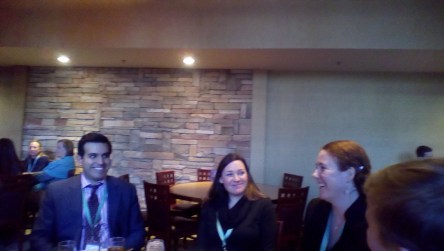
WW’s Katie Merritt, chatting with FMC’s Sara Padilla and Alex Canepa pictured. WW’s Elizabeth Atwell  (back of her head showing), Jen Cheek and yours truly also present

IMG_20160113_110038

Allison Karpyn’s incentive evaluation presentation

IMG_20160113_121713

FMC’s FMM presentation

IMG_20160113_122854

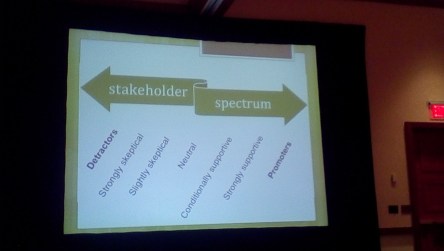
FMC’s audience involvement spectrum

IMG_20160113_144754

One of only 2 off-site meals, this one had with WW’s Gabrielle Langholtz who sang Hamilton the musical songs to the waiter. Not odd behavior if you know her…

IMG_20160113_145934

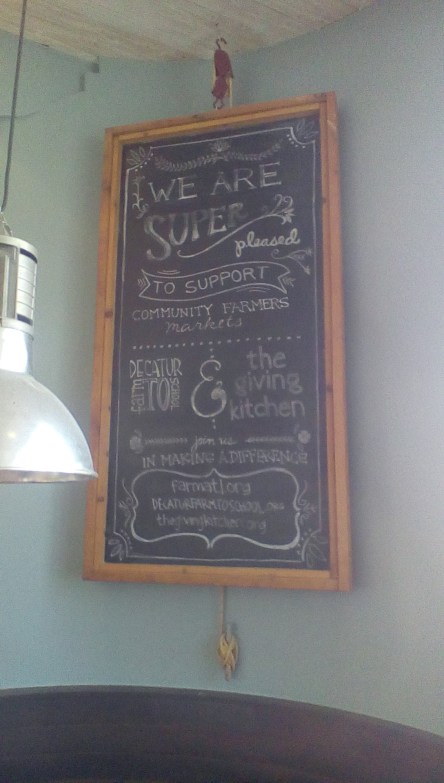
The food we ordered off that chalkboard menu; all great.

IMG_20160114_071034

The dog that came with my airbnb, Sadie, wondering why I am leaving so early on a cold day..


Atlanta

Like any market leader worth her salt, my North Carolina pal Salem told me on the first day of the Wholesome Wave Summit in Atlanta that she was going to check out two of the public market projects around town, the Dekalb Market and the Ponce City Market. Of course, I invited myself along immediately. Once done with the days sessions and networking, and with her smartphone barking directions at us, we finally found our way to the first without too many wrong turns as the twilight became evening.

The Dekalb market is actually titled “Your Dekalb Farmers Market” and is in its 39th year of operation. Still managed by the same husband and wife that started it as a produce stand, it is more than 100,000 square feet of sales space of produce, meat, seafood, herbs, cheese, beer and wine and even a recycling center. Whether farmers have much if any relationship with it is not clear, but certainly, it serves a respectable amount of diverse needs, including offering meat prepared for multiple religious and cultural requirements and a wide selection of herbs and oils for varied ethnic meals.

It’s only a few miles outside of Atlanta and easily accessible for the 7 days per week that it is open. The parking lot is large and well lit, with the lot and the market set off from the road by itself. Once inside, the signs are many and include warnings for no photography being allowed. So do note that the photos that I include here were taken inadvertently by er…someone else.

0111161855-00

Lots of nice tomatoes available and they do sell by box too, although the price didn’t seem like any break at that amount.

0111161853-00

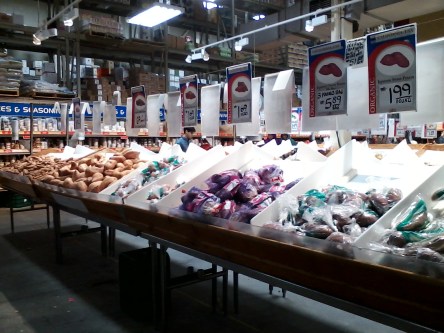
I counted 10 varieties of sweet potatoes

0111161847-00

Nice signage at the Dekalb Market

We bought a few items at YDFM,  with Salem noting as we left that each staff person had which languages that they were fluent in on their nametag. Shoppers were diverse and buying large amounts.

The second market isn’t far from the first, although this one is within the city of Atlanta proper. This “market” is brand new and clearly designed as a festival marketplace and situated within a larger (fancy) retail and housing development in an old Sears headquarters building. Parking was complicated, as some of the closer spaces were marked as 30 minutes or less (with signs firmly promising that towing strictly enforced, even after 7 p.m.) and others were allowed with paid parking from the parking station. Interestingly, the development had staff positioned at each pay station to assist and even though it was near freezing outside, they were extremely helpful and polite!

Once inside, we found that the space was still under construction, with small restaurants or prepared food stalls  lined up along the perimeter. The middle of the space looks to be on its way to becoming an office tower. Pictures wouldn’t do much, as the space was large and any picture would have shown lots of still under construction areas so I took no interior shots.

Those eating in the Ponce City Market were mostly of a type: young, white and informally dressed. We perused some of the eating places quickly, but as we were hungry, we found a warm and cheerful taco place with cocktails. Good staff, food excellent.

0111161928-00 (1)

2nd market: the Ponce City Market in Atlanta


Story about the amusement park opening on the roof in 2016 inspired by the original that was replaced by Sears.

Sweeping study of US farm data shows loss of crop diversity the past 34 years

U.S. farmers are growing fewer types of crops than they were 34 years ago, which could have implications for how farms fare as changes to the climate evolve, according to a large-scale study by Kansas State University, North Dakota State University and the U.S. Department of Agriculture. Less crop diversity may also be impacting the general ecosystem.
“At the national level, crop diversity declined over the period we analyzed,” said Jonathan Aguilar, K-State water resources engineer and lead researcher on the study.
The scientists used data from the USDA’s U.S. Census of Agriculture, which is published every five years from information provided by U.S. farmers. The team studied data from 1978 through 2012 across the country’s contiguous states.

Source: Sweeping study of US farm data shows loss of crop diversity the past 34 years

A New Potential Replacement for Body Mass Index 

West Virginia University computer scientists Syed Ashiqur Rahman and Donald Adjeroh proposed a new alternative to BMI: the Surface-based Body Shape Index (SBSI). Though decidedly more of a mouthful to say, the indicator is far more rigorous, based upon four key measurements: the body surface area (BSA), vertical trunk circumference (VTC), height (H), and waist circumference (WC).
Unfortunately, A Body Shape Index (ABSI), an alternative to BMI that garnered a lot of attention when it was proposed back in 2012, seems to have mostly fizzled out, earning only 83 mentions in PubMed, the international database for biomedical science, since its inception. Over the same period, BMI has been mentioned more than 34,000 times. The new indicator, SBSI, is probably doomed to the same fate. Thus far, it seems that simplicity trumps accuracy in health research, at least as far as BMI is concerned.

link to abstract

Carnival food 101

The post below was from 2014 but is reposted for the kickoff today of Carnival 2016 in New Orleans. Our holiday season really begins today and runs through the first weekend of May when JazzFest ends.  It includes St. Patrick’s Day and St. Joseph’s Day in mid March so it is a ongoing parade route season! What that means is friends visiting, parties at various homes and listening to music and dancing and eating are on our schedule for the next few months. Don’t be fooled by the media’s focus on Bourbon Street or on bead-throwers: Carnival is a street celebration that allows citizens the chance to gather and offer satirical pokes at the powers that be. It even includes a demand by Rex on Mardi Gras Day that the city cease functions on its day:

“I do hereby ordain decree the following,” Rex says, “that during the great celebration all commercial endeavors be suspended. That the children of the realm be freed from their studies and be permitted to participate in the pageantry.”
And to the city’s political leaders, he adds:
“That the mayor and City Council cease and desist from governance.”

The mayor responds: “We will fulfill the will of the people and turn over the key to the city to you, so that tomorrow in New Orleans will be a day of abandon; Happy Mardi Gras.”

The Carnival season ends on Mardi Gras Day, February 9,  which is a very early end to Carnival this year.

We have officially begun the 2014 Carnival season in Louisiana. The season starts on the Feast of the Epiphany, Jan 6th and runs through Fat Tuesday, the day before Ash Wednesday,

Interestingly, January 6th is also the birthday of the Maid of Orleans, Joan of Arc who is honored in New Orleans with a startlingly gold statue and her own lovely parade today. That parade along with the Phunny Phorty Phellows parade held on the St. Charles streetcar line tonight are the first parades of our season. As you probably can tell, all of this is closely linked to the Catholic tradition deeply embedded in French Louisiana.

The link to the video shows how a commercial king cake is made, which is the cake we eat throughout the season. The tradition is explained well in the video, so I’ll just add that with the surge in local and artisanal foods, many more types of king cake are now available in the area. Whole wheat cakes, french-style Galette des Rois cakes and more can be found at markets, at stores and bakeries. Happy Carnival!

The best ones ( I think) are made of brioche and have a cinnamon flavor, but there are so many kinds to choose from these days

The best ones ( I think) are made of brioche and have a cinnamon flavor, but there are so many kinds to choose from these days

Yes that is a plastic baby in there- If you get that in your piece of cake, you buy the next.

Yes that is a plastic baby in there- If you get that in your piece of cake, you buy the next.

Galete des Rois

Galete des Rois

How a king cake is made

Wrapping up 2015 with Food First

The third of 3 organizations that I am highlighting today. Of the three, this is the international organization, and one that has created some very thoughtful and provocative positions for food organizers. The democratization of all supporting systems is vital to winning food sovereignty and Food First has done admirable work on that level for 40 years.
The sophistication of their work on environmental issues, social justice, monetary policy, labor policies and much more allows all little markets and gardens to be a integral part of a huge movement. As someone who has seen many movements splinter or become proprietary before they matured enough to have wide impact, I am thankful to those who remember and work so that this rising tide carries all boats.
And way too often, those of us building those fulcrums of local food systems-farmers markets- focus only on doing and spend too little reflecting or analyzing on what has worked and what hasn’t. Lucky for us, Food First is on top of that too.
Through Food First, I have learned about dozens of inspiring campaigns across the globe and had access to some of our most influential thinkers. Spending a little time at the vision level and checking out what is happening at the global level is what makes working locally entirely satisfying. I hope that you find Food First as useful as I have.

Source: World Hunger: Ten Myths : Food First

Wrapping up 2015 with Backyard Gardeners Network

Okay, I said that I would post two stories of organizations doing great work that help direct marketing producers and markets, but I decided I should support one organization in my own city too, so now it is three.
I chose this organization because it has quietly shared resources and space to anyone wishing to grow food, to work at a garden or increase food sovereignty in the Lower 9 or across New Orleans. I first met BGN’s E.D. Jenga Mwendo about 10 years ago and was able to spend some time with her then and have kept an eye on her organizing since. I am impressed with her enthusiasm for honest grassroots work and her willingness to partner with larger entities whenever necessary, and yet not allow her community to be swallowed up by their intentions. In other words, in a very turf-y area of organizing here in New Orleans (no pun really intended), she does her level best to rise above all of that and do what is good and nurturing.

BGN-Annual-Update-201513

Source: ANNUAL UPDATE | Backyard Gardeners Network