A well done piece by a former farmers market manager and constant supporter of farms about the evolution of markets and healthy food alternatives.
farmers
On-Farm Slaughter May Be Legal, But It’s Complicated
H-515, the Agency of Agriculture, Food and Markets housekeeping bill, made it legal for farmers to facilitate on-farm slaughter, but not conduct it themselves. The limitations – and wording – of the rule are causing some frustration and confusion.
On-Farm Slaughter May Be Legal, But It's Complicated | Vermont Public Radio.
Meatonomics
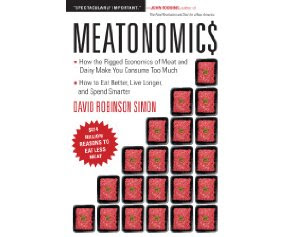
Meatonomics is the first book to add up the huge “externalized” costs that the animal food system imposes on taxpayers, animals and the environment, and it finds these costs total about $414 billion yearly. With yearly retail sales of around $250 billion, that means that for every $1 of product they sell, meat and dairy producers impose almost $2 in hidden costs on the rest of us. But if producers were forced to internalize these costs, a $4 Big Mac would cost about $11.
Knight Foundation supports research for farmers markets
As a member of Farmers Market Coalition’s research team, I for one am very excited to receive this support from the Knight Foundation and their Prototype Fund. This pilot will allow FMC to listen to markets’ needs and ultimately fashion dynamic solutions to upload simple data (customer counts, number of new products offered, staff time dedicated to outreach for at-risk populations) to then see that data in an appealing info-graphic style for use with market partners as well as to see it aggregated on a national map with other markets data.
Please let me know if you have ideas or experience in data work in your market that may lend itself to iterations of this prototype and please look forward to more information throughout the year on this Farmers Market Metrics work happening at FMC.
Growing for Market
The link to the excellent Growing For Markets site. In the January 2014 issue, I have an article where I share the latest news on SNAP at farmers markets. GFM is a great magazine for news and tips for market farmers and organizers. You can subscribe at different levels for print or online (which can include their excellent archives) or you can simply purchase a single issue.
Better Health for Food Deserts: Are Mobile Farmers Markets the Answer? | Health on GOOD
Thanks to new NYC friends Anna and Manuel of Zago for sending this. Whenever I see an article on mobile markets, a few questions immediately come to mind, here are some in no particular order:
• How can people use these initiatives to leverage good food coming into their area more regularly? Has there been an example of a mobile truck initiative that led to food security? It would seem to me that if paired with some other food and social initiatives either in concert or in succession, this might be a powerful tool.
• Has anyone figured out a good business model yet? I believe that there is one out there, yes have not read of it yet.
Possibly using it as a simultaneous delivery mechanism for middle or upper income food orders might help offset the costs.
Or maybe mobile trucks can be a meal service that offers healthy food also as healthy prepared meals sent out just before and during non-traditional meal times (for those working people with typically odd work schedules) at low prices, along with some information. Sort of a combination of the food truck with the mobile market.
Or one of those ideas on our “someday” list at my last organization in New Orleans-to create a “useful” mobile market with non-food items like paper products, juice, simple hardware items etc along with those food items.
• Along those lines, is this type of thing best used as a temporal idea that to begin to promote good food and to gather initial data to then get the area to the next more permanent idea or is there a long term strategy as to their use?
• Finally, when farmers sell to these outlets, does it increase their reach or decrease it? In other words, have farmers begun to grow or make products just for these endeavors or are they taking products from other outlets? And if they have added this to their sales reach, is it financially viable for them to do so? And from the standpoint of the organizers, are many of these using their very mobility to share gleaned or seconds from those market farmers that these mobile trucks can reach easily and in some quantity on market day?
or as Manuel eloquently wrote in the conversation we had via email around this topic:
One of the biggest challenges for me when thinking about scale and community, especially when thinking about underserved urban populations, is the problem of density and offerings. The smaller and more challenged the environment the more difficult is to build volume, presence and relevance.
YES.
I look forward to the continuing conversation around this idea and connecting these initiatives to market organizations whenever applicable.
Better Health for Food Deserts: Are Mobile Farmers Markets the Answer? | Health on GOOD.
Organic Living at the Gardens of Eagan
The link at the bottom of this post is to an extraordinary book excerpt about the physical and emotional effects of a hailstorm by the owners of one of the first certified organic farms in the Midwest. As a market organizer that has been through my share of disaster and recovery spells, I can tell you that concern and awareness quickly fades among those not immediately affected long before the producers actually completely recover. You can see that in the annoyance on shoppers faces two or more seasons later when they inquire about their favorite products and are told that the farm is not ready to return. You can see the lack of empathy on legislators faces when they are asked what is to be done for small family farms or boats to help them rebuild. Truly, the aftermath of any disaster on any community food production needs to be shared more widely and for longer periods than it is usually.
In this passage from her book, the farmer explains beautifully what happens both to the people and the plants of her farm; the depth of emotion is naked and exposed:
This is just wrong. June is supposed to be bursting green and lush, the bounty of the universe in full evidence. This is squalor and violence. Instead of spring-fresh, the air is a stench of decay and rot. I can intellectualize. No one is hurt. We won’t starve, go broke, or lose the farm. Many plants will recover. But when I stop distracting myself and notice how I feel, I am vulnerable and exposed, like I have been beaten by a merciless sky and left to survive on my own wits. I know this is just emotion, but I feel completely isolated despite so much support. I look for reality. I know it’s out there somewhere. I can’t see it. I don’t understand the purpose. Maybe there is none. Maybe hail just exists.
Read more: http://www.utne.com/food/organic-living-gardens-eagan-ze0z1311zjhar.aspx#ixzz2jydgjt00
Organic Living at the Gardens of Eagan – Food – Utne Reader.
The 25% shift
I am just finishing up a commentary for an online magazine in my original home of Cleveland, Ohio and to remember some details, I pulled out the Michael Shuman report “The 25% Shift: The Benefits of Food Localization for Northeast Ohio & How to Realize Them” that he and coauthors Brad Masi and Leslie Schaller completed for the Northeast Ohio food community and its municipal partners. I find it informative and ambitious.
From the summary:
The following study analyzes the impact of the 16-county Northeast Ohio (NEO) region moving a quarter of the way toward fully meeting local demand for food with local production. It suggests that this 25% shift could create 27,664 new jobs, providing work for about one in eight unemployed residents. It could increase annual regional output by $4.2 billion and expand state and local tax collections by $126 million. It could increase the food security of hundreds of thousands of people and reduce near-epidemic levels of obesity and Type-II diabetes. And it could significantly improve air and water quality, lower the region’s carbon footprint, attract tourists, boost local entrepreneurship, and enhance civic pride.
The more than 50 recommendations would be helpful for any food system to review:
CropMobster™ | How It Works –
Here is an interesting link that came to me through the smart people at Food Tank.
An online site to help farmers sell the produce at “come and get it” prices that is not sold through their marketing outlets.
Waste not
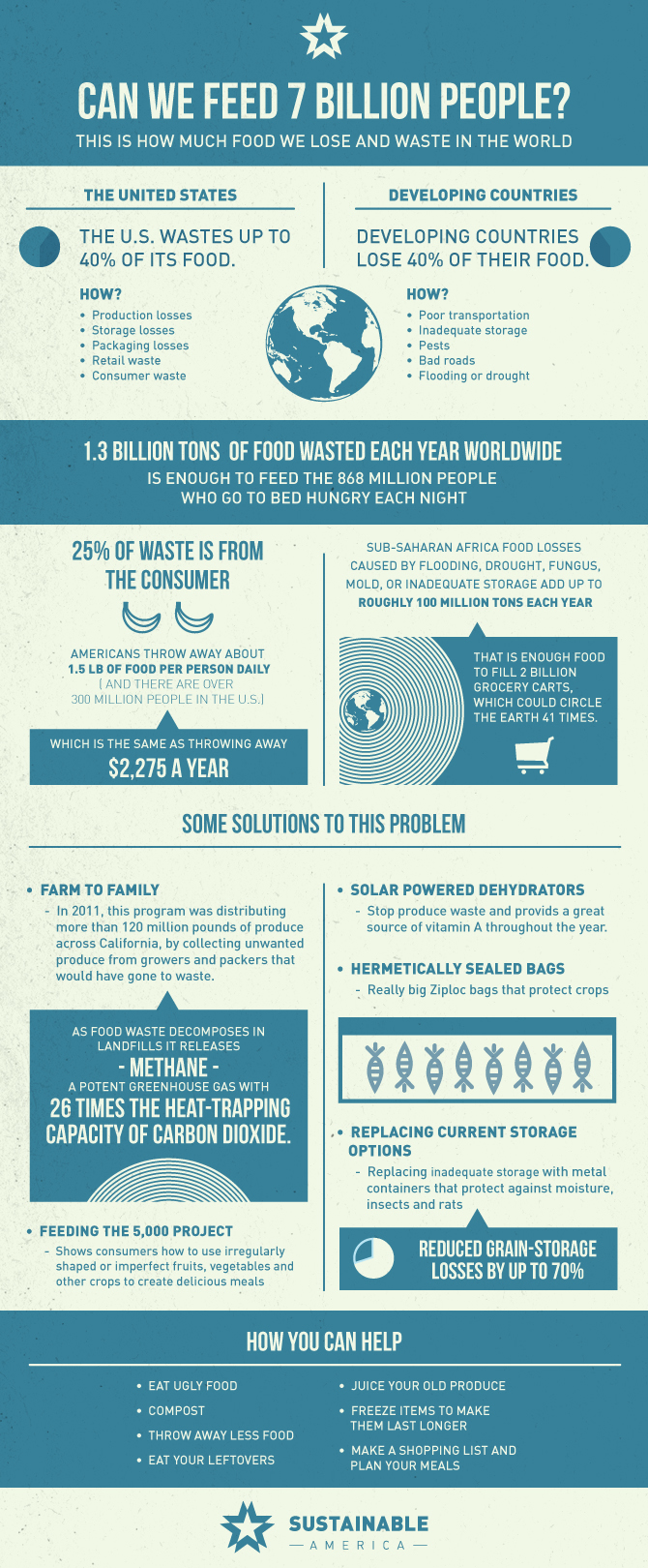
40% of our food is wasted; 25% is wasted by the consumer. Great points to share with your community.
Sustainable Ag Trainings in the Deep South
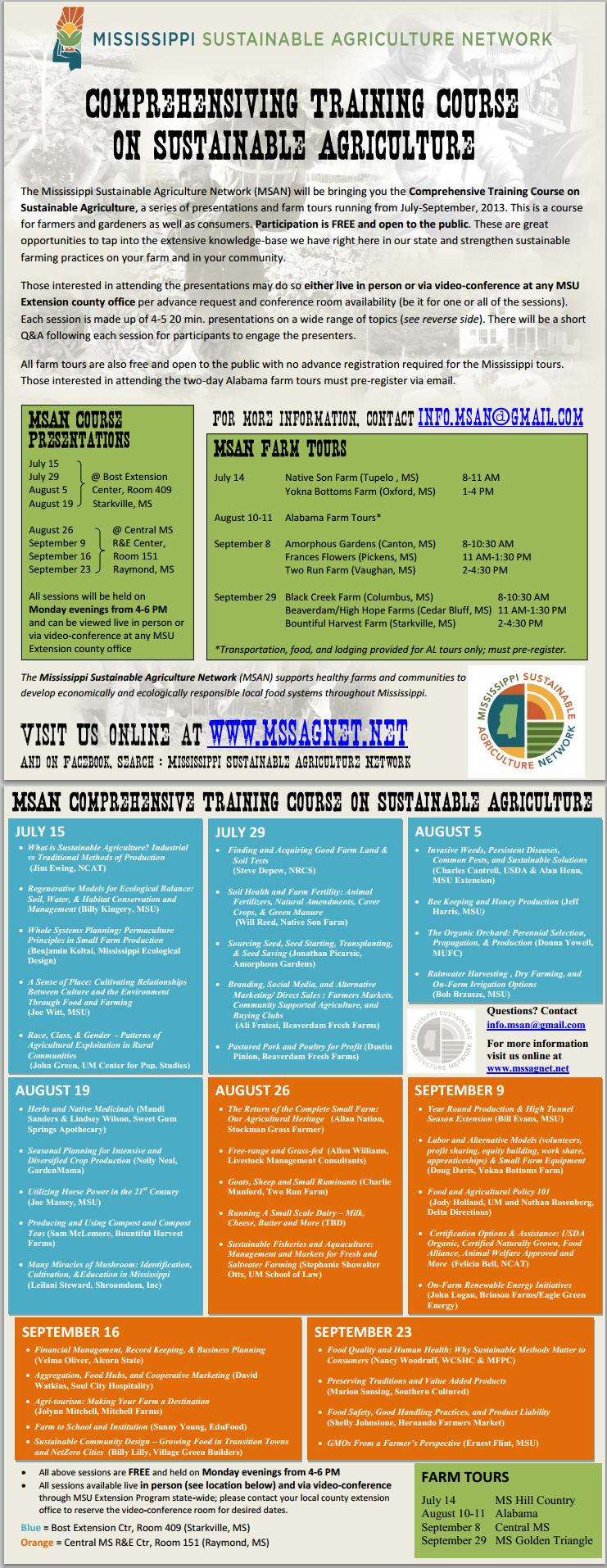
Mississippi Sustainable Agriculture Network’s trainings-2013
Dallas and Durham: why are markets and farmers a threat?
An excellent piece on cities that are unsure of how to handle the explosion in the number of farmers markets, and by extension, small-scaled agriculture within city limits. There may be some correlation between cities that still operate markets themselves and how restrictive their rules are for other markets, but I’d hazard a guess that it has more to do with how they handle small business and open space as a whole. And how they view their relationship to the entire region.
In any case, it shows the need for markets and for all food organizers to realize early on that policy work is an essential part of their work. And for more legal and municipal templates for markets to be written and shared across the US. Lastly, and maybe most importantly, the need to gather information on a market’s economic, social, intellectual and natural benefits to be able to make the case to cities about the positive impact of markets.
“Dallas is one city that has historically owned its own farmers’ market,” Sarah Perry, founder of White Rock Local Market, writes in an email. “This is important because it makes Dallas’ interests in ‘farmers’ markets’ a bit different than other cities.”
At first, residents at private markets believed that as long as they kept sites clean and orderly, they had no reason to think they were doing anything wrong. That held true for a while, but once officials realized that some of these markets were a going concern, they started hassling market organizers about permits. Dallas had no provision for a farmers’ market permit, however, and general “special events” permits were expensive and required police presence.
…
Another issue in Durham is minimum parking requirements. For smaller farmers, there’s only a requirement if the farmer wishes to set up any sort of permanent structure from which to sell their goods. In that case, they need to have at least one parking space. Which, more often than not, is going to require a curb cut, an expense most small farmers can’t afford.
http://nextcity.org/daily/entry/whos-afraid-of-the-city-farmer
Small-Scale Farmers Are Key To Economy
“…the report cites key studies, which show a positive relationship between agriculture and poverty reduction. For instance, one study has shown that for every 10 per cent increase in farm yields, there was a seven per cent reduction in poverty in Africa. In contrast, growth in manufacturing and services has not shown comparable impact on poverty.”
As some of you know, I believe that the era of mission-driven farmers markets has just begun and that how we view our work needs to expand to help the farmers and buyers that we work with. In that mindset, we should begin to examine the idea of public markets entirely devoted to restaurant/grocer (then wholesale) sales of local goods, curated with the same intention and mission by those of us that currently manage retail farmers markets.
In order to do that, we should learn from wholesale terminals such as this one in Canada. I found a couple of things within this article about the Ontario Terminal fascinating. My notes are in italics.
In less than 40 seconds, DiLiso has placed his order: cabbage, cipollini onions, bean sprouts and bok choy. Na enters the data on a hand-held digital device then, with a mutual nod, moves on to another client, leaving DiLiso to gather up his vegetables.
That’s how deals are done at The Ontario Food Terminal, the giant U-shaped building on 16 hectares off the Queensway in west Toronto: friendly, no-nonsense, fast.
(Notice the ability to enter sales on a hand held device?)
———————————–
DiLiso and his small crew criss-cross the market to find sellers they trust who have the best deals on vegetables.
“It’s all about relationships,” DiLiso says.
(I dunno- it sounds like it is as much about price?)
 Helping Farmers Markets Grow