The 25% shift

I am just finishing up a commentary for an online magazine in my original home of Cleveland, Ohio and to remember some details, I pulled out the Michael Shuman report “The 25% Shift: The Benefits of Food Localization for Northeast Ohio & How to Realize Them” that he and coauthors Brad Masi and Leslie Schaller completed for the Northeast Ohio food community and its municipal partners. I find it informative and ambitious.

From the summary:
The following study analyzes the impact of the 16-county Northeast Ohio (NEO) region moving a quarter of the way toward fully meeting local demand for food with local production. It suggests that this 25% shift could create 27,664 new jobs, providing work for about one in eight unemployed residents. It could increase annual regional output by $4.2 billion and expand state and local tax collections by $126 million. It could increase the food security of hundreds of thousands of people and reduce near-epidemic levels of obesity and Type-II diabetes. And it could significantly improve air and water quality, lower the region’s carbon footprint, attract tourists, boost local entrepreneurship, and enhance civic pride.
The more than 50 recommendations would be helpful for any food system to review:

25% shift

Mississippi Gulf Coast Farmer/Shopper Survey Project-2013/2014 – Helping Public Markets Grow

This is one of the surveys we are using with the shopper/farmer survey project along the Mississippi Gulf Coast. Sorry-only review copies are available at this point-all of the surveys will be published with the final report in 2014.

Surveys

(Found on http://www.helpingpublicmarketsgrow.com under surveys/evaluation if link does not work.)

Link to data collection slideshow

Gave this presentation recently to the University of Virginia Morven Institute’s “Farmers Markets and Applied Food Systems Research” course. Slideshow

Here is more on this exciting summer course that I am thrilled to be associated:

Morven Institute

Nutrition Assistance Report Part II

More quotes and odds and ends from the Nutrition Assistance Project Report. U.S. Department of Agriculture, Food and Nutrition Service, Office of Research and Analysis, Nutrition Assistance in Farmers Markets: Understanding Current Operations by Sujata Dixit-Joshi et al. April 2013.

I hope this is helpful to those readers that don’t have the time to read 799 pages!
Here is a link to my original post about this report

———————————————————————————–
Stated purpose of project:
“To seek innovative ways to increase SNAP participants access to farmers markets (fms) and direct marketing farmers (dmf)”

Questions being asked in this project:
1. What are the characteristics of fms and dmfs and do they vary by SNAP authorization status?
2. What procedures are being used to add SNAP programs at fms and dmfs?
3. What is the nature of incentive programs?
4. What organizations serve fms and dmfs?

Three studies to be done in next few years:
FM Operations (was completed 2013)
FM Client Survey
Orgs administering SNAP at FMs Survey
—————————————————————————————

Details from FM Ops study:

2 phases of Operations study:
1. Nine markets were interviewed in depth, selected by FNS based on regions and demographic of poverty level in area.

2. 1682 farmers markets and 570 direct marketing farmers were surveyed between January and May 2012, Organized in 4 study strata:
Stratum 1: Snap authorized FMs and DMFs with redemptions from July 1, 2010- August 31, 2011
Stratum 2: SNAP authorized FMs and DMFs with no redemptions from July 1, 2010-August 31, 2011
Stratum 3: SNAP authorized FMs with redemptions from July 1, 2007- August 31, 2010 but none since in 2011. (FNS did not track DMFs separately before 2010.)
Stratum 4: Never SNAP authorized
————————————————–

3.9 Farmers Markets Operating Budget

“In CY 2011, farmers markets relied on multiple funding sources for their operating budget. A vast majority of the markets depended on vendor fees: only 10 percent of the markets did not collect any vendor fees. Sponsorship from business organizations (28.7%), fundraising events (24.7%), and government organizations were also important sources of funding for the markets’ operating budgets. About 10 percent of the markets received funding from State government.

About 76 percent of the farmers markets charged the vendors a flat fee. Among the farmers markets that charged vendors a flat fee, almost one-half implemented a flat fee per season while about
 40 percent implemented a flat fee per market day. Fewer than 10 percent of the markets assessed vendor fees as a percentage of sales, and less than 2 percent charged vendors based on the size of their rental space.”

5.3.1 Type and Characteristics of Outlet Where Direct Marketing Farmers Reported the Most SNAP Sales
“In CY 2011, a majority of the direct marketing farmers selected farmers markets as the outlet where they had the most SNAP sales.
… data suggest that direct marketing farmers who had prior certification may discontinue SNAP participation because they sell at outlets where they can use the market’s authorization to redeem SNAP. A sizeable majority of the direct marketing farmers in all three strata used their own authorization to redeem SNAP benefits at the outlet (Table 5-12).
In all three strata, receiving retail value of products was cited by 54 percent of the respondents in strata 2 and 44 percent of respondents in Stratum 1 (as reason for using the direct marketing outlets). About one-third of the direct marketing farmers in Strata 1 and 2 indicated that convenience was the most important driver for selling products at the outlet. A few reasons included location of the market (proximity to the farm, busy area, etc.); high volume of customers, particularly SNAP, WICFMNP and SFMNP customers; role in starting or operating the market, and to serve the local community.”

———————————————————————————–

Details of benefit programs at market (fms) and with direct marketing farmers (dmfs):

In 2009, 18% of the markets had access to card processing; by 2011, it was 35% (Briggs et al)
In 2011, 71.8 billion was redeemed in SNAP benefits and 11.7 million at farmers markets which is .016%

Markets with no incentive program had an average of $867 per season in SNAP sales and those with incentives averaged $2587 per season (p38)

(Expect more to come on this blog from this report….)
USDA report: Nutrition Assistance in Farmers Markets: Understanding Current Operations

I have begun to take notes on the 799 page report released by the USDA last week (authored by Westat) on nutrition assistance programs managed at markets/with direct marketing farmers.
This (FM Ops) is the first completed phase of the 3 phases of research. Next will be a FM Client Survey, followed by a survey of organizations administering SNAP at farmers markets.

First, the data collection info:

2 parts to this research of FM Ops

First, 9 markets were interviewed in depth, picked by FNs based on their FNS regions and level of population below poverty level:
Eastern Market, Detroit MI
Peachtree Road, Atlanta GA
South Boston, Boston MA
Clark Park, Philadelphia PA
Market On The Square, Mobile AL
Fort Pierce, Ft. Pierce FL
Wytheville, Wytheville VA
Sitka, Sitka AK
Overland Park, Overland Park KS

Second, 1682 farmers markets and 570 direct marketing farmers were surveyed organized in 4 groups:
1. Those that were SNAP authorized and had redemptions between July 1, 2010 and August 31, 2011-77.4% (FMS) and 68.2% (DMFs) response among this group

2. Those that were SNAP authorized but had no redemptions between July 1,2010 and August 31, 2011- 69% (FMs) and 65% (DMFs) response among this group.

3. Those that were SNAP authorized and had redemptions between July 1, 2007 and August 31, 2010, but had no redemptions after August 31, 2010 – 56.8 % (FMs) response among this group -FNS did not differentiate FMs from DMFs until 2010 so there is no individual data on DMFs.

4. Never SNAP authorized- 51.8% (FMs) response among this group. Same issue as above in tracking DMFs so no numbers for that group in this stratum.

Westat also conducted focus groups with 2 markets in DC and Maryland, with some fascinating input from the participants:
“They don’t all make you feel that way, but sometimes you come across one that makes you feel a little bit like, ‘Oh, another EBT card.’ I don’t think they all do it and it’s not every time, but few and far between. They make you feel a little embarrassed, like a second class citizen.”

Much more to come…..

Vermont Feasibility Report

Very proud to release the Vermont Feasibility Market Currency Report this week. I was contracted last fall to do this work by Vermont Agency of Agriculture, Food and Marketing (VAAFM) in partnership with Northeast Organic Farming Association of Vermont (NOFA-VT).

The focus was whether there were opportunities to merge the coupon (FMNP and incentives) and SNAP programs into a universal currency for all of Vermont’s farmers markets (and also ultimately assist CSAs and other direct marketing outlets) in order to streamline the systems now being used.
The final report covers technology issues, market capacity, costs and outreach for the Vermont farmers markets and offers recommendations for streamlining through pilots and policy and further analysis.

This link takes you to my website where the report is listed.

I am happy to talk about the report or to answer any questions.
Dar

Report

Market Characteristics

I have been working on some documents that I hope will help explain markets a little better to the larger food community and to market partners. Since markets remain the most efficient (and democratic) mechanism for anchoring and expanding community food systems, knowing how to build successful versions is more vital than ever.
The link will take you to one document that will share some of the background of how identifying markets by their sets of internal and external characteristics has evolved. By looking at markets structure, product mix and partnerships/projects, researchers are working to show how markets are not “one-size-fits-all” and that describing and sharing markets characteristics will allow communities to choose the most appropriate market type and also to find appropriate measurements when expanding their reach into more organizing scenarios.
And certainly, better definition will help vendors pick the best market for their business goals while also aiding markets that want to understand and work with neighboring markets.
All in all, collecting characteristics from markets is a good idea that’s time has come.

If you have other descriptions to add, send them along and I’ll be happy to discuss.

This article is now under the Market Evaluation drop down menu linked below and labeled typology/market characteristics:

http://www.helpingpublicmarketsgrow.com/market-characteristics.html

North American Urban Agricultural Survey

We are very excited to invite you to participate in a Portland State University survey of organizations and businesses across the US and Canada involved in urban agriculture projects.

Urban agriculture is growing rapidly throughout North America, and we are interested to learn about the experiences of the organizations involved, as well as any obstacles they face. Municipalities have begun to craft new policies and regulations related to urban agriculture, and we hope that the information obtained from this study will help guide city planners and policymakers as they develop policies and programs that effectively meet the needs of practitioners.

This survey is intended for organizations and businesses, big or small, formal or informal, that are engaged in urban agriculture on any scale. The survey should take about 20 minutes to complete. Feel free to email us (urbanagsurvey@pdx.edu) or call Nathan McClintock at 503-725-4064 if you have any questions about the study.

We appreciate your time and interest. We’d also be grateful if you could forward this widely to your urban agriculture networks throughout the US and Canada – we know that there are many exciting urban agriculture initiatives that do not have a web presence, and we would like to hear from all the organizations that are doing this great work. Apologies in advance for cross-postings.

Follow this link to the Survey:
http://survey.qualtrics.com/WRQualtricsSurveyEngine/?SID=SV_9TOXJEPPQKIUSqx&_=1

Bivalve Project from Louisiana

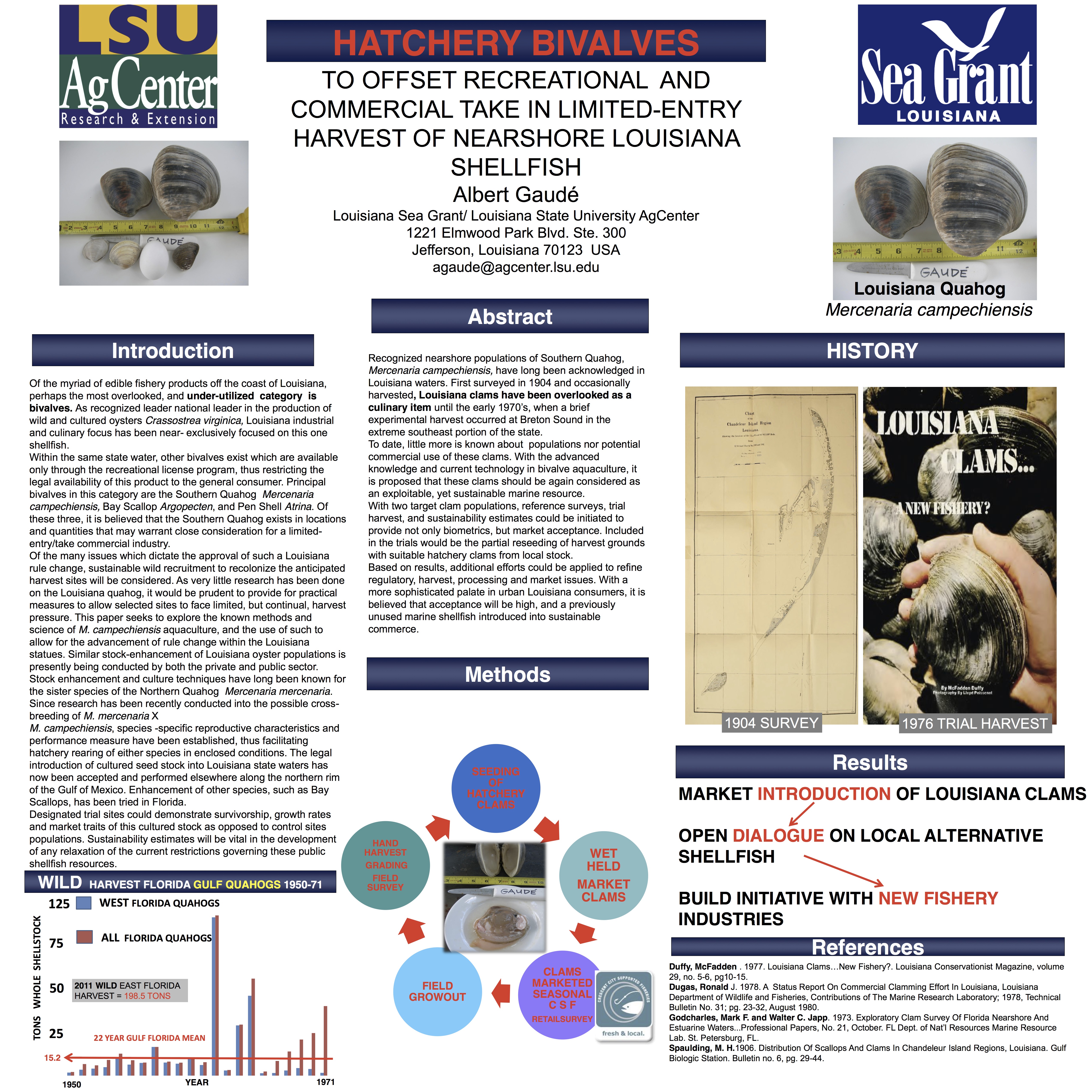
Fisheries Agent Rusty Gaude has long advocated for more production of the Southern Quahog, Mercenaria campechiensis and sees it as a possible new direction of direct marketing to offset the reduced output of oyster production in Southeast Louisiana. He has served on the New Orleans farmers market board and is advocating that the bivalve test be carried out as part of the Crescent City Supported Fisheries project. This project is done during Lent each year, where Crescent City Farmers Market shoppers can preorder a bag each week of seafood caught by the family fishers at the market.

WAS Nashville Poster

Governance case study

In 2012, I did an introductory set of case studies on market structure to begin to get some good information to markets that are struggling with their founding or expansion.
The case studies that I did were of markets that had offered to share their background and systems with me that covered some regularly used types of governance.
However, I would like to stress that often when markets ask for help with their governance, what they really need is help designing appropriate management systems. In other words, if the market community has the ability to understand and even help decide on rules and decisions and manages its organizational risks well, then I often have to conclude that the governance is fine (although sometimes the pool of available advisors to serve is too small or maybe the work is as not clearly defined as it needs to be). What is more often in flux is the design of the management job and a market’s planning for project design.
It is clear that consultants need to have more options for management to match the many types of markets that exist. On top of that, how a market decides on projects to undertake every year should be more comprehensive than a manager’s good idea and willingness of volunteers to help.
I expect to do some work on management systems and project design in 2013 and to be able to share new resources. Until then, take a look at the Market Governance Case Study Report:
HPMG-MG report