Using food stamps at farmers’ market in limbo

Although this story from Madison is a bit sobering (and was probably meant to be an alarming title by the writer, good work there Lindsay), it is also a well-reported one about the issues that we currently face in the hard work of encouraging benefit dollars to be spent on healthy food with farmers at markets. Clearly, by working closely with municipal partners these excellent markets have already begun to build deep understanding and support among those officials. We are still searching for an answer (or answers) to the costs and time needed to administer these programs, but there is no doubt that the success in attracting low-income shoppers has impressed our potential partners. I believe these programs will be rewarded in the long run with sustainable funding or with cooperative administration for managing the financials and outreach pieces if we keep telling our story in as many ways as we can.
What seems clear to me is that markets cannot continue to knock on doors for small amounts every season to fund these programs, but must instead find income streams that will maintain these programs over years. That work must happen even as we band together to fight for better technology and back office systems on a regional and national level. We can do both of those things if we collect and share data (good and bad) and talk often to each other about these issues.

The city has expressed significant support for EBT at farmers’ markets as well. In August through October of this year, grants from several local hospitals made $8,000 available in “MadMarket Double Dollars” at four smaller markets on the north side, the Eastside market at the Wil-Mar Neighborhood Center and two on the south side. For every $1 in Quest benefits, the user got another $1 from the grant.

City officials want to expand that program.

“We saw incredible growth of SNAP use at those (smaller) markets,” said Mark Woulf, the city’s alcohol and food policy coordinator. “That’s something we don’t want to lose. … Hopefully we can work through a solution.”

Woulf said financial support of the DCFM’s FoodShare program would require City Council approval, but it “would be on the table.” He conducted some of the follow-up surveys after the Double Dollars pilot program and was encouraged by what he heard.

“The Eastside market did something unprompted, which was give us a break down of (SNAP use at) individual vendors,” Woulf said. “I was impressed by how well spread out it was.”

Using food stamps at farmers' market in limbo : Ct.

Better Health for Food Deserts: Are Mobile Farmers Markets the Answer? | Health on GOOD

Thanks to new NYC friends Anna and Manuel of Zago for sending this. Whenever I see an article on mobile markets, a few questions immediately come to mind, here are some in no particular order:

• How can people use these initiatives to leverage good food coming into their area more regularly? Has there been an example of a mobile truck initiative that led to food security? It would seem to me that if paired with some other food and social initiatives either in concert or in succession, this might be a powerful tool.

• Has anyone figured out a good business model yet? I believe that there is one out there, yes have not read of it yet.
Possibly using it as a simultaneous delivery mechanism for middle or upper income food orders might help offset the costs.
Or maybe mobile trucks can be a meal service that offers healthy food also as healthy prepared meals sent out just before and during non-traditional meal times (for those working people with typically odd work schedules) at low prices, along with some information. Sort of a combination of the food truck with the mobile market.
Or one of those ideas on our “someday” list at my last organization in New Orleans-to create a “useful” mobile market with non-food items like paper products, juice, simple hardware items etc along with those food items.

• Along those lines, is this type of thing best used as a temporal idea that to begin to promote good food and to gather initial data to then get the area to the next more permanent idea or is there a long term strategy as to their use?

• Finally, when farmers sell to these outlets, does it increase their reach or decrease it? In other words, have farmers begun to grow or make products just for these endeavors or are they taking products from other outlets? And if they have added this to their sales reach, is it financially viable for them to do so? And from the standpoint of the organizers, are many of these using their very mobility to share gleaned or seconds from those market farmers that these mobile trucks can reach easily and in some quantity on market day?

or as Manuel eloquently wrote in the conversation we had via email around this topic:
One of the biggest challenges for me when thinking about scale and community, especially when thinking about underserved urban populations, is the problem of density and offerings. The smaller and more challenged the environment the more difficult is to build volume, presence and relevance.

YES.

I look forward to the continuing conversation around this idea and connecting these initiatives to market organizations whenever applicable.

Better Health for Food Deserts: Are Mobile Farmers Markets the Answer? | Health on GOOD.

Why Urban States Need Their Rural Counties

Although this article was ostensibly about the different secession movements afoot, it is also uses the rural/urban context for the argument that the red/blue divide has to be bridged more often before it gets worse. One place that has happened is in farmers markets and on farms where both groups often interact to access what they deem as healthy or culturally accurate foods. This means that it is crucial for market organizers to think of their pop up town square as a “no politics” zone where libertarians can meet anarchists and yellow dog Democrats and Tea Partying Republicans can hold spaces in line for each other and ultimately, find some common ground on Saturday morning. It is just as important that market organizers balance the needs of their urban or peri-urban shoppers/farmers with those of their rural farmers and vice versa and as important that rural farmers markets find ways to link with their urban peers to change policy or to add benefits to gain new shoppers. Why Urban States Need Their Rural Counties – Emily Badger – The Atlantic Cities.

Carolina Farm Stewardship Association 2013 Conference

The Carolina Farm Stewardship Association (CFSA) is a farmer-driven, membership-based 501(c)(3) non-profit organization that helps people in the Carolinas grow and eat local, organic foods by advocating for fair farm and food policies, building the systems family farms need to thrive, and educating communities about local, organic agriculture.

Our key program areas are:
Education
Advocacy
Food Systems
Farm Services
Founded in 1979, we are the oldest and largest sustainable agriculture organization in the Southeast. For over three decades, we have successfully united farmers, consumers and businesses to build a just, healthy food and farming future.

Program | Carolina Farm Stewardship Association.

Organic Living at the Gardens of Eagan

The link at the bottom of this post is to an extraordinary book excerpt about the physical and emotional effects of a hailstorm by the owners of one of the first certified organic farms in the Midwest. As a market organizer that has been through my share of disaster and recovery spells, I can tell you that concern and awareness quickly fades among those not immediately affected long before the producers actually completely recover. You can see that in the annoyance on shoppers faces two or more seasons later when they inquire about their favorite products and are told that the farm is not ready to return. You can see the lack of empathy on legislators faces when they are asked what is to be done for small family farms or boats to help them rebuild. Truly, the aftermath of any disaster on any community food production needs to be shared more widely and for longer periods than it is usually.

In this passage from her book, the farmer explains beautifully what happens both to the people and the plants of her farm; the depth of emotion is naked and exposed:
This is just wrong. June is supposed to be bursting green and lush, the bounty of the universe in full evidence. This is squalor and violence. Instead of spring-fresh, the air is a stench of decay and rot. I can intellectualize. No one is hurt. We won’t starve, go broke, or lose the farm. Many plants will recover. But when I stop distracting myself and notice how I feel, I am vulnerable and exposed, like I have been beaten by a merciless sky and left to survive on my own wits. I know this is just emotion, but I feel completely isolated despite so much support. I look for reality. I know it’s out there somewhere. I can’t see it. I don’t understand the purpose. Maybe there is none. Maybe hail just exists.

Read more: http://www.utne.com/food/organic-living-gardens-eagan-ze0z1311zjhar.aspx#ixzz2jydgjt00

Organic Living at the Gardens of Eagan – Food – Utne Reader.

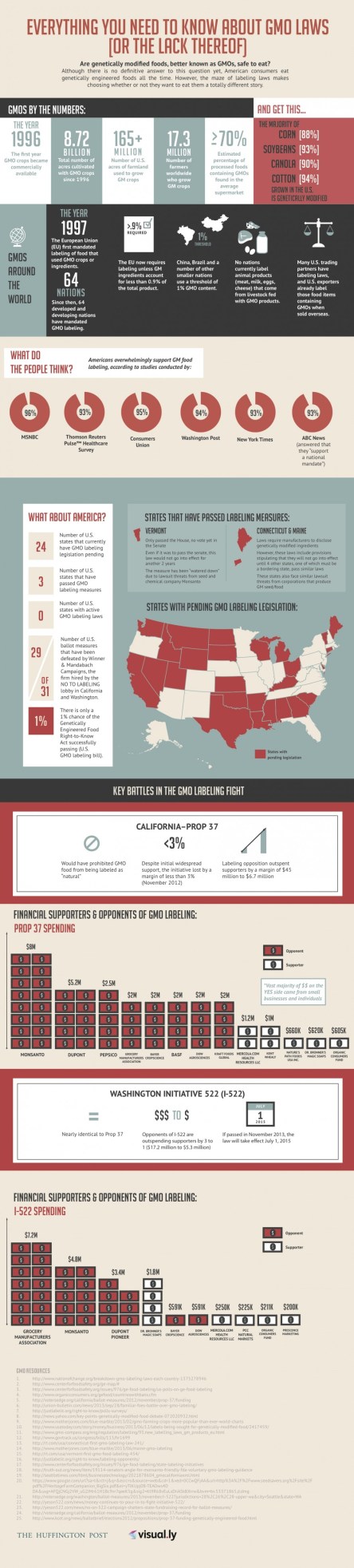
GMO Infographic from HuffPost

GMO Infographic from HuffPost

The 25% shift

I am just finishing up a commentary for an online magazine in my original home of Cleveland, Ohio and to remember some details, I pulled out the Michael Shuman report “The 25% Shift: The Benefits of Food Localization for Northeast Ohio & How to Realize Them” that he and coauthors Brad Masi and Leslie Schaller completed for the Northeast Ohio food community and its municipal partners. I find it informative and ambitious.

From the summary:
The following study analyzes the impact of the 16-county Northeast Ohio (NEO) region moving a quarter of the way toward fully meeting local demand for food with local production. It suggests that this 25% shift could create 27,664 new jobs, providing work for about one in eight unemployed residents. It could increase annual regional output by $4.2 billion and expand state and local tax collections by $126 million. It could increase the food security of hundreds of thousands of people and reduce near-epidemic levels of obesity and Type-II diabetes. And it could significantly improve air and water quality, lower the region’s carbon footprint, attract tourists, boost local entrepreneurship, and enhance civic pride.
The more than 50 recommendations would be helpful for any food system to review:

25% shift

Nashville’s beloved farmers market faces some tough rows to hoe | City Limits | Nashville Scene

This article is from the beginning of the year:

“The idea of bringing in a private company to run the operation comes less than a year after a review from Metro’s finance department that was critical of the market’s finances and management. Then-market director Jeff Themm stepped down from the role in June of last year, shortly after the review, and Nancy Whittemore, director of Metro General Services, has been serving as interim director ever since.

Comer says the market board has worked with General Services to address most of the issues brought up in the report, including better enforcement and compliance with civil service rules, and more thorough housekeeping and maintenance. She says they’re still working through the report, and part of that means looking at “all possible options” when it comes to making the market financially sustainable.”

Between an ongoing deficit and privatization talk, Nashville's beloved farmer's market faces some tough rows to hoe | City Limits | Nashville Scene.

I have not heard or seen any updates to this since this article and RFP were published.

6,000 lbs of food on 1/10th acre

Sharing farming details with market communities was the subject of a recent FMC webinar via by Washington State’s Colleen Donovan. That archived webinar can be viewed at http://farmersmarketcoalition.org/information-marketplace/.
This video also gives some very good information about growing food on very small acreage and could be embedded on farmers markets or farmers sites for community members to learn more about small lot farming.

▶ 6,000 lbs of food on 1/10th acre – Urban Farm – Urban Homestead – Growing Your Own Food – YouTube.

How to bring farmers markets to the urban poor – The Washington Post

I appreciate that this was written from a vendor point of view, since there’s not enough of that out there. Moreover, I think we need a national awareness campaign about how markets have begun to adeptly organize themselves around diverse shopping bases while also paying attention to the deep needs of their farmers and producers. That strategy  makes them unique within the food system since markets have to constantly manage the social and human benefits along with the economic ones.
What strikes me as unsaid in this piece and in so many that I read is that time must be taken to explain to the users of markets about  organizers using different strategies to achieve these goals, including selecting different vendor groups based on location, choosing locations either embedded deep within a targeted area or on the edge between multiple zip codes, while creating different sets of incentives to achieve those goals. As long as people think that markets see themselves as a one-type-fits-all, we will constantly struggle with our impacts when seeking support from folks like the USDA, city government and private funders. You can hear that struggle in the comments about “pricing” in this piece.

How to bring farmers markets to the urban poor – The Washington Post.

Mississippi Gulf Coast Farmer/Shopper Survey Project-2013/2014 – Helping Public Markets Grow

This is one of the surveys we are using with the shopper/farmer survey project along the Mississippi Gulf Coast. Sorry-only review copies are available at this point-all of the surveys will be published with the final report in 2014.

Surveys

(Found on http://www.helpingpublicmarketsgrow.com under surveys/evaluation if link does not work.)

Getting milk to market requires a village- an Afghanistan village

“It’s a small thing, in light of Afghanistan’s many ailments. But what makes this dairy shop truly remarkable is that it is part of an operation that comprises all elements of Afghan society—communists, commanders, shopkeepers, everyday citizens, and yes, even the Taliban. That’s an incredibly rare thing in this war-torn country. But when it comes to fresh milk and butter, Afghans have found something worth not fighting over.”
Afghan milk story