“The Law of Seeds” is a Bill of Rights for seeds, created by Beth Grossman. She scribed these rights with a quill pen on eleven vintage seed bags that are also painted with images of the stages of germinating corn from seed to mature plant. This traveling art exhibit evokes an appreciation of the wonders of seeds and the importance of protecting this precious source of our food chain. Brisbane, CA was the first U.S. city to adopt this Law of Seeds as a Proclamation. As the exhibit travels, the artist hopes to encourage other cities to develop, adopt and enforce rights of nature.
farmers/farming information
Organic Farmers Object to Whole Foods Rating System
Matt Rogers, associate global produce coordinator at Whole Foods, said the program was an attempt to help consumers make choices, and he noted that by forbidding some if not all pesticides and awarding points for conservation and reduced water use, Whole Foods is raising the bar for conventional suppliers and inching them closer to organic standards.
“Organic is an incredibly deep standard, and at Whole Foods we celebrate that in very consistent, long-term ways,” said Mr. Rogers, who worked for more than three years to put the program together. “But the organic standard does not cover water, waste, energy, farmworker welfare, and all of these topics are really important, too.”
That means, however, the conventionally grown produce may end up with a higher rating. For instance, photos taken at a Whole Foods store in Capitola, Calif., and included with the farmers’ letter show a heap of conventionally grown asparagus from Mexico that is rated “best” for $4.99. Yet another photo, taken at a Whole Foods some 30 miles north in Cupertino, shows a pile of organic asparagus from Durst Organic Growers that is rated “good,” the lowest Responsibly Grown rating, for $7.99.
“This program is our reaction to a fast-moving marketplace that gives us an opportunity to engage on these issues with our supply chain in a way we haven’t been able to before,” Mr. Rogers said.
Supply chain? oh he means farmers and harvesters.
Organic Farmers Object to Whole Foods Rating System – NYTimes.com.
Louisiana updates its cottage law on labels for raw honey, state sales tax
June 2015: The update means no label is required to sell raw honey and deletes the earlier need for registering at the state for sales tax collection. However, if there is local (parish or municipality) sales tax registration and collection required, it does not lift that requirement.
The following foods were specifically listed:
- Baked goods, including breads, cakes, cookies and pies
- Candies
- Dried mixes
- Honey and honeycomb products
- Jams, jellies, and preserves
- Pickles and acidified foods
- Sauces and syrups
- Spices
My original post on the subject in 2013
2014 revisions to cottage food law
New for 2015: no label required for sales of raw honey
Good site for the cottage food community which includes some interpretation of laws.
More detail from the sales tax issue. The original article from TP overstates the sales tax issue a bit. I asked for a clarification from the sponsor and this is what I was sent:
The pertinent information is in the bill itself on page 1, line 19 through page 2, line 5 of HB 79 Enrolled – which provides as follows:
“No individual who prepares low-risk foods in the home shall sell such foods unless he is registered to collect any local sales and use taxes that are applicable to the sale of such foods, as evidenced by a current sales tax certificate issued to the seller by the sales and use tax collector for the parish in which the sales occur.”
This means that if any local sales taxes are applicable to the sale of the food, then the seller must be registered to collect that tax in order to sell his home-produced food legally. If no local sales taxes are applicable to the sale of the food, then the seller doesn’t need to be registered to collect taxes on the sale of the food.
The main purpose of this particular amendment that HB 79 makes to the cottage law is to strike the reference requiring sellers to register to collect state sales tax. This correction was necessary as state sales tax does not apply to food for home consumption
Hope this helps,
Brandy Pearce
Legislative Assistant to
Representative Richard Burford
The Association of State and Territorial Health Officials on cottage food laws
Vending for a day
My regular Saturday market stop two weeks ago ended with my pal and one of my favorite vendors, Norma Jean of Norma Jean’s Cuisine asking me to assist her the next week by managing her table while she handled a demo nearby.
So, this week I packed my bag for a 3-5 hour market trip which meant adding a gallon of water, bandanna, Florida water and my watch.
Since leaving Market Umbrella in 2011, I haven’t spent more than 2 hours behind a table as a manager or a vendor; I do help my pals Rob and Susie sell their baked goods when the line backs up since I often sit behind their table with them anyway, chatting about a million subjects, so stepping up to take the money or to bag items is the least I can do.
When I do consulting work with a market, I am there for a full day sometimes, but it is definitely a different vibe than managing or vending.This day, I was responsible for all of the sales at Norma’s table; no wandering off when I saw something to eat or see. Knowing the products well enough to answer questions easily and not in a rushed manner, keeping money straight, all had to be managed on my own.
I think every market manager and board member should step in and run a vendor table for an hour or two. It is important to watch the traffic, gauge the body language, note the questions of visitors and to get the vibe from that point of view.
Some thoughts from today:
1. It’s fascinating to me how many people were thrown by not seeing Norma. The products by themselves are not always enough to signal the same vendor. I think that is a great thing- the relationships between the shoppers and the vendors are meaningful and so the person-to-person connections are as important as we assert they are.
2. The number of new people, always: I think vendors and managers forget how many people are at the market for the first time. When I sensed someone new to the market by what they asked or how they moved through the market, I would ask them if they were a regular shopper and so heard from many first-timers. It shows how a market and its vendors need must be prepared to introduce their items and the system over and over and over again and not to assume that everyone knows their stuff or about the market. And this is a rural/suburban market and not an urban market and still has lots of newcomers.
3. Body language: Norma had left me a chair to sit in (I don’t think I’ve ever seen her sit in it actually) but I didn’t dare, having been trained at Market Umbrella that sitting at market for staff or volunteers was a no-no. It’s not that sometimes it isn’t okay; if the market is a tailgate market and right up against the table it can work (and look) well for a moment or two. However, those deep camp chairs that allow someone to sink down, I say no. But standing in place for so long was difficult for me; as a market manager, I had rarely stood in place for more than 5 minutes at a time and even had a rule to not engage in any conversation for more than 10 minutes. If needed,I would ask that person if I could call them to finish talking on Monday. Today, I found because I had to stand still so long, I had my hands on my hips regularly and so began to put them on the table or in my pockets or add busy work to stop doing it.
4. Even though many shoppers and all of the vendors know me and I am well acquainted with Norma’s products, I am even more of a true believer that employees are never going to equal with having the producer or their family standing there. The confidence in the products and the awareness of every step of the process is not at the same level. Add to that, how unlikely it is that any small feedback offered by shoppers or visitors will translate into action if it is given to an employee. Or, if slow sales of any one item is due to the lack of interest from shoppers or lack of sales technique of the employee. So even if markets allow employees to sell (which is quite necessary for most), I recommend that they add a rule that the producer has to sell at least once every month or two.
5. I love watching and being part of the barter of the market. As many of us know, many vendors barter their goods rather than exchange currency and to see the regular versions of that; Norma gets gluten-free bread for the vegan pesto samples in exchange for her items, and to be “paid” in those goods too helps remind me that we still are not measuring the true number of transactions at a market. Norma also has a barter system with one customer who has a credit slip at her booth-no one else is afforded that system, but I certainly have seen other vendors do that with some of their skilled neighbors as well.
6. How necessary it is for market staff or volunteers to roam the market regularly. So often, vendors get too busy to take a bathroom break or get change or need something and are stuck until someone happens by to assist. Lucky for me, Norma was within eyeshot as needed, and the sister managers Jan and Ann rolled by and connected with me once or twice. Checking in with your vendors can elevate the trust and raise the spirits of a market struggling in other ways.
7. When Norma finished her demo and sales earlier than expected, she cleaned up there and took over at her table, sending me on my way with warm thanks and gifts of food. As I got in my truck, I thought of how I get to finish my day there and then and not continue to sell, to then have to pack up/clean up, count the money to see if any profit has been made, and to make decisions for next week, next month etc. That long day and the added worry when the day is mediocre or bad has to be frightening and/or demoralizing to even the most confident producer. For many of our vendors, they have work for mid-week markets to start by mid-afternoon after market or the next morning or for some, to get a little rest for their other full-time job come Monday morning. My hat is off to those who believe enough in artisanal food or products to spend their life producing them for us.
8. What an enjoyable day.
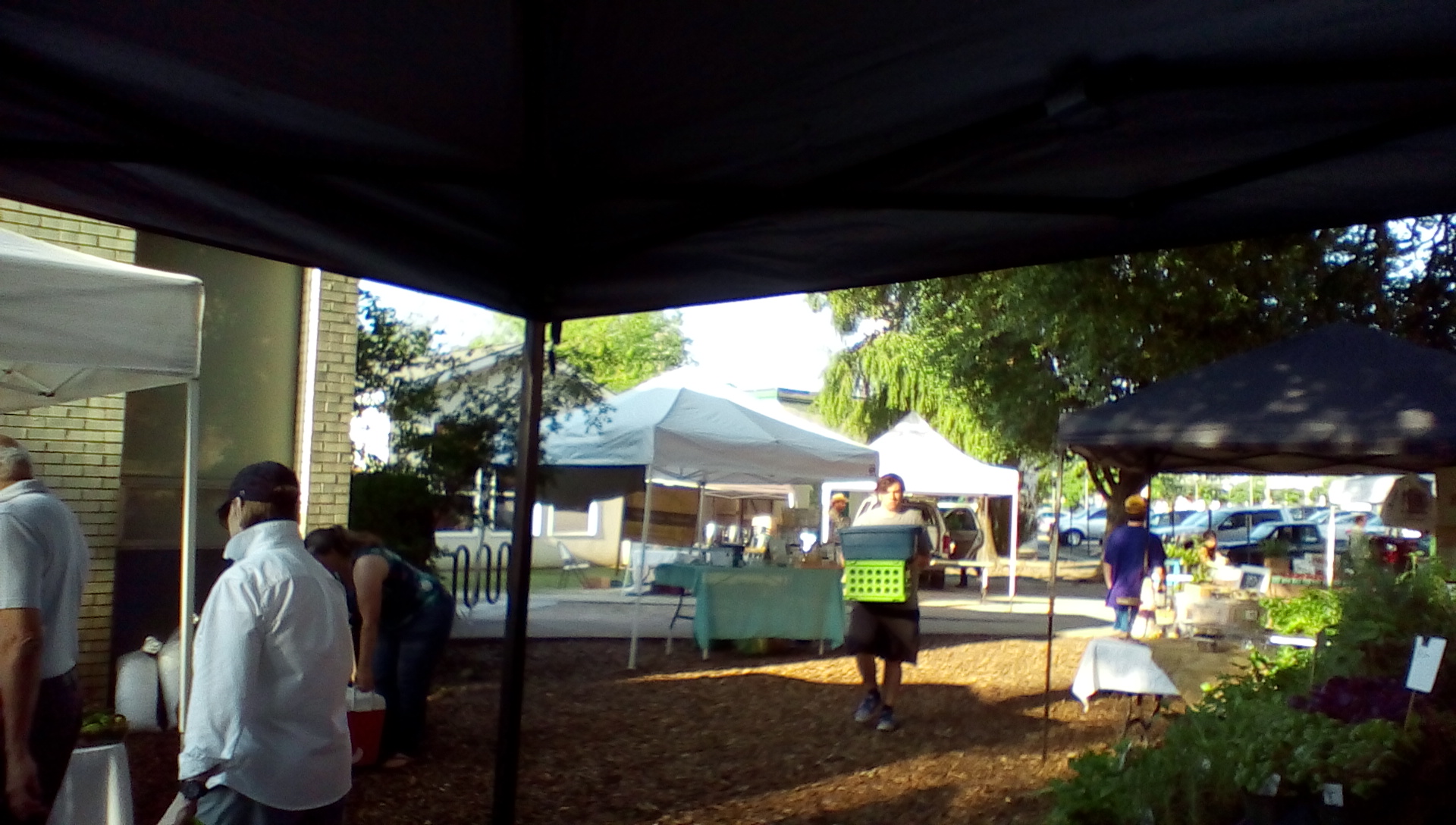
Vendors walking their items in

Vendors getting tents up
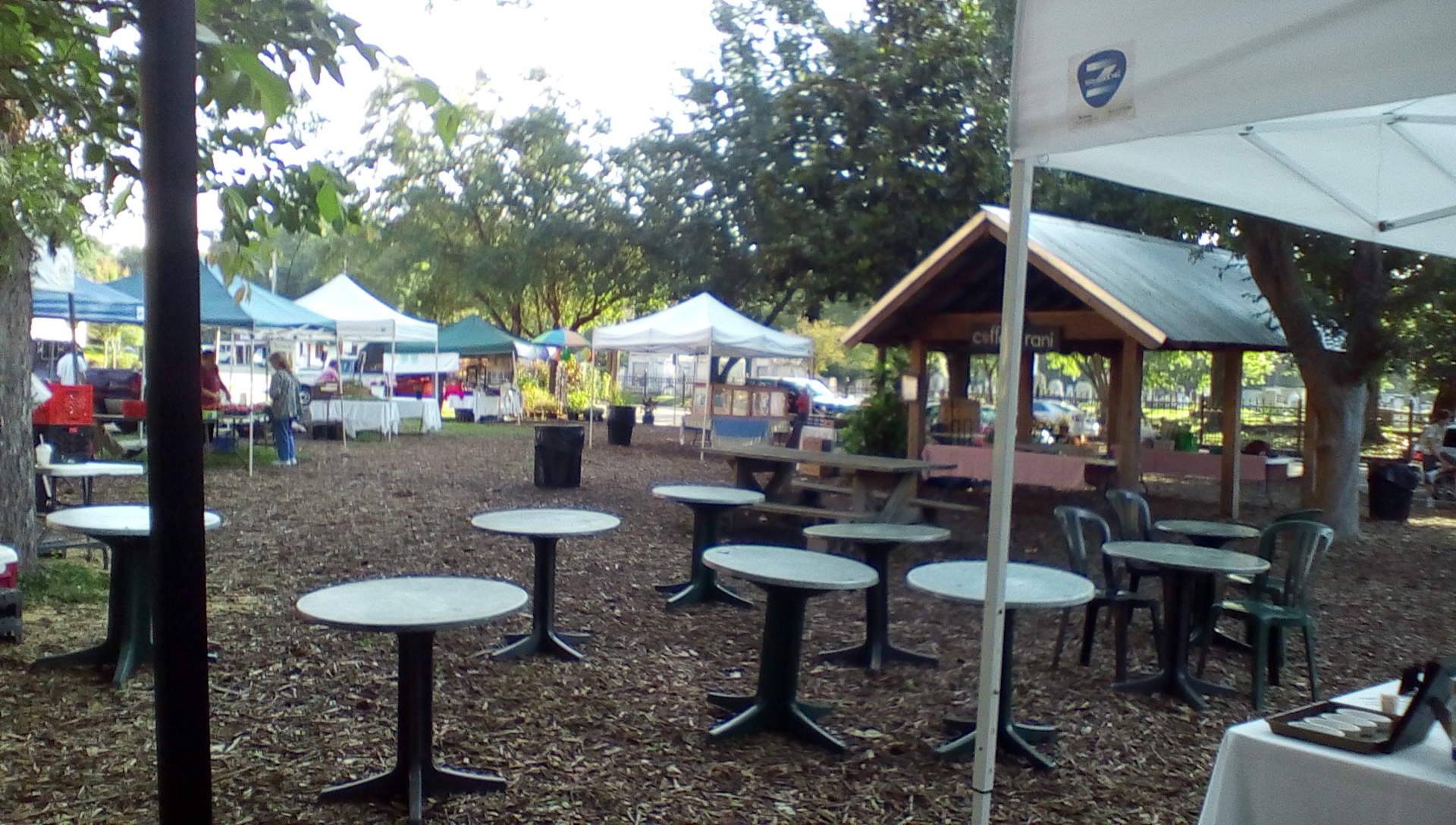
The seating before the market opens

Norma Jean’s cold area

Norma Jean is all set up and ready for me to sell for her

This is what she was demoing and selling at the other booth. Really nice version of Salad Nicoise, without the tuna.

What the market looks like when the musicians are playing midday
Make It, Grow It, Sell It – Whole Green Heart
FYI: this program is being offered by someone who has experience vending at farmers markets
A Home-Study Program for Building a Rewarding, Successful and Profitable Business Selling at Farmers Markets
For vendors, one of the key messages that we have found helps them grow their businesses is that it takes a combination of production expertise and business expertise to really be successful in the farmers’ market sector. I ran an organic herb farm, selling at farmers’ markets, for 18 years. I also managed a farmers’ market for 6 years, and because I come from an adult education background, I’ve been training other vendors and managers in our province since 2011 as the Director of Training for Farmers’ Markets of Nova Scotia. I speak at farmers’ market and organic agriculture conferences around North America and have learned even more from this rich interaction with so many other passionate, thoughtful people in various roles across our sector. For vendors, one of the key messages that we have found helps them grow their businesses is that it takes a combination of production expertise and business expertise to really be successful in the farmers’ market sector. I am launching a new home-study program for farmers’ market vendors.”
Tom Spicer, the man who taught Dallas how to eat better, has died
Met him once and had a fascinating conversation on food and New Orleans and markets and restaurants and a few other topics. He was a true New Orleanian: engaging, voluble, opinionated and talented at a wide range of crafts.
People like this are necessary to those of us waging the often-solitary fight to build a sustainable food system piece by piece, person by person: they inspire and challenge us with their words and their actions. Thank you Spiceman. Tom Spicer, the man who taught Dallas how to eat better, has died | Dallas Morning News.
an example of the type of comments left on Dallas sites upon news of his passing:
Tom Spicer meant more to me being in business than anyone. He was one of my first customers and he encouraged me from the very beginning. Tom gave me a list of my best accounts to this day! Tom was so passionate and fun to speak with , he started me off on my food journey in life and was essential in helping my company get started. Fennel and dill pollen spice would never be here today without Tom Spicer.
Open source gleaning model helps NC market farmers address hunger issues
I had the great pleasure to become acquainted in 2012 with this innovative program that is closely linked to the North Carolina farmers markets and individual farmers to get food flowing to more people- but this model made sure that it was NOT at the expense of farmers businesses. Their Donation Stations allows customers to buy an extra share to donate to those in need and also allowed farmers credit for any donations that they made. Their wholesale work to get more agencies to buy regional food is also extremely important.
Open source model helps NC solve hunger problem | opensource.com.
Farmers Market Metrics Vendor Metrics Released
Farmers Market Impact Metrics Released for First Season of Testing
Research project addresses the need for consistent measurement of farmers market impacts nationwide.
Researchers at the University of Wisconsin-Madison and the national nonprofit, the Farmers Market Coalition (FMC) released metrics this week that will allow markets and their partners to gather data on vendor and customer activities. The data will assist market organizers in constructing targeted marketing and advocacy plans and will offer farmers and other producers specific information on building their business goals.
The project is funded by the USDA’s Agriculture, Food, and Research Initiative (AFRI) and will allow nine markets across the U.S. to test data collection and reporting techniques in 2015 and 2016. The project team gathered known metrics used over the last decade in farmers markets and food system research and prioritized those that could be easily gathered by the market community itself. The metrics were grouped into one or more of four types of benefit they provide:
economic (i.e. sales or job creation), ecological (land stewardship), social (new relationships) and human (skills gained or knowledge transferred).
The research project’s principal investigator Alfonso Morales, Assistant Professor at University of Wisconsin-Madison said, “We believe that it is vital that grassroots markets have the tools and embedded skills to gather data on behavior for their own needs, not only on shopper activity but also on the small businesses that depend on these markets for their family’s income.”
From the list of 90 metrics identified, the team focused its initial efforts into refining 38 of those metrics for immediate use by the nine pilot markets chosen for the project. Participating markets selected those metrics that are most useful to their current work and will begin to gather data in late spring 2015. The data will be analyzed by the project team and final reports shared with the markets later in the year. The team will conduct another round of data collection at the same pilot
markets in 2016.
The first round of metrics sent to the markets focus on collecting vendor data through questions embedded into vendor applications or through direct surveys or observation at market of vendors. Later rounds of metrics will allow visitor data to be collected using the same methods, while future metrics are likely to focus on the “placemaking” skills of the market and the internal workings of the organization running the market.
Vendor metrics for this project include acres in production for markets, distance traveled from production to market, sales data, and the number of women-owned businesses. Jen Cheek, Executive Director of Farmers Market Coalition affirmed, “Many markets are not sure what to collect and when; others already collect some of this data but are unsure of how to use it once collected. These measurement projects that FMC is taking on with the University of Wisconsin will offer shared language and common-sense guidelines for reporting, while allowing markets and
their vendors the freedom to define what success means to their market and community.”
Find the vendor metrics here and a template letter for vendors here and a glossary of terms and vendor tree here.
#
The Farmers Market Coalition (FMC) is a 501(c)(3) nonprofit dedicated to strengthening farmers markets for the benefit of farmers, consumers, and communities. For more information about the Farmers Market Coalition, including Farmers Market Metrics please visit their website at http://www.farmersmarketcoalition.org.
Farm Shares | Grow Dat Youth Farm
A recent success story in New Orleans for urban farming and school-aged youth, Grow Dat has sold their produce through at their City Park farmstand, at farmers markets, through online ordering/home delivery services and now with this CSA method. GDYF is a well-regarded project that has produced very real outcomes in a challenging funding and food environment. The success of Grow Dat’s project work along with their constant advocacy for urban farmers has truly risen all boats.
What the Frack? Beginning Farmers’ Energy and Pollution Dilemma – Hobby Farms
An important post for markets to share with their farmers.
What the Frack? Beginning Farmers’ Energy and Pollution Dilemma – Hobby Farms.
Still time to register for the Southern Sustainable Agriculture Working Group meeting in Mobile AL, January 14 – 17 2015
 Early bird registration for the Southern Sustainable Agriculture Working Group is still open for a little bit longer (2 more days) through December 21st. Register online, or download a registration form and get it postmarked no later than Dec 21st for the lowest conference rates. They accept, via mail, checks made payable to Southern SAWG. They accept, via mail and online, VISA, Master Card, American Express and Discover credit cards. Pre-registration continues through midnight on January 7th. After that, registration will be on location in Mobile.
I will be leading two workshops and also moderating an open discussion (information exchange) this year. Find me here:
Information Exchange:
Friday, 10:45 a.m. – Noon
Using EBT, “Double Coupon” and Other Programs at Farmers Markets – Does your market employ the EBT, FMNP, Food Insecurity Nutrition Incentive Program (FINIP) or WIC programs? Do you have a double coupon incentive program for SNAP, WIC or SFNMP? Discuss technology issues and share best practices for implementing these programs at markets.
Workshops:
Saturday, 10:30 a.m. – 12:00 noon
Why Farmers Markets? Learn to Communicate Their Value to Your Community – Making the case for farmers markets to farmers, shoppers and community leaders is crucial for continued community support, yet most markets struggle with this task. Learn how to capture and communicate meaningful measures of your market’s success. Using exercises and worksheets from the Farmers Market Metrics project, this session will give you practical examples of simple and effective data collection techniques that you can use for your market. Darlene Wolnik, Helping Public Markets Grow (LA) and Sarah Blacklin, NC Choices (NC).
Saturday 3:30-5:00 pm
Farmers Markets as Business Incubators: How Market Managers Can Help Improve Their Vendors’ Businesses – Increasingly competitive market outlets for local food means that the top farmers often jump from market to market. This session will offer practical strategies for market managers and board members on identifying and understanding their anchor vendors and their needs, as well as addressing the challenges of retaining new vendors. Darlene Wolnik, Helping Public Markets Grow (LA) and Sarah Blacklin, NC Choices (NC).
2015 Conference Program — Southern Sustainable Agriculture Working Group.
Sow-it-Forward-Program

A screen shot of the introductory slide.
Check out this 3-4 minute slide show that makes a great case for supporting Kitchen Gardeners International’s work:
Sow-it-Forward-Program.
Please pass along the slideshow to those that benefit from it and take a look at their site while you’re at it.
Food Safety Modernization Act (FSMA) | Farmers Market Coalition
Some extremely important advocacy has been done by NSAC and FMC on the need for more edits to the FSMA in order for family farms and small business producers to be able to survive and thrive. Their recommendations include needed edits to the rules for farmers markets to be able to manage risk and yet to be allowed to encourage innovation to happen. Please read their updates and analysis on the FSMA and get your comments in by December 15.
Food Safety Modernization Act (FSMA) | Farmers Market Coalition.
Food Systems for Healthy Places
Great post by Dr. Morales on some of his current project work, including his perspective on the Indicators for Impacts AFRI-funded project that we both are working on through 2016.
Food Systems for Healthy Places | BEPHC | Georgia Institute of Technology | Atlanta, GA.
 Helping Farmers Markets Grow