Organic Living at the Gardens of Eagan

The link at the bottom of this post is to an extraordinary book excerpt about the physical and emotional effects of a hailstorm by the owners of one of the first certified organic farms in the Midwest. As a market organizer that has been through my share of disaster and recovery spells, I can tell you that concern and awareness quickly fades among those not immediately affected long before the producers actually completely recover. You can see that in the annoyance on shoppers faces two or more seasons later when they inquire about their favorite products and are told that the farm is not ready to return. You can see the lack of empathy on legislators faces when they are asked what is to be done for small family farms or boats to help them rebuild. Truly, the aftermath of any disaster on any community food production needs to be shared more widely and for longer periods than it is usually.

In this passage from her book, the farmer explains beautifully what happens both to the people and the plants of her farm; the depth of emotion is naked and exposed:
This is just wrong. June is supposed to be bursting green and lush, the bounty of the universe in full evidence. This is squalor and violence. Instead of spring-fresh, the air is a stench of decay and rot. I can intellectualize. No one is hurt. We won’t starve, go broke, or lose the farm. Many plants will recover. But when I stop distracting myself and notice how I feel, I am vulnerable and exposed, like I have been beaten by a merciless sky and left to survive on my own wits. I know this is just emotion, but I feel completely isolated despite so much support. I look for reality. I know it’s out there somewhere. I can’t see it. I don’t understand the purpose. Maybe there is none. Maybe hail just exists.

Read more: http://www.utne.com/food/organic-living-gardens-eagan-ze0z1311zjhar.aspx#ixzz2jydgjt00

Organic Living at the Gardens of Eagan – Food – Utne Reader.

National 2013 Food Hub Survey-NFGN

Authored by Michigan State University Center for Regional Food Systems & The Wallace Center at Winrock International
From the Executive Summary:

Findings from the survey showed that food hubs across the country are growing to broaden the distribution infrastructure for local food. From the survey, 62% of food hubs began operations within the last five years, 31% of food hubs had $1,000,000 or more in annual revenue and the majority of food hubs were supporting their businesses with little or no grant assistance—including food hubs that identified as nonprofits. Financially, the most successful food hubs tended to be for-profit and cooperative in structure, in operation for more than 10 years and working with a relatively large number of producers. The values-based nature of food hubs makes it hard to judge many of them solely on their level of financial success.
The survey also revealed a number of persistent challenges and barriers to growth that even the most financially successful food hubs faced.
For example, many food hubs indicated their needs for assistance in managing growth and identifying appropriate staffing levels for their hubs. They also often pointed to their need for capital and other resources to increase their trucking and warehousing capacity.

NFGN Report

Book Review: Louisiana Eats

13328918-mmmainFull disclosure: Poppy is my pal. She is someone who calls me up and then shows up, with a gift, thoughtful questions and always hilarious stories.
What made me a fan of hers early on was her razor-sharp take on people and situations, sometimes devastatingly so. Yet she is enormously kind and open to those people who ring true. No one that receives her wrath  is ever underserving. If they get it, they usually have made one of two unforgivable sins: either they underestimated HER or they underestimated her city, her state or her people.

Another disclosure: I believe Poppy deserves as much credit as anyone in my region for rebuilding the New Orleans food system after the federal levee breaks in 2005. Too many stories to tell here, but come on over and if you care, I’ll tell you some of them over a drink. Or two. There are a lot of them to tell. Some of them are funny, some are sweet, some even a bit crazy.

These two points are linked since her life’s work is to actively promote entrepreneurs and real ideas that will build (or rebuild when necessary) the culture of her place, Louisiana. In doing that work, she extended her range to all authentic food systems across the globe through her Slow Food International connection that  meant that New Orleans gained the Slow Food vibe from the mid 1990s on.
Let me also say that most of the SFUSA folks understand her range, giving her much early credit for shaping the U.S. work that she built with others-that is, until she had to unleash her wrath on previous Slow Food leadership over the (mis) direction of a crucial program that she had helped shepherd. Luckily, she and SF made up.
Remember, I warned you that she is a fierce opponent when she feels it’s necessary.

When she started the Louisiana Eats show, she had already done a great deal of writing and television. Her talents really came to light when she began this show; her intense enjoyment and knowledge of the people and history of food and culture through one-on-one conversations on our local NPR station and now in this book. I remember a glorious Saturday morning on Louisiana Eats when she and Rien Fertel talked about praline sellers and another when she talked with Miss Linda Green, The Yakamein lady, and another when she talked with French bread baker John Gendusa among many others. Each time, I would stop what I was doing and literally stand there and listen intently to her intricate questions and always learn something. And her interaction with the dean of New Orleans Creole food, Leah Chase which is always touching and amazing since you get to hear two chefs with great respect for each other just banter and share stories.  And when she has on young activists or farmers (like Nick Usner who is in the book), you can hear the hope in her voice for the new energy coming along…
So this book is a reminder of many lovely Saturdays  and is indicative of the tone that I myself have adopted for much of my food activism: wild enthusiasm, critical assessment and a deep appreciation of the stories and background of those unique people that tell of our culture and food. Because of her, I know to seek them out, and maybe I’ll find some new folks from those Poppy has brought to us on her show and in this book. The book itself (lovely photos and recipes) is informative and a great companion to her show and I know that it will stand the test of time as a true record of some of the people that we have in our world. And of my pal who contributes so much to our place.

<a href=”http://www.goodreads.com/review/list/635646-blue-collar-mind”>View all my reviews</a>


Fishing for answers

Kevin M. Bailey, a senior scientist at the Alaska Fisheries Science Center and affiliate professor at the University of Washington has written a detailed explanation of the economic, scientific and political underpinnings surrounding the Alaskan pollock in his new book, Billion Dollar Fish. This is the product that makes up much of the school cafeteria/fish stick/filet o’fish market and therefore its demise or success has a far-reaching impact on commercial fishing policies. The study of fishing systems is helpful to anyone that is thinking of growing food systems into complete systems. In studying fishing/harvesting, other subjects such as pollution from industries such as agriculture, game fishers, border issues and the aftermath of disasters must be considered even as most Western citizens have grown deeply unaware of their waterways with the advent of the highway and railroad systems.
Ocean communities are complex. The fates of species are braided with feedback systems, complicated interactions, and co-dependencies. We don’t understand much about marine fishes because our ability to observe what really goes on in the ocean is limited, and because the lives of fishes are so foreign to our own existence. An incomplete understanding is not a good foundation for engineering solutions. Yet in harvesting them, we try to manipulate the productivity of fish stocks by setting harvests levels as close to the bone as we can cut.

Billion Dollar Fish

Louisiana to close spring inshore shrimp season Thursday | Gulf Coast – WDSU Home

The education that markets must do to encourage more direct interaction between shoppers and vendors includes things like explaining fishing seasons along and near coastal waters. I have found that many, many people in my state are unaware of the seasonal nature of shrimping and are unaware of the difference between the fleets that are fishing in the Gulf (federal waters) and the family boats using the “inside” waters (state waters).
And that the very presence of fishers in these waters allows all of us concerned with oil companies and others that are constantly extracting from our waterways to have “eyes on the street” as it were.
In short, markets must remember that information is their currency.

Officials say data collected in recent weeks by state biologists indicate increased quantity, distribution and percentage of small, juvenile white shrimp within these waters. The decision to close this area was made in an effort to protect these developing shrimp and provide opportunity for growth to larger and more marketable sizes.

http://www.wdsu.com/news/local-news/gulf-coast/louisiana-to-close-spring-inshore-shrimp-season-thursday/-/12537462/20972638/-/svxc95/-/index.html#ixzz2Z2V8CBYo

&lt”>

This graph is also useful:

Graphic from Times-Picayune

and this view from the seafood trade journal:
La Seafood and markets

A Food Atlas For Everyone

Food AtlasFood Atlas by Darin Jensen
My rating: 4 of 5 stars

I love maps. When I travel, I study maps online to have some sense of the geography underfoot, as much to understand who the people might be as not to get lost. It’s amazing how people appreciate that bit of homework when you go to their place.
I have maps of my city (New Orleans) and of my river (Mississippi) on the wall of my house and the Slow Food RAFT map (see below) on my business card.

Slow Food RAFT map

Slow Food RAFT map


I have books of maps authored by favorites such as geographical historian Rich Campanella and activist Rebecca Solnit, whose collaborative map book (“Infinite City”) of her home of San Francisco is a thought-provoking juxtaposition of right and wrong, culture and place.

When I came across the Kickstarter campaign for this Food Atlas, I jumped at the chance to support it. It arrived last week and I have read it while sipping my morning coffee (while reading about Strong Coffee traditions in the Middle East and “Bird Friendly” coffee origins), referred to it while writing about farmers markets (the one on SNAP and farmers markets) and studied the Texas Seafood Landings map after making flounder tacos just north of Lake Pontchartrain, home of most of the seafood catch for my bioregion. It’s a very new book and so won’t be found everywhere yet, but you can buy it from them now at
http://www.guerrillacartography.net/home

It is a wealth of maps on food production, distribution, security, exploration, identities and to pick out my favorites is to shortchange the breadth of this book.
It’s not just for activists, or “foodies” but for everyone and I think it could affect (and galvanize) people just as M. Pollan’s “The Omnivore’s Dilemna” did. I grow tired of long text articles about food (Yes, I do include myself in that finger pointing!) and would hope that this sort of map project could become a new way to educate and illuminate the small world that we live on.

I can’t wait for the editors to follow up on their promise to expand the reach of this series including to add more Asian and African food maps and to get this Atlas in hands everywhere. Its a bit heavy on maps of the West Coast and of the US, so much so that it occurs to me that having a set of food maps that show the lopsided view we have of ourselves in the US versus how others see us or experience us might be a good edition. In any case, hurrah.

..

View all my reviews

Bivalve Project from Louisiana

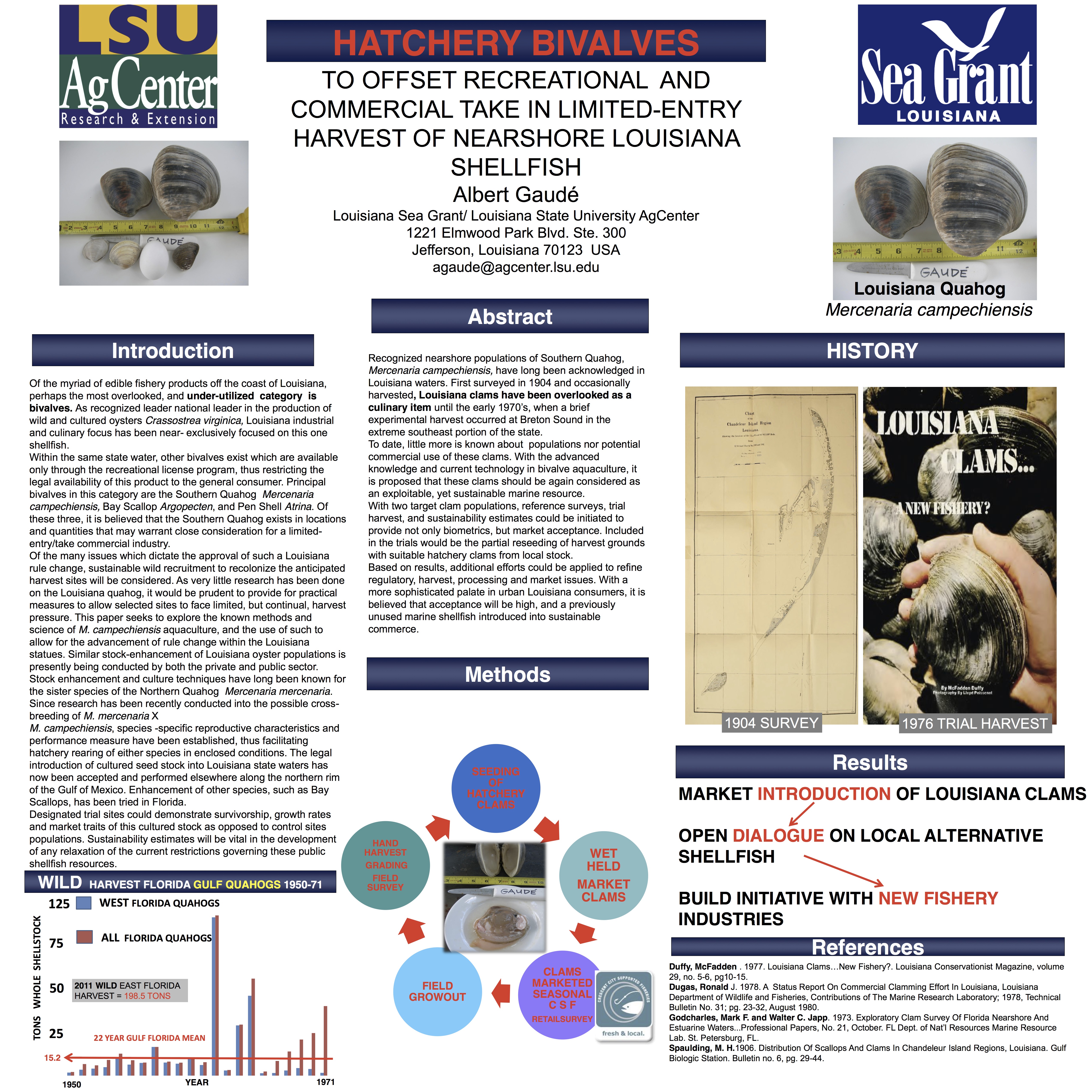
Fisheries Agent Rusty Gaude has long advocated for more production of the Southern Quahog, Mercenaria campechiensis and sees it as a possible new direction of direct marketing to offset the reduced output of oyster production in Southeast Louisiana. He has served on the New Orleans farmers market board and is advocating that the bivalve test be carried out as part of the Crescent City Supported Fisheries project. This project is done during Lent each year, where Crescent City Farmers Market shoppers can preorder a bag each week of seafood caught by the family fishers at the market.

WAS Nashville Poster

DAWN Launches Rural Worker Cooperatives Assistance Program | Democracy at Work Network

I do think that one of the emerging trends that is coming to community food system work – especially markets – will be worker cooperatives. Take advantage of the excellent peer work that DAWN offers to learn more about this and to assist rural farmers and producers in your area.

DAWN Launches Rural Worker Cooperatives Assistance Program | Democracy at Work Network.

Welcome to the market

One of the 35 or so short films I did for MarketUmbrella a few years ago to show the resiliency and enterprise in our farmers, fishers and markets. This one was designed for new vendors to watch so that they could understand what “setting up” at the market meant.

All are available on YouTube.


Hunting and fishing popular again

http://usat.ly/Qt2O4N

Fruits We’ ll Never Taste

My own original Slow Food chapter leader (and emerging radio personality) Poppy Tooker coined the phrase “Eat it To Save It” as a way to link human need for good food to awareness of environmental trends. There is no question that if Americans could see, smell and taste what we have lost just in the 20th century as far as foodstuffs, we would have farmers as senators, mayors and presidents once again.

the book, “Salmon Nation People, Fish, and Our Common Home” is a great example of one region’s attempt to clarify what needs to be saved. Put out by a great regional ngo, Ecotrust, Salmon Nation is worth having in your library.
This article is also a great way to think about “untasteable foods.”

Fruits We' ll Never Taste.