Maryland Food System Map | Center for a Livable Future

This is one of my favorite food system sites . Wouldn’t it be great if each state and every regional projects collected and shared this type of visual data?

A screen shot of the Maryland Food Map circa July 2013.

A screen shot of the Maryland Food System Map circa July 2013.


Note from the organizers:

Map updates include expanded Nutrition Assistance data and updated points of interest for Maryland.
Nutrition Assistance – new and updated data about federal nutrition assistance programs.
SNAP usage by Zip Code
Schools with 50% or more children who are eligible for free and reduced cost meals
Afterschool Meal Program Sites
WIC office locations
NOTE: The following existing data layers have been moved to this category:
SNAP Participation by County
SNAP Retailers
WIC Retailers
Points of Interest – updated points of interest note changes in addresses and expand lists statewide.
Institutional sites in this list – schools and hospitals – will be expanded further this year, as we gather data and statistics about how these institutions are using local food. Here are the layers currently updated:
Hospitals
Public schools
Recreation centers
Senior centers

Maryland Food System Map | Center for a Livable Future.

Saxapahaw: Gatorade next to Kombucha

What a treat I had yesterday. Sarah of the Carrboro Farmers Market has been patiently squiring me around the area, meeting to meeting, meal to meal. Hopefully, all of you have made it to this area of North Carolina and had some of their amazing food, centered by the pork, chicken -well, all meat- that they love and know how to cook in so many interesting ways.
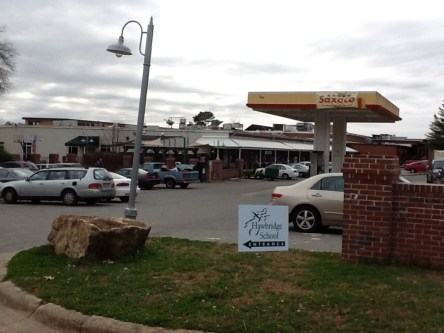
Yesterday, Sarah took me a few miles out of Carrboro to a little town called Saxapahaw (pronounced sax-paw the Carrboro native says) for lunch and for a quick meeting. That meeting easily became an afternoon, because of the fascinating Saxapahaw General Store.
20121212-081229.jpg

Here is what their website says about their beginnings:

The Saxapahaw General Store as it now exists began in June 2008 when Jeff Barney, butcher and self-taught cook, and Cameron Ratliff, teacher and self-taught biscuit maker, worked with former owner Mac Jordan to begin a new life for the convenience store and gas station that had served the community for several years. They imagined a spot where a village could gather for refreshments, meals, and basic home provisions, run by folks whose varied backgrounds have each taught them they can influence their world by collaborating with their neighbors. They hoped to serve the residents of Saxapahaw with a range of products that could allow everyone to feel welcome. They decided to become stewards of local foods, good wine and beer, nutritious snacks, and eco-conscious dry goods.

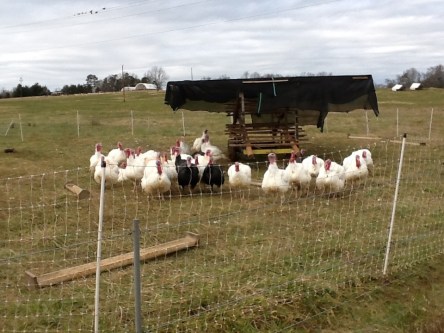
What I saw was a business model that looked right. Once I met the dynamo farmer Suzanne, I became even more sure. Suzanne took us across the street to the pastures after our lunch
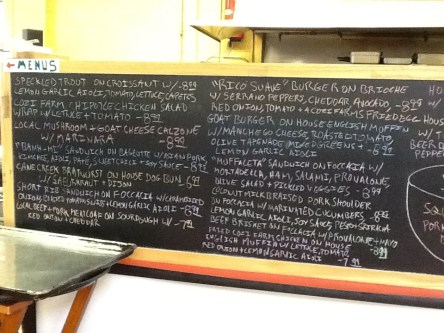
(the picture below shows what is available for lunch-all of the meat is local and much of the produce too)
20121213-051100.jpg

The turkeys were the last of the year, with these destined for ground turkey in the next week or so.
Much of the poultry production is done herself alongside Saxapahaw neighbors and coworkers; the humane treatment of her animals at the end of their lives is so important to this farmer that she told us she would not use many of the processing plants available to her. And that if that was the only way that they could be processed that she wouldn’t raise animals for food.
20121212-081024.jpg
She pointed out the ducks that they had only begun to raise for food and the vegetable garden, also beginning. At this point, the store is buying from the very talented growers that surround the area thanks to the Carrboro Farmers Market and its younger sister markets, but the emporia is going to grow some of its own produce across the street. The composting is carefully monitored before being shared with their animals, so as to not waste any of the precious produce.

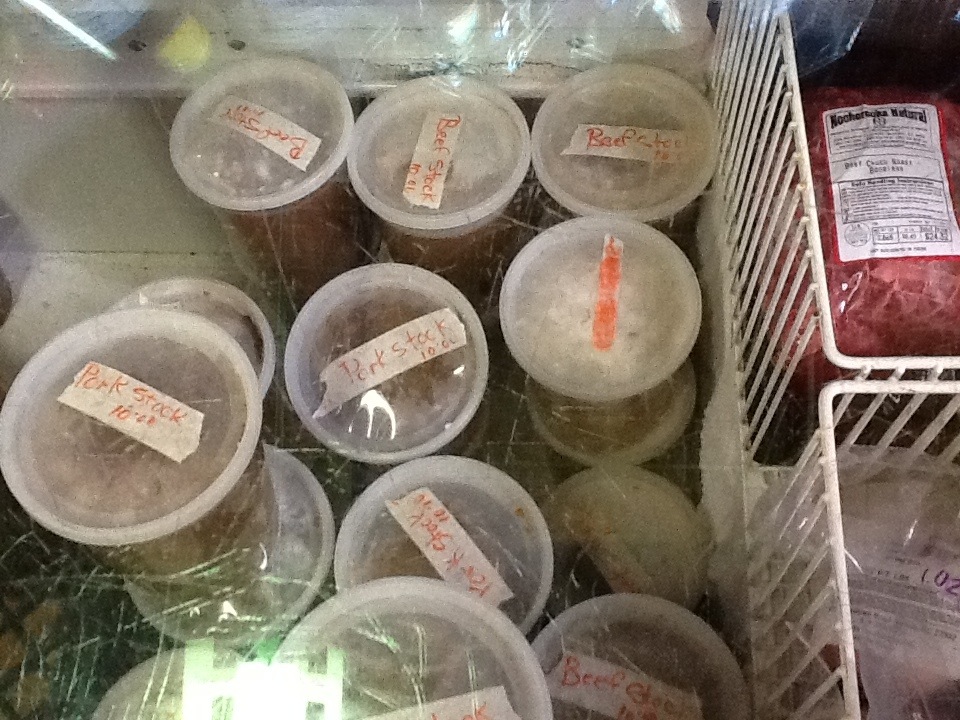
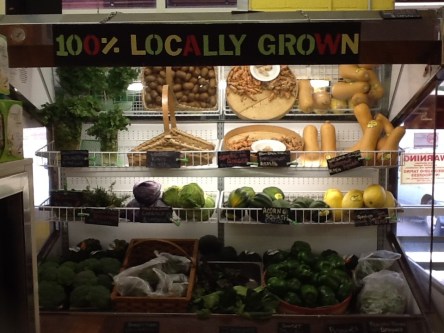
The store is set up to roam and shop after one has put their order in at the counter. Coca-cola products are lined up near pure ginger root drinks, homemade baked goods and local preserves near the small candy area. Hunting gear and motor oil can also be picked up as well along with some biodiesel or gas for your truck.

The store is both a throwback and a nod to the future. Suzanne talked extensively about the ongoing need for more equipment as well as sharing individual stories of the staff and their talents. Throughout our time there, people of varying ages and backgrounds came and went, bought food, drink and dry goods.
As public health and regional planners look for store models that can offer dignity and inclusion to food producers as an encouragement to sell there (just as the farmers market world has done) this store should become a Mecca. Using around 1500 square feet to offer as many culturally appropriate items as possible (Suzanne dreams of the day she can put out her gizzards and turkey necks next to the stock already offered) and real food choices next to convenience items still necessary to the real world, the Saxapahaw General Store is a food organizer’s dream come true.

20121212-081115.jpg

20121212-081751.jpg

20121212-084526.jpg

Makin’ Groceries in Lower Nine | NolaVie – Life and Culture in New Orleans

I’ve written about Jenga Mwendo before. She is a dedicated activist for lower 9. This idea is a fantastic one and one that I’ll make sure to support.

Makin’ Groceries in Lower Nine | NolaVie – Life and Culture in New Orleans.

Environmental factors spread obesity, study shows

If there was ever a study that assisted markets with choosing the right location for markets hoping to incentivize significant nutritional behavior changes…. The well structured analysis simply points out how “Areas with above-average concentrations of food-related businesses had high-than-normal prevalence of obesity and diabetes.” In other words, it might be an example of Tulane Professor Diego Rose’s food swamp language, which explains that large concentration of bad food is much more prevalent than no food (a food desert) where obesity and diabetes is a prevailing issue. If more of this teams’ studies show that the fluctuations found correlate to a socioeconomic disparity (as they think it might), then we might have the data to further the market theory that markets located on “edge communities” serving more than one socioeconomic community will do a great deal for all of those communities.

Environmental factors spread obesity, study shows.

Chicago Outdoor Produce Stands Serving Underserved Areas Approved By City Council

Hopefully, many of you are planning on heading to the Midwest for the PPS September International Public Market Conference on September 21-23, 2012. If you do, it might be worth an extra few days to drive or take the train to Chicago and see their growing local food presence. Every time I go, I find another sustainable project or food system piece to check out. It certainly has to do with the current federal administration’s own interest (and connection to the new mayor) in their home city, and probably also has to do with the last mayor’s interest in greening the city; Daley was the one who put the rooftop garden on city hall after all.

The cart approach that Mayor Emmanuel is offering in the press release attached here has its supporters and detractors. I, for one think before we use these less balanced fixes to try to address food insecurity and sovereignty issues, the farmers market movement needs to be better at knowing how to identify the types of markets that work in these different situations. Or, at least, make sure that the powers that be have farmers needs in mind and have time to build food producers’ long range direct marketing plans. Those types of markets would be collected using the research that myself and others are working on: identifying characteristics, indicators to get typology of markets. My project, using the acronym Market CITY, will be bringing together researchers, practioners and stakeholders to start to build the typology framework. More on that later.
But, do start to plan your Midwestern fact-finding trip and I hope you can find time to seek out these regional farming initiatives when you travel.

Chicago Outdoor Produce Stands Serving Underserved Areas Approved By City Council.

Another educational food production platform, if nothing else….

When I worked at marketumbrella.org, one of the many projects that I helped design and run was our White Boot Brigade, the roaming shrimper market for added seasonal seafood sales. Rouse’s Supermarkets was an early supporter of the WBB, and we genuinely enjoyed working with this Houma-based family company. Since they gamely took on being the main grocery store chain in our city (when Sav-A-Center decided that post-Katrina New Orleans wasn’t for them), I for one was very happy as I knew them and knew their stores. New Orleanians are VERY picky about their “markets” (as stores are often called) and yet, the Rouse family has mostly met their needs. As for buying locally, they do buy, they do support local entrepreneurs. Farmers have a harder time getting their produce in there, but value-added farmers market vendors seem to be doing well.
They just opened a store a few blocks from the flagship Saturday farmers market in downtown New Orleans, and I think it will help both the market and the store. That store is the subject of this excellent story on their new rooftop garden.

The only supermarket in downtown New Orleans is the first grocery in the country to develop an aeroponic urban farm on its roof.

What exactly is an aeroponic urban garden?

Think vertical instead of horizontal. The garden “towers” use water rather than soil, and allow plants to grow upward instead of outward. It was developed by a former Disney greenhouse manager, and is used at Disney properties, the Chicago O’Hare Airport Eco-Farm and on the Manhattan rooftop of Bell Book & Candle restaurant.

Rouse’s downtown

Earth Day FMC radio interview

Stacy Miller, Executive Director of Farmers Market Coalition and Michael Hurwitz, Greenmarket Executive Director (and FMC Board member) talk about markets and food systems.
Good quotes for all of you to use in your annual reports and grants proposals:
(Stacy)
“The myth that somehow that supermarkets are this gleaming beacon of healthy choices…”
“in 2006 that first year of the (FMPP) grant program, they spent a million on promoting farmers markets…that same year, McDonald’s spent 850 million on its traditional media advertising…”
“We’re really in the early stages for fighting for health and equity…”
“I see farmers markets as the ultimate food hub”

in response to the assertion that food deserts are a myth:
(Michael) “Don’t get me started..”

“Our greatest competition are subsidies and advertising”

“Institutional buyers are trying to pay as little as they can”

Straight, No Chaser

Food Among the Ruins / Guernica / A Magazine of Art & Politics

I am quite suspicious of media that tries to decree our movement as the answer to a region’s entire set of problems, and as a food activist, I am on record as being uneasy with terms like “urban ag” as I believe in regional ag as the better term to describe entrepreneurial farming in both the urban and rural areas TOGETHER. I mean if a rural farmer came to me and told me to support rural farming, I’d argue for the urban by asking for him or her to consider their regional needs.
And I also like regional ag since it includes existing farmers and appreciates our hinterlands and waterways which we also need to supply food for our beloved cities. I believe in urban farming, let me say that- but as for agriculture, I think we’re best served when we just support family farming and farming as an honorable profession.. Add to that, the power shift that needs to happen to support new farmers should happen today by supporting those existing farmers, some of whom are still stuck deep in in the industrial food system. We can polarize them and point at them as “part of the problem” but it may be better to learn from them and to assist them in gaining knowledge and awareness about why they may want to join us over in the alternative food system.

However, I love these quotes from legendary Detroit activist Grace Lee Boggs from the article linked below about Detroit’s agricultural movement:

“The food riots erupting around the world challenge us to rethink our whole approach to food,” she said, but as communities, not as bodies politic. “Today’s hunger crisis is rooted in the industrialized food system which destroys local food production and forces nations like Kenya, which only twenty-five years ago was food self-sufficient, to import 80 percent of its food because its productive land is being used by global corporations to grow flowers and luxury foods for export.” The same thing happened to Detroit, she says, which was once before a food self-sufficient community.

I asked her whether the city government would support large-scale urban agriculture. “City government is irrelevant,” she answered. “Positive change, leaps forward in the evolution of humankind do not start with governments. They start right here in our living rooms and kitchens. We are the leaders we are looking for.”

Detroit: Farming Paradise?

Food Among the Ruins / Guernica / A Magazine of Art & Politics.

Queens isn’t done yet

I look forward to hearing a response from Greenmarket about the post at the bottom, especially as I know the Greeenmarket Director lives in Queens, and is truly committed to expanding the good food revolution to every part of the city.

My response would be that,yes California is unique in so many ways, including the amount of year-round produce available. Also, there are food deserts everywhere, including California and farmers markets often stand alone in combating those with healthy food. We need others in the fight, those shops and resellers who pay a fair price for farmers goods, and understand how produce should be displayed and sold properly. This takes time and patience and I hope that every time there is a farmer selling produce that is useful for her daughter, she takes the time to be an early adapter, so that one day, Queens will be a farm paradise.
Link to story

“First ever food desert conversation about how to make this work”

Chicago- After the meeting, the mayor sat down for an exclusive interview with ABC 7 political reporter Charles Thomas. The mayor said his meeting with the chief executive officers of six of the nation’s largest food/grocery chains was historic.

“Never anywhere in the country. First-ever conference with a mayor, first-ever discussion about the food desert. First-ever discussion with anybody about how to make this work,” said Emanuel.”

First ever?
with anyone?
are you sure Mayor?
and why no mom and pop stores at that historic table?
or farmers?
These incentives- is this the new word for short-term subsidies aka tax breaks?

Chicago story

Map of shrinking food deserts in Pittsburgh

this map shows smaller food deserts in the summer, when farmers markets are open. I find the new graduate student focus on farmers markets fascinating. It seems since so many probably grew up with the latest iterations, they assume their longevity. Glad of that.
Not sure its news that food deserts shrink when markets are open. Although, if it helps officialdom realize that we open farmers markets where they are needed, it could help.

I do prefer the Diego Rose (Louisiana Public Health Institute) definition of “food swamps” rather than food deserts to be more descriptive usually. Meaning areas swamped with bad food, rather than no food.

Map