Race, Class, and Community in San Francisco’s Mission District – “A Time of Skinny Cows”

Great article about the (negative) relationship of the food movement to gentrification and therefore culture. We have to know the entire history of our movement (including its elitist characteristics) and acknowledge how our work has positive and negative implications on the less fortunate even as we continue to push its boundaries.
Some quotes from the article that I found useful:

“We think of gentrification principally in terms of real estate, race, and class, but I more often find that food is the thermometer reading the temperature of gentrification.”

“Much of what we call food politics today—buying local, farming organic, eating vegetarian—originally came from collectives that wanted to raise awareness about industrially produced food. The People’s Food System of the mid-’70s was a network of community food stores and small-scale food collectives that organized to take back control of food from large agricultural and chemical companies; they built direct connections to farmers to establish the first farmers’ markets. Meanwhile, the Black Panthers were hosting free community breakfasts in their neighborhoods, and Alice Walters opened Chez Panisse partly as a space to talk about politics. Various collectives shared the urban farm known as the Crossroads Community (The Farm) on Potrero Avenue at the edge of the Mission.
All this activity resulted in a paradox: as radical food politics succeeded, healthy food became commodified as elite food, proving that successful social movements can be gentrified, just like neighborhoods. The best farmers’ market in San Francisco, at the Ferry Building, is also the least affordable, and Waters’ Chez Panisse, the standard-bearer of locally grown, seasonal food, has become one of the most expensive restaurants in Berkeley.”

Read more: http://www.utne.com/arts-culture/san-franciscos-mission-district-zm0z13mazwil.aspx?page=5#ixzz2LGcdfe6r

SNAP Redemptions at Farmers Markets Exceed $11 Million in 2011

Last year, I posted the original graph that FMC and CFSC created to show food stamp (SNAP) redemption at markets since the 1990s.
This is the most updated published graph:

Farmers Market Coalition» Blog Archive » SNAP Redemptions at Farmers Markets Exceed $11 Million in 2011.

By the way, 2012 redemption was over 16 million. FMC will have an updated story this week or next.
Great job folks.

Bees Aware

How Dying Bees Affects Food Supply

History of Food Stamp Usage at Markets

I often refer to the 2010 report “Real Food, Real Choice: Connecting SNAP Recipients With Farmers Markets” that was done by CFSC and FMC. The page that I refer most to is this one, so thought I’d post it here.

20121213-111403.jpg

Link to the entire report

Food as an organizing tool…

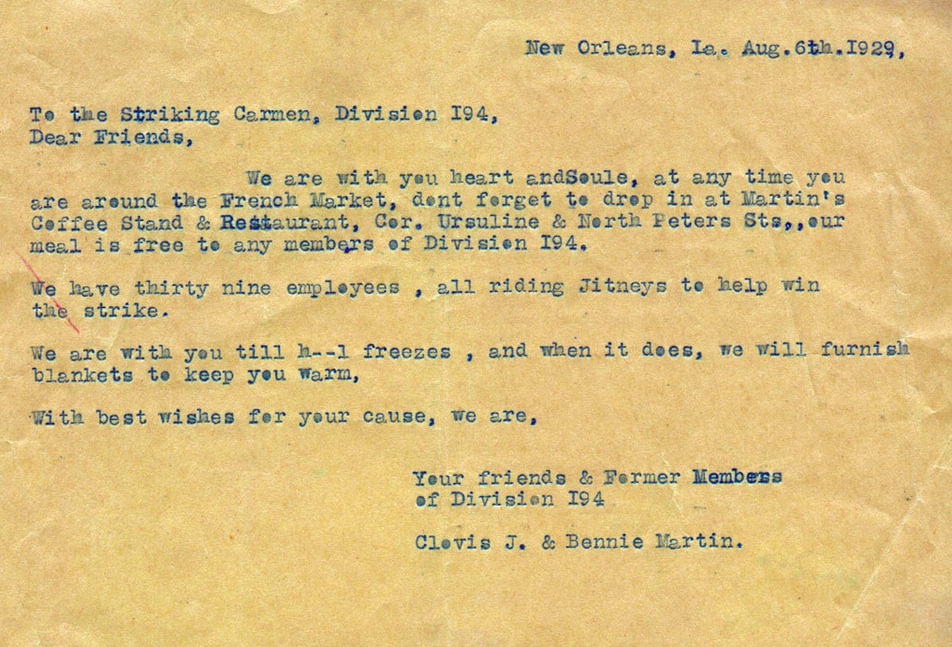
In an email today, I referenced the birth of the New Orleans sandwich that we call the po-boy, so I thought I would share the story more fully. The po-boy is a french bread sandwich loaded with seafood, meat or believe it or not, potatoes and gravy inside. The origin of this sandwich has to do with the streetcar strike in New Orleans in 1929: baker John Gendusa and restaurant owners Bennie and Clovis Martin made this sandwich and sold it as cheaply as possible to its customers and gave it for free to the “poor boys” on strike.
The telegram that the Martin Brothers sent the strikers is legendary in New Orleans:

Remember how the food world can support larger issues as an inspiration or simply as an economic haven for those on the front lines. Lucky for me, po-boys are still available everywhere in New Orleans, although the Martin Brothers restaurant closed in the 1970s: however, the Gendusa Bakery remains one of our beloved French bread bakeries in the city still.

New campus HQ OK’d for Nicholls culinary school

Believe it or not, my food obsessed city of New Orleans is NOT the home of a dozen first-rate culinary schools; well, actually zero would be the number that we currently have. There has long been talk of Johnson and Wales putting a school in the NOLa area, but this program and school in a new campus headquarters along the Mississippi River Delta of Louisiana (about 50 miles outside of New Orleans) appeals to me more.
Chef John Folse has been extremely dedicated in building this program and his deep commitment to finding homegrown food professionals is commendable, as has been his long time support of the region’s farmers markets. On top of that, he has the encyclopedia on Cajun and Creole cuisine, a highly regarded reference book: Folse Encyclopedia and his cheese making operation is also excellent and one of the few artisanal cheese operations at this level in our state: Bittersweet Plantation

So, to wrap up, a good guy who has done as much as he can to build food systems in his home state. More like him are always welcome.

New campus HQ OK'd for Nicholls culinary school.

Letter to a fellow food organizer

a colleague asked me to give her my opinion on trends and jobs in the alternative food system retail sector. Here is the beginning of my response:

Okay,
Here’s a few of my cents as requested:

As you know, the food hub conversation has taken a lot of the oxygen in the room (and a lot of the funding) away from direct farmer support and farmers markets and as a result, it feels like we are simply treading water in a lot of instances. Spread too thin. Certainly in the expansion of direct marketing farming or in getting any serious cross-sector analysis, we’re not jumping ahead much of where we were 5 years ago.

It’s not that I’m against food hubs, but some of them sound a lot like city governments’ “one-stop shops” which I am not sure has worked either. And it smacks of “scaling up” which is a suspect phrase to someone like me who has seen how long it takes a market farmer to really be ready to price at his or her comfort level and to innovate products. The Cliff Notes version of the market vendor lifespan is that it takes years of a market organizations time and “expertise” to patiently get a farmer to an economic and social comfort level where they actually tell you that they are about to go bankrupt or get divorced or get ready for a kid to go to college and so thats why their business is changing so you can help it change for the better. And that those folks are RETAIL vendors, with tables and tents and signs designed to help them sell retail, and not necessarily the same ones to approach or to change to wholesale vendors seems to be missed by some wholesale organizers.

Sometimes, it also feel that we are extrapolating the wrong lessons of what has worked to build food retail points of entry. Let me say I’m probably not “up” on all of the good work being done, although I do know and learn from original thinkers like Anthony Flaccavento’s and M. Shuman’s excellent research and analysis work. It’s just that the a lot of the scaling up and institutional buying conversation seems wildly uneven from case to case and the skills are simply not embedded into the host area to keep the thing moving forward once a founder leaves or a project fails.

What is true in the food system is that currently the public health sector rules, so therefore the conversation around low-income and at-risk end users of healthy food is the main thing being funded, which is a glorious turn around for those who always had the plan to take the food system there (meaning to everyone) no matter what anti-localvore writers try to say.<
10 years ago, the talk was all about social cohesion and dynamic Main Streets and 15 years before THAT, it was all about farmers extending seasons and growing sustainably, and it was always about doing it for everyone.

The public health sector is staying put, and learning more and more about how to use our points of entry to get results in true behavior change. That sector has changed farmers markets more than any other stakeholder (and that includes government stakeholders) because there are so many levels of public health intervention that they are willing to try wild ideas which often work and because they measure everything they do. However, I expect that the needle will move again-what will be the next issue that leads food system work- environmental impacts or immigrant issues or racial inequities or food safety or civic planning? Who knows really. Of course, it will depend on the crisis that shows up.

As for careers and jobs, it is my biased opinion that the open-air farmers market continues to rule the hearts (if not the minds) of most of the public while inside the food system, organizers favor the urban farm as the winning hand. Oddly, no one has brought these two together in any meaningful way or even examined the impacts of the two combined or separately beyond simple economic data or numbers of projects, as if quantity of projects really mean anything.

I think you know my obsession is with measuring the economic, social, human and natural capital of markets AND also with finding a way to make markets the entry point for training food organizers on all aspects of food system work. I foresee a national training program with skills trained in the first 6 months which are transferrable to all parts of the food system and beyond. Along those lines, there is already a push for a voluntary market manager accreditation system (which is beginning in places like Michigan) that might be similar in neighboring states so someone would have a leg up regionally if they have taken the training.
Add to that a yearly networking session for market managers and for those in my mythical training program and you may have the beginning of a movement, instead of rising and falling tide of new markets and projects every year.

And after all, the farmers markets remain the best fulcrum for food systems, so what happens there should matter to everyone else.

What also seems true is in the last 2-3 years the terrain has shifted a great deal, away from larger “big tent” orgs partnering on everything to much more nimble entrepreneurial types sharing knowledge on common problems and tactics. Regionality may once again become the strongest card we can use to strengthen our systems across state lines and across single issue campaigns to truly achieve success. Interestingly, this seems to also true in DC, where there is not one national policy shop office that truly represents the entire membership of most food organizers. Collaboration there has been somewhat successful.
But to leave markets for a minute (hate to do it but I will) I also believe that the wholesale food system is ready for a boost. And no, food hubs so far ain’t cutting it, as far as really reshaping buying habits of purchasers and institutions like the farmers markets HAVE been successful in re shaping the consumer’s buying habits- the 2-3 percent that listen, that is. THAT, of course, is another looming issue-98% of the public who have not used alternative food systems much. And even for the 2-3 percent, what is the actual change-one season? Farmers market shoppers become CSA members or vice versa? What about how they feel about the environment or local businesses after they stick to the market?

So research is needed in examining what is actually been done and not just the PROJECTS, but the efforts of stakeholders, the typology of successful farmers, and the efficient host organizations.
I would also say that as CFSC struggles with it’s post-strategic planning transition (speaking as a Board member for a few more months that assures you that that info is not secret but quite transparent and shared within the CFSC community) and Slow Food reexamines it’s work and searches for a new leader and FMC searches for a new leader, it may turn out all of the national organizations turn more to each other and others to collaborate more closely along with racial equity orgs like GFJI and Alliance for Building Capacity and IATP.

They might. So the collaboration points are a good place to look for work. Chapters? Maybe. Community unionism? Maybe. Or simply skill building and shared measurement in all partnerships. That would help. However, as we strengthen the regional orgs and multi-sector orgs more -since I’m sure im not the only one thinking this way- that may be where the jobs end up too.

In any case or in all cases, what seems clear to be missing in many cases is the entrepreneur’s point of view, whether its a farmer, or a baker or the neighboring business that needs that market or even the market or other food retail organization itself that seem to be considered built already and left out of the capacity building money. (I guess many feel we had our money moment, huh?) So maybe we need more innovative financing too, like CSEs or granny accounts or even to attempt the other part of a currency system-loans and massive fundraising in the market community itself, using the wooden token system as a starting point.
After all, its the entrepreneur is who needs to be encouraged. The entrepreneurs are who need to be analyzed. And entrepreneurs will be multiplying as corporations shut down and lay off more and more, and so seems like the most obvious point of expansion for work opportunities.
So to paraphrase Abigail Adams, …remember the entrepreneurs and be more generous and favorable to them than your ancestors.

Hope that helps, Darlene

Fruits We’ ll Never Taste

My own original Slow Food chapter leader (and emerging radio personality) Poppy Tooker coined the phrase “Eat it To Save It” as a way to link human need for good food to awareness of environmental trends. There is no question that if Americans could see, smell and taste what we have lost just in the 20th century as far as foodstuffs, we would have farmers as senators, mayors and presidents once again.

the book, “Salmon Nation People, Fish, and Our Common Home” is a great example of one region’s attempt to clarify what needs to be saved. Put out by a great regional ngo, Ecotrust, Salmon Nation is worth having in your library.
This article is also a great way to think about “untasteable foods.”

Fruits We' ll Never Taste.

SOURLANDS WORLD PREMIERE


SOURLANDS WORLD PREMIERE
When: June 27, 7 p.m.
Where:
Off-Broadstreet Theatre, Hopewell, NJ
Tickets:
$20 (includes light refreshments & glass of wine or beer)
How to Get Tickets:
sourland.org
(Note: This is the website of the Sourland Planning Council. Tickets not available quite yet!)

Celebrities: After the screening, stay for a Q&A with director Jared Flesher, Mercer County Naturalist Jenn Rogers, and Princeton University Energy Plant Manager Ted Borer.

Details: All proceeds from ticket sales will benefit the Sourland Planning Council, a local non-profit organization working to protect the ecological integrity, historical resources and special character of the Sourland Mountain region.

SOURLANDS FILM FESTIVAL PREMIERE
When: July 11, 7 p.m.
Where: Princeton Public Library
Tickets: Free and Open to the Public
How to Get Tickets: Just show up!

Celebrities: After the screening, stay for a Q&A with director Jared Flesher, native plant expert Jared Rosenbaum and Wattvision CEO Savraj Singh.

Details:
A special summer event of the Princeton Environmental Film Festival.

Here’s their trailer:
Sourlands

Let’s retake ugly food too

This report makes a great point about our unease with ugly fruit. I believe that the entire responsibility DOES go to those supermarkets that started to stage light and wax fruit for display. They have lost the ability to lure people in with smells or bursting ripeness. Let me also say that the finger pointing to the consumer in this story as the culprit is unsubstantiated; we have become conditioned based how food has been presented in our lifetime, and it’s up to the farmers markets (once again!) to change that perception with gentle encouragement.
WE can bring back the ugly fruit too, by simply encouraging our farmers to bring “seconds” and then to promote them. Why not ask the farmers to bring a few boxes that are not perfect and do as the Monica family in New Orleans does- label the box “chef special” which, of course brings every serious home cook to peer in the box and then drop their jaw at the lower price.
report

WWNO: Louisiana Eats 12-28-11: Year In Review

Poppy Tooker is a favorite of every serious (and lighthearted) food organizer in my region – and if you want to get honest about it – those smart ones far beyond her beloved Gumbo Nation.

I could go on and on about her, but let me say this: Food organizers should be so lucky as to have a Poppy Tooker in their midst. She has done many things, including being largely responsible for the speed in which we rebuilt our food system after the federal levee breaks by alternately cheering, cursing and championing those producers (and market managers like myself) that needed to get back up and running, finding us money and support and the words to explain ourselves.
For many years, she has reclaimed food and its dignity in dozens of ways, with unique style and dedication, even while making everyone shake their head with laughter or hide it in fear of her righteous wrath at times too.
All as a VOLUNTEER.
She wrote the glorious Crescent City Farmers Market cookbook and now finds herself a radio star of the first order on the public radio station in New Orleans. Listen to her online now, here, because she is going to be heard a lot more places soon, and you can say, “Oh Poppy? I been listening to her for YEARS..”

WWNO: Louisiana Eats 12-28-11: Year In Review (2011-12-28).

Utne Visionary

Food hero Gary Paul Nabhan surely deserves this award since his “place-based” food research has been groundbreaking for decades. “Coming Home To Eat” was the first short mile diet I read and it is quite different from the rest (still), with the cultural reclamation context he shares in it. His Renewing America’s Food Traditions (RAFT) work was immensely useful for me and my fellow organizers; the RAFT map (see below) is a wonderful representation of how America should be seen. Gary’s books range from a leisurely walk through a Franciscan walk in Italy to why peppers are heaven to some to his essays on desert life. Treat yourself:
Book list

Utne award

Southern Food

Although we have many barriers yet to remove in the South, we are lucky to have valued and retained a great deal of our food culture. We are also lucky to have Southern Foodways Alliance diligently working to capture history and help create new history too. Their website is a treasure trove of stories, recipes and facts of southern food. Their events often sell out quickly-for good reason.

One of the projects they have begun is a movie. Here is the filmmaker’s story:
Hey, I’m Joe York. I make documentaries for the Southern Foodways Alliance and the University of Mississippi’s Media & Documentary Projects Center. In early 2010, we began production of a feature-length documentary film with the oh so original working title of “Southern Food: The Movie”.
Read more about his project:
Movie

And become a member to stay in touch with all of their excellent work.