Food by Boat: The Appeal of Floating Farmers Markets | EcoSalon | Conscious Culture and Fashion.
Food by Boat: The Appeal of Floating Farmers Markets
0 CommentsLeave a comment
 Food Atlas by Darin Jensen
My rating: 4 of 5 stars
I love maps. When I travel, I study maps online to have some sense of the geography underfoot, as much to understand who the people might be as not to get lost. It’s amazing how people appreciate that bit of homework when you go to their place.
I have maps of my city (New Orleans) and of my river (Mississippi) on the wall of my house and the Slow Food RAFT map (see below) on my business card.

Slow Food RAFT map
When I came across the Kickstarter campaign for this Food Atlas, I jumped at the chance to support it. It arrived last week and I have read it while sipping my morning coffee (while reading about Strong Coffee traditions in the Middle East and “Bird Friendly” coffee origins), referred to it while writing about farmers markets (the one on SNAP and farmers markets) and studied the Texas Seafood Landings map after making flounder tacos just north of Lake Pontchartrain, home of most of the seafood catch for my bioregion. It’s a very new book and so won’t be found everywhere yet, but you can buy it from them now at
http://www.guerrillacartography.net/home
It is a wealth of maps on food production, distribution, security, exploration, identities and to pick out my favorites is to shortchange the breadth of this book.
It’s not just for activists, or “foodies” but for everyone and I think it could affect (and galvanize) people just as M. Pollan’s “The Omnivore’s Dilemna” did. I grow tired of long text articles about food (Yes, I do include myself in that finger pointing!) and would hope that this sort of map project could become a new way to educate and illuminate the small world that we live on.
I can’t wait for the editors to follow up on their promise to expand the reach of this series including to add more Asian and African food maps and to get this Atlas in hands everywhere. Its a bit heavy on maps of the West Coast and of the US, so much so that it occurs to me that having a set of food maps that show the lopsided view we have of ourselves in the US versus how others see us or experience us might be a good edition. In any case, hurrah.
..
The Healthy Farms Healthy People Coalition is sharing the below information, that was distributed by Steering Committee member organization, Public Health Institute.
Public Health Institute Call to Action:
Tell the Senate: America Depends on Our Nutrition Programs
On Wednesday the Senate Budget Committee began considering proposals that would slash billions from our country’s nutrition programs-reducing funding that provides SNAP (food stamps) to over 47 million Americans, and completely eliminating the nutrition education program SNAP-Ed. As budget conversations continue over the next few days, a proposal on the table from Senator Roberts, to slash $36 billion, is expected to be the first of many misdirected attempts to balance the budget by literally taking healthy foods off of people’s plates. The proposed cuts could go even higher, if we don’t stand up for nutrition programs today.
On the heels of last week’s devastating sequester cuts, we can’t afford to sever one of the most important safety nets for our poorest families. Cutting nutrition programs won’t reduce poverty, stop children from going hungry or provide resources that improve diets.
Call your senators.
We are very excited to invite you to participate in a Portland State University survey of organizations and businesses across the US and Canada involved in urban agriculture projects.
Urban agriculture is growing rapidly throughout North America, and we are interested to learn about the experiences of the organizations involved, as well as any obstacles they face. Municipalities have begun to craft new policies and regulations related to urban agriculture, and we hope that the information obtained from this study will help guide city planners and policymakers as they develop policies and programs that effectively meet the needs of practitioners.
This survey is intended for organizations and businesses, big or small, formal or informal, that are engaged in urban agriculture on any scale. The survey should take about 20 minutes to complete. Feel free to email us (urbanagsurvey@pdx.edu) or call Nathan McClintock at 503-725-4064 if you have any questions about the study.
We appreciate your time and interest. We’d also be grateful if you could forward this widely to your urban agriculture networks throughout the US and Canada – we know that there are many exciting urban agriculture initiatives that do not have a web presence, and we would like to hear from all the organizations that are doing this great work. Apologies in advance for cross-postings.
Follow this link to the Survey:
http://survey.qualtrics.com/WRQualtricsSurveyEngine/?SID=SV_9TOXJEPPQKIUSqx&_=1

Great points from Meter at the Illinois Farmers Market Association Thursday:
Community food systems build health, wealth, connection and capacity
Local food may be the best path toward economic recovery in U.S.
If we can’t grow an economy around food, how do we expect to grow it around windmills or technology?
Counting food miles matter less than banding business together to work for a social value.
Farmers often create systems that are often more efficient by reducing energy costs and using “waste” products to do value-added. Snowville Creamery in Pomeroy Ohio sells their skim to Jeni’s Splendid Ice Cream for a high quality ice cream product. Both businesses are innovating waste reduction and distribution systems that shorten the chain.
Community food systems don’t just measure the multiplier-they build the multiplier.
Southern Illinois farmers (Meter’s study) show that from 1969 to 2010 commodity farmers sold 1.1 billion worth of products and spent 1.1 billion in production costs during the same time.
1.8 billion amount of food bought in Southern Illinois region; 1.7 billion of it was produced outside of the region.
If every person in that region bought 5.00 of local food directly from local farms each week, farms would earn 191 million of new farm income (why not have a 5.00 campaign at farmers markets?)
The promise of permanent markets abroad in the 1970s drove farmers into the “Get big or get out” mindset and into more debt. Those permanent markets disappeared within the generation.
The link between the oil crisis of 1973 can most likely be directly linked to the obesity crisis: the oil crisis in the U.S. led to the rise of the corn economy which added high fructose corn syrup to production.
Viroqua, Wisconsin is a model of an economic development recovery after their national company that had supplied 85 jobs left town. The city government convinced the owner to sell their building for a small amount (explaining to the company that the investment that the county had made for 30 years maybe should be repaid before leaving).
Viroqua used 100,000 square foot building to start to build an entire local food system and expect to replace those 85 jobs within the next 2 years.
Spent most of Wednesday in a lovely room at historic LongueVue House and Gardens in New Orleans with bankers, community development coordinators and cooperative activists listening to economist/writer Michael Shuman describe different ways to encourage investment in localized systems.
His latest book, Local Dollars, Local Sense details strategies for creating investment in local systems as well as measuring the power of these systems. Michael is available to come to your community and have the same talk with YOUR investors and to expand your community’s knowledge about capital. I strongly encourage you to do that.
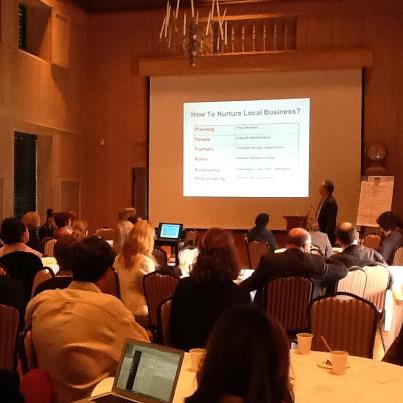
Shuman in New Orleans leading his Community Wealth Workshop
 The Town That Food Saved: How One Community Found Vitality in Local Food by Ben Hewitt
My rating: 4 of 5 stars
While in Burlington, VT for a series of meetings and the NOFA-VT Winter Conference, I stopped at the Crow Bookstore to see what I could pick up for background on Vermont’s agricultural movement to understand its emergence as a “direct marketing” flag bearer for the alternative food community.
The book is focused on Hardwick, Vermont a small town (3200 pop.) 30 miles from the capitol of Montpelier and an hour or so from Burlington.
Hewitt starts slowly with the idea of exploring Hardwick’s reputation as a “National Alternative Agricultural Star”, which he acknowledges has been made so by outside media, including Hewitt himself and The New York Times among others.
The book profiles a few of the Hardwick’s ag economy’s “leading citizens” including Tom Stearns of High Mowing Seeds, Pete Johnson of Pete’s Greens (at the time, the state’s largest CSA, along with mucho wholesale and farmers market sales), Andrew Meyer of Vermont Soy Company, and assorted others like Jasper Hills Farms, Tom Gilbert of Highfields Center For Composting, North Hardwick Dairy, Claire’s Restaurant, Buffalo Mountain Coop, Center For an Agricultural Economy, and a few individual farmers and neighbors who take the time to give their opinion on the state of things in Vermont. He lets those interviewed tell him the pros and cons of what they and their neighbors are creating. He finds a couple of schools of thought although all sides seem to agree that this is a revolution of one type or another. Some offer their analysis of the Hardwick story from the point of view of a small, committed group building new components for achieving wealth and knowledge to share while the others believe they show it through their independent but community-connected lifestyle that doesn’t want to “win” over the other guys and exists as the opposite of what American capitalism has weakly offered most places.
This book was helpful to me. I spend my life thinking about alternative food systems and most of that time working among the disciples of it rather than those not yet sure that it serves them. To his credit, that Hewitt includes a few voices critical of this system like Steve Gorelick and Suzanna Jones in Walden is incredibly useful and incredibly rare in books of this kind. Their argument is one that I hear less often but one that I actually agree with: the new system cannot be built on the industrial model: either from its economics, its scale or its terminology. Suzanna points out her loathing of terms like entrepreneurs and food security and gave me the first laugh of the book: “People are always doing stupid things in the name of groovy ag movements.”
Hewitt makes the fair point that much of what is being touted as local food is actually being exported or simply out of the reach for the cash-restricted Hardwick citizen. Those participating will agree but make the point that they are preparing the way for the next wave of farmers and entrepreneurs and boldly testing systems and new relationships.
He also considers the hard work and commitment that these new ag leaders are putting into building their projects. All of them are thinking about how to spread their worth and influence while showcasing their (often dazzling) project success to investors and policymakers.
I found Tom Gilbert to be a particularly effective champion for both sides of the argument, probably in part because he seems to see the holes that yet exist in it.
“We have not created a new system in Hardwick; we’re just rebuilding and utilizing the infrastructure that was already here. I think we let the media get ahead of us. People read all of this amazing stuff was happening and it put everyone’s expectations on steroids…This is a building process, and we’re not ready to put the roof on, because we haven’t put the walls up yet.”
Hewitt also includes one of the most elegant, simple descriptions of local systems that I have seen in recent years in the book. It’s on Page 172 and I could write it out (because I copied it!) but I think everyone should read it within context of the arguments made.
The question of how to measure these systems is also touched upon and since that questions is so near and dear to my own heart, I wish more time had been spent discussing that with the members of the community.
Near the end, Hewitt attempts to unravel the issue of scale, which also proves that he has done his homework because it seems to me to be the Kryptonite of alternative food systems. A comment from Tom Stearns near the end shows the complicated relationship that this community has with the issue: “There is the assumption that big is bad, but maybe it’s just that big is only bad when doing bad things.”
I can only imagine what Suzanna Jones thought about THAT statement.
The Town That Food Saved as the title seems to me to be one of the only under thought-out ideas in this book. Hardwick seems saved by its size, its wealth of shared intellectual capital (sorry Suzanna!) and by being in a state that offers a safety net to all and yet seems to try to leave its citizens alone.
As for food systems, Hewitt hits on the reason why alternative food systems are growing so quickly in Vermont when he talks about the editorial that the Hardwick Gazette printed, linking food system skills to participation in democratic systems, and he himself does it on the aforementioned page 172: the idea of being responsible for your own and your neighbors’ (read community in 21st century speak) quality of life has never gone out of fashion in Vermont.
To finish that argument, my go-to guy in this story (Tom Gilbert) said it very well: ‘One of my missions is to equip people with the tools for community health and sovereignty. I‘m most interested in how whole systems can be used to combat other forms of oppression.”
Amen brother. And pass the local cider.
In 2012, I did an introductory set of case studies on market structure to begin to get some good information to markets that are struggling with their founding or expansion.
The case studies that I did were of markets that had offered to share their background and systems with me that covered some regularly used types of governance.
However, I would like to stress that often when markets ask for help with their governance, what they really need is help designing appropriate management systems. In other words, if the market community has the ability to understand and even help decide on rules and decisions and manages its organizational risks well, then I often have to conclude that the governance is fine (although sometimes the pool of available advisors to serve is too small or maybe the work is as not clearly defined as it needs to be). What is more often in flux is the design of the management job and a market’s planning for project design.
It is clear that consultants need to have more options for management to match the many types of markets that exist. On top of that, how a market decides on projects to undertake every year should be more comprehensive than a manager’s good idea and willingness of volunteers to help.
I expect to do some work on management systems and project design in 2013 and to be able to share new resources. Until then, take a look at the Market Governance Case Study Report:
HPMG-MG report
DIY community organizing.
The late winter and spring are mad times for a farmers market consultant. The numbers of workshops and conferences has doubled or tripled in the last few years and every year since 2005 or so, I have been honored to be asked to present at 4 to 10 state or national convenings. I very much appreciate the opportunity to work with many market and market advocates at one time and to hear about new ideas and to meet some of those names I read from reports and posts on listserves.
In January, I spoke at NOFA-VT’s Direct Marketing Conference for the second year and I must say it’s a favorite of mine-a great mix of market organizers, farmers and agencies. Very focused and well attended. NOFA does an extremely professional job putting this on without showing the blood, sweat and maybe even tears, but knowing them its probably blood, sweat and laughs…
Part of why I went there was to conduct interviews with farmers and market operators to ensure their point of view is included within the state feasibility report that I am doing for NOFA and VAAFM (Vermont Agency of Agriculture, Food and Markets) on their EBT, WIC, FMNP systems and what steps it would take to build a comprehensive and universal system for their markets. (And no, I don’t ski or participate in winter sports so outdoor fun doesn’t factor in….)
Unfortunately, my schedule, vendors winter flu and other issues prevented me from getting enough interviews, so I decided to come back and to buttonhole some more folks at the other conference I have heard about from many Vermonters-NOFA’s Winter Conference. Workshops, TED talks, a multitude of different points of views from producers to “eaters” and a seed swap among many other things.
If you’re nearby and can make it, you might want to register and check it out for yourself. If you’re further away, you might want to download their brochure and put one on in your town.
The Kashi REAL Project™ is committed to helping solve the Real Food Deficit, and as a part of their ongoing efforts, have partnered with the non-profit Share Our Strength’s Cooking Matters® Colorado. Cooking Matters Colorado is tackling the Real Food Deficit by equipping families with the tools to make healthy meals at home, practice responsible food shopping, shift budgeting behaviors, and teaching children and families healthy eating habits that last a lifetime. For every poll answer, $1 is donated to help Cooking Matters Colorado** expand their cooking skills courses to more families and help build stronger, healthier communities.
I had just thinking recently what happened to communities doing grassroots assessments? Seemed like I used to read a great deal about those, and then not so much, and then along comes this excellent story…
Eradicating Food Deserts One Congregation at a Time | Civil Eats.
These end of the year pieces can be interesting and yet disheartening too. This one seems to have a social justice lens and as such, it may be slightly more focused on winning policy changes in the industrial ag sector over actual alternative system wins in 2012. However, I agree with most of her top 5.
Erin O'Donnell: The Food Movement in 2012: Our Top 5 Learnings.
 Helping Farmers Markets Grow