Beating the Monopolies: Barry Lynn Explains How We Will Win 


The first thing we have to say is, “I’m not a consumer. I am a citizen. I produce things. I produce labor. I produce goods. I produce ideas. I will have open and free markets into which to sell my goods, my ideas, my labor. There will be competition for my goods, my ideas, for my labor, and there will be no intermediary standing between me and my neighbors telling us how to do business with one another, just the way Sam Adams and John Hancock said back in 1773.” That’s the first thing we have to do.

The second thing is, for anyone who’s in a position of authority, a position of power, a position of leadership, this could be within your community, within your town, within your church, is just go out there and talk about this. You don’t have to figure out what the fixes are. There’s going to be a thousand fixes. There’s going to be 10,000 fixes. That’s the beauty of antitrust law, of anti-monopoly law, is we have an immense number of tools that we can bring to bear. What we have to do is see the problem, and help our fellows see the problem. We have to make it safe for other people on the Hill, on Capitol Hill, to talk about this.


podcast

Grocery and farmers markets

I just finished a blog post for FMC co-written with Alex Canepa about Amazon and Whole Foods. Our short answer in our rather long piece was we don’t know how this merger will affect food generally and local food specifically, but it doesn’t look promising.

Because of that post, I have spent even more time recently reading about grocery stores and food purchasing in reports from trade papers, some general books, and articles, all of which are sure of only a few things:

  1. Current storefront retail sales are sluggish.
  2. Consolidation of stores or of chains doesn’t help the consumer.
  3. Online sales of food is one of the few growth patterns in food but if anyone has figured out how to use this method to actually make a profit it’s still unknown.

One of the reasons why the media is obsessed with stories about the big chains is because the story is simpler: success only means profit which means either increasing the number of stores or same-store sales and no matter where you are in the US, it’s the exact same story. There is no need to worry about seasonal interruptions, cultural uniqueness or local factors or find other measures of success.

All of this means that in this age, the farmers market story has to be powerful, exciting and positive. The days of flyers in the coffeehouses and yard signs on market days as the only way to let folks know about the market are basically done.

The stories we tell need to encapsulate what our marvelous markets of the modern era actually do:

Offer civic space to all citizens, with no purchase necessary;

Introduce people to good food produced by their neighbors;

Increase access to healthy foods for our at-risk neighbors;

Encourage wise stewardship of land;

Champion the innovators of our good food system;

Support the larger food and farming system as leaders;

Advocate for better policies at the city, state, and national level.

All of that goes back to one of my action phrases for market leaders for 2017 which was laid out in this blog earlier this year:

Don’t Hide the Hard Work.

In order for the community you live in to understand how their markets do all of these things, the market organization needs to be constantly visible and engaged. The staff, board, advisors and anchor vendors need to let people know their role at the market, invite feedback and then share what they learn with the market community.

Language that defines those things markets do has to be put into metric form and shared regularly with the larger community. That is because anecdotes and stories are not enough for those who do not know us. They need simple and directed assertions as to why shopping directly for their food matters. They need it in 140 characters or less or in a single picture on Instagram or even told them by an influencer whose blog they follow.

Now, you may find those ideas ridiculous; I can understand that thinking as someone who gave up her smartphone a few years back (after being one of the first with a Blackberry, and then an iPhone and then an iPad), but the reality is mass communication has changed forever. And not just for young people: most studies of social media show that some channels – like Facebook – are increasingly used by older people. And not just how, but what they are looking for has changed. That is why the sector that is most sensitive to any change in people’s lives – grocery shopping – has become a free-for-all.

We need to face it head on and decide how the farmers market and larger good food system will flourish in spite of this chaos. Each market needs to check in on all of these areas above and ask itself how is it doing on each and then act upon the findings.

This is the best chance we have to not be submerged by the mess that is retail right now. By aligning ourselves and our farmers as community leaders and our markets not simply as sales outlets, we can continue our revolution even as the storefronts around us change names and focus and even in some cases, disappear from view.


Update: check out this story about the new NEW players in food: (and yes the first is “related” through the Albrecht family to Trader Joe’s): Aldi and Lidl.


Genius awards highlight recipients’ work around food, place and justice

The foundation’s prestigious “genius grants” were awarded to 24 people around the country, including a painter, a playwright, a mathematician, a social justice organizer, an immunologist and an urban planner. Recipients of the $625,000 awards, which come with no strings attached, are selected based on “exceptional creativity” and the promise and potential for important advances in subsequent work. Since the grant program started in 1981, 965 people have been named MacArthur Fellows.

• Greg Asbed co-founded the Coalition of Immokalee Workers in 1993 to combat injustices in the tomato-growing industry and in 2011 launched the coalition’s Fair Food Program, which uses the purchasing power of brands to compel growers to improve farm workers’ working conditions. The Florida Tomato Growers Exchange and over a dozen purchasers, including Walmart and major fast-food chains (except Wendy’s), have signed on to the Fair Food Program, which is monitored by the independent Fair Foods Standards Council.

• Inner-City Muslim Action Network (IMAN) Executive Director Rami Nashashibi a Palestinian American Muslim lauded for helping build partnerships across racial, religious and socioeconomic divides in Chicago’s most impoverished neighborhoods, said there is a “fierce urgency” to the current political climate. One of their projects is The Corner Store Campaign which addresses the long history of injurious business practices, ingrained racial tensions, and unhealthy food options that typifies many inner-city corner stores. Since its launch, the Campaign has focused on four critical goals:

  • Developing alternative business models for corner stores on Chicago’s South Side.
  • Using public policy to promote lasting change toward food justice.
  • Launching an education campaign that stresses the benefits of healthier lifestyles.
  • Healing racial tensions between Muslim and/or Arab store owners and their mostly Black patrons.

•Kate Orff is a landscape architect envisioning new forms of public space that reveal and revive the hidden ecological systems underlying our built environments and encourage urban residents to become active stewards of their natural surroundings. Orff is the founder of SCAPE, a landscape architecture firm with a focus on redesigning landscapes to deal with climate change, especially sea-level rise and flooding. Last year, SCAPE won the Buckminster Fuller Challenge for Living Breakwaters, a plan to improve coastal resiliency around Staten Island through oyster habitats. (The project was designed as part of the post-Sandy Rebuild by Design initiative from the federal government.)

• In 1997, Rich founded the Center for Urban Pedagogy (CUP) and, in collaboration with a group of other educators, advocates, artists, and architects, developed a roster of programs to engage community-based organizations and public school students in explorations of such topics as tenant rights, affordable housing, and infrastructure design. Rich’s focus on place, policy, and design has broadened to include development of more democratic urban planning mechanisms and design and construction of permanent physical spaces. He served as chief urban designer and director of planning (2008–2015) for Newark, New Jersey, a city marked by decades of disinvestment and sustained by traditions of political activism. There he worked with long-standing advocates like Ironbound Community Corporation to begin transforming Newark’s waterfront along the Passaic River with public parks, trails, and environmental installations. He also engaged a citywide coalition of neighborhood-based organizations in replacing Newark’s unwieldy and outdated zoning and land-use regulations with a user-friendly version (the first revision in over fifty years) based upon goals of environmental justice and accountable development.

All 2017 MacArthur Grant Recipients

Why strong and weak ties are both necessary

A good article that describes bridging and bonding types of social capital. It is important for markets to understand which of them are at play in their market and how that depends on the market type the community is building. Basically, a person gets comfort and advice from their strong ties (bonding) and new information from weak ties (bridging) and so both are helpful for any type of behavior change.

For example, Food Access and Neighborhood/Niche market types often prioritize bonding social capital, while Flagship and Main Street market types focus on bridging social capital.  There is no one answer to how to build (or to measure) social capital, but it is important for every intervention to understand the two and which is preferable based on the strategy involved.

At a time when the United States is becoming more starkly and rigidly unequal, when Americans are sorting themselves into demographically uniform clusters, we are evidence of the problem. We are, at least passively, the cause of the problem.

This is the downside of high neighborliness. It is a classic case of “bonding social capital,“ which tightens the weave of trust among people who are already alike—as opposed to “bridging social capital,” which helps generate trust among unlike groups.

Bonding capital makes for in-group loyalty and unity. But a civically healthy society depends on bridging capital, and what social scientist Mark Granovetter has called “the strength of weak ties.” America is sick today in part because the weak ties that used to be fostered by diverse neighborhoods and associations are dissipating….

The Worst Thing About Good Neighbors – CityLab

As we’re scrambling to fix health care, food stamps are quietly paying off.

I look forward to reading the report in total but I think any market community knows that focusing on healthy food is a very good indicator of the willingness for behavior change. Of course, I’d be interested to see how many participated in incentive campaigns and/or shopped at farmers markets with their SNAP dollars.

Berkowitz’s study looked at roughly 4,400 low-income adults, about 40% of whom were on SNAP. When Berkowitz’s team compared how much the average person in each group was spending on health care, they found the SNAP group spent about $1,400 less per year.

For comparison, the average single adult on SNAP receives about $1,500 a year in benefits.

A total of 4447 participants (2567 women and 1880 men) were enrolled in the study, mean (SE) age, 42.7 (0.5) years; 1889 were SNAP participants, and 2558 were not. Compared with other low-income adults, SNAP participants were younger (mean [SE] age, 40.3 [0.6] vs 44.1 [0.7] years), more likely to have public insurance or be uninsured (84.9% vs 67.7%), and more likely to be disabled (24.2% vs 10.6%) (P < .001 for all). In age- and gender-adjusted models, health care expenditures between those who did and did not participate in SNAP were similar (difference, $34; 95% CI, −$1097 to $1165). In fully adjusted models, SNAP was associated with lower estimated annual health care expenditures (−$1409; 95% CI, −$2694 to −$125). Sensitivity analyses were consistent with these results, also indicating that SNAP participation was associated with significantly lower estimated expenditures.

Source: story

In case anyone needs convincing:

Diet is the second highest risk factor for early death after smoking. Other high risks are high blood glucose which can lead to diabetes, high blood pressure, high body mass index (BMI) which is a measure of obesity, and high total cholesterol. All of these can be related to eating the wrong foods, although there are also other causes.
https://www.theguardian.com/society/2017/sep/14/poor-diet-is-a-factor-in-one-in-five-deaths-global-disease-study-reveals

Natural Disasters by Location: Rich Leave and Poor Get Poorer

Excellent analysis about the long-term effects of disasters on poverty increase.

Poverty rates also increased by one percentage point in areas hit by super-severe disasters. That suggests that people who aren’t poor are migrating out or that people who are poor are migrating in. It might also mean that the existing population transitioned into poverty.

Source: Natural Disasters by Location: Rich Leave and Poor Get Poorer – Scientific American

Nonprofit Fundraising: Venture Philanthropy

Venture philanthropy institutions are less averse to risks than typical foundations. This can give nonprofits more freedom to be open about their challenges and test whether or not their model is working. Having a venture philanthropist as a funder typically requires a heavy time investment including frequent calls, intensive support, and questioning. Be sure this is what they’re looking for. You should have criteria to determine which grants are right for you. How much time do you want to invest? Do you want a one time grant or a partnership? Venture philanthropy is not simply transactional funding.

Sometimes referred to as social entrepreneurialism, philanthropists may choose to provide start-up capital and loans to organizations that provide a social service and kick back revenue to pay for the investment. They usually have a mission focus. They then often use the investment payback to fund more projects in the community and are often non-profits themselves.

Tipping Point is one example of this type of investment. Since 2005, Tipping Point has raised more than $150 million to educate, employ, house and support those in need in the Bay Area. Last year alone, we helped put 23,000 people on a path out of poverty.

Source: Lessons from Funders

Place-making experiment tracks kindness, trust

How might a market measure this same idea?
Should we consider universal design choices that all markets could share that define farmers markets as a significant community space?

Visitors reported feeling 40% happier at the rainbow intersection than they did at a standard intersection a block away, and they were 60% more likely to want to meet friends there. They also believed that if they lost their wallet there, they were much more likely to get it back if a stranger found it.

Unique, trust-building places may also boost kindness. In an experiment Happy City conducted in Seattle, we discovered that pedestrians were actually kinder to strangers on streets when the sidewalks and building facades exhibited more detail and local character. We sent out actors posing as helpless tourists to different kinds of environments and watched to see how pedestrians treated them. On street edges with more small local shops and services, passers-by were more likely to stop and offer help than in nearby spaces lined with anonymous blank walls.
For years, public-space designers have measured their success primarily by measuring the number of people who linger in the places they create. Now we are beginning to see that public design influences our feelings and the way we treat other people, too. We’ve only begun to scratch the surface on the link between place-making and social trust.

https://qz.com/1056716/rainbow-painted-crosswalks-can-boost-trust-among-strangers/Story

How about a plan for January 20 and beyond?

I thought this deserved a repost based on the amount of direct action happening across many sectors.

DW's avatarHelping Farmers Markets Grow

Every direct marketing farmer and outlet has to be prepared for the next years of work, no matter what political affiliation one has. The reality is that many of the food and farming programs that we have worked to expand over the last few years may disappear, or at least shrink in size or in reach. As leaders, you should be cognizant of 3 levels of activism: advocacy, mobilization and organizing. Knowing the difference between those  is often the key to avoiding burnout and for engaging people successfully: actively educating others about ideas and needs around your market and its producers (advocacy), encouraging others to be active about those ideas and needs (mobilization),  teaching others to lead, defining tactics and building campaign strategies to push those ideas forward or to address a looming legislative crisis(organizing). There are wonderful resources like this one from NYFC to get up…

View original post 2,098 more words

Share with Charlottesville

I hope National Farmers Market Week was productive in your area. I hope your market received great support both from your community’s producers and its shoppers. I hope the media covered whatever event you hosted at your market. Good job everyone on spreading the news of our continued and expanding impacts.

Unfortunately, this was not the case for at least one market last weekend: the Charlottesville City Market, which was open for business on Saturday during the tragic events that happened two blocks away. Vendors and shoppers had courageously decided to show up, knowing the tense build-up over the past few days to the scheduled rally that afternoon. The market was attempting to do once again what it has done for many years: connect and comfort its citizens through the shared love of regional food and the championing of local creative output.

Instead, the name of its town is currently synonymous with riots and murder and the safety of its downtown with its lovely parks and pedestrian mall will be questioned, as it is likely to be threatened by more events like the ones that the world watched with horror last weekend.

I know this market. I have shopped there, gathered data there and discussed the hopes and dreams of its organizers and its vendors when there. It is like a great many of our markets across the country, located on underused weekend space, open to anyone and everyone, full of gorgeous produce and hand-crafted items proudly displayed by its makers. It is managed by the city and has been operating since the early 1970s, making it a “first wave” markets in my timeline of market eras.

This is what one regular market goer, William J. Antholis, Director and CEO of the Miller Center at UVA wrote about the market on this day:

My wife and I took our daughters for a walk around the protests, four blocks south (of their home), to the farmer’s market on the other side of the historic, pedestrian-only Downtown Mall. Immediately, we felt the sense of danger as fully armed white supremacist protestors walked dangerously close to counter-protestors. Taunts were already being hurled in both directions.

When we arrived at the market, we were surprised to find it eerily quiet. The market is usually packed on a Saturday morning. Row after row of beautiful heirloom tomatoes sat undisturbed, in a rainbow array of colors. Bread stands and coffee stands and local artisans had plenty of product, and not enough customers.

Stacy Miller, Farmers Market Coalition’s former Executive Director, has lived in Charlottesville for six years and is among the vendors at Charlottesville
City Market. Nervous about the potential for violence (and anticipating a slow
sales day, she said), she withdrew her participation several days before.

Several other vendors shared messages of solidarity and commitment to be there ‘come hell or high water’ on our public Facebook group. One said, specifically, “We won’t stand down for these terrorists! They come to our town uninvited and unwanted!… We will stand our grounds, with our fellow vendors and friends, against fascism, against xenophobia, against oppression!” While I certainly shared the sentiment, and I made sure to visit the market early to do my own shopping and wish good luck to those still setting up, I was eager to get back home, readying for other plans later that day. A helicopter (which may have been the same one crashing later that day) was already circling loudly overhead and would become my background noise nearly all day, as we barricaded into our little apartment. Thankfully, my husband was not working at the hospital that day, and we updated each other from various media sources, texts, and Twitter as things escalated, with photos of Nazis “indiscriminately” beating black youths in a parking garage. As my son napped (and, presumably, dreamed) 20 feet away, we quietly watched jerky, just-taken videos and photos of the black Charger with Ohio plates plowing through people on the downtown mall four blocks away, at an intersection I walked almost daily.”

When I read those quotes, I have to confess I had a little PTSD from my days of organizing New Orleans’ markets during hurricane seasons. As a matter of fact, on the Saturday before the landfall of Katrina our market manager, Tatum Evans was off so I was in charge of the day. The newscasters had told us on Thursday that the storm was to veer to Florida and any impact in the city would be negligible, so at that point, most locals stopped watching hour by hour updates.
Of course, since I was managing a market, I continued to monitor the weather and noticed the size of the storm and the lack of major movement eastward. I called vendors on Friday and told them they had the option of staying home, with no rent penalties for missing the day. Still, most showed up and as the day wore on, the tension in and around the market was palpable and the small number of shoppers also obvious. Stories of lines forming for gas and of panic rising around the city began to weigh on me and on our Executive Director Richard McCarthy who was calling me every half hour. Finally at 10:30, I closed the market.

I tell you that because as a result of that and other tense mornings in New Orleans, I felt the market’s anxiety in Charlottesville all the way down here in Louisiana, and I am sure many of you did too.

The use of public space for a public market is a heavy responsibility. Not only does one have to manage tender young businesses and seasoned ones side by side, but also shoulder the responsbility of managing risks of slip and falls, theft, disagreements, weather, dog bites and more crop up constantly.
And this last weekend, we saw once again that even when all of that is managed well, the danger around a market can still overwhelm its good intentions and positive vibe. (Update from C-ville market folks: The market was finally forced to close early because of the nearing clashes and the helicopters circling right overhead, making it impossible to communicate.)

I don’t really have a lesson to impart here. I just wanted to send my admiration to the Charlottesville City Market, to its manager Justin and to the entire team at the market, to its hard working vendors and its loyal shoppers and tell them that to me, YOU are Charlottesville. You are what I think about even as your city’s name is plastered across every news site and linked forever to a very, very bad day in American history.
I know that your market will once again become the center of health, wealth and good civic engagement. As a matter of fact, you will become that as early as next Saturday.
People will gather and hug and probably shed some tears in your lot. They will ask vendors how they are and vendors will ask that of their shoppers. Shoppers will tell vendors they hope they remain committed to coming to their downtown market and vendors will ask the same of their shoppers. The very best of what we do with farmers markets will become evident to everyone in Charlottesville over the next few weeks and months. Media will come to show “normal” activity returning and the market will know to embrace that opportunity and use it to encourage people to leave their homes and connect once again on Saturday mornings.
I know this because it is what happened to us during those months of darkness in 2005-2010.
And I know I was changed because of the love and care that the market community showed everyone here. I believe that markets do something that few other entities or ideas do in modern America: they build and keep community across age, background, political divides and socioeconomic status. I am proud to be part of that.
So let’s send out some good community energy to our friends in Charlottesville; I guarantee they’ll appreciate it.

Slow Food Nations sights

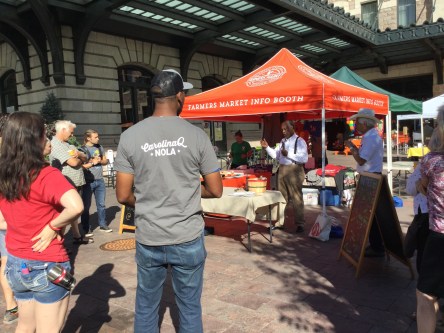
Check out my blog post on FMC’s site about what went on in Denver last weekend. Until then, here are some pics of the city and the events.

SFNLarimerSquare

Larimer Square

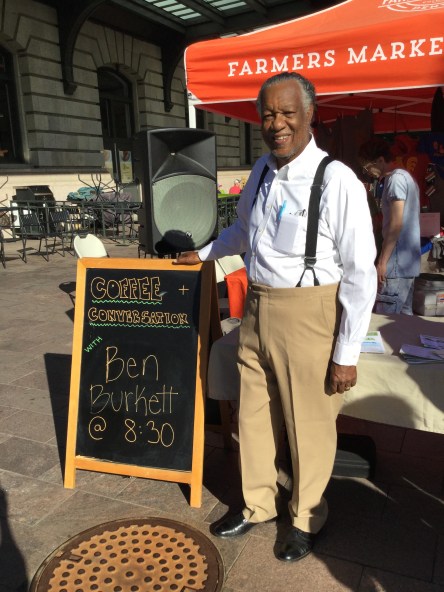
SFNC&CBurkett

Ben Burkett draws a crowd to Coffee and Conversation Sunday

BurkettFMDenver
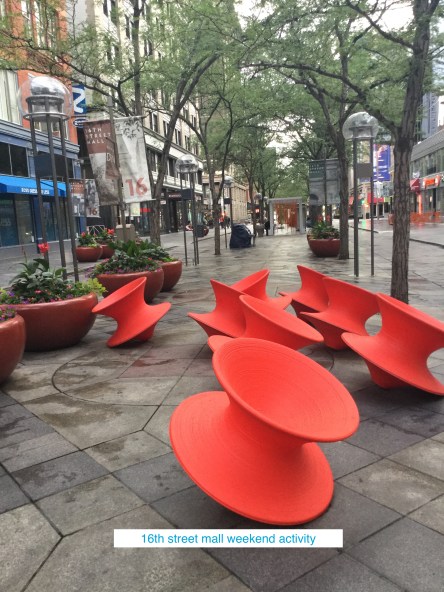
Cometogetherseating16th street mall

temporary seating on the 16th street mall for a separate Prototyping Festival

BCFM Temp tattooFMC

Longmont FM manager Genevieve Gross models FMC tat

BCFMManager

Genevieve shows off SF and FMC temp tats

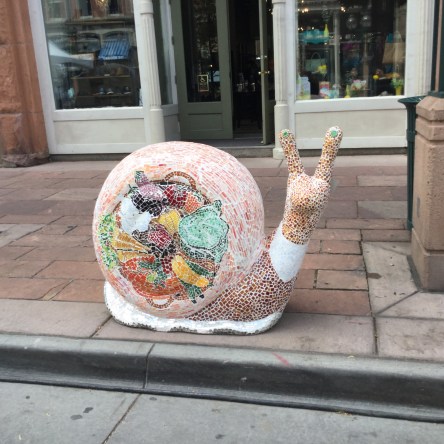
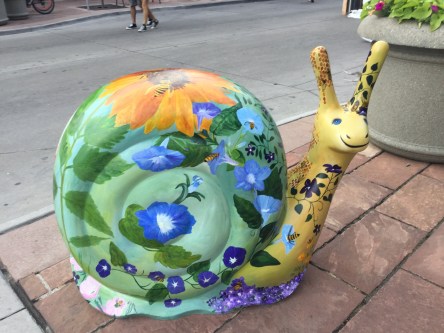
SFNSnail

SF snail

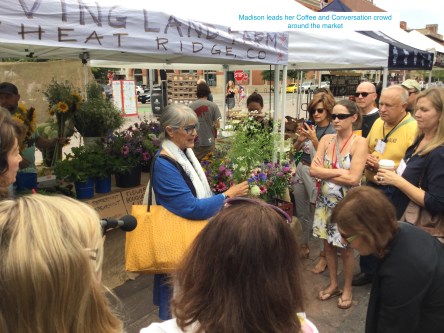
MadisonC&C

Author Deborah Madison tours the market during her Coffee and Conversation event

MadisonWaters@USFM

Alice Waters attends Madison event at the Saturday FM at Union Station

McCarthyWolnikSFN

Richard McCarthy and I meet up at SF Nations

McCarthyMexicoSFN

McCarthy captures set up team at Mexico tent

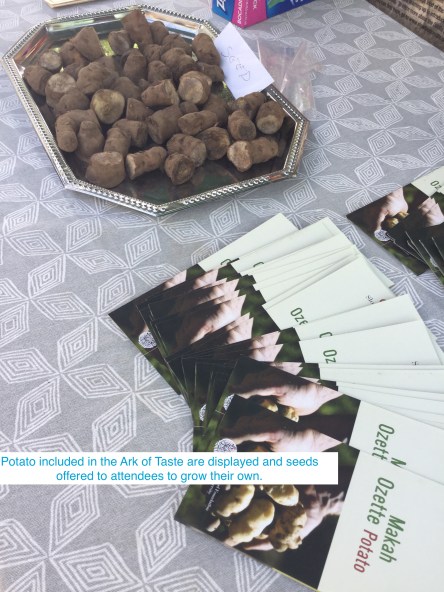
MakahOzettePotato

Ark of Taste potatoes available to save

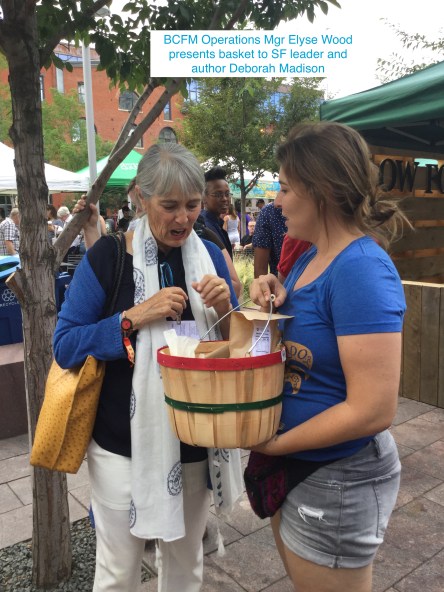
ElyseDeborahMadison

BCFM Operations Manager Elyse Wood presents basket of market goodies to Deborah Madison

Denver 16th street mall

Prototyping seating on 16th street mall

Snail

SF Snail

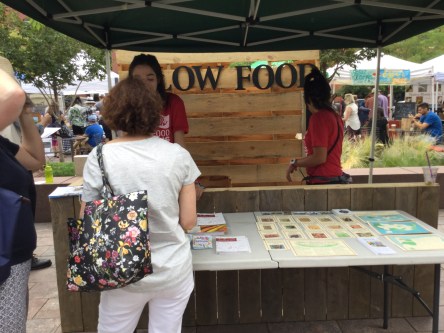
USFMsign
LarimerSq

Larimer Square

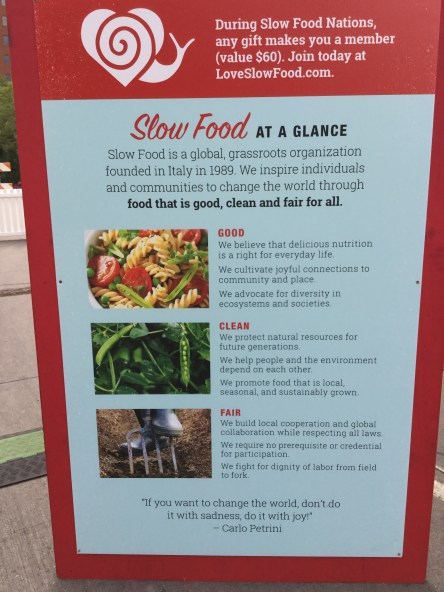
SF@glance
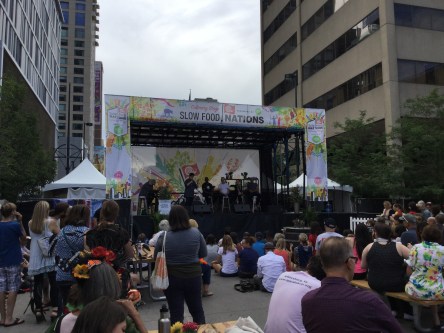
SFNstage

Crowd listens to SF Founder Carlo Petrini

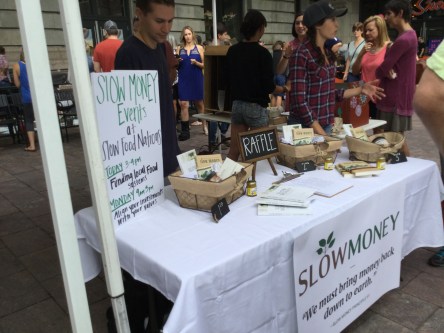
Slow MoneySF@UnionStationFMLocalCatchSFNFermentingChange
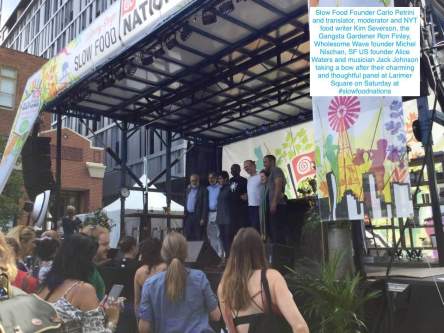
SF panel LS Petrini et al

Petrini and translator, Severson, Findley, Waters, Nischan and Johnson take a bow.

Food court or food hall: is there a difference?

To answer my own question to start:
I think there may be at least two instructive differences: one is that the food hall is about food AND social space and not simply an amenity offered while doing other retail shopping; second, the quality of the food is meant to be more artisanal or at least, of a higher quality than what most U.S. food courts offer. The food hall may be what James Rouse had in mind when he began to develop the festival marketplace decades back. Unfortunately just like that idea, the food hall will probably soon be used to describe every half-formed pitch for food aggregation that doesn’t really mean the same thing at all.

In one new food hall in New Orleans (St. Roch Market), the location had served as a public market long ago and is still owned by the city , but since 2005, the city had struggled with finding anyone who would manage the site to offer food to the neighborhood. One issue was the price tag needed to renovate the structure that the city wanted to split with the user. Another was the lack of parking and (small) size. Still, in terms of conversation among locals about how it should be used, it was a very hot property. I was even asked to write about this particular site  before the food hall idea had been fully formed:

Finally from a need to check it off the “done”lost, the city did a smaller renovation and chose a young entrepreneur to develop it from the white box they offered. Since its opening, it has become a bit of a lightning rod about trendy food places and gentrification. It has its defenders, mostly millennials and visitors to the city, who use it for easy-to-plan group meet-ups with food and drink.

Some of the original group of vendors chosen have already moved on and some of their issues led one alternative paper to accuse the operators of cronyism. Other vendors have moved to other locations better suited to their demographic or operational needs.
Then there was a late-night graffiti spree caught on video that started another round of pros and cons on the site’s current use while on the edge of one poor neighborhood and directly across from a more gentrified one.
I have heard that since the opening of St. Roch the operator is being asked to develop 2-3 more of these food halls, with at least one in New Orleans and another in Florida.

Clearly, this trend requires some watching for food organizers and maybe some local analysis.
BI story on food halls