Harvest of Change

An engaging interactive story on today’s agribusiness sector from the Des Moines Register and USA Today.

Amid all the challenges, farmers find lucrative markets shaped by shifting consumer tastes. Farmers markets, where consumers can interact directly with the growers of their food, expanded steadily in the USA from 1994 to 2014, almost quintupling to 8,268, according to the U.S. Department of Agriculture.

In 2012, fresh fruits and vegetables sold directly to consumers were a $1.3 billion industry, up 8% since 2007, the census found. That same year, organic food sales reached about $27 billion, according to the USDA, up from $11 billion in 2004.

link to the 5-part story in The Register

Harvest of Change.

Inside the ‘Pay What You Want’ Marketplace

I wonder how many markets reach out to the yard sale-rs as potential shoppers? An ad in the paper near the listings perhaps? Or creating an event for a cookbook swap or a kitchen item swap at the market? This is one way markets can utilize the ecological community that connects farmers markets to other like-minded re-users interested in less packaging and waste in modern society.

The informal economy [of the yard sale] grants consumers much more power to stretch the value of their dollar—which has become especially crucial in the context of the Great Recession and other times of economic stress and uncertainty, where yard sales and other means of informal trade can be a survival strategy for many middle- and lower-class people.

Story

Training Your Brain to Prefer Healthy Foods

Scientists have suspected that, once unhealthy food addiction circuits are established, they may be hard or impossible to reverse, subjecting people who have gained weight to a lifetime of unhealthy food cravings and temptation. To find out whether the brain can be re-trained to support healthy food choices, Roberts and colleagues studied the reward system in thirteen overweight and obese men and women, eight of whom were participants in a new weight loss program designed by Tufts University researchers and five who were in a control group and were not enrolled in the program.

“We don’t start out in life loving French fries and hating, for example, whole wheat pasta,” said senior and co-corresponding author Susan B. Roberts, Ph.D., director of the Energy Metabolism Laboratory at the USDA HNRCA, who is also a professor at the Friedman School of Nutrition Science and Policy at Tufts University and an adjunct professor of psychiatry at Tufts University School of Medicine. “This conditioning happens over time in response to eating – repeatedly! – what is out there in the toxic food environment.”

Training Your Brain to Prefer Healthy Foods.

Plastic versus paper

From USAToday:

There’s a growing generation gap when it comes to using plastic for purchases under $5, a survey out this week by CreditCards.com reveals. More than half of Millennials are likely to whip out a card for a pack of gum or a newspaper, while 77% of people older than 50 still dig out cash.

The plastic cards young people are reaching for at cash registers these days are overwhelmingly debit. Those ages 18 to 29 favor debit over credit by a ratio of almost 3 to 1, the survey of 983 credit card holders showed.

Other findings from the survey, conducted by Princeton Survey Research Associates International for CreditCards.com done July 17-20 and July 24-27:
• Overall, 65% of Americans typically pay for purchases under $5 with cash; 22% use debit cards, and 11% use credit cards.
• Cash is the preferred payment method for almost eight in 10 rural card holders, vs. 62% of city dwellers and suburbanites.

Gulf Coast, 9 years later: Still unfinished.

The link below is from my New Orleans blog that details our life here post Katrina: today August 29th, it will be 9 years since that terrible day when our region suffered through the hurricane and then through the much larger federal levee disaster.

We community organizers learned that we needed to be constantly available to our family, our friends and neighbors (including our farmers and fishers) as they rebuilt their lives and businesses. And we had to carry the story of citizen-led recovery to our colleagues in other places while remaining vigilant when home to help combat bad ideas from our decision makers.
We still need to do that work unfortunately.
Some of this piece may be too local, but the sentiment is clear I think. Basically, the years of 2010/2011 were when we really began to really feel the pressure from corporations trying to find deals; this post tells some of what we were going through:

“We are now coming up to 6 years after the federal levee system disintegrated in New Orleans. When we look around, do we see our old neighbors, a resurgence in small mom and pop businesses, and a generally more livable city than before?
I’d say no….”

Complete post from New Orleans Can Thrive

Graphic and misleading title: “Local food might not be as ‘local’ as you think”

An example of how the media reports unfairly on farmers markets; the idea that each market community decides its own definition of local is clear in the graphic, but the headline is misleading. It would be better and more appropriate if the story was titled:
Each community decides local for itself
Graphic: Local food might not be as 'local' as you think.

Survey Monkey sez start with your conclusion

Writing your conclusion first is just like proposing a hypothesis for a science experiment.

How America’s Largest Worker Owned Co-Op Lifts People Out of Poverty

New York City is going—in a big way—for worker-owned cooperatives. Inspired by the model of CHCA and prodded by a new network of co-op members and enthusiasts, Mayor Bill de Blasio and the New York City Council allocated $1.2 million to support worker cooperatives in 2015’s budget. According to the Democracy at Work Institute, New York’s investment in co-ops is the largest by any U.S. city government to date.

Cooperatives are businesses owned and controlled by their members on the basis of one member, one vote. Given enough time, worker-owned cooperatives tend to increase wages and improve working conditions, and advocates say a local co-op generally stays where it’s founded and acts as a leadership-building force.

How America's Largest Worker Owned Co-Op Lifts People Out of Poverty | Common Dreams | Breaking News & Views for the Progressive Community.

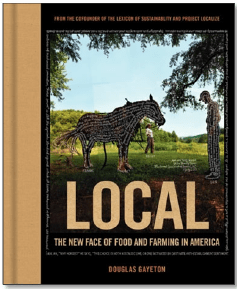
Can the lexicon of local make a global impact? Book review by Stacy Miller

LOCALLexiconBk

You may want to check out the Journal of Agriculture, Food Systems, and Community Development’s (JAFSCD) “Book Nook”, which contains in-depth reviews of current books on food systems. The link at the end of this post directs you to a review of a new book on the language of sustainability: Local: The New Face of Food and Farming in America, by Douglas Gayeton. The review is by Stacy Miller, who many readers will know as the Farmers Market Coalition’s founding Executive Director. Stacy is now working as an independent consultant and as a FMC Program Advisor and also spends some of her time valiantly untangling my words by serving as an editor or by offering some spot analysis for many of the reports that I am doing for markets and their advocates.

Finding the appropriate bright and brave words to describe the energetic nature of a farmers market as well as the larger food system work happening is something we both think about in this work that we do and she probably had to think about daily as the FMC director. I can remember a day in her kitchen when we wrote down and discussed lots of words to describe what became the skeleton of the Farmers Market Metrics project at FMC and how we had to leave it unfinished when I left town a day later, promising to return to it. We did, and still do good-naturedly debate (alongside our colleagues at FMC and University of Wisconsin) for and against the use of different words and definitions within that metrics work.
So, to expand her thinking to this lovely book on the entire realm of sustainability language in our farming and food world seems mighty appropriate. Here are a few of my favorite passages from her review, linked below:

“The idea that language is fundamental to social movements is nothing new. The power to bestow names on objects, people, places, and philosophies is undervalued, so we hardly notice when it gets abused. Noam Chomsky famously observed that
destructive paradigms thrive because they impose on people “the feeling that they really are incompetent to deal with complex and important issues: they’d better leave it to the captain” (Chomsky,1987, p. 42).”

“I give a lot of credit to a former film director who can find a compelling poster child for, and condense the complexities of, expansive terms like economies of community (see Figure 1), soil food web, GMO, or traceability.”

“The hypothesis behind the Lexicon of​ ​ Sustainability is compelling… We tune​ ​out vocabulary we don’t understand, avoid dialogue ​ ​or questions that make us feel ill-informed or​ ​hopeless, and thereby enable a cycle of peripheral ​ ​awareness that looks dangerously like apathy. And​ ​the corporate food monopolies take advantage of ​ ​this whenever they can — on packaging, in advertising,​ ​and in lobbying efforts designed to “protect ​ ​us” from too much information.”

I will pass this review to many of my colleagues and will also get this book based on her review and pass that around too. What better can be said?

DATA + DESIGN A simple introduction to preparing and visualizing information

A free online book to data visualization by the creators of Infoactive. I am proud to be a Kickstarter backer of this innovative company and hope we can lure them into the farmers market/food system world of data collection. This book came out of that campaign and-well, maybe just read what the author said about how the book came to be:

“It started with a message on Kickstarter:
Hi Trina! Stats dork from Chicago here….Do you have any plans to include tutorials for basic data cleaning and data selection techniques for users who may not have any statistics background?
At the time, I didn’t know that this one message would turn into a book, a community, and a global endeavor to make information design more accessible.

The message author, Dyanna Gregory, was a statistical programmer who knew the challenges of teaching university-level stats to those who don’t identify as math nerds. I was an entrepreneur building Infoactive, a web application to help people create interactive infographics and data visualizations. I was also a Reynolds Fellow at the Donald W. Reynolds Journalism Institute where my goal was to find ways to simplify the process of making data visualizations in newsrooms. I had launched a Kickstarter campaign to support Infoactive, and we had nearly 1,500 backers who were excited about breaking down barriers in data visualization.

We all believed in the vision of making data simple.

But working with data can be far from simple. Data come in all different shapes, sizes, and flavors. There’s no one-size-fits-all solution to collecting, understanding, and visualizing information. Some people spend years studying the topic through statistics, mathematics, design, and computer science. And many people want a bit of extra help getting started.”

Link to book

FNS begins process to offer grants for replacement EBT services and equipment

This is a pre-solicitation notice to assist Department of Agriculture (USDA), Food and Nutrition Service (FNS) and State agencies to establish a process to award support grants to eligible farmers’ markets and to develop a method that offer replacement Supplemental Nutrition Assistance Program Electronic Benefits Transaction (SNAP EBT) equipment and services for farmers’ markets and direct-marketing farmers.
The solicitation package will be posted on fedbizopps on or August 22, 2014. All additional details (i.e. closing date, FAR Clauses, Evaluation Factors) will be included in the solicitation package.

The request for proposal (RFP) will have a two part evaluation. Part 1 will be evaluated using a pass/fail evaluation. Part 1 evaluation factor is Experience: Offeros shall demonstrate experience with Farmers Markets and direct-marketing farmers nationwide and associated partnership experience working with the Farmer Market and direct-marketing farmer.

RFP

Part 2 evaluation factors will be provided in the solicitation package.

Alternatively, interested parties may go to https://www.fbo.gov/ and search for the Notice by using the solicitation number AG82014.