Products increasing at farmers markets

The Monica family, who have been Crescent City Farmers Market vendors for more than a dozen years, continue to add new products derived from the markets products already grown and offered.
Their evolution as savvy and leading market vendors has been remarkable and a pleasure to watch.

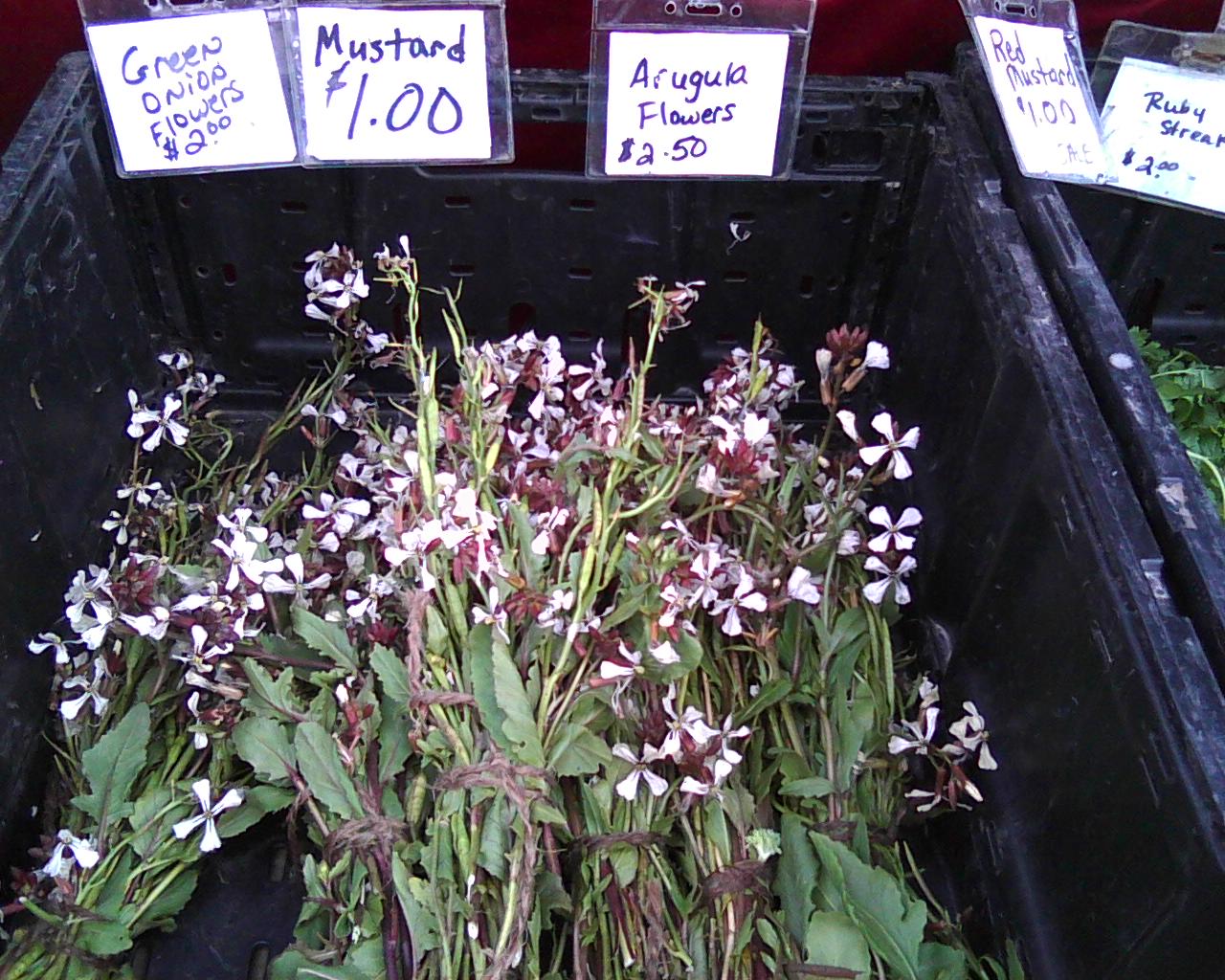
Arugula flowers

Arugula flowers

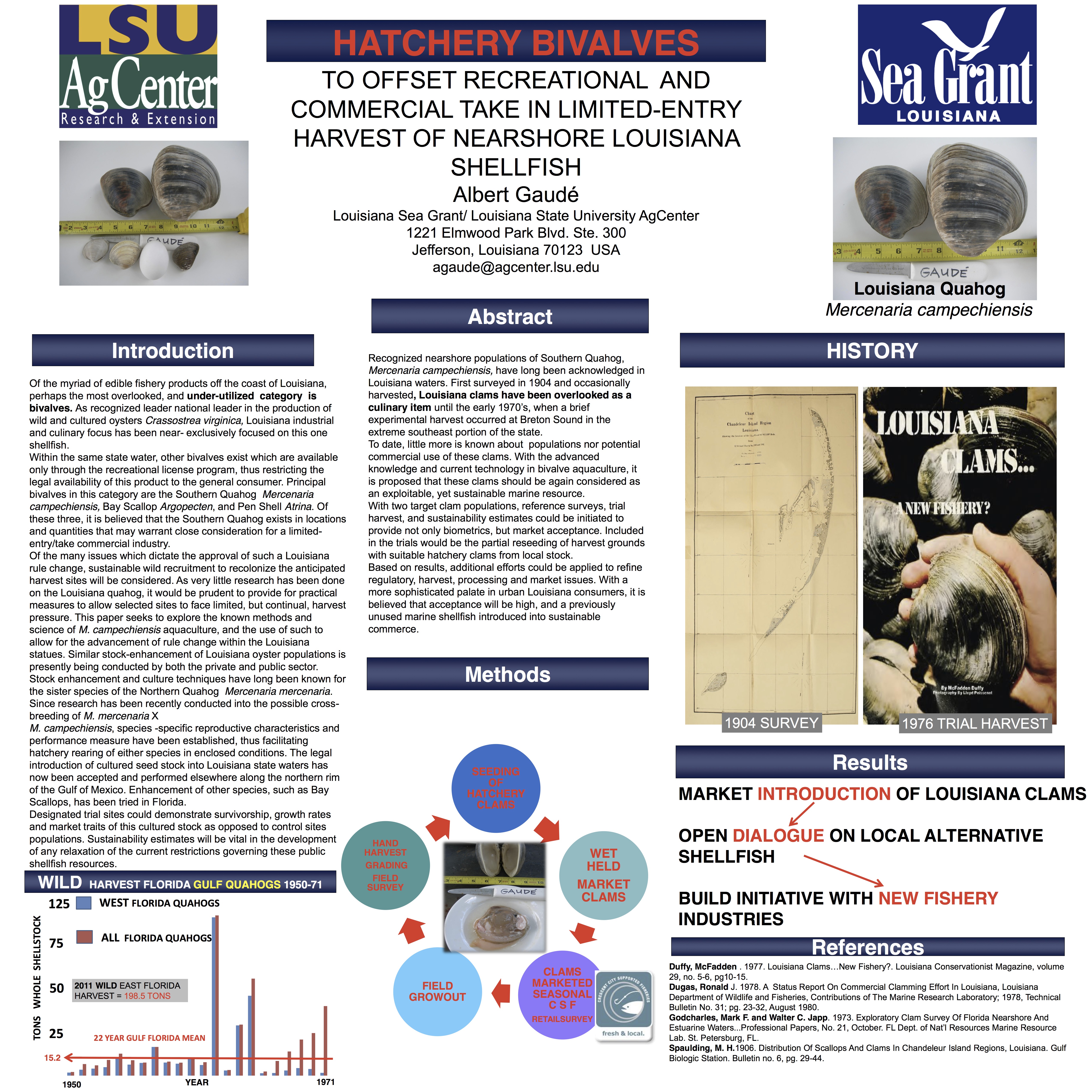
Bivalve Project from Louisiana

Fisheries Agent Rusty Gaude has long advocated for more production of the Southern Quahog, Mercenaria campechiensis and sees it as a possible new direction of direct marketing to offset the reduced output of oyster production in Southeast Louisiana. He has served on the New Orleans farmers market board and is advocating that the bivalve test be carried out as part of the Crescent City Supported Fisheries project. This project is done during Lent each year, where Crescent City Farmers Market shoppers can preorder a bag each week of seafood caught by the family fishers at the market.

WAS Nashville Poster

Review of “Black, White and Green: Farmers Markets, Race and the Green Economy”

Black, White, and Green: Farmers Markets, Race, and the Green EconomyBlack, White, and Green: Farmers Markets, Race, and the Green Economy by Alison Hope Alkon
My rating: 3 of 5 stars

Very well done snapshot of a piece of the Northern California local food system, especially its history. As much as I thought I knew, I learned some more about how it began from this book. I appreciated that this book was centered around these two farmers markets and their environmental and social justice leanings, which is a great lens to view multiple types of organizing, intentions and sets of outcomes.
I especially like the time she takes to link the work in each market to their larger community goals AND to the economic goals of the green economy.

here are some wonderful passages on the tensions and values of this emerging alternative system:

“One becomes an environmentalist, for example, through the consumption of green products such as organic food rather than the traditional means of voting, lobbying or attending protests. While this strategy allows supporters to inscribe their social movement goals into their everyday life practices. it also creates individuals who infuse the logic of the market into both their ordinary behavior and their desires for social change (Larner and Craig 1999)”

“The promise of the green economy is that the market can be made to value, and therefore to protect, humans and the environment.”

“In these markets, actors choose from among competing narratives to envision and emphasize the spaces where buying and selling green products leads to environmental protection and social justice.”

“Furthermore, proponents of the social change potential of the green economy attempt to redefine capitalism not as an exploitative system that must be overcome or restricted in order to protect people and the environment but as a tool to create a more just and sustainable world.”

“…Working towards these goals (environmental sustainability and social justice) becomes possible, in part, because participants in each farmers markets define environment and justice in ways that render them compatible with one another.”

“The compatibility between sustainability and justice achieved at these farmers markets is not inherent. Farmers market managers, as well as some vendors and regular customers, actively work to conceptualize strategies that speak to both goals.”
>As a community food system organizer, I believe this book is a necessary whistle stop on anyone’s travels to successful organizing around food.
Take the time to read this thoughtful book and then pass it along to your friends and comrades.

View all my reviews

Bill McKibben’ s Math Starts Adding Up

Standing in front of an estimated crowd of 50,000 people gathered for the Forward on Climate rally yesterday on the National Mall in Washington, D.C. he said, “All I ever wanted to see was a movement of people to stop climate change, and now I’ve seen it.”

Certainly, anyone involved in shortening the food chain and shifting the power structure of wealth and health in this world should have Bill McKibben as one of their bookmarked writers. What I really like about this story is the excitement he has in the movement itself. I look forward to this day with our sub-sect of community food system community.

When asked what he thought winning would require, McKibben said, “I’ve got no idea. It will take more than any of us can imagine.” That might be surprising coming from a man so concerned with numbers and so good at making them compelling. But right now, the only math that seems to matter to him is how long it has taken to get to this point. And for that reason, he’s savoring the moment.

Read more: http://www.utne.com/environment/bill-mckibbens-math-starts-adding-up.aspx#ixzz2MVdRmHwy

Community Wealth Workshop

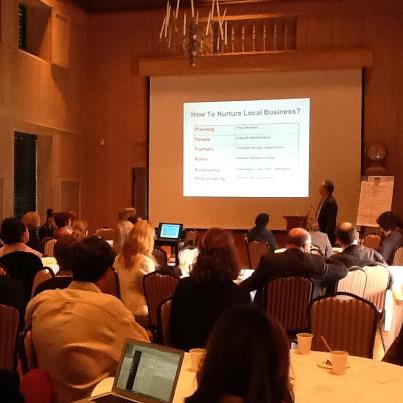
Spent most of Wednesday in a lovely room at historic LongueVue House and Gardens in New Orleans with bankers, community development coordinators and cooperative activists listening to economist/writer Michael Shuman describe different ways to encourage investment in localized systems.
His latest book, Local Dollars, Local Sense details strategies for creating investment in local systems as well as measuring the power of these systems. Michael is available to come to your community and have the same talk with YOUR investors and to expand your community’s knowledge about capital. I strongly encourage you to do that.

Shuman in New Orleans leading his Community Wealth Workshop

Shuman in New Orleans leading his Community Wealth Workshop

Review of “The Town That Food Saved”

The Town That Food Saved: How One Community Found Vitality in Local FoodThe Town That Food Saved: How One Community Found Vitality in Local Food by Ben Hewitt
My rating: 4 of 5 stars

While in Burlington, VT for a series of meetings and the NOFA-VT Winter Conference, I stopped at the Crow Bookstore to see what I could pick up for background on Vermont’s agricultural movement to understand its emergence as a “direct marketing” flag bearer for the alternative food community.

The book is focused on Hardwick, Vermont a small town (3200 pop.) 30 miles from the capitol of Montpelier and an hour or so from Burlington.
Hewitt starts slowly with the idea of exploring Hardwick’s reputation as a “National Alternative Agricultural Star”, which he acknowledges has been made so by outside media, including Hewitt himself and The New York Times among others.
The book profiles a few of the Hardwick’s ag economy’s “leading citizens” including Tom Stearns of High Mowing Seeds, Pete Johnson of Pete’s Greens (at the time, the state’s largest CSA, along with mucho wholesale and farmers market sales), Andrew Meyer of Vermont Soy Company, and assorted others like Jasper Hills Farms, Tom Gilbert of Highfields Center For Composting, North Hardwick Dairy, Claire’s Restaurant, Buffalo Mountain Coop, Center For an Agricultural Economy, and a few individual farmers and neighbors who take the time to give their opinion on the state of things in Vermont. He lets those interviewed tell him the pros and cons of what they and their neighbors are creating. He finds a couple of schools of thought although all sides seem to agree that this is a revolution of one type or another. Some offer their analysis of the Hardwick story from the point of view of a small, committed group building new components for achieving wealth and knowledge to share while the others believe they show it through their independent but community-connected lifestyle that doesn’t want to “win” over the other guys and exists as the opposite of what American capitalism has weakly offered most places.

This book was helpful to me. I spend my life thinking about alternative food systems and most of that time working among the disciples of it rather than those not yet sure that it serves them. To his credit, that Hewitt includes a few voices critical of this system like Steve Gorelick and Suzanna Jones in Walden is incredibly useful and incredibly rare in books of this kind. Their argument is one that I hear less often but one that I actually agree with: the new system cannot be built on the industrial model: either from its economics, its scale or its terminology. Suzanna points out her loathing of terms like entrepreneurs and food security and gave me the first laugh of the book: “People are always doing stupid things in the name of groovy ag movements.”

Hewitt makes the fair point that much of what is being touted as local food is actually being exported or simply out of the reach for the cash-restricted Hardwick citizen. Those participating will agree but make the point that they are preparing the way for the next wave of farmers and entrepreneurs and boldly testing systems and new relationships.
He also considers the hard work and commitment that these new ag leaders are putting into building their projects. All of them are thinking about how to spread their worth and influence while showcasing their (often dazzling) project success to investors and policymakers.
I found Tom Gilbert to be a particularly effective champion for both sides of the argument, probably in part because he seems to see the holes that yet exist in it.
“We have not created a new system in Hardwick; we’re just rebuilding and utilizing the infrastructure that was already here. I think we let the media get ahead of us. People read all of this amazing stuff was happening and it put everyone’s expectations on steroids…This is a building process, and we’re not ready to put the roof on, because we haven’t put the walls up yet.”
Hewitt also includes one of the most elegant, simple descriptions of local systems that I have seen in recent years in the book. It’s on Page 172 and I could write it out (because I copied it!) but I think everyone should read it within context of the arguments made.
The question of how to measure these systems is also touched upon and since that questions is so near and dear to my own heart, I wish more time had been spent discussing that with the members of the community.
Near the end, Hewitt attempts to unravel the issue of scale, which also proves that he has done his homework because it seems to me to be the Kryptonite of alternative food systems. A comment from Tom Stearns near the end shows the complicated relationship that this community has with the issue: “There is the assumption that big is bad, but maybe it’s just that big is only bad when doing bad things.”
I can only imagine what Suzanna Jones thought about THAT statement.

The Town That Food Saved as the title seems to me to be one of the only under thought-out ideas in this book. Hardwick seems saved by its size, its wealth of shared intellectual capital (sorry Suzanna!) and by being in a state that offers a safety net to all and yet seems to try to leave its citizens alone.
As for food systems, Hewitt hits on the reason why alternative food systems are growing so quickly in Vermont when he talks about the editorial that the Hardwick Gazette printed, linking food system skills to participation in democratic systems, and he himself does it on the aforementioned page 172: the idea of being responsible for your own and your neighbors’ (read community in 21st century speak) quality of life has never gone out of fashion in Vermont.
To finish that argument, my go-to guy in this story (Tom Gilbert) said it very well: ‘One of my missions is to equip people with the tools for community health and sovereignty. I‘m most interested in how whole systems can be used to combat other forms of oppression.”
Amen brother. And pass the local cider.

View all my reviews
The passing of a volunteer and friend

Just got word that a longtime volunteer of the Crescent City Farmers Market and a personal friend passed away this week. Judy Serice was there near the beginning with the small group that founder Richard McCarthy gathered around him to help him build this dream. Judy was a true fan of the market and for the rest of her life, she always championed it in every way possible. A champion cook herself- she won a category of the Pillsbury Bake-Off with (I believe) her chicken and dumplings recipe. I’m actually angry with myself that I remember neither the details of the year (1970?) or the dish exactly, because I used to send Judy into peals of laughter when I introduced her and knew all of the details.  (She also later won our Orange Julius contest partly because of her making the recipe at market in her “vintage” green mixing blender.)

Judy was a teacher by trade, a chef by talent and a mother by choice. She had a thoroughly modern view of the world, but honored the New Orleans traditions she was raised with and shared with her 3 children (John, Mark and Ashley), one of whom became a professional chef. Her advice to me while I ran the markets was invaluable, especially when it came to matters of literally, taste. Judy was always spot on  with her assessment of vendors products and I actually created a “Mystery Chef” program partly because of her, which asked for anonymous evaluations of products to then share with the vendors to help them continue to refine their table.

Even after she stopped volunteering, Judy and I (and her market buddy, the ever acerbic and delightful Pat) would have lunch and chat and spend a fascinating few hours. To listen and laugh with Judy and Pat were among the best moments of my market management and my larger life in those years.

I’ll miss my buddy and always remember how a volunteer taught me so much.


Race, Class, and Community in San Francisco’s Mission District – “A Time of Skinny Cows”

Great article about the (negative) relationship of the food movement to gentrification and therefore culture. We have to know the entire history of our movement (including its elitist characteristics) and acknowledge how our work has positive and negative implications on the less fortunate even as we continue to push its boundaries.
Some quotes from the article that I found useful:

“We think of gentrification principally in terms of real estate, race, and class, but I more often find that food is the thermometer reading the temperature of gentrification.”

“Much of what we call food politics today—buying local, farming organic, eating vegetarian—originally came from collectives that wanted to raise awareness about industrially produced food. The People’s Food System of the mid-’70s was a network of community food stores and small-scale food collectives that organized to take back control of food from large agricultural and chemical companies; they built direct connections to farmers to establish the first farmers’ markets. Meanwhile, the Black Panthers were hosting free community breakfasts in their neighborhoods, and Alice Walters opened Chez Panisse partly as a space to talk about politics. Various collectives shared the urban farm known as the Crossroads Community (The Farm) on Potrero Avenue at the edge of the Mission.
All this activity resulted in a paradox: as radical food politics succeeded, healthy food became commodified as elite food, proving that successful social movements can be gentrified, just like neighborhoods. The best farmers’ market in San Francisco, at the Ferry Building, is also the least affordable, and Waters’ Chez Panisse, the standard-bearer of locally grown, seasonal food, has become one of the most expensive restaurants in Berkeley.”

Read more: http://www.utne.com/arts-culture/san-franciscos-mission-district-zm0z13mazwil.aspx?page=5#ixzz2LGcdfe6r

Governance case study

In 2012, I did an introductory set of case studies on market structure to begin to get some good information to markets that are struggling with their founding or expansion.
The case studies that I did were of markets that had offered to share their background and systems with me that covered some regularly used types of governance.
However, I would like to stress that often when markets ask for help with their governance, what they really need is help designing appropriate management systems. In other words, if the market community has the ability to understand and even help decide on rules and decisions and manages its organizational risks well, then I often have to conclude that the governance is fine (although sometimes the pool of available advisors to serve is too small or maybe the work is as not clearly defined as it needs to be). What is more often in flux is the design of the management job and a market’s planning for project design.
It is clear that consultants need to have more options for management to match the many types of markets that exist. On top of that, how a market decides on projects to undertake every year should be more comprehensive than a manager’s good idea and willingness of volunteers to help.
I expect to do some work on management systems and project design in 2013 and to be able to share new resources. Until then, take a look at the Market Governance Case Study Report:
HPMG-MG report

“I am a river to my people”

Be forewarned- here is another of my odd musings on the nature of organizing….

The quote from Lawrence of Arabia contained in this clip below is my favorite from the movie and one that immediately stuck with me after hearing it years ago.
Later on in life, I realized that it was because Bedouin Shaikh Auda abu Tayi was portrayed as a wily, committed freedom fighter but more than that, as a community organizer. This speech speaks to his leadership style (well, in a violent way) and how outsiders cannot or should not judge it with their own yardstick:

Being a river to his people translated (to me) as simply being the conduit for resources and knowledge while allowing them their cultural identity. So my feeling is that it is the same for great markets: that they are rivers in their community and, as such, need to carry the knowledge and resources forward for their community without impeding the cultural flow.

Now back to your regularly scheduled non-Anthony Quinn life…

Back to Burlington

The late winter and spring are mad times for a farmers market consultant. The numbers of workshops and conferences has doubled or tripled in the last few years and every year since 2005 or so, I have been honored to be asked to present at 4 to 10 state or national convenings. I very much appreciate the opportunity to work with many market and market advocates at one time and to hear about new ideas and to meet some of those names I read from reports and posts on listserves.
In January, I spoke at NOFA-VT’s Direct Marketing Conference for the second year and I must say it’s a favorite of mine-a great mix of market organizers, farmers and agencies. Very focused and well attended. NOFA does an extremely professional job putting this on without showing the blood, sweat and maybe even tears, but knowing them its probably blood, sweat and laughs…
Part of why I went there was to conduct interviews with farmers and market operators to ensure their point of view is included within the state feasibility report that I am doing for NOFA and VAAFM (Vermont Agency of Agriculture, Food and Markets) on their EBT, WIC, FMNP systems and what steps it would take to build a comprehensive and universal system for their markets. (And no, I don’t ski or participate in winter sports so outdoor fun doesn’t factor in….)
Unfortunately, my schedule, vendors winter flu and other issues prevented me from getting enough interviews, so I decided to come back and to buttonhole some more folks at the other conference I have heard about from many Vermonters-NOFA’s Winter Conference. Workshops, TED talks, a multitude of different points of views from producers to “eaters” and a seed swap among many other things.
If you’re nearby and can make it, you might want to register and check it out for yourself. If you’re further away, you might want to download their brochure and put one on in your town.

How to Win Grants from Private Foundations


  • THURSDAY, FEBRUARY 28, 2013
  • 2:00 pm EST
  • DURATION: 60 minutes

AFTER FEBRUARY 14: $96 EARLY BIRD: $75

As governments cut back and donors get more selective, more and more nonprofits are turning to private foundations for support.

But attracting private foundation money is very different than seeking corporate aid or federal and state grants.

To learn how you can stand out from the competition and understand what foundations are seeking, join The Chronicle of Philanthropy for a Webinar that features insights from a veteran program officer who has reviewed thousands of proposals over the last decade. Tobi Printz-Platnick of the Morris and Gwendolyn Cafritz Foundation will offer practical advice for increasing your odds of success, shed light on how foundations make their decisions, and show you how to talk about your organization’s weaknesses as well as its strengths.

You’ll also hear from a fundraising consultant and author, John Hicks, who will explain how to build strong ties to program officers, demonstrate that your work aligns with a foundation’s mission, and set your organization apart from the competition.

What Will You Learn?
  • Tips for ensuring you give foundations the information they want.
  • Do’s and Don’ts for your next grant proposal
  • Strategies for improving your odds of winning support
Who Should Attend?
  • Grant-proposal writers
  • Chief development officers, development directors, and fundraisers
  • Executive directors and board members
SPEAKERS:

Tobi  Printz-Platnick
TOBI PRINTZ-PLATNICK

Program Officer

Morris and Gwendolyn Cafritz Foundation

John  Hicks
JOHN HICKS

President

J.C. Geever, Inc.

http://philanthropy.com/webinars/detail/1022?CID=WEBINARS1022E3